Tuas Biomedical Park plays an important role in Singapore’s pharmaceutical and biotechnology manufacturing industry. The estate hosts major industry names, including GSK Biologicals, Lonza Biologics, MSD, Pfizer, and Roche. These operations depend on strong quality controls, reliable research data, and consistent laboratory practices. Singapore’s Economic Development Board reported $4.4 billion in biomedical manufacturing investment commitments in 2025, with projects expected to create 1,775 jobs over five years.
This growth makes laboratory compliance and research integrity increasingly important for businesses operating in the sector. Good Laboratory Practice (GLP) helps laboratories maintain control over nonclinical safety studies, from study planning and data collection to reporting and archiving.
The Singapore Accreditation Council (SAC) manages the national GLP Compliance Monitoring Programme under OECD principles. Global Quality Services provides professional GLP consultancy to help Tuas Biomedical Park businesses prepare their laboratory systems for SAC recognition.
Why GLP Compliance Matters for Pharmaceutical Companies in Tuas Biomedical Park
GLP compliance becomes particularly important when a laboratory conducts nonclinical health and environmental safety studies that support regulatory submissions. For businesses in Tuas, a properly managed GLP system can help them:
- Maintain traceable records throughout nonclinical safety studies.
- Demonstrate compliance with OECD GLP principles.
- Strengthen confidence in study reports and supporting data.
- Improve oversight of external laboratories and study partners.
- Support international acceptance of applicable safety study data.
- Reduce the risk of documentation gaps during regulatory inspections.
Singapore joined the OECD Mutual Acceptance of Data framework in January 2010. This arrangement supports acceptance of qualifying GLP study data across more than 30 participating countries, subject to their applicable requirements.
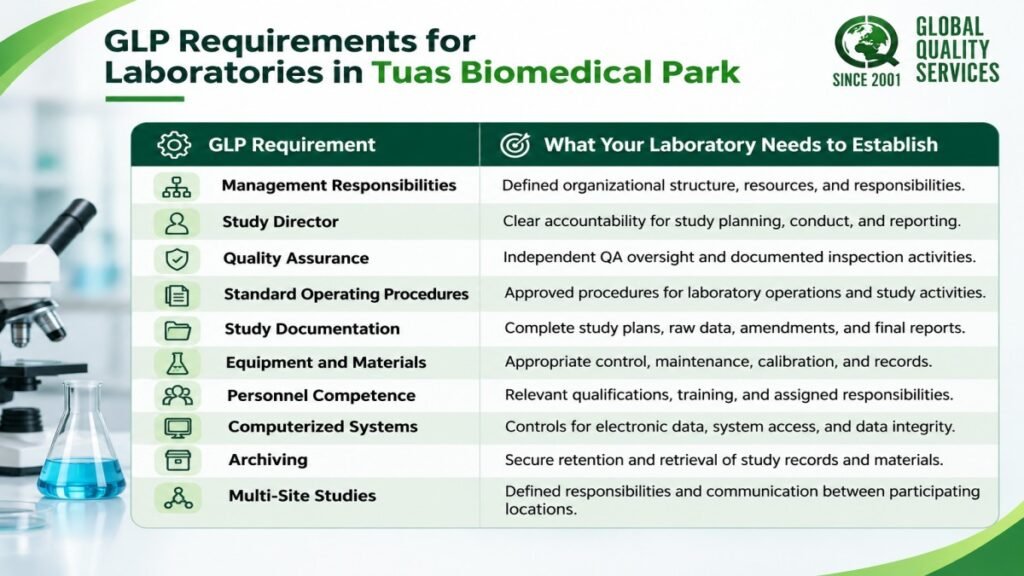
GLP Requirements for Laboratories in Tuas Biomedical Park
The OECD Principles of Good Laboratory Practice establish clear expectations for laboratory management, study personnel, quality assurance, documentation, and data integrity. Laboratories in Tuas Biomedical Park should pay particular attention to the following requirements:
GLP Compliance Challenges for Biomedical Facilities in Tuas
Biomedical manufacturing and research facilities often manage complex operations across departments, equipment, personnel, and external partners. These arrangements can create specific GLP compliance challenges.
1. Managing Multi-Site Studies
Some nonclinical studies involve multiple facilities or external testing locations. The laboratory must clearly define responsibilities, communication arrangements, and study oversight across all participating sites.
2. Maintaining Electronic Data Integrity
Laboratories use computerized systems to capture, process, and store study information. They need appropriate access controls, audit trails, backup arrangements, and system validation where applicable.
3. Maintaining Independent Quality Assurance
The QA unit must conduct its inspections and report findings without interference from study personnel. Management must provide sufficient authority and resources to maintain this independence.
4. Controlling Study Materials
Test and reference items require proper identification, handling, storage, and documentation. Laboratories need reliable records that connect these materials to the relevant studies.
5. Protecting Long-Term Study Records
Nonclinical studies generate important raw data, reports, specimens, and supporting documents. Laboratories need suitable archive arrangements that protect these records and allow authorized retrieval.
How Global Quality Services Helps You with GLP Certification in Tuas Biomedical Park
Global Quality Services is a reputed consultant with more than 26 years of professional consultancy experience. We support businesses with management system consultancy, regulatory compliance, documentation, training, and certification preparation. Our consultancy experience across different industries helps us understand the management, documentation, and operational controls that businesses need to maintain.
Why Choose Global Quality Services?
- More than 26 years of professional consultancy experience
- Over 1,450 customers supported
- Presence across 17 locations
- More than 1,200 training programs delivered
- Singapore Certified Management Consultant credentials
- Experience across international management system standards
We bring broader laboratory management knowledge through our experience with ISO/IEC 17025, which addresses testing and calibration laboratory competence. This experience helps us understand laboratory documentation, technical controls, and quality management requirements.
Our GLP Consultancy Process for Tuas Biomedical Park Laboratories
Global Quality Services follows a structured consultancy approach to help your laboratory prepare for SAC recognition:
Step 1: Laboratory Assessment
We review your study activities, laboratory structure, existing procedures, personnel responsibilities, and proposed recognition scope.
Step 2: Compliance Gap Analysis
Our consultants compare your current arrangements with OECD GLP principles and identify the areas that need attention.
Step 3: Documentation Development
We help your team prepare the GLP manual, SOPs, study records, quality assurance procedures, and supporting documents.
Step 4: Employee Training and Implementation
We guide employees on their GLP responsibilities, documentation practices, study controls, and quality assurance requirements.
Step 5: Internal Compliance Assessment
We review your laboratory’s implementation, check relevant records, and help management address identified compliance gaps.
Step 6: SAC Assessment Preparation
We help your team organize the required documentation, understand assessment expectations, and prepare for the official GLP evaluation.
GLP Recognition in Singapore: What Tuas Biomedical Park Laboratories Should Know
The Singapore Accreditation Council manages the national GLP Compliance Monitoring Programme. The program follows the OECD Principles of Good Laboratory Practice and recognizes facilities that meet its requirements for nonclinical safety studies.
Laboratories seeking recognition need to establish an appropriate organizational structure, appoint responsible study personnel, maintain a quality assurance function, and demonstrate control over their study activities.
The application also requires information about the proposed scope of recognition and types of studies. SAC reviews the facility’s compliance through its assessment arrangements and determines whether it meets the applicable criteria.
GLP recognition differs from ISO certification and laboratory accreditation. It focuses on the organizational conditions and controls that govern nonclinical safety studies.
Businesses should also remember that a GLP-recognized facility must maintain its compliance after recognition. Management needs to continue its quality assurance activities, control study documentation, and maintain suitable laboratory arrangements.
Get Expert GLP Consultancy in Tuas Biomedical Park from Global Quality Services
Strengthen your laboratory’s compliance arrangements with professional GLP consultancy from Global Quality Services. Our reputed consultants help pharmaceutical manufacturers, biotechnology businesses, and research facilities in Tuas Biomedical Park understand OECD requirements, develop suitable documentation, and prepare for SAC assessment.
With more than 26 years of consultancy experience and over 1,450 customers supported, we bring established management system expertise to your compliance requirements.
Contact our Global Quality Services team for a proposal. Work with an experienced consultancy team to prepare your laboratory for GLP recognition and strengthen confidence in your nonclinical study practices.
Frequently Asked Questions
1. What types of studies fall under Singapore’s GLP Compliance Programme?
The program covers applicable nonclinical health and environmental safety studies involving pharmaceuticals, pesticides, food and feed additives, cosmetics, veterinary medicines, and industrial chemicals.
2. Does GLP recognition apply to an entire pharmaceutical manufacturing facility?
Not automatically. GLP recognition relates to the facility’s applicable nonclinical safety study activities and approved scope. Routine manufacturing and quality control operations follow their relevant regulatory and quality requirements.
3. Can a laboratory outsource some activities and still maintain GLP compliance?
Yes. A facility can engage external service providers where appropriate. However, management must establish suitable oversight, responsibilities, documentation, and controls for outsourced activities.
4. What role does the Study Director play in GLP compliance?
The Study Director holds overall responsibility for the conduct of an assigned study. This role includes overseeing the study plan, coordinating relevant activities, reviewing study information, and ensuring the final report accurately reflects the results.
5. Does SAC recognize laboratories outside Singapore under its GLP programme?
The Singapore GLP programme focuses on facilities that apply for recognition under its national monitoring arrangements. Overseas facilities should approach their respective national GLP monitoring authorities.