Organisations that collect, use, store, or process personal information need a structured way to manage privacy risks across their business operations. ISO/IEC 27701:2025 Certification provides a framework to establish and continually improve a Privacy Information Management System (PIMS), helping organisations demonstrate how they govern the processing of personally identifiable information (PII).
Published in October 2025, ISO/IEC 27701:2025 is the revised edition of the international privacy information management standard. It establishes requirements for organisations acting as PII controllers and processors, regardless of their size or sector. Global Quality Services (GQS) provides certification-related services to help organisations understand the standard, assess their requirements, and prepare their privacy management systems for the applicable conformity assessment process.
What Is ISO/IEC 27701:2025 Certification?
ISO/IEC 27701:2025 is an international standard for establishing, implementing, maintaining, and continually improving a Privacy Information Management System. It sets out requirements and provides guidance for managing privacy responsibilities when personal information is processed.
The standard applies to organisations that determine how and why personal information is processed, as well as those that process information on behalf of other organisations. This includes businesses handling customer records, employee information, user accounts, financial details, and other identifiable personal data.
A PIMS establishes a consistent approach to privacy governance. It brings together responsibilities, risk assessments, operational controls, documented procedures, performance evaluation, and continual improvement within a management system.
The 2025 edition also introduces an important structural change: ISO/IEC 27701 is now a standalone management system standard. Unlike the 2019 edition, it no longer requires an organisation to hold ISO/IEC 27001 certification to implement and certify its PIMS. Organisations can still integrate privacy management with an existing information security management system where appropriate.
Why Should Organisations Consider ISO/IEC 27701:2025 Certification?
Personal information often moves between departments, digital platforms, service providers, and business partners. Without clearly assigned responsibilities and consistent processes, organisations may struggle to track how information is collected, accessed, shared, retained, or deleted.
ISO/IEC 27701:2025 provides a management framework for addressing these responsibilities systematically. Its value extends beyond technology teams because privacy decisions can affect HR, customer service, marketing, procurement, legal functions, and senior management.
Establish Consistent Privacy Management
A PIMS defines how business functions assign and manage privacy responsibilities. This reduces reliance on informal practices and helps employees follow consistent procedures when handling personal information.
Identify and Address Privacy Risks
The standard requires organisations to assess privacy risks and plan appropriate treatment measures. This gives organisations a structured basis for identifying weaknesses in their processes and reviewing whether their controls remain suitable as operations change.
Demonstrate Accountability to Business Partners
Customers, enterprise clients, and suppliers may want evidence that personal information is managed through defined processes. An independently issued certificate, where applicable, can provide evidence of conformity with the standard and support discussions about privacy governance.
Improve Personal Data Handling Practices
Documented procedures can clarify how information is collected, used, accessed, disclosed, retained, and disposed of. The specific measures depend on the organisation’s activities, risk assessment, and applicable legal obligations.
Support Privacy Compliance Activities
ISO/IEC 27701 can help organisations structure their privacy management practices in relation to relevant data protection requirements, including the GDPR and other applicable privacy laws. Certification does not automatically establish legal compliance; organisations must still evaluate and meet the laws that apply to their operations.
Integrate Privacy and Information Security Management
Organisations with ISO/IEC 27001 may align their privacy and information security processes to reduce duplication where requirements overlap. However, ISO/IEC 27701:2025 can also be implemented as a standalone management system.
Benefits of ISO/IEC 27701:2025 Certification
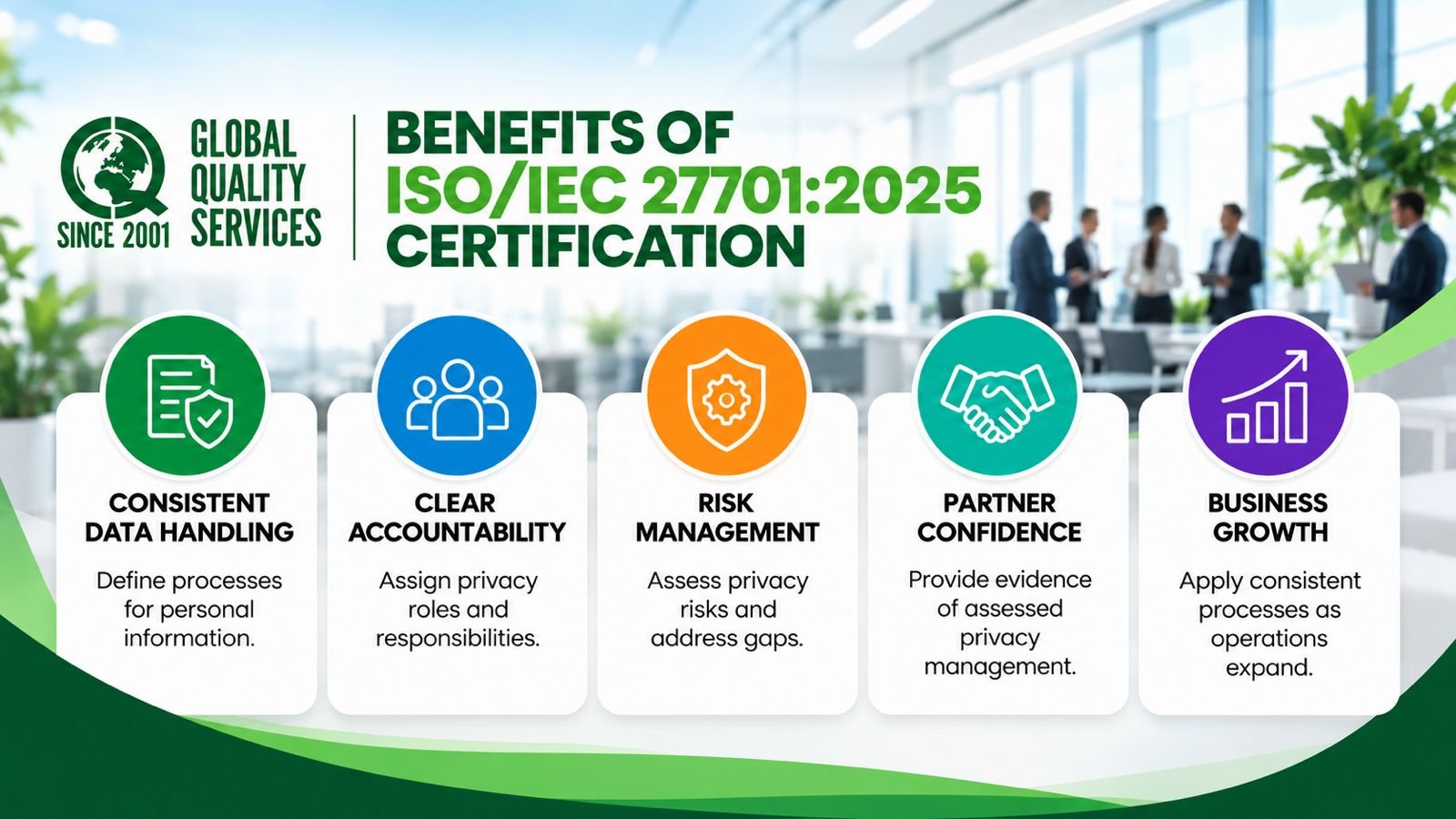
ISO/IEC 27701:2025 Certification helps organisations establish a structured approach to managing personal information and privacy-related responsibilities. By implementing a Privacy Information Management System (PIMS), businesses can improve oversight of data processing activities, strengthen accountability, and demonstrate that their privacy management practices have been independently assessed.
1. Strengthens Privacy Governance
A PIMS defines privacy policies, responsibilities, and decision-making processes across the organisation. This helps management establish clear ownership of privacy-related activities and maintain consistent practices across departments.
2. Improves Privacy Risk Management
The standard requires organisations to identify and assess privacy risks associated with their processing activities. This enables them to prioritise risks, plan appropriate treatment measures, and review controls when business operations or data processing practices change.
3. Builds Customer and Business Partner Confidence
Customers, suppliers, and enterprise clients may seek evidence of a company’s approach to protecting personal information. Certification from an independent certification body can demonstrate that the organisation’s PIMS has been assessed against the standard’s requirements.
4. Clarifies Data Processing Responsibilities
Organisations may act as personally identifiable information (PII) controllers, processors, or both. A PIMS helps define responsibilities relevant to these roles, including how personal information is handled and how privacy obligations are managed across business relationships.
5. Supports Privacy Compliance Management
ISO/IEC 27701:2025 provides a framework for organising privacy management activities in line with applicable data protection requirements. It can help businesses maintain documented processes and oversight, although certification does not automatically establish compliance with every privacy law.
6. Encourages Continual Improvement
Internal audits, management reviews, performance evaluation, and corrective actions help organisations assess whether their PIMS remains effective. These activities provide a structured way to address weaknesses and adapt privacy management practices as risks and operations evolve.
7. Aligns Privacy Management with Business Operations
Privacy responsibilities often span IT, HR, customer service, procurement, legal teams, and third-party relationships. A PIMS helps integrate privacy considerations into routine business processes instead of treating them as an isolated technical responsibility.
Which Organisations Need ISO/IEC 27701:2025 Certification?
ISO/IEC 27701:2025 is relevant to organisations that are accountable for processing personally identifiable information. Its applicability is determined by the organisation’s activities and privacy responsibilities, rather than its size or industry alone.
IT Services, SaaS, and Cloud Providers
Technology companies may process user profiles, account details, support records, usage data, and information entrusted to them by business customers. A PIMS helps establish consistent privacy responsibilities across services and operations.
Data Centres and Managed Service Providers
Organisations providing hosting, managed infrastructure, and technology services may handle or have access to personal information as part of customer environments. Privacy management helps clarify responsibilities, access practices, and contractual obligations.
Banking, Financial Services, and Insurance
Financial organisations process customer identities, transaction-related information, employee records, and other sensitive business data. A structured privacy management system can help organise the processes used to govern that information.
Healthcare and Health Technology
Hospitals, clinics, laboratories, health platforms, and related service providers may process patient and employee information. Their privacy arrangements need to reflect the nature of the data, the services provided, and applicable legal requirements.
Business Process Outsourcing and Customer Support
BPO providers, contact centres, payroll processors, and outsourced service teams may process personal information on behalf of clients. A PIMS can help define data handling responsibilities across service delivery, access management, retention, and third-party relationships.
E-Commerce, Retail, and Digital Platforms
Online retailers and digital platforms may manage customer accounts, contact details, order histories, and other identifiable information. A privacy management system can help establish repeatable processes for handling this data throughout the customer lifecycle.
Professional Services and Consulting Firms
Legal, accounting, recruitment, and professional services firms may handle client files, employee information, candidate records, and confidential personal data. ISO/IEC 27701 provides a framework for managing privacy responsibilities within these activities.
ISO/IEC 27701:2025 Certification Process
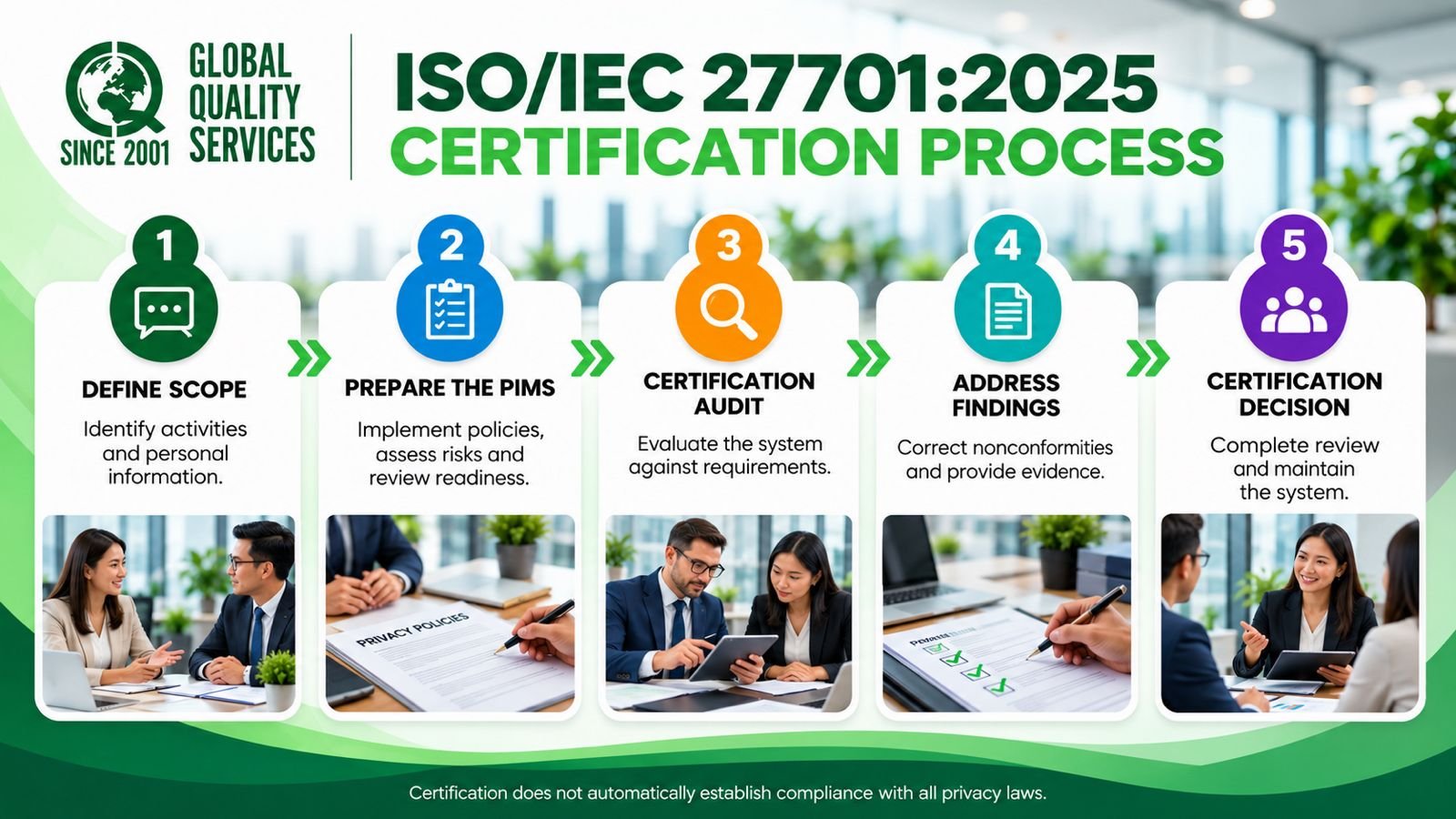
Obtaining ISO/IEC 27701:2025 Certification involves defining the PIMS scope, establishing the required management system, implementing privacy processes, and undergoing an independent certification assessment. The preparation timeline depends on the organisation’s size, processing activities, existing controls, and readiness.
Step 1: Define the PIMS Scope
Identify the business units, locations, systems, services, and personal data processing activities that will fall within the management system. Determine whether the organisation acts as a PII controller, processor, or both, and establish the relevant boundaries of the PIMS.
Step 2: Conduct a Gap Assessment
Compare existing privacy policies, procedures, risk assessments, operational practices, and records against ISO/IEC 27701:2025 requirements. Document the gaps and prioritise the actions needed to establish a conforming management system.
Step 3: Develop PIMS Documentation
Prepare or update the documented information required for the organisation’s PIMS. Depending on the scope, this may include privacy policies, defined responsibilities, risk assessment and treatment records, operational procedures, and processes for managing relevant privacy obligations.
Step 4: Implement Privacy Controls and Processes
Put the documented arrangements into practice across the relevant business functions. This may include reviewing data handling procedures, clarifying access responsibilities, managing third-party processing relationships, and establishing processes for responding to privacy-related requests.
Step 5: Conduct Internal Audit and Management Review
Evaluate whether the PIMS has been implemented effectively and whether the relevant requirements are being met. Internal audits identify potential nonconformities, while management reviews provide an opportunity to assess performance, outstanding issues, and improvement priorities.
Step 6: Complete the Independent Certification Audit
An independent certification body assesses the PIMS against ISO/IEC 27701:2025 requirements. The organisation must address any identified nonconformities through the certification body’s established process before certification can be granted.
Step 7: Maintain Certification and Improve the PIMS
After certification, maintain the management system through ongoing monitoring, internal audits, management reviews, corrective actions, and applicable surveillance audits. Review the PIMS when business activities, technologies, suppliers, or privacy risks change.
What Does ISO/IEC 27701:2025 Cover?
The standard follows the harmonised structure used by ISO management system standards. Its requirements cover the management system as a whole, with privacy risk management at the centre of planning and operational decision-making.
Organisational Context and PIMS Scope
Organisations determine the internal and external factors affecting their privacy management system, identify relevant interested parties, and define the boundaries of the PIMS. The scope should reflect the organisation’s actual processing activities and responsibilities.
Leadership and Privacy Responsibilities
Senior management establishes direction and commitment for the PIMS. Privacy policies, assigned responsibilities, and appropriate authority help ensure that privacy management is incorporated into business operations rather than treated as an isolated IT activity.
Privacy Risk Assessment and Treatment
Organisations identify privacy risks associated with their processing activities, evaluate those risks, and determine suitable treatment measures. These decisions should be documented and reviewed when changes in systems, services, suppliers, or processing activities affect the risk profile.
Resources, Competence, and Awareness
A functioning PIMS requires appropriate resources, personnel with relevant competence, and awareness of privacy responsibilities. Communication and documented information also help ensure that privacy processes are understood and applied consistently.
Operational Planning and Control
Organisations establish and maintain processes for carrying out privacy-related activities in line with their requirements. The controls and procedures adopted depend on the organisation’s role as a PII controller or processor, its processing activities, and identified risks.
Performance Evaluation and Continual Improvement
Monitoring, internal audits, management reviews, and corrective actions help determine whether the PIMS is effective. Organisations use these activities to address nonconformities and improve the management system over time.
How to Obtain ISO/IEC 27701:2025 Certification
The certification process begins with understanding the organisation’s personal data processing activities and comparing its existing privacy management arrangements with the requirements of the 2025 edition.
Step 1: Define the Scope of the PIMS
Identify the departments, services, systems, locations, and processing activities covered by the privacy management system. Clarify whether the organisation acts as a PII controller, processor, or both for different activities.
Step 2: Conduct a Gap Assessment
Review current policies, procedures, risk assessments, operational controls, and documented records against the requirements of ISO/IEC 27701:2025. Record the gaps that need to be addressed before the certification audit.
Step 3: Establish and Document the Management System
Develop or update the policies, processes, responsibilities, risk treatment plans, and records required for the defined PIMS scope. Documentation should reflect actual organisational practices rather than exist only for the audit.
Step 4: Implement the Required Processes
Put the defined privacy management arrangements into operation. This may involve clarifying access responsibilities, reviewing data processing activities, establishing procedures for privacy-related requests, managing suppliers, and improving employee awareness where relevant to the organisation.
Step 5: Evaluate Readiness
Review implementation evidence, assess the effectiveness of the processes, and address identified gaps. Internal audits and management reviews should be conducted as required by the standard before the organisation proceeds to certification.
Step 6: Complete the Certification Audit
An independent certification body evaluates the PIMS against the applicable requirements. The organisation must address any nonconformities identified during the assessment in accordance with the certification body’s process. Certification is granted only when the certification body determines that its requirements have been met.
Step 7: Maintain and Improve the PIMS
After certification, the organisation maintains its management system and participates in the applicable surveillance and recertification arrangements. Changes in services, processing activities, risks, and legal obligations should be reflected in the ongoing operation of the PIMS.
How Does Global Quality Services Support ISO/IEC 27701:2025 Certification?
Global Quality Services works with organisations to clarify their certification requirements and prepare for the applicable assessment process. The scope of engagement can be aligned with the organisation’s existing management systems, personal data processing activities, and readiness needs.
Depending on the agreed scope, GQS services may include:
- PIMS gap assessment: Reviewing current privacy management arrangements against the requirements of ISO/IEC 27701:2025.
- Scope and requirements review: Identifying the relevant business functions, processing activities, and management system boundaries.
- Documentation review: Examining policies, procedures, risk assessment records, and other documented information relevant to the PIMS.
- Implementation planning: Helping the organisation prioritise actions needed to address identified gaps.
- Audit readiness: Reviewing available implementation evidence and helping the organisation prepare for the independent certification assessment.
- Transition planning: Helping existing certificate holders identify areas to review when moving from ISO/IEC 27701:2019 to the 2025 edition.
Certification decisions remain the responsibility of the independent certification body appointed for the assessment. The scope of GQS’s engagement should be agreed in advance and should not be interpreted as a guarantee of certification.
ISO/IEC 27701:2025 provides a management system framework for privacy information management, while privacy laws establish legal obligations for organisations within their scope. Depending on where an organisation operates and whose information it processes, relevant requirements may include the EU General Data Protection Regulation (GDPR), the UK GDPR, or India’s Digital Personal Data Protection Act and applicable rules.
Organisations should assess their legal obligations separately and use the PIMS to manage relevant responsibilities, risks, and processes. ISO/IEC 27701:2025 certification does not replace legal advice, statutory compliance activities, or any specific regulatory approval that may apply.
Start Your ISO/IEC 27701:2025 Certification Journey
A structured Privacy Information Management System can help your organisation manage personal information through defined responsibilities, risk-based controls, and continual improvement. Whether you are establishing a new PIMS or planning the transition from ISO/IEC 27701:2019, the first step is to understand the requirements that apply to your processing activities and current management system.
Contact Global Quality Services to discuss your ISO/IEC 27701:2025 certification requirements, assess your readiness, and determine the appropriate next steps for your organisation.
Frequently Asked Questions
1. Can an organisation obtain ISO/IEC 27701:2025 certification without ISO/IEC 27001?
Yes. The 2025 edition is a standalone management system standard, so ISO/IEC 27001 certification is no longer a prerequisite for ISO/IEC 27701:2025 certification. An organisation may still integrate its PIMS with an existing information security management system.
2. What is the difference between ISO/IEC 27701:2019 and ISO/IEC 27701:2025?
The main structural change is that the 2019 edition extended ISO/IEC 27001 and ISO/IEC 27002, whereas the 2025 edition establishes ISO/IEC 27701 as an independent management system standard. Organisations should review their existing arrangements and confirm the transition requirements with their certification body.
3. Is ISO/IEC 27701:2025 certification mandatory?
The standard is not universally mandatory for every organisation. However, a customer, business partner, tender, or contractual arrangement may require or prefer it. Organisations must separately determine which privacy laws and regulatory requirements apply to their activities.
4. How long does it take to obtain ISO/IEC 27701:2025 certification?
The timeframe depends on the size and complexity of the organisation, the scope of personal data processing, existing privacy controls, documentation, and readiness for audit. Organisations with established management systems may have a different preparation timeline from those building a PIMS from the beginning.
5. Does ISO/IEC 27701:2025 certification guarantee compliance with GDPR or other privacy laws?
No. Certification provides evidence that a defined management system has been assessed against the standard. Legal compliance depends on the organisation’s actual processing activities and the requirements of each applicable jurisdiction.