Healthcare quality isn’t simply a matter of doing the right things during treatment. Consistency in the management of clinical processes, patient safety, communication, risks, and delivery results matters too. That is where EN 15224 Healthcare Quality Management System comes into play. This is a specific framework for the implementation of general quality management principles within clinical processes and patient care activities. There is certainly no shortage of need here either.
According to the WHO, approximately 1 out of every 10 patients suffers some form of injury due to their experience with health services, at least half of which could be prevented. For healthcare organizations, such statistics make quality management more than just another certification standard. There could be many potential advantages to achieving certification, including improved safety practices, process optimization, and increased trust among patients. Learn more about EN 15224 in the coming sections.
What is EN 15224
EN 15224 is the European version of a Quality Management System within the context of healthcare institutions. As such, it uses ISO 9001 as its foundation but adds more healthcare-specific criteria, particularly around patient safety, clinical processes, risk management, and quality of healthcare services.
Some of the benefits of implementing EN 15224 include improving the safety and quality of patient care, managing risks associated with clinical and healthcare processes, standardizing clinical processes, minimizing errors and adverse events, monitoring and improving healthcare services, and increasing stakeholder confidence.
Why Does Your Healthcare Facility Need EN 15224 in Singapore
Singapore’s healthcare sector places strong emphasis on patient safety, clinical quality, and reliable care. EN 15224 helps healthcare organizations manage these areas through a structured quality management system designed specifically for healthcare services. It can help facilities improve clinical processes, control risks, and deliver more consistent patient care.
Healthcare facilities can benefit from EN 15224 by:
- Improving patient safety: Identify and reduce risks that may affect patient care.
- Strengthening clinical processes: Maintain consistent and well-defined healthcare procedures.
- Managing risks: Address clinical and operational risks before they lead to problems.
- Improving patient satisfaction: Support better communication, coordination, and care delivery.
- Supporting compliance: Demonstrate a structured approach to healthcare quality management.
- Encouraging continual improvement: Use audits, reviews, and corrective actions to improve performance.
- Building trust: Show patients and stakeholders a clear commitment to quality and safe healthcare.
The 11 Essential Quality Characteristics of EN 15224
Unlike general management frameworks, EN 15224 demands that healthcare organizations measure, document, and consistently improve their performance across 11 core clinical areas:
1. Appropriate and Correct Care
The system mandates that medical and nursing interventions are fully justified by clinical evaluation and executed accurately in accordance with current evidence-based medicine guidelines.
2. Accessibility of Care
Facilities must optimize patient pathways to ensure that medical services, diagnostics, and specialist consultations are available to patients without unnecessary or hazardous delays.
3. Continuity and Coordination
Every transition of care—whether an internal shift between intensive care and general wards, or an external referral to a step-down facility—must be supported by meticulous clinical documentation to prevent critical data gaps.
4. Clinical Effectiveness
Organizations must track patient outcomes systematically to confirm that clinical interventions yield the intended diagnostic or therapeutic results.
5. Efficiency of Care
Resources, including operating theater time, diagnostic machinery, and clinical personnel, must be managed efficiently to optimize patient care and lower unnecessary operational costs.
6. Equity in Care Delivery
The system requires policies that guarantee every patient receives identical, high-quality medical care, free from discrimination based on background or status.
7. Evidence-Based and Knowledge-Driven Practices
All diagnostic protocols, nursing care plans, and surgical checklists must align with verified medical research and formal clinical consensus.
8. Patient-Centered Care and Physical Integrity
Treatment pathways must respect patient autonomy, incorporate informed consent, and prioritize physical comfort, dignity, and psychological support.
9. Timely and Responsive Care
Medical infrastructure and emergency response systems must be optimized to deliver interventions exactly when clinically necessary, preventing the deterioration of acute conditions.
10. Patient Safety and Risk Management
The standard mandates a robust adverse-event reporting system alongside a clear Corrective and Preventive Action (CAPA) framework to actively minimize clinical errors, hospital-acquired infections, and medication mishaps. Just as an infrastructure facility might implement our ISO 14064 Certification scheme to map out physical and operational carbon risk profiles, EN 15224 maps out systemic paths to neutralize clinical risk before it reaches the patient.
11. Ease of Assessment and Transparency
Clinical indicators, patient satisfaction metrics, and treatment outcomes must be clearly documented and made available for structured internal and external clinical audits.
Who Needs EN 15224 Certification in Singapore?
Any organization operating within the healthcare delivery spectrum can utilize EN 15224 to elevate its clinical governance and operational resilience. According to specialized breakdowns from the Singapore Accreditation Council (SAC), these standards are highly valuable across the biomedical sector:
- Hospitals and Day Surgery Centers: Acute care and private hospitals seeking to instill uniform quality protocols across multi-disciplinary medical departments.
- Specialist and Primary Care Clinics: Outpatient clinics, dental practices, and specialized aesthetics centers looking to build strong patient trust.
- Diagnostic & Clinical Laboratories: Radiodiagnostic centers, blood banks, and pathology labs that require flawless tracing, validation, and safety controls for medical testing.
- Allied Health and Eldercare Facilities: Nursing homes, rehabilitation centers, and home hospice services where care continuity and risk management are critical to patient well-being.
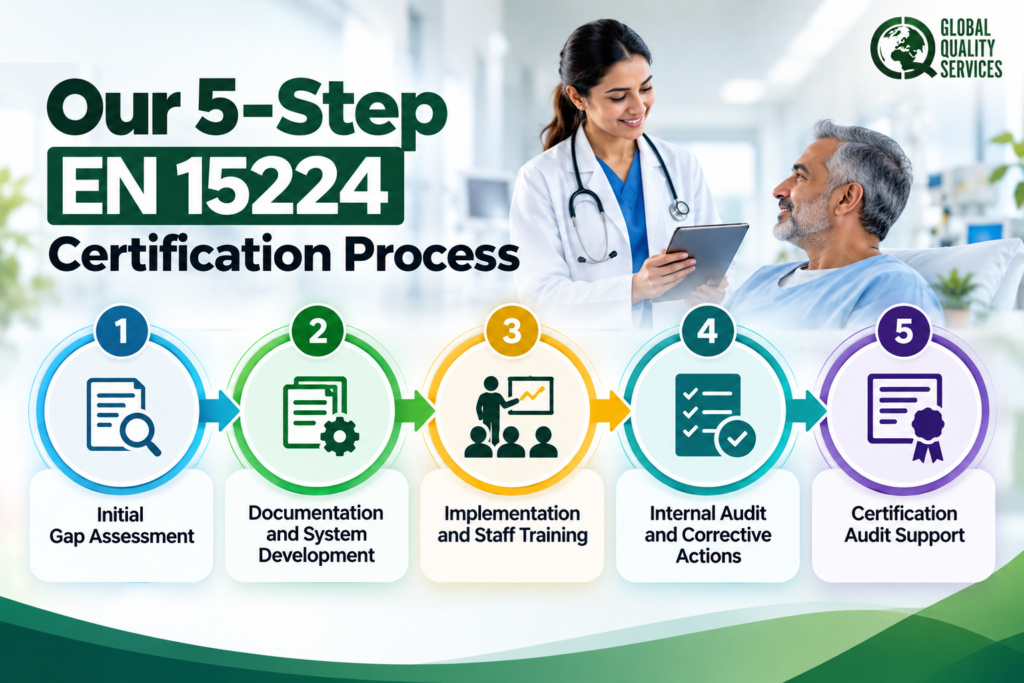
Our 5-Step EN 15224 Certification Process
Getting ready for EN 15224 becomes easier when each stage is handled systematically. Global Quality Services guides your facility through the following five steps:
1. Initial Gap Assessment
We assess your existing quality system, clinical processes, records, and practices against EN 15224 requirements.
2. Documentation and System Development
We help develop or update the required policies, procedures, SOPs, records, and quality controls.
3. Implementation and Staff Training
Your team receives guidance and training to implement the requirements effectively in daily healthcare operations.
4. Internal Audit and Corrective Actions
We conduct an internal review to identify gaps, address nonconformities, and prepare your facility for the external audit.
5. Certification Audit Support
We support your team during the certification stage and help address any findings raised by the certification body.
Key Benefits of Securing EN 15224 Certification
Attaining EN 15224 certification transforms mandatory regulatory compliance into an active badge of operational excellence, safeguarding your clinical team and your patients simultaneously. Partnering with Global Quality Services to implement this framework delivers immediate strategic advantages to your healthcare organization:
- Drastic Reduction in Clinical Errors: Minimizes diagnostic errors, cross-contamination, and medication mistakes through structured validation and proactive risk assessments.
- Seamless Alignment with MOH Frameworks: Simplifies compliance inspections under local legislative requirements by maintaining highly structured, audit-ready medical governance logs.
- Optimized Patient Trust and Retention: Demonstrates a transparent commitment to world-class clinical standards, directly improving patient satisfaction scores and institutional reputation.
- Structured Operational Workflows: Cuts down administrative redundancies for medical teams, allowing doctors and nurses to focus more energy on direct patient care.
How Global Quality Services Streamlines Your Path to Compliance
Global Quality Services helps healthcare organizations approach EN 15224 with practical guidance that fits their existing operations. Our focus is not just on preparing documents, but on helping your team build a quality system that can be maintained after certification. Here is what makes Our EN 15224 Consulting Different:
- 26 Years of Experience: Benefit from the knowledge and practical experience gained through 26 years of helping organizations strengthen their management systems and prepare for certification.
- Healthcare-Focused Expertise: Guidance tailored to clinical and healthcare service environments.
- Risk-Based Approach: Support in identifying and addressing risks that can affect patient safety and care quality.
- Team Training: Helps clinical and administrative staff understand their quality responsibilities.
- End-to-End Guidance: Assistance from the initial assessment through certification and corrective actions.
Get Expert Support for EN 15224 Certification
Build a healthcare quality management system that supports safer care, stronger processes, and consistent service delivery. Global Quality Services provides practical EN 15224 consulting, including gap assessment, documentation support, staff training, internal audits, and certification audit preparation. Get the right guidance at every stage and move towards EN 15224 certification with greater confidence.
Frequently Asked Questions
1. How does EN 15224 differ from the standard ISO 9001?
While ISO 9001 focuses on general business quality and customer satisfaction across any industry, EN 15224 is explicitly engineered for healthcare. It replaces generic business terms with clinical language and mandates specific compliance across 11 healthcare-focused quality characteristics, including patient safety and clinical effectiveness.
2. Can our facility integrate EN 15224 with existing ISO 9001 systems
Yes. Because EN 15224 shares the same High-Level Structure (HLS) as ISO 9001, Global Quality Services can seamlessly blend the two frameworks. This allows you to address business administration and clinical risk management under a single, unified quality management system.
3. Is funding support available for healthcare certification in Singapore?
Eligible local enterprises and healthcare groups can tap into the Enterprise Development Grant (EDG), available through the Business Grants Portal, an initiative backed by the Singapore government, to help offset the costs of consulting, training, and adopting international standards.
4. How long does the EN 15224 implementation process typically take?
The timeline varies depending on the size of your facility and the maturity of your current workflows. Generally, a comprehensive rollout spanning gap analysis, documentation, staff training, and final certification takes between 4 to 8 months.
5. What is the validity period of the EN 15224 certificate?
The certificate is valid for 3 years from the date of official issuance. To maintain its validity, the facility must undergo brief annual surveillance audits, followed by a comprehensive re-certification assessment before the third year concludes.