
Singapore’s growing dependence on digital services makes ICT resilience a business priority. The Cyber Security Agency of Singapore reported that almost nine in ten organisations experienced at least one cybersecurity incident in 2025.
ISO/IEC 27031 helps organisations prepare their ICT systems to maintain operations during disruptions and recover effectively. A reputed consultant can help assess existing arrangements, identify gaps, develop recovery plans, and align ICT readiness practices with business continuity needs.
What is ISO 27031 Certification
ISO/IEC 27031 guides ICT readiness for business continuity. It helps organisations prepare their technology infrastructure to support business continuity objectives during disruptive incidents.
The standard focuses on the availability and recovery of critical ICT services. It connects technology recovery arrangements with wider business continuity plans.
For example, a Singapore-based financial services company may experience a server failure that interrupts customer transactions. ISO 27031 guidance helps the company plan recovery priorities, assign responsibilities, establish recovery targets, and restore essential systems.
Why is ISO 27031 Important for Businesses in Singapore
Singapore has a technology-driven business environment. Companies depend on digital infrastructure to manage transactions, customer information, supply chains, and internal operations. Even a short ICT disruption can affect productivity, revenue, and customer confidence.
ISO 27031 gives businesses a structured approach to preparing for these interruptions.
Here is why it matters:
- Protects critical ICT services: Helps organisations identify essential technology services and prepare recovery arrangements for unexpected disruptions.
- Reduces operational interruptions: Encourages businesses to plan recovery activities before technical failures affect their daily operations.
- Supports business continuity: Connects ICT recovery plans with wider business continuity objectives and organisational priorities.
- Improves incident preparedness: Helps teams understand their responsibilities during technology-related emergencies.
- Strengthens customer confidence: Demonstrates that the organisation takes technology resilience and service availability seriously.
- Supports regulatory expectations: Helps organisations develop ICT continuity practices relevant to their industry-specific obligations.
Singapore businesses operating in finance, healthcare, logistics, telecommunications, and technology can particularly benefit from stronger ICT continuity planning.
Key Requirements of ISO 27031:2025
ISO/IEC 27031:2025 is the latest edition, published in May 2025. It replaces the earlier ISO/IEC 27031:2011 edition with revised technical guidance. The standard focuses on ICT readiness and its contribution to business resilience.
Businesses should address the following areas when implementing its recommendations.
1. ICT Risk Assessment
Identify potential threats that could interrupt ICT services. Assess risks associated with cyberattacks, hardware failures, software issues, network outages, and external service dependencies.
2. Business Impact Analysis
Determine how ICT disruptions could affect business activities. Identify critical applications, systems, databases, and technology services that support essential organisational functions.
3. Recovery Time Objective (RTO)
Establish realistic recovery time objectives for critical ICT services. Define how quickly your team must restore each system after a disruption.
4. Recovery Point Objective (RPO)
Set acceptable limits for data loss during an ICT incident. Determine how frequently your organisation must back up important information to meet recovery expectations.
5. Minimum Business Continuity Objective (MBCO)
Define the minimum level of business operations your organisation must maintain during a disruption. Align ICT recovery priorities with these operational expectations.
6. ICT Recovery Planning
Develop recovery procedures for critical infrastructure, applications, networks, and information systems. Assign responsibilities and document the actions teams must follow during disruptions.
7. People and Resource Readiness
Identify employees, technical specialists, facilities, hardware, and external suppliers needed for ICT recovery. Assign backup personnel to support essential technology services.
8. Testing and Continuous Improvement
Test recovery arrangements through planned exercises and technical simulations. Review test results, identify weaknesses, and update recovery procedures when business or technology requirements change.
These areas help organisations build ICT readiness around measurable recovery objectives and operational priorities.
Step-by-Step Process for ISO 27031 Implementation in Singapore
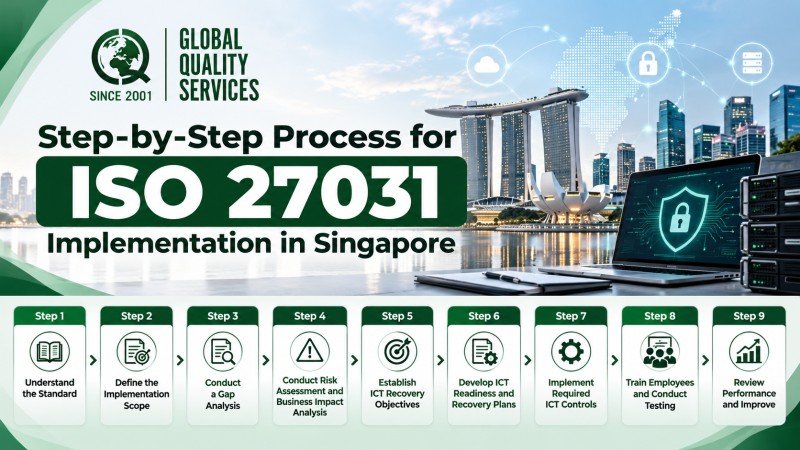
Implementing ISO 27031 requires coordination between management, IT teams, information security professionals, and business continuity personnel. Follow these steps to develop an effective ICT readiness programme.
Step 1: Understand the Standard
Review ISO/IEC 27031:2025 and understand its guidance on ICT readiness. Identify how its recommendations relate to your organisation’s existing information security and business continuity practices.
Step 2: Define the Implementation Scope
Identify the business units, ICT infrastructure, applications, networks, and services covered by the implementation. Set clear boundaries based on operational priorities and business continuity objectives.
Step 3: Conduct a Gap Analysis
Review existing ICT recovery arrangements against the standard’s guidance. Identify missing procedures, weak recovery controls, unclear responsibilities, and areas that require improvement.
Step 4: Conduct Risk Assessment and Business Impact Analysis
Evaluate technology-related threats and their potential business consequences. Identify critical ICT services, assess operational dependencies, and establish recovery priorities based on business impact.
Step 5: Establish ICT Recovery Objectives
Set appropriate RTO, RPO, and MBCO targets for critical services. Discuss these targets with business owners and technical teams before finalising recovery expectations.
Step 6: Develop ICT Readiness and Recovery Plans
Prepare documented procedures for system recovery, data restoration, infrastructure availability, and incident coordination. Assign responsibilities and establish clear escalation arrangements.
Step 7: Implement Required ICT Controls
Introduce suitable backup arrangements, redundant infrastructure, recovery resources, monitoring systems, and access controls. Coordinate these measures with your existing IT and information security operations.
Step 8: Train Employees and Conduct Testing
Train relevant employees on their recovery responsibilities. Conduct simulations and recovery exercises to evaluate whether your procedures meet established recovery objectives.
Step 9: Review Performance and Improve
Evaluate testing results, document identified weaknesses, and implement corrective actions. Review your ICT readiness arrangements regularly to address changing business needs and emerging technology risks.
Benefits of ISO 27031 Implementation
ISO 27031 implementation helps Singapore businesses build stronger technology resilience. It also improves coordination between IT operations and business continuity teams.
Here are some important benefits:
- Better disaster recovery: Helps organisations restore essential ICT services through planned recovery procedures and clearly defined priorities.
- Lower data loss: Encourages appropriate backup frequencies and recovery point targets to protect important business information.
- Improved resource planning: Helps management identify the people, infrastructure, and technology resources required during recovery.
- Stronger supplier coordination: Encourages organisations to consider external technology providers and their role in ICT service continuity.
- Greater operational visibility: Helps management understand critical technology dependencies and identify weaknesses in existing recovery arrangements.
- Improved decision-making: Gives leadership clearer information about recovery priorities, resource requirements, and acceptable disruption periods.
- Better integration: Supports coordination between information security, ICT operations, and business continuity management activities.
Why Choose Global Quality Services for ISO 27031 in Singapore
Partner with Global Quality Services to strengthen your ICT readiness and business continuity practices in Singapore. Our experienced consultants help you assess existing systems, identify recovery gaps, and develop practical ICT continuity plans.
We work closely with your team to align recovery objectives with business needs and improve technology resilience. Contact Global Quality Services today to discuss your ISO 27031 implementation requirements and prepare your business for unexpected disruptions. Our regional presence across Singapore, the Philippines, Indonesia, Malaysia, and China supports businesses with their certification needs across key Asian markets.
Frequently Asked Questions
1. Does ISO 27031:2025 prescribe specific software or technology solutions?
No. The standard does not mandate particular software, hardware, or vendors. Organisations can select technologies based on their infrastructure, operational requirements, recovery objectives, and available resources.
2. How often should organisations review their ISO 27031 arrangements?
Organisations should review their ICT readiness arrangements regularly and after significant changes to infrastructure, applications, suppliers, business operations, or technology-related risks.
3. Can small and medium-sized businesses implement ISO 27031?
Yes. Small and medium-sized businesses can adopt its guidance by prioritising critical ICT services, selecting realistic recovery targets, and developing arrangements that match available resources.
4. Does ISO 27031 require organisations to maintain a separate ICT recovery team?
No. Organisations can assign ICT recovery responsibilities to existing employees or departments. However, they should establish clear accountability, technical competencies, and backup personnel.
5. What changed between ISO 27031:2011 and ISO 27031:2025?
The 2025 edition introduces a technically revised structure, clarifies the scope, and adds technical content to several sections, reflecting developments in ICT continuity practices.