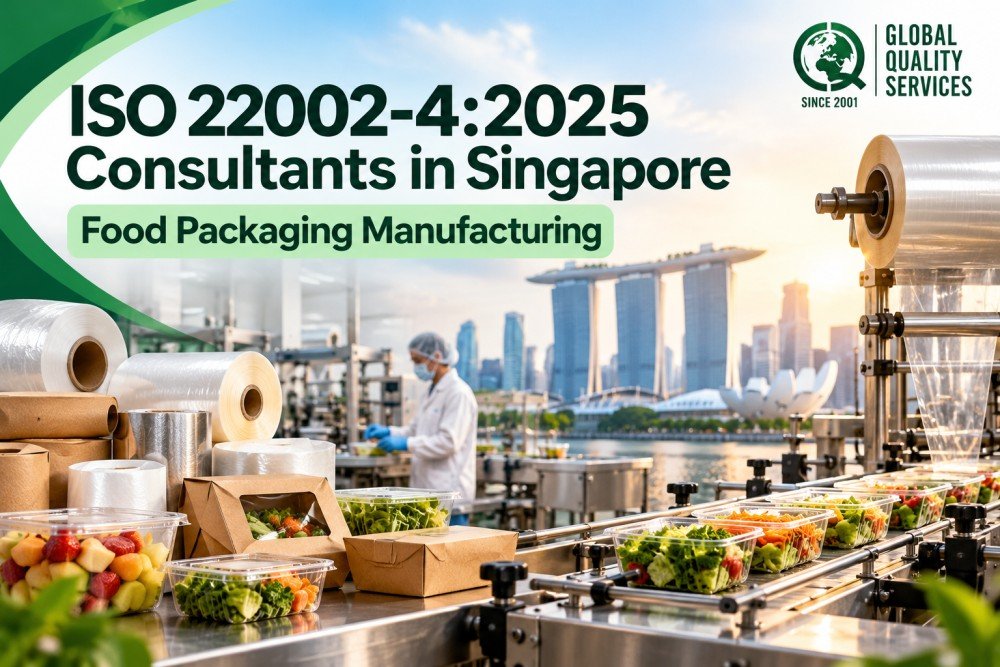
Food packaging manufacturers must ensure that they have systems in place to ensure that their products are not only of good quality but also free from contamination and any material-related hazards. Having poor packaging controls can result in batch rejections, complaints, and loss of contracts when supplying food manufacturers, retailers, or international customers.
Approximately 1/3 of all domestic waste in Singapore is packaging-related, including plastics. With more focus on packaging, it is important to choose the right materials, handle them correctly, and ensure traceability.
When looking for ISO 22000-4:2025 consultants for your business, please be aware that this is the correct standard reference. By working with Global Quality Services, we can help you understand what controls you currently have in place, identify the relevant food safety hazards, and prepare for certification. Learn more below.
What is ISO 22002-4:2025?
ISO 22002-4:2025 is an international standard outlining the Prerequisite Program (PRP) requirements to control food safety hazards within food and feed packaging. This was published in July 2025, replacing the previous ISO/TS 22002-4:2013.
This standard works in conjunction with ISO 22002-100:2025 to ensure that you have suitable controls and conditions in place for your activities. ISO 22002-100:2025 outlines the general PRP requirements for food, feed and packaging. ISO 22002-4:2025 applies to packaging manufacturers of all sizes. It outlines the requirements that are relevant to manufacturers producing;
- Plastic containers, films and pouches.
- Paperboard cartons and corrugated.
- Metal cans, lids and food containers.
- Glass bottles and jars.
- Flexible and multi-layer packaging.
- Packaging for food processing, storage and transportation.
Why do Food Packaging Manufacturers in Singapore Need ISO 22002-4:2025
If you don’t have controls in place to manage the materials, conditions, equipment and finished goods within your packaging processes, you may risk creating food safety hazards. This may result in materials not being suitable, chemical residues, and physical contamination. This can impact your customers, suppliers, export contracts and reputation as a manufacturer in Singapore. By implementing ISO 22002-4:2025, you can;
- Demonstrate that you meet your customers’ requirements by showing that you have controls in place for packaging production.
- Reduce the risk of contamination by having suitable controls in place for materials and hazards.
- Increase confidence from your suppliers by providing suitable evidence to your customers.
- Improve traceability by having suitable controls in place to identify materials and batches.
- Ensure consistency in your production by having clear roles and controls.
- Prepare for customer audits by having suitable records and controls in place.
Key Requirements of ISO 22002-4:2025 for Packaging Manufacturers
ISO 22002-4:2025 outlines the PRPs for packaging. As a manufacturer, you should consider the materials, processes, equipment, and facilities you have to ensure suitable controls are in place.
1. Packaging Materials and Chemical Migration
Materials used for packaging should be suitable for their intended use and controlled to reduce the risk of chemical hazards. This could include inks, coatings, adhesives, additives, etc. Controls should be in place to;
- Ensure suitable supplier approval and material specifications.
- Materials are suitable for their intended use.
- Chemical contamination and migration.
- Storage and handling of materials.
- Identification and traceability of batches.
Singapore has regulations around food packaging. Ensure that you understand the requirements for the packaging you produce.
2. Recycled/Nano Based/Plant Based Materials
Depending on the make-up of your materials, you may have different risks. Recycled plastics, nano-materials and plant-based materials should be assessed. Controls should be in place to:
- Ensure suitable materials.
- Supplier specifications and evidence.
- Potential contamination.
- Identification and segregation of materials.
- Traceability and changes to materials/suppliers.
Just because your materials are recycled or plant-based does not mean they are suitable for food contact. Ensure you assess the materials for their intended use.
3. Hygiene
Areas used for production should be suitable for producing packaging for food and feed. This can be achieved by ensuring suitable cleaning, personal hygiene, pest control, waste management and equipment maintenance. Consider the risks from dust, lubricants, cleaning chemicals, faulty equipment, etc.
4. Physical Hazards and Blade Control
Loose items, faulty parts and sharp tools can cause physical contamination. Identify the risks and ensure you have suitable controls in place for cutting equipment, maintenance tools, etc. Depending on your requirements and risk assessment, controls could include an approved list of tools, limiting blades, inspections, tool accountability and procedures for missing/damaged tools.
5. Tamper-Proof Processes
Ensure that you have suitable controls in place to ensure the integrity of your packaging throughout production. This could include checking seals, closures, line clearance, product identification and segregation of damaged/rejected packaging. If there is a risk of tampering, suitable controls should be in place to limit access and verify.
6. Equipment Maintenance
Equipment used for production should be suitable for its intended use. If maintenance isn’t carried out correctly, this can cause contamination, defects, and inconsistency. Suitable controls should be in place to:
- Ensure preventive maintenance and inspections.
- Repairs and maintenance records.
- Lubricant and maintenance material control.
- Monitoring of relevant conditions.
- Changes and breakdowns.
- 7. Storage, Transportation and Traceability
Packaging can become contaminated if stored/transported incorrectly. Ensure that your raw materials and finished goods are protected from moisture, dust, pests, chemicals, and physical damage.
Difference Between ISO 22002-4:2025 and ISO 22002-100:2025
ISO 22002-100:2025 outlines the general PRP requirements for food, feed, and packaging. ISO 22002-4:2025 outlines the additional requirements specific to food and feed packaging manufacturers.
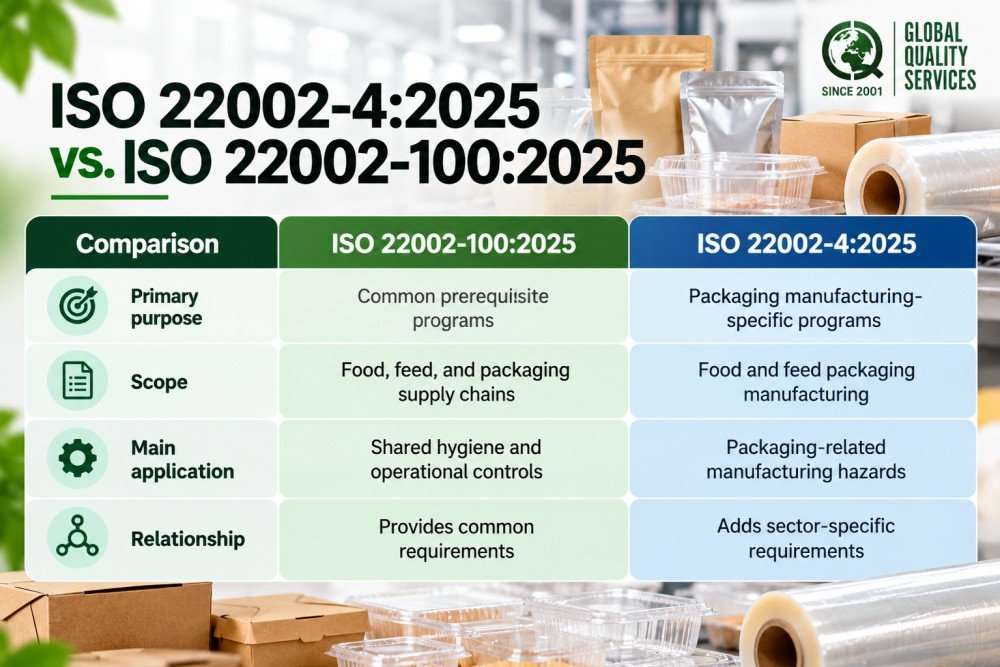
When implementing your PRPs, you should consider both standards. Any exclusions should be justified and should not impact food safety.
How Global Quality Services Experts Can Help with ISO 22002-4:2025 in Singapore
Choosing the right consultant can impact the quality of your implementation, how much time your team will spend trying to resolve any gaps, and how prepared you are for an independent assessment. Global Quality Services can provide consultancy to help you implement the requirements of ISO management systems. As a reputable consultant, we can provide:
- Experience: We can provide consultancy to help organisations achieve ISO management system compliance.
- Recommendations: We can provide recommendations based on your materials, processes, and risks.
- Local Knowledge: We can provide consultancy for manufacturers supplying to local and international markets.
- Personalised: We can provide advice specific to your site, current controls, customer requirements, and implementation.
- Knowledge of related standards: We can advise how to integrate the packaging-specific requirements with your overall food safety management system.
- Clear Communication: We can provide direct support to help your team understand the requirements.
- Regional Support: We can provide consultancy for businesses operating within key Asian markets.
Our approach will ensure that you have suitable controls in place that can be implemented by your team. We will help you understand what areas to focus on, create the necessary evidence, and prepare for an independent assessment.
Who Should Use ISO 22002-4:2025 Certification in Singapore
This consultancy is suitable for organisations that produce packaging for food/feed. This can include;
- Plastics and flexible packaging manufacturers
- Paper/cardboard packaging producer
- Glass packaging manufacturers
- Metal food containers/lids
- Multi-layer/specialty packaging producers
- Suppliers of packaging to food manufacturers/processors
How to Prepare for ISO 22002-4:2025 Implementation in Singapore
To ensure a successful implementation, you should have a good understanding of your operations and the risks associated with your products/processes. Global Quality Services can help your team with:
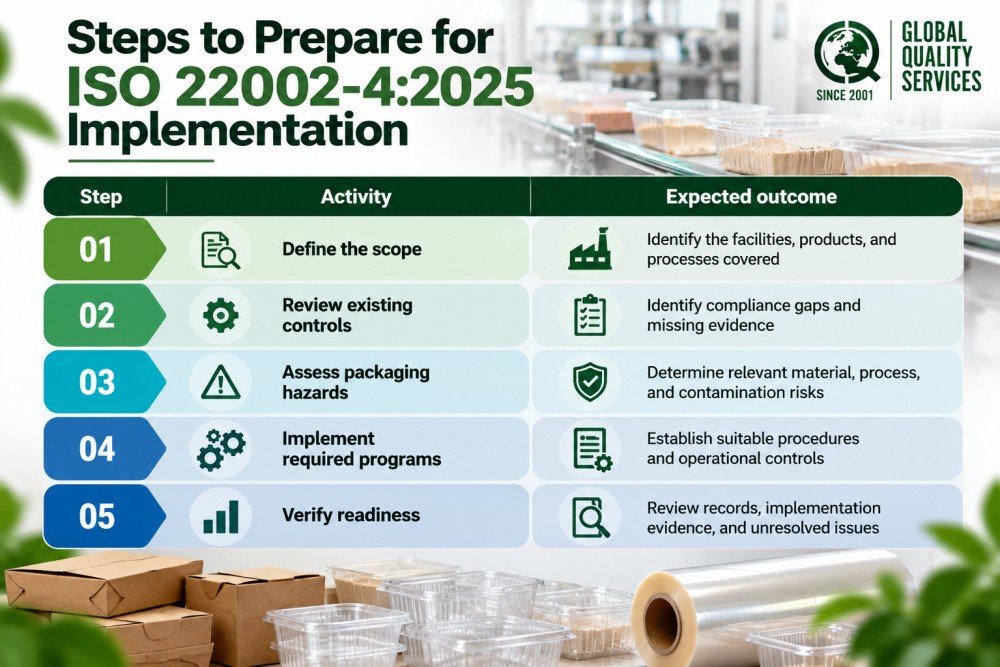
The time taken to implement will depend on the size of your site, complexity of your processes, current documentation, and any gaps identified. Global Quality Services can help you create a realistic plan.
ISO 22002-4:2025 and Related Food Safety Standards
Food packaging manufacturers may need to integrate their PRPs with food safety requirements. The correct standards will depend on what you do, what your customers expect, and your responsibilities within your supply chain.
If you are looking to set up or improve your food safety management system, then we can also help with ISO 22000 Certification in Singapore. If you are looking to achieve additional food safety certifications, then you may also want to consider FSSC 22000.
Get ISO 22002-4:2025 Consultancy for your Packaging Business in Singapore
Prepare your packaging for customer scrutiny and an independent certification by working with our consultants to identify any gaps, assess packaging hazards, improve documentation, and implement suitable controls.
Talk to our team to understand what you have at your site, what materials you use, what processes you have in place, and what your certification goals are. We will help you understand what consultancy we can offer based on your requirements, current systems, and readiness. Our regional presence means we can help businesses within Singapore, the Philippines, Indonesia, Malaysia, and China.
Frequently Asked Questions
1. What evidence should we ask for from our packaging material suppliers?
Start by asking for material specifications, declaration of conformity if applicable, test reports for relevant use, and material composition. The exact evidence will depend on the type of packaging you produce, whether it is in contact with food, and what regulations apply. Within your supplier approval process, you should define what evidence is needed.
2. How should we control a new packaging material?
Before approving for routine use, you should complete a formal change review. Look at the intended use of the material, what it is made from, any contamination risks, compatibility with the process, and evidence from the supplier. Document the decision and update any relevant specifications, procedures, and hazard assessments.
3. What should a manufacturer do if a customer changes the specifications for their food packaging?
Complete a review of the change. Check if this impacts any materials, inks, coatings, adhesives, settings, inspection methods, or handling of the finished product. Update any relevant documents and get the necessary approvals.
4. How can a company control ISO 22002-4:2025 across multiple sites?
Create policies and documents to ensure consistency whilst considering differences in materials, equipment, processes and risks. Each site should have suitable evidence of implementation. An internal review can identify any inconsistencies and where additional support may be needed.
5. What happens if an auditor identifies a non-conformance?
You will need to understand the finding, identify the cause, implement the suitable corrective action/correction, and provide evidence as required by the certifying body. Global Quality Services can help your team investigate the issue, improve the relevant controls, and create supporting evidence. Whether the response meets their requirements will be decided by the certifying body.