ISCC certification can be useful for companies in Jurong East looking to prove the sustainability and traceability of their materials. It can help manufacturers, chemical companies, materials suppliers, traders, and any other companies working with renewable or recycled feedstocks fulfill consumer demand, substantiate sustainable practices, and retain access to supply chains requiring verification of sustainable data.
Singapore is investing heavily in sustainable industry manufacturing. According to data from the Singapore Economic Development Board, sustainable product production on Jurong Island has increased 1.4 times since 2019, aiming for a 1.5-fold increase by 2030. The increase reflects the rising need for sustainable materials and lower-carbon industrial operations.
Should your company operate in Jurong East and seek ISCC certification, engaging the services of a competent consultant will assist you with determining the relevant scheme and compiling proper documentation without unnecessary auditing hiccups. Read further to find out how Global Quality Services can assist your business in preparing for certification.
What Is ISCC Certification
International Sustainability and Carbon Certification, abbreviated as ISCC, refers to a certification framework designed to enable organizations to prove the sustainable sourcing, traceability, and proper management of eligible feedstocks and goods throughout the supply chain process.
ISCC applies to different types of feedstocks, among which agricultural biomass, waste & residues, renewable raw materials, and recycled carbon-containing materials can be mentioned. Applicable criteria will vary based on the selected ISCC program, feedstock type, and organizational position within the supply chain process.
Businesses located in Jurong East may need ISCC certification for operations such as manufacturing, processing, collection, storage, and trading of eligible materials. The main purpose of obtaining ISCC certification is to prove the provenance and sustainability of materials based on applicable criteria.
Why Businesses in Jurong East Need ISCC Certification
ISCC certification can help your company respond to these requirements with documented evidence rather than relying on general sustainability statements. Key benefits include:
- Stronger customer confidence: Demonstrate that your business follows the applicable sustainability and traceability requirements.
- Better supply chain transparency: Maintain records showing where eligible materials come from and how they move through your operations.
- Access to relevant markets: Meet ISCC-related requirements when customers, contracts, or target markets require certification.
- Reliable sustainability claims: Support claims about certified materials with appropriate records and accounting procedures.
- Improved audit preparation: Establish clear responsibilities, documentation, and controls before the certification audit.
- Greater commercial readiness: Prepare your business to respond to supplier assessments, sustainability questionnaires, and customer verification requests.
Which Businesses in Jurong East Should Consider ISCC Certification
ISCC certification may benefit businesses that handle eligible sustainable, renewable, or recycled materials and need to demonstrate their origin and traceability.
Chemical and Materials Manufacturers
Companies producing chemicals, polymers, plastics, and specialty materials may need ISCC PLUS to support eligible bio-based, bio-circular, or circular material claims.
Recycling and Waste Management Companies
Businesses collecting, processing, or supplying eligible waste and residue materials may need to demonstrate material origin, handling, and traceability.
Biofuel and Renewable Energy Suppliers
Relevant producers, collectors, traders, and processors may require ISCC EU or another applicable ISCC scheme, depending on their activities and target markets.
Raw Material Traders and Distributors
Businesses buying, selling, storing, or distributing eligible materials may need documented transactions and traceability records to support certified supply chains.
Packaging and Consumer Product Manufacturers
Companies using eligible renewable or recycled feedstocks may benefit from ISCC PLUS when customers require substantiated material sourcing claims.
ISCC EU vs. ISCC PLUS: Which Scheme Does Your Business Need?
Selecting the appropriate scheme is an important early decision. Applying the wrong requirements can lead to unnecessary work or leave your business unprepared for its intended market.
ISCC EU
- Main application: Relevant biofuels, bioliquids, and bioenergy supply chains.
- Key focus: Applicable sustainability and greenhouse gas saving requirements.
- Typical participants: Eligible feedstock suppliers, collecting points, traders, processors, and fuel producers.
- Scheme selection: Depends on the relevant regulated market and supply chain.
ISCC PLUS
- Main application: Broader markets, including chemicals, plastics, packaging, and other industrial applications.
- Key focus: Sustainability, traceability, and chain of custody under the selected scheme requirements.
- Typical participants: Eligible raw material suppliers, manufacturers, processors, and traders.
- Scheme selection: Depends on the materials, claims, and voluntary or customer requirements.
How to Get ISCC Certification in Jurong East
A clear preparation plan helps your business understand the certification requirements, organize the necessary evidence, and address gaps before the audit.
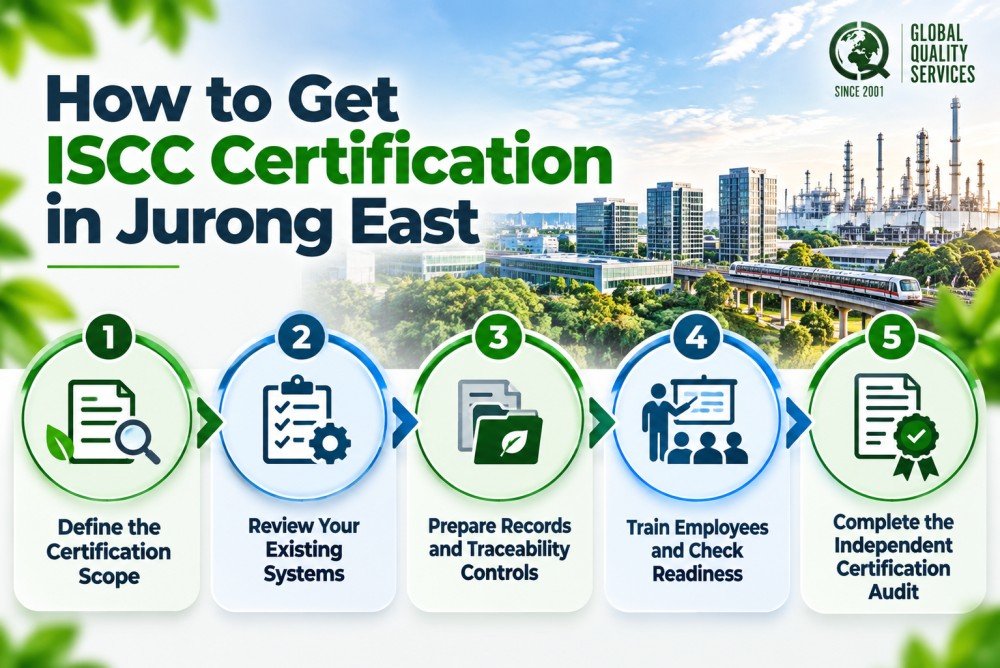
Step 1: Define the Certification Scope
Determine your company’s operations, sites, products, material streams, and position within the value chain. Verify if the ISCC EU, ISCC PLUS, or another appropriate system aligns with your needs.
Step 2: Review Your Existing Systems
Review the data trails of purchases, suppliers, materials movement, manufacturing processes, storage procedures, and sales. Find areas where there are weaknesses relative to the relevant ISCC criteria.
Step 3: Prepare Records and Traceability Controls
Create the documentation required to track sustainable materials throughout your organization. You can think of these documents as sustainability declarations, delivery documentation, evidence from suppliers, quantification records, and mass balance reports, among others.
Step 4: Train Employees and Check Readiness
Communicate clearly with procurement, manufacturing, stock control, sales, and compliance teams about their duties. Perform an internal audit to catch any problems ahead of time.
Step 5: Complete the Independent Certification Audit
Organize an audit with an ISCC-certified third party. Deal with any issues highlighted in the audit and submit your supporting documentation. You will only receive certification if your organization meets the relevant criteria and gains approval from the certifying body.
Documents Required for ISCC Certification
The documents required for ISCC certification in Jurong East depend on your scheme, site activities, materials, and supply chain position. Your preparation should focus on records that establish sustainability compliance and traceability.
Common documents and records may include:
- Company registration and facility details.
- A description of the certification scope and business activities.
- Supplier details and relevant sustainability declarations.
- Purchase orders, invoices, delivery notes, and dispatch records.
- Goods receipt, storage, production, and inventory records.
- Material input and output reconciliation, including mass balance records where applicable.
- Procedures for material identification, segregation, or accounting, as required by the scheme.
- Greenhouse gas data and calculations, where applicable.
- Employee responsibilities, training records, and relevant operating procedures.
- Internal review findings and corrective action records, where required.
How Global Quality Services Experts Help You with ISCC Certification in Jurong East
Choosing a reputed consultant can make a difference when your business needs to meet sustainability requirements without creating unnecessary work for employees. Global Quality Services (GQS) supports businesses with certification consultancy, management system implementation, training, and audit preparation. Key reasons to work with GQS include:
- 21 years of experience in management system consultancy and certification support.
- More than 1,450 customers across 17 locations, reflecting experience serving businesses in different markets.
- Industry-focused guidance for manufacturers, suppliers, processors, and other businesses with specific certification needs.
- Practical documentation support to help teams prepare records that match their actual operations.
- Personalized consultancy based on your products, business activities, supply chain, and target market.
- Integrated certification guidance, including relevant environmental and chemical industry standards.
- Regional support for companies managing certification requirements across multiple facilities or markets.
Related Certification Services for Your Business
ISCC may form part of a wider sustainability and environmental compliance program. Depending on your business activities, other standards may address different needs.
- ISO 14001:2026 Certification: Relevant to businesses seeking a structured environmental management system.
- RC 14001 Certification: Relevant to chemical companies looking to strengthen environmental, health, safety, and Responsible Care practices.
These standards serve different purposes and do not replace ISCC certification. GQS can help you determine whether combining relevant programs makes sense for your business.
Get ISCC Certification Support in Jurong East from Global Quality Services
Prepare your business for ISCC certification with guidance tailored to your operations, materials, and customer requirements. Global Quality Services can help you assess your current systems, identify documentation gaps, and plan the steps needed to prepare for the independent audit.
Contact the Global Quality Services team and discuss your certification requirements and request a consultation. Share your business activities, the materials you handle, and your target market so our team can help you identify the appropriate certification route and scope.
Frequently Asked Questions
1. Is ISCC certification mandatory for businesses in Jurong East?
ISCC certification is not universally mandatory for every business in Jurong East. It may be required when a business operates within a regulated supply chain, supplies customers that specify ISCC certification, or wants to substantiate certain sustainability claims. The requirement depends on the product, market, and applicable scheme.
2. How long does it take to obtain ISCC certification?
The timeline will depend on how extensive your certification scope is, how complicated your operational environment is, whether your documentation exists already, and how ready you are for an audit.
3. Which ISCC scheme is suitable for my company?
ISCC EU certification could be appropriate for companies working within eligible biofuels or bioenergy value chains that comply with EU regulations. ISCC PLUS certification could be appropriate for companies dealing with renewable, bio-circular, or circular feedstocks in industry.
4. Can a small or medium-sized business in Jurong East apply for ISCC certification?
Absolutely. Smaller firms may seek out ISCC certification if their business activities qualify under the program’s guidelines. It depends on what your company does and where it fits into the value chain.
5. Does GQS issue the ISCC certificate?
The Global Quality Services offers assistance in preparing for certifications. Certification audits and decisions about certification are carried out by a certified certification body accredited for ISCC certification. It is important for businesses to check whether the certification body is indeed accredited before applying.