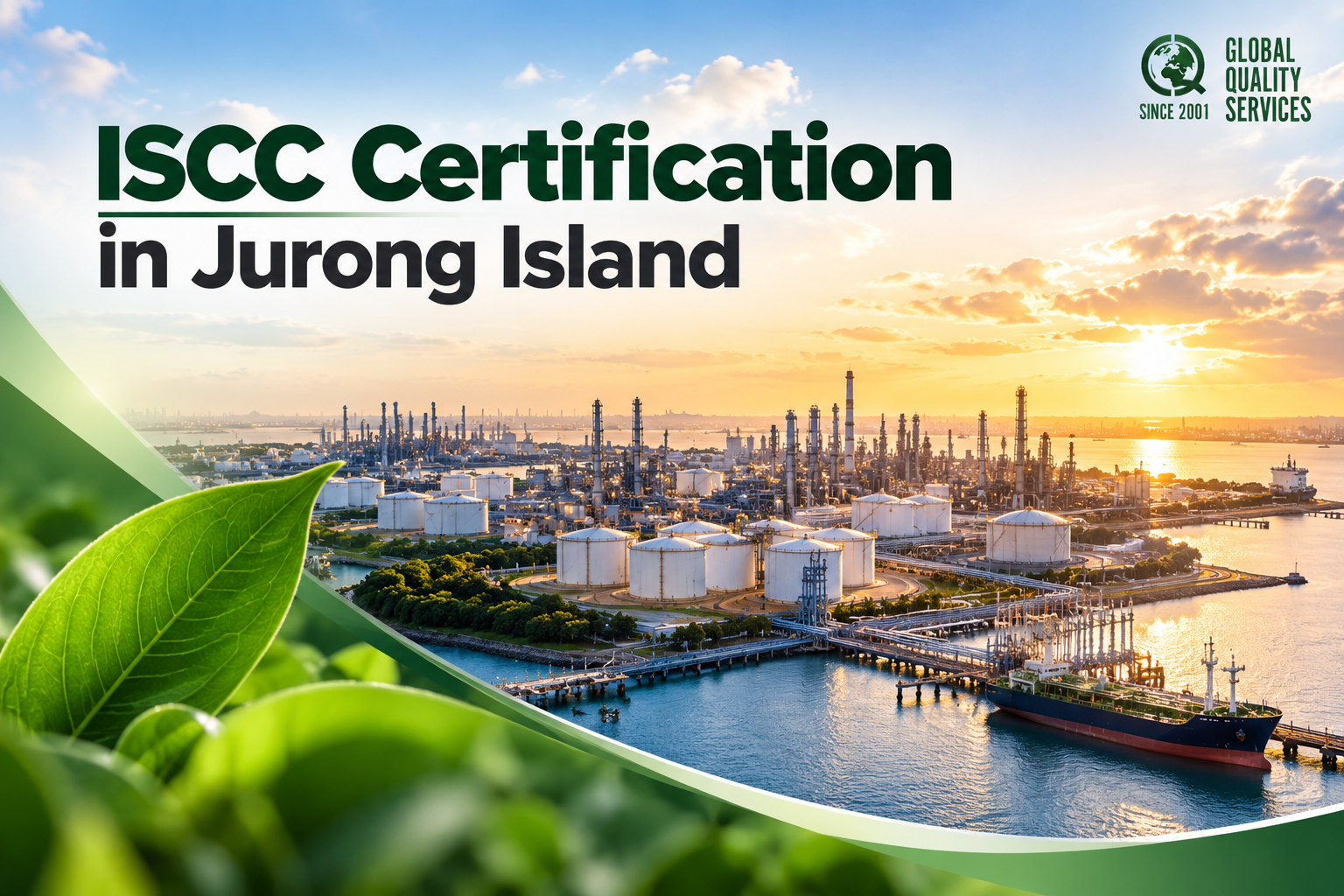
Jurong Island is a key hub for Singapore’s energy and chemicals industry, where sustainability and responsible sourcing are becoming increasingly important. Businesses handling renewable fuels, bio-based materials, recycled feedstocks, or eligible chemical products can benefit from ISCC certification in Jurong Island to demonstrate compliance with relevant sustainability and traceability requirements.
According to Singapore’s National Climate Change Secretariat, the country aims to increase sustainable product output from Jurong Island by 1.5 times its 2019 level by 2030. This target supports Singapore’s plan to develop the island into a sustainable energy and chemicals park.
For businesses serving international markets, ISCC certification can help meet customer requirements and support credible sustainability claims. Global Quality Services provides tailored consultancy to help companies identify the right scheme, organize documentation, and prepare for certification audits. Read on to understand the requirements and how our team can support your business.
What Does ISCC Certification Mean for Your Business
International Sustainability and Carbon Certification, commonly known as ISCC, is a certification system that covers sustainability and traceability requirements for eligible materials and supply chains. It applies to several sectors, including renewable fuels, bio-based products, circular materials, and other eligible feedstocks.
The exact requirements depend on the scheme you choose. For example, a company supplying renewable materials to chemical manufacturers may have different certification needs from a business producing fuel for a regulated market.
For businesses on Jurong Island, this distinction matters. Before investing time and money in certification, you need to know which scheme applies to your products, what your customers expect, and which parts of your operation must be covered.
ISCC certification can help your company demonstrate that it follows the applicable sustainability requirements. It can also give customers documented evidence of how eligible materials are sourced, handled, processed, and traded.
Why Should Jurong Island Companies Consider ISCC Certification?
A customer may ask for sustainability evidence before approving a supplier. Another may require a specific certification before accepting a shipment. If your business cannot provide the required documents, you could face delays or lose a commercial opportunity. ISCC certification can help address these concerns when the relevant scheme is recognized by the customer or market involved. Here is how it may benefit your business:
- Meet customer requirements: Demonstrate compliance with applicable ISCC criteria when certification is required by a buyer.
- Improve supply chain records: Keep relevant information about incoming materials, stock movements, processing, and outgoing products in order.
- Support sustainability claims: Maintain evidence for the claims your company makes about eligible products and materials.
- Prepare for market requirements: Establish the controls needed for customers or markets that recognize the selected ISCC scheme.
- Identify record-keeping gaps: Find problems in supplier documents, inventory records, or material calculations before the audit.
Which Businesses in Jurong Island May Need ISCC Certification
ISCC certification may be relevant to several types of businesses across the energy and chemicals supply chain. The need for certification depends on the materials handled, the company’s role, and the requirements of its customers.
Energy and Petrochemical Companies
Companies working with eligible renewable feedstocks, alternative fuels, or sustainable chemical inputs may need to demonstrate where their materials come from and how they are handled. ISCC consultancy can help these businesses identify the records and controls required for their intended certification scope.
Biofuel and Renewable Fuel Producers
Fuel producers may need to demonstrate that their feedstocks meet the sustainability criteria of the relevant scheme. They may also need records covering suppliers, production quantities, material use, and product deliveries.
Chemical Manufacturers and Processors
Chemical businesses exploring bio-based or circular raw materials may need a suitable certification to support customer requirements. The appropriate scheme depends on the product, its intended use, and the claims the company wants to make.
Traders and Storage Operators
Companies that buy, sell, store, or handle eligible materials may have responsibilities for keeping transaction records and maintaining material traceability. The exact obligations depend on the scheme and the activities included in the certification scope.
Recycling and Circular Material Businesses
Businesses dealing with eligible recycled feedstocks or circular raw materials may consider ISCC PLUS where the scheme fits their products and operations. They must be able to provide the evidence required to support the relevant material claims.
For businesses looking to strengthen their sustainability practices, Global Quality Services also offers ISO 14046 Certification Consultants in Jurong Island for water footprint assessment and ISO 14001 Consultancy and Certification for responsible care and environmental management.
Which ISCC Scheme Should You Choose
ISCC has different schemes for different markets and purposes. Choosing the right one at the start helps prevent unnecessary work and confusion during preparation.
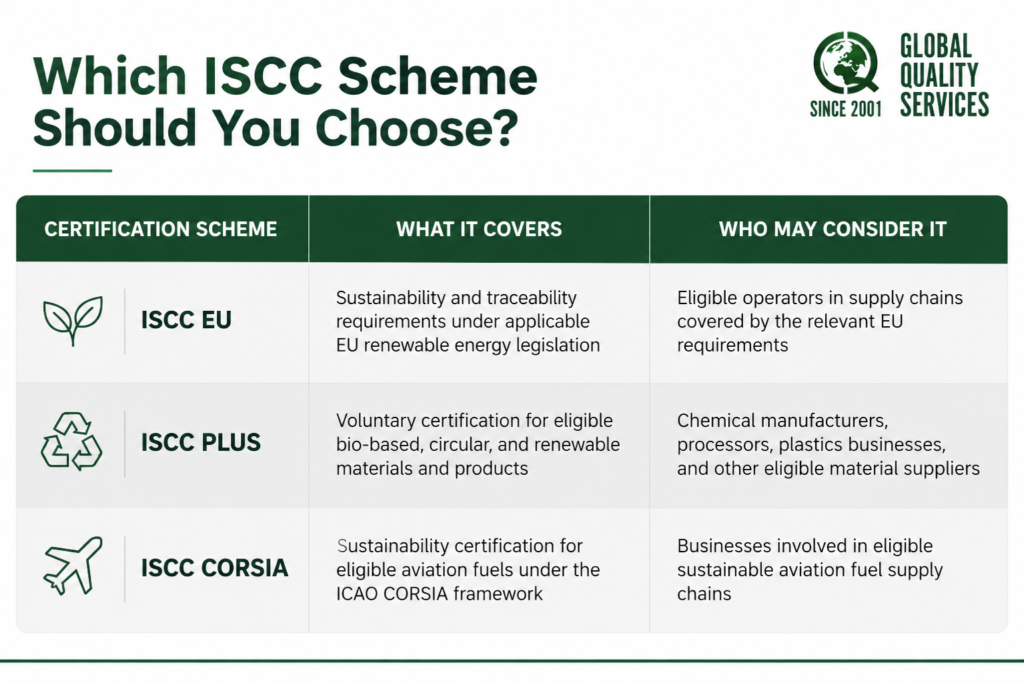
The right choice depends on your products, business activities, intended market, and customer requirements. A certificate under one scheme does not automatically satisfy the requirements of another.
How to Get ISCC Certification in Jurong Island
The work involved in certification varies from one company to another. A business with organized supplier records and established stock controls may be better prepared than one that has to build these arrangements from scratch. We can help your team prepare through the following stages:
Step 1: Confirm Your Certification Requirements
Start by reviewing your products, suppliers, business activities, and target markets. This helps establish which ISCC scheme may apply and which facilities or processes need to be included.
Step 2: Review Your Current Records
Look at how your company records purchases, deliveries, stock movements, production, and sales. The purpose is to find out whether the available information supports the requirements of the selected scheme.
Step 3: Organize the Required Documents
Gather supplier declarations, invoices, delivery records, inventory information, and other relevant evidence. Depending on your activities, you may also need mass balance records, greenhouse gas information, or sustainability declarations.
Step 4: Address Gaps Before the Audit
If documents are missing or quantities do not match, resolve these issues before the formal assessment. Employees responsible for purchasing, production, inventory, and sales should understand the records they need to maintain.
Step 5: Arrange the Certification Audit
Once your business is ready, arrange an assessment with an ISCC-recognized certification body. The auditor checks your operation against the requirements of the selected scheme. Any nonconformities must be addressed in line with the applicable certification rules before a certificate can be granted.
What Documents Are Required for ISCC Certification?
There is no single document list that applies to every company. The requirements depend on the scheme, products, and activities covered by the application. Your business may need to prepare:
- Company registration and facility details.
- A description of the certification scope.
- Supplier information and relevant sustainability declarations.
- Purchase orders, invoices, and delivery records.
- Inventory and stock movement records.
- Production and material input-output records, where applicable.
- Mass balance calculations, where required.
- Procedures for handling certified and non-certified materials.
- Employee training records and assigned responsibilities.
- Sales documents and sustainability declarations, where applicable.
- Greenhouse gas calculation records when required by the scheme.
Common ISCC Certification Problems and How to Avoid Them
Many certification issues arise from gaps in everyday business records rather than a lack of written policies.
- Selecting the wrong ISCC certification scheme.
- Incomplete supplier documents and sustainability declarations.
- Errors in material traceability and inventory records.
- Incorrect mass balance calculations.
- Missing greenhouse gas emission data, where applicable.
- Poor employee awareness of ISCC requirements.
- Unsupported sustainability claims.
- Unresolved nonconformities before the certification audit.
Addressing these matters early gives your company a better understanding of its readiness for certification. It also helps avoid last-minute document collection and unnecessary pressure on employees.
How Global Quality Services Experts Help You with ISCC Certification in Jurong Island
Choosing a consultant is an important decision, especially when certification affects several departments and customer commitments. You need a team that understands certification requirements and can relate them to the way your business operates. Global Quality Services offers:
- A reputed consultant for certification and management system consultancy.
- 26 years of experience in quality and certification-related services, as stated in the GQS company profile.
- Industry-focused guidance based on your products, activities, and intended certification scope.
- Practical advice on documentation, material tracking, and audit readiness.
- Clear communication about applicable requirements and preparation priorities.
- Support in identifying gaps before the formal assessment.
- Consultancy tailored to the selected ISCC scheme and your business needs.
- Assistance with preparation for assessment by an appropriate certification body.
- Guidance for businesses that also need support with related management system certifications.
Our focus is to help you understand what your company needs to prepare, where your current systems may fall short, and what work should be completed before the audit. The aim is to make certification preparation more manageable without adding unnecessary steps.
Prepare for ISCC Certification with the Right Consultant
If your company is planning to pursue ISCC certification in Jurong Island, start by confirming the scheme that matches your products and business goals. Preparing without a clear scope can lead to wasted effort, missing documents, and avoidable delays.
Get in touch with Global Quality Services about your operations, certification needs, and target markets. Our experts will guide you through the prep process and develop a realistic path forward toward assessment. Our regional presence across Singapore, the Philippines, Indonesia, Malaysia, and China supports businesses with their certification needs across key Asian markets.
Frequently Asked Questions
1. How much does ISCC certification cost in Jurong Island?
The cost depends on the selected scheme, company size, number of sites, business activities, and audit requirements. Consultancy fees and certification body fees may be separate. A review of your scope is the best starting point for estimating the work involved.
2. How long does ISCC certification take?
The timeline depends on your existing records, the complexity of your supply chain, the gaps that need attention, and the certification body’s availability. A company with well-maintained records may need less preparation than one that must establish new procedures and tracking systems.
3. Is ISCC PLUS suitable for chemical manufacturers?
It may be suitable for chemical manufacturers handling eligible bio-based, circular, or renewable materials. The company must confirm that its products, activities, and intended claims fall within the applicable scheme requirements.
4. Can a trading company apply for ISCC certification?
Yes, trading companies may be eligible when their activities fall within the selected scheme. They may need to maintain supplier information, transaction records, and evidence showing the movement of eligible materials through the supply chain.
5. Does Global Quality Services issue ISCC certificates?
No. GQS provides consultancy and certification preparation support. An authorized certification body conducts the assessment and decides whether the company meets the requirements for certification.