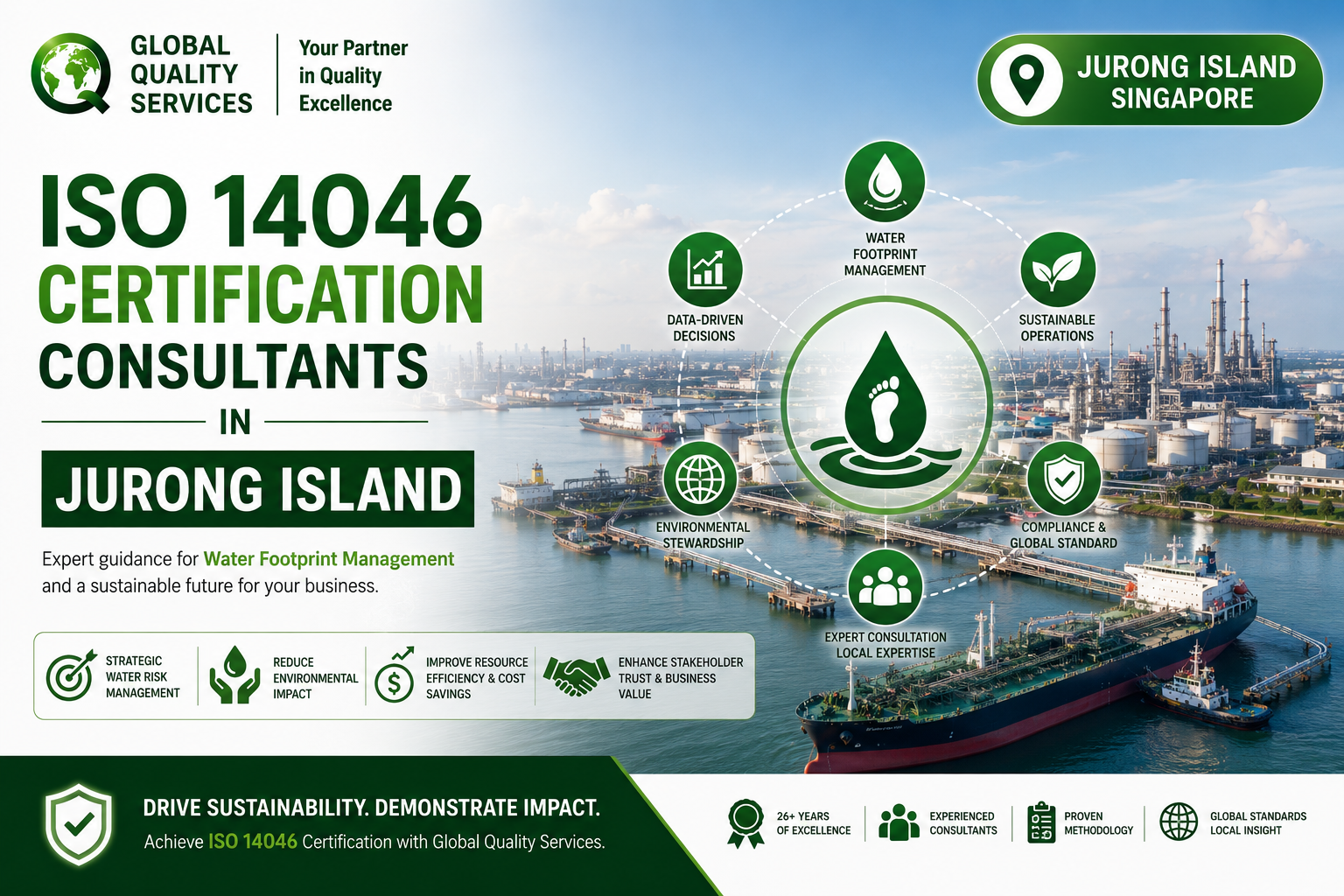
Every plant on Jurong Island runs on water. Cooling towers, boiler feed, process streams, effluent treatment: none of it works when the water stops. On an island built for refining, petrochemicals, and specialty chemicals, water sits inside almost every unit operation you run.
Yet most sites still cannot put a defensible number on how much water they actually consume, or what that consumption does to a water-stressed nation. That is the gap ISO 14046 closes.
As ISO 14046 certification consultants in Jurong Island, GQS runs the entire water footprint assessment for you, from raw data through to independent third-party verification, so the figure you report can stand up to a customer audit, an ESG rating or a PUB query.
What Is ISO 14046 Certification?
ISO 14046 is the international standard for measuring the water footprint of a product, a process or an entire organisation. Published as ISO 14046:2014, its full title is “Environmental management. Water footprint. Principles, requirements and guidelines.” It is built on life cycle assessment, the same ISO 14040 and ISO 14044 methodology used for carbon and wider environmental studies.
Here is the deal: ISO 14046 goes beyond counting litres. It quantifies how your water use and discharges affect water availability and quality across the full life cycle, then presents the outcome as a single figure or a profile of water-impact indicators. Only air and soil emissions that reach water are counted, which keeps the study focused on real water impact.
One point is worth making clear. ISO 14046 is a water footprint assessment and verification standard, not a management system standard like ISO 14001. There is no annual pass-or-fail certificate in the ISO 14001 sense.
Instead, any water footprint result you plan to publish or use in a comparison must undergo an independent critical review. GQS manages that review process end-to-end, which is what most Jurong Island sites mean when they ask for ISO 14046 certification.
Why Jurong Island Companies Need ISO 14046 Water Footprint Certification
Singapore is one of the most water-stressed countries in the world, with no natural aquifers or large rivers to fall back on. PUB and the Ministry of Sustainability and the Environment supply the country through the Four National Taps: local catchment, imported water, NEWater and desalinated water. National water demand is projected to almost double by 2065.
Jurong Island sits at the sharp end of that pressure. Industrial water in Singapore is now supplied almost entirely to Jurong Island, and NEWater feeds the island’s thirstiest users: petrochemical plants, power generation and wafer fabrication. Non-domestic use already accounts for more than half of national water demand. When water is this scarce and your sector consumes this much of it, a measured water footprint stops being a nice-to-have.
Here is what is pushing water up the agenda for Jurong Island operators:
| Pressure | What it means for your plant |
|---|---|
| PUB trade effluent limits under the Sewerage and Drainage Act | Discharges are monitored closely, with VOC sensors flagging illegal releases. A quantified water profile keeps you ahead of enforcement. |
| Mandatory Water Efficiency Requirements | Large water users must report and manage consumption. ISO 14046 gives you the underlying data. |
| ESG and CDP Water disclosure | Investors and rating agencies now ask for water metrics, not estimates. A verified footprint answers the question directly. |
| Customer and supply-chain audits | Global chemical and electronics buyers increasingly require water data from their suppliers. |
| Water cost and reuse economics | Knowing where your water impact concentrates shows where reuse, seawater cooling or NEWater substitution pays back fastest. |
The short version: an ISO 14046 water footprint turns a compliance risk and a reporting headache into one credible number you can act on.
What Does an ISO 14046 Water Footprint Assessment Cover?
An ISO 14046 study follows the four-phase life cycle assessment structure. Each phase builds on the last.
| Phase | What happens |
|---|---|
| 1. Goal and scope | We define why the study exists, what it covers (a product, a process or the whole site), the system boundary and the water impact categories to assess. |
| 2. Water use inventory | We map every direct and indirect water input, output and degradative use across the boundary: intake, cooling, process water, steam, effluent and supply-chain water. |
| 3. Water impact assessment | We convert that inventory into impact using regionalised methods such as AWARE and WULCA, so Singapore’s water scarcity is reflected rather than a global average. |
| 4. Interpretation and reporting | We pinpoint the hotspots, test how sensitive the result is to assumptions, and write the report to ISO 14046 requirements ready for critical review. |
You might be wondering how granular this gets. Very. For a semiconductor line, producing ultra-pure water alone can consume 1.5 to 2 litres of municipal water for every litre of ultra-pure water made, before a single wafer is cleaned. ISO 14046 captures that kind of hidden water intensity that a utility bill never shows.
Our ISO 14046 Certification Process for Jurong Island Businesses
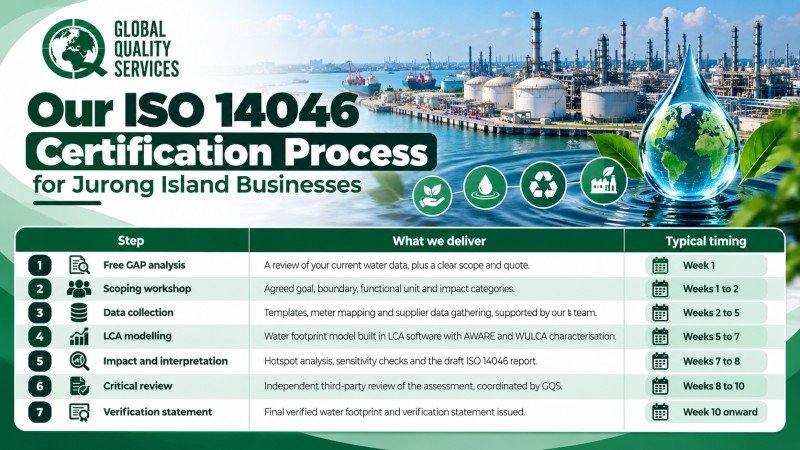
We keep the path to certification structured and predictable. Here is how we do it:
| Step | What we deliver | Typical timing |
|---|---|---|
| 1. Free GAP analysis | A review of your current water data, plus a clear scope and quote. | Week 1 |
| 2. Scoping workshop | Agreed goal, boundary, functional unit, and impact categories. | Weeks 1 to 2 |
| 3. Data collection | Templates, meter mapping and supplier data gathering, supported by our team. | Weeks 2 to 5 |
| 4. LCA modelling | Water footprint model built in LCA software with AWARE and WULCA characterisation. | Weeks 5 to 7 |
| 5. Impact and interpretation | Hotspot analysis, sensitivity checks and the draft ISO 14046 report. | Weeks 7 to 8 |
| 6. Critical review | Independent third-party review of the assessment, coordinated by GQS. | Weeks 8 to 10 |
| 7. Verification statement | Final verified water footprint and verification statement issued. | Week 10 onward |
Start with the GAP analysis. It is free, and it tells you exactly what data you already hold and what we still need to build the model. From there, most single-site studies reach a verified footprint in roughly eight to twelve weeks, depending on how many products and processes sit in scope and how quickly supply-chain data comes back.
We support you three ways throughout: consultancy to build the study, training so your team can maintain it, and certification support to carry you through the review. That is the same model we have run for more than 1,450 clients.
Benefits of ISO 14046 Certification
A verified water footprint pays back in more than one place.
It sharpens regulatory standing. With PUB monitoring trade effluent and enforcing water efficiency, an ISO 14046 study gives you defensible numbers instead of estimates when a regulator or auditor asks. It also strengthens ESG and CDP Water reporting, where a verified figure carries far more weight than a self-declared one.
It finds money, too. The impact assessment shows precisely where your water burden concentrates, which is where reuse, seawater cooling towers or NEWater substitution deliver the biggest return. Sites on Jurong Island have used that insight to cut both freshwater draw and effluent charges.
And it fits your existing systems. ISO 14046 slots in alongside the standards many Jurong Island plants already hold:
- ISO 14001 certification for environmental management, where the water footprint feeds your environmental aspects.
- ISO 46001 water efficiency, which turns footprint findings into an operational water management system.
- ISO 14064 carbon footprint and ISO 50001 energy management, so water, carbon and energy are measured on one consistent basis.
- ESG reporting and, for chemical operators, RC 14001 Responsible Care.
Run these together and you avoid duplicated data collection while presenting one coherent sustainability story.
Why Choose Global Quality Services for ISO 14046 Consulting in Jurong Island
Global Quality Services is a TÜV SÜD and SCMC certified management consultancy with 21 years behind us and more than 1,450 clients across 17 locations. We pair hands-on life cycle assessment capability with a working knowledge of Singapore’s water regime, so your study is technically sound and locally relevant.
A few things set our ISO 14046 work apart:
- Real LCA capability, using recognised software and regionalised water scarcity data rather than generic factors.
- End-to-end delivery, including coordination of the independent critical review your result needs.
- On-the-ground presence across Singapore, the Philippines, Malaysia and Indonesia for multi-site groups.
- Grant guidance: eligible Singapore companies may offset ISO consulting costs through the Enterprise Development Grant.
Ready to put a real number on your water? Book your free GAP analysis and quote through our contact page, or call the Singapore office on +65 9344 1973.
Frequently Asked Questions
- What is ISO 14046 certification?
ISO 14046 certification is independent verification that your organisation’s or product’s water footprint has been assessed to ISO 14046:2014. The standard uses life cycle assessment to quantify water consumption and its impact on water availability and quality.
2. Is ISO 14046 a certification or a verification?
Strictly, it is a verification standard. ISO 14046 sets out how to assess and report a water footprint, and any result intended for public use must pass an independent critical review rather than a management system certification audit. In everyday use, companies call the verified outcome ISO 14046 certification.
3. What is the difference between ISO 14046 and ISO 14001?
ISO 14001 is a broad environmental management system covering all your environmental aspects. ISO 14046 is a focused water footprint assessment. Many sites run their ISO 14046 study inside an existing ISO 14001 framework so the water data supports their wider environmental objectives.
4. Is grant funding available for ISO 14046 in Singapore?
Eligible Singapore-registered companies may be able to offset ISO consulting costs through the Enterprise Development Grant. GQS can advise on eligibility and the application during project scoping.
5. What data do we need for an ISO 14046 assessment?
You will need water intake and discharge records, meter data, process and cooling water figures, effluent volumes and quality, and where relevant, key supplier water data. Our GAP analysis identifies exactly what you already hold and what we need to gather, and we provide templates to make collection straightforward.
6. How much does ISO 14046 certification cost?
Cost depends on scope: the number of products or processes assessed, data availability and site complexity. We provide a fixed quote after the free GAP analysis, so you know the full cost before any work begins.