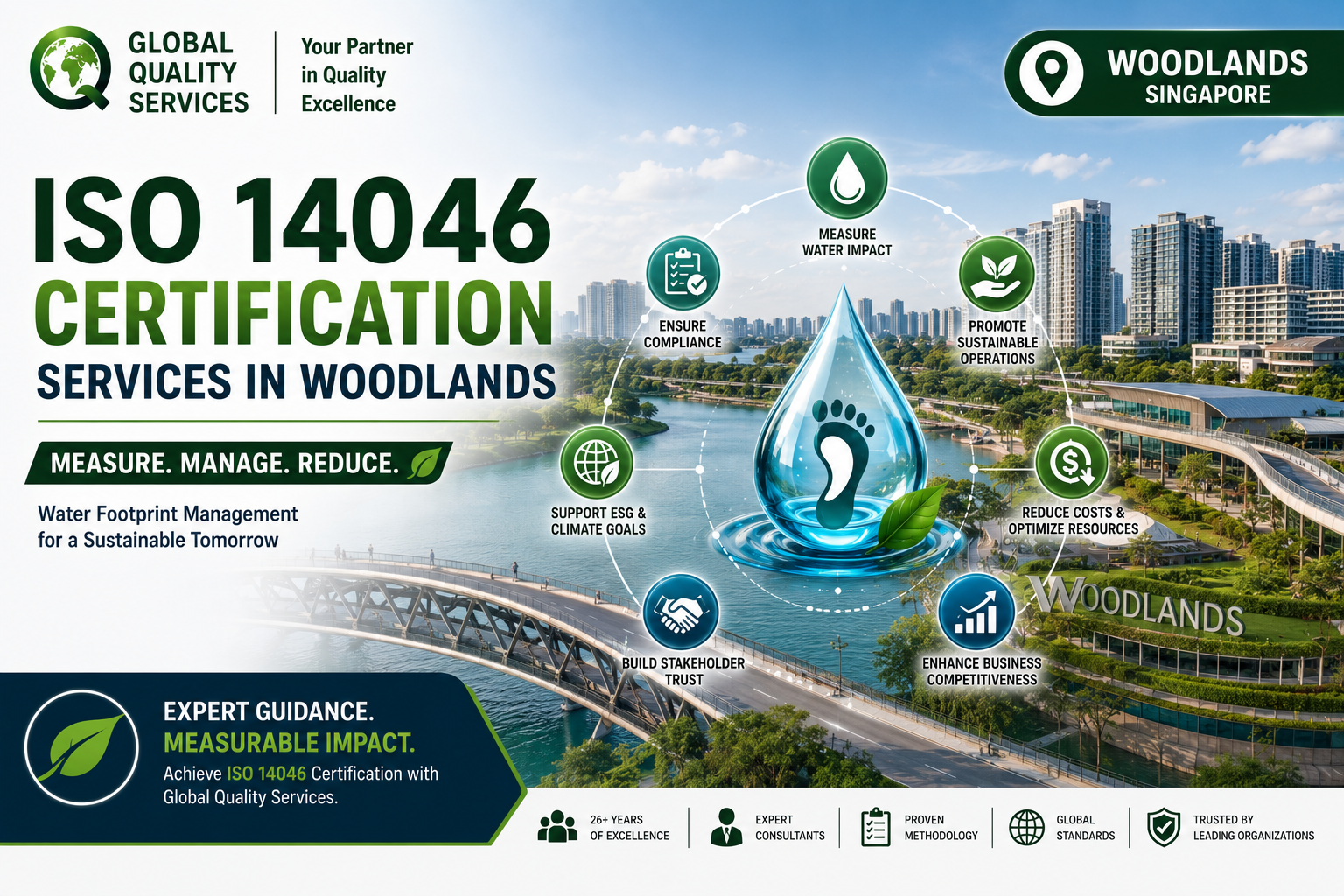
Is your Woodlands operation confident about how much water it really uses, once you account for what flows in through your ingredients, suppliers, and cross-border supply chain, rather than just what passes your on-site meter? GQS Singapore provides ISO 14046 certification services in Woodlands, helping food producers, precision manufacturers and industrial operators across the North measure, verify and reduce their water footprint. Backed by 21 years of experience and a team of SCMC and TUV SUD trained consultants, we turn scattered water data into a single, independently verified figure your business can report and defend.
What Is ISO 14046 Certification?
ISO 14046 is the global standard for calculating the water footprint of a product, process or organisation through life cycle assessment (LCA). Issued as ISO 14046:2014 by the International Organization for Standardization, it works differently from a certifiable management system such as ISO 9001. It is a measurement framework. So when a business talks about “ISO 14046 certification”, what it usually means is a water footprint study carried out to the standard and then confirmed by an independent verifier, which turns a self-declared number into a credible one.
An ISO 14046 study looks at three kinds of water: blue water drawn from surface or ground sources, green water from rainfall, and grey water polluted during your operations. Those flows are modelled against water impact categories such as scarcity and quality degradation, using the same LCA phases defined in ISO 14040 and ISO 14044. The final result is a water footprint you can disclose, compare year on year, and use to target reductions.
Why ISO 14046 Matters for Businesses in Woodlands
For Woodlands, a district built around food, agri-tech and cross-border trade, a verified water footprint speaks directly to the water-intensive and supply-chain-heavy nature of the businesses based there.
Woodlands anchors Singapore’s Northern Gateway and its growing agri-tech and food corridor, linking the Agri-Food Innovation Park, the Senoko Food Zone and the rejuvenated Sungei Kadut Eco-District. Food processing, aquaculture and urban farming all use large volumes of water as an ingredient, a coolant and a cleaning input, which makes water footprint data unusually valuable for operators here.
The North is also served by the Kranji Water Reclamation Plant and Kranji Reservoir, part of Singapore’s strategy to recycle far more water as national demand heads toward doubling by 2060. The sensitive wetland habitat at nearby Sungei Buloh adds another reason to understand and limit water quality impacts. A study to ISO 14046 gives Woodlands facilities the evidence base to reduce consumption and manage that impact credibly.
Woodlands is also Singapore’s main land link to Malaysia, through the Causeway, the coming RTS Link and the Johor-Singapore Special Economic Zone. Many manufacturers here run cross-border supply chains, where a large share of water impact sits upstream, across the border. ISO 14046, built on life cycle thinking, is designed to capture exactly that supply-chain water footprint, not just what happens on site. That matters as customers and investors increasingly ask for verified water data in line with PUB’s water efficiency expectations and in ESG reporting.
Who Needs ISO 14046 Water Footprint Certification in Woodlands
- Any Woodlands business with high water use, food or agri-food processes, or a cross-border supply chain is well suited to ISO 14046.
- Food and beverage manufacturers in the Senoko Food Zone and across the North use water throughout production, so a water footprint feeds directly into cost, quality and sustainability decisions. This works hand in hand with our FSSC 22000 food safety certification.
- Agri-tech, urban farming and aquaculture operators around the Agri-Food Innovation Park depend on water as their core production input, which makes footprint measurement central to efficient, credible growing.
- Precision engineering and semiconductor firms in Woodlands North Coast and the Wafer Fab Parks run water-intensive processes, where an assessment reveals where consumption and losses actually occur.
- Timber, furniture, construction and environmental-technology businesses in the Sungei Kadut Eco-District, now shifting toward circular and green models, can use water footprinting to support that transition. It pairs naturally with ISO 59000 circular economy certification.
- Cross-border manufacturers and logistics operators using the Causeway and RTS Link carry significant upstream water impact that only a life cycle assessment captures.
- Commercial buildings and business parks in the Woodlands Regional Centre benefit from water footprint data as part of wider building sustainability and ESG reporting.
What ISO 14046 Requires: The Water Footprint Assessment Process
An ISO 14046 study runs through the four standard phases of life cycle assessment, focused on water.
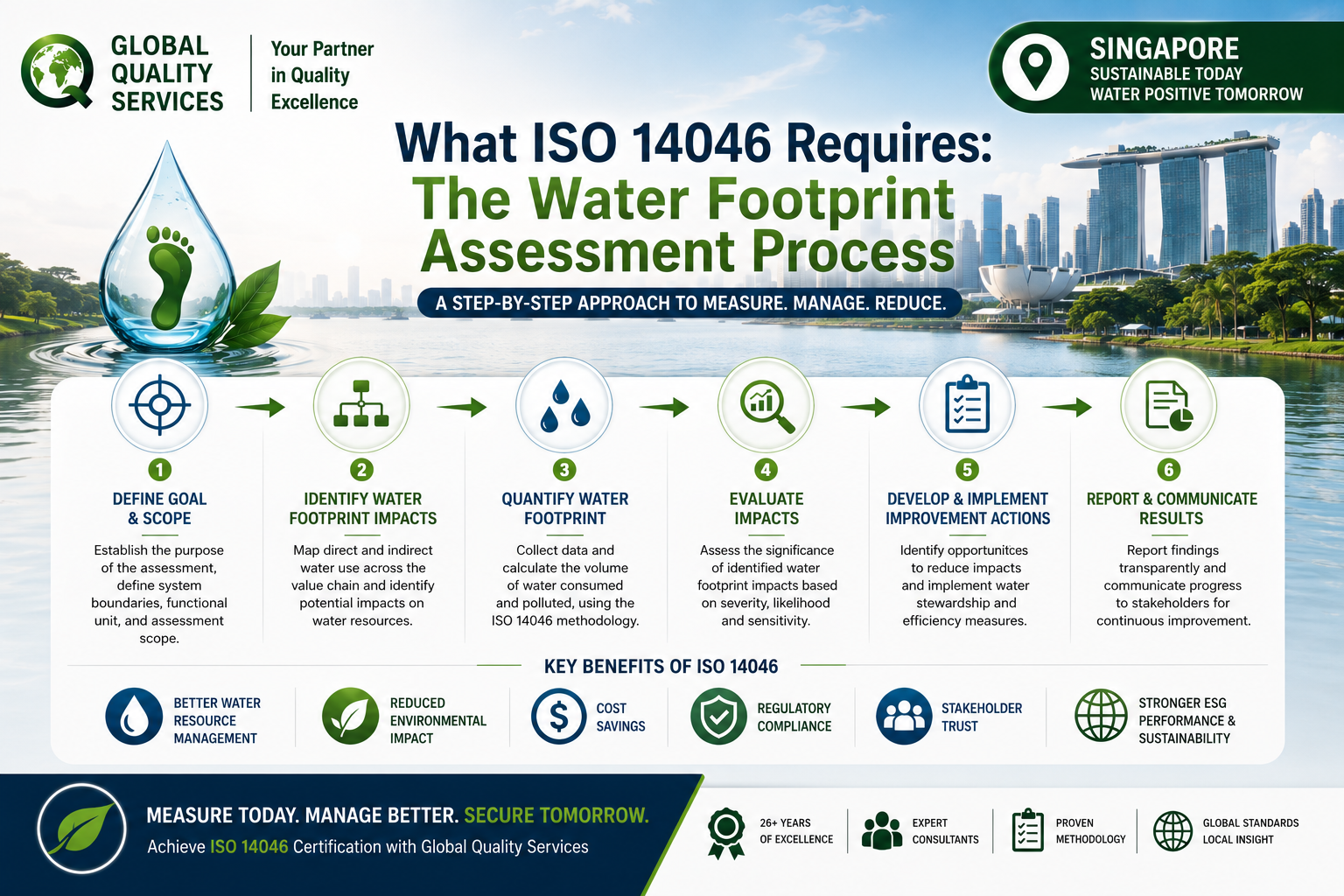
One point worth noting: the standard covers reporting, but public-facing claims such as eco-labels fall outside ISO 14046 and follow separate rules. GQS keeps your reporting robust and correctly scoped.
How GQS Singapore Delivers ISO 14046 in Woodlands: Step by Step
GQS manages your water footprint end to end, from the first data conversation to independent verification, shaped around your Woodlands operation.
- Step 1: Scope and goal setting. We define what the study needs to prove and where its boundary sits, including any cross-border supply-chain stages, so the result answers real customer, regulator or board questions.
- Step 2: Water inventory build. We map every water flow at your site and across the key upstream stages, then flag the data gaps to close before modelling starts.
- Step 3: LCA modelling. We construct the water footprint model to ISO 14046, applying ISO 14040 and ISO 14044 principles and suitable water impact methods.
- Step 4: Impact assessment. We calculate your footprint and identify the processes, ingredients and supplier stages carrying the heaviest water impact.
- Step 5: Reporting. We deliver a clear, standard-aligned water footprint report that both technical staff and management can act on.
- Step 6: Verification support. We ready your study and evidence for third-party verification, so the result is credible and defensible rather than self-declared.
- Step 7: Reduction planning. We help turn the numbers into a practical water reduction plan and connect them to your wider efficiency, circular-economy and ESG goals.
Global Quality Services Helps You With More Than 26 Years Of Experience
Woodlands businesses get more from water footprinting when it runs alongside related food, environmental and management-system certifications, all delivered by GQS. Ready to measure and verify your water footprint in Woodlands? Global Quality Services (GQS) Singapore makes ISO 14046 straightforward, from the first data session to independent verification. Contact our team for a scoped quote for your facility.
Frequently Asked Questions
1. Is ISO 14046 a certification or a water footprint assessment?
ISO 14046 is a water footprint assessment standard rather than a management-system certification. You carry out a study to the standard and have the result independently verified, which is why “ISO 14046 certification” in practice means a verified water footprint. GQS handles both the study and the verification for your Woodlands operation.
2. Can ISO 14046 capture water impact from our cross-border supply chain?
Yes. Because ISO 14046 is built on life cycle assessment, it accounts for indirect water use across your whole value chain, including upstream stages in Johor and beyond the Causeway. For many Woodlands manufacturers, this supply-chain water often outweighs on-site use, which is exactly why a life-cycle-based footprint is worth doing.
3. Is ISO 14046 useful for food and agri-food businesses in the North?
Very. Food processing, aquaculture and urban farming are water-intensive, so a water footprint pinpoints where water is used and lost, and where reductions pay off most. It also strengthens sustainability claims to buyers, and pairs well with FSSC 22000 for food-safety-certified producers.
4. How long does an ISO 14046 assessment take in Woodlands?
Most studies take about 2 to 4 months, depending on the scope, the number of processes, and how accessible your water and supplier data is. Facilities with good metering and supplier records move faster. GQS provides a realistic timeline once the scope is agreed.
5. How does ISO 14046 differ from ISO 46001?
ISO 14046 measures your water footprint, meaning the potential water-related environmental impact across the life cycle. ISO 46001 is a water efficiency management system for reducing consumption operationally. Many North businesses use ISO 14046 to quantify impact and ISO 46001 to manage it, and GQS delivers both.