Singapore’s water demand is projected to almost double by 2065, with the non-domestic sector expected to account for more than 60 percent of that demand, up from 55 percent today. For businesses, that trajectory is already translating into regulatory requirements and rising costs right now.
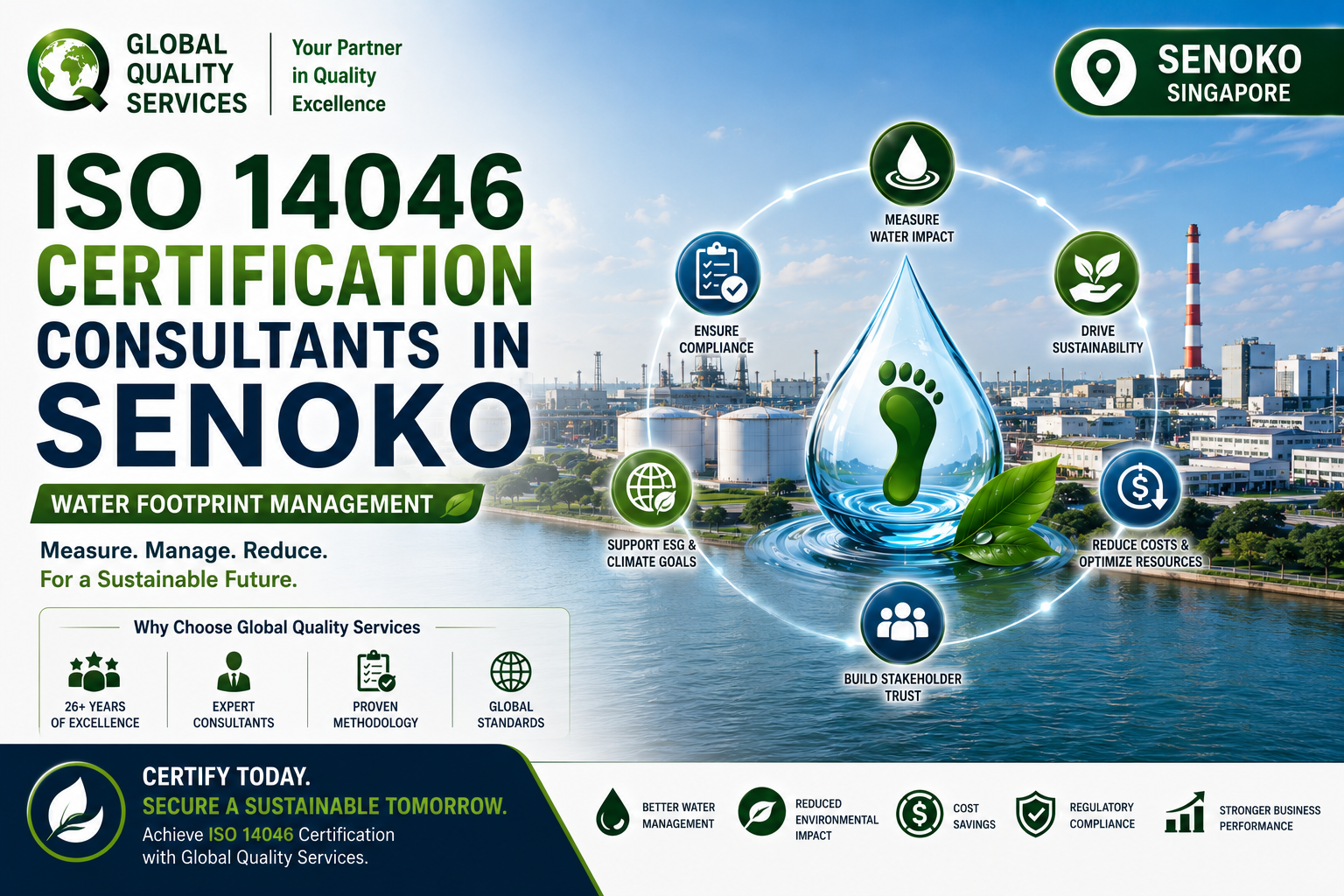
ISO 14046 Certification Consultants in Senoko is the international standard for water footprint assessment. It provides the principles, requirements, and guidelines for measuring and reporting the water impacts of products, processes, and organizations using a Life Cycle Assessment methodology. For Singapore companies operating under PUB’s tightening water efficiency framework, ISO 14046 provides the measurement foundation that turns water management from a general commitment into a quantified, auditable, and credible one.
Global Quality Services supports Singapore companies through the ISO 14046 water footprint assessment and verification process, from initial scoping and data collection through to a verified water footprint report that satisfies ESG disclosure requirements, buyer qualification needs, and PUB regulatory expectations.
Why ISO 14046 Certification Consultants in Senoko Matter
Three developments in 2024 and 2026 have made water footprint assessment a practical business need rather than a sustainability aspiration for Singapore industrial companies.
- PUB’s mandatory water recycling requirements, effective January 2024. Since 1 January 2024, PUB’s Mandatory Water Efficiency Requirements apply to new projects consuming at least 60,000 cubic meters of water annually. Wafer fabrication plants must achieve a minimum recycling rate of 50 percent. Electronics plants and biomedical and pharmaceutical plants must recycle specified waste streams. A verified ISO 14046 water footprint assessment provides a structured, internationally recognized framework for measuring water consumption and demonstrating recycling performance against these thresholds.
- Singapore water prices increased 50 cents per cubic meter over two years. Water tariffs rose in two phases in April 2024 and April 2025. For high-volume water users in semiconductor manufacturing, food production, data centers, and pharmaceuticals, that increase represents a direct and material cost. ISO 14046 identifies where in the production process water is being consumed and at what intensity, giving companies a data-driven basis for targeting efficiency improvements rather than guessing.
- Singapore’s S$97 million investment in water technology innovation. PUB secured funding for a new industrial water research program with two Industrial Water Solutions Innovation Ecosystem Alliances launching during Singapore International Water Week 2026, targeting the wafer fabrication and data center sectors. Companies with verified water footprint data are better positioned to access PUB’s Water Efficiency Fund grants and technology partnerships than those relying on estimated or unverified consumption figures.
What ISO 14046 Certification Consultants in Senoko Covers
ISO 14046:2014 specifies principles, requirements and guidelines related to water footprint assessment of products, processes and organizations based on life cycle assessment (LCA). It provides principles, requirements and guidelines for conducting and reporting a water footprint assessment as a stand-alone assessment, or as part of a more comprehensive environmental assessment.
The assessment covers three levels of scope.
- Product water footprint. Quantifies the water impacts associated with a specific product across its full life cycle, from raw material extraction through manufacturing, use, and end of life.
- Process water footprint. Isolates the water impacts of a specific process or activity within an organization’s operations, without extending to the full product life cycle.
- Organizational water footprint. Covers the total water impacts of an organization’s activities across a defined scope, which may include supply chain water use for organizations with significant upstream water dependency.
Unlike methods that only count the volume used, ISO 14046 incorporates critical variables such as the water availability of the basin, the pressure on ecosystems and the quality of the water returned to the environment after the production process. The result is a single value or a profile of impact indicator results that covers both water scarcity impacts and water quality degradation impacts.
Who Needs ISO 14046 in Singapore
Semiconductor and Wafer Fabrication Companies
Data centers, the rise of artificial intelligence, expanding semiconductor manufacturing, as well as pharmaceutical and medical technology sectors have created unprecedented demands on global water resources. Singapore’s wafer fabrication plants are already subject to PUB’s mandatory 50 percent recycling requirement. ISO 14046 provides these companies with a standardized, third-party-verifiable measurement framework that satisfies both regulatory reporting expectations and water disclosure requirements across their global supply chains.
Data Centres
Singapore’s data centre sector has faced moratoriums and capacity controls directly tied to its energy and water intensity. A verified ISO 14046 water footprint provides quantified evidence of water consumption efficiency that supports ongoing operational approvals and strengthens ESG disclosures required by institutional investors and hyperscaler clients.
Food, Beverage, and Consumer Goods Manufacturers
Food and consumer goods production is among the most water-intensive industrial categories. International buyers and retailers increasingly require verified water footprint data from their Singapore-based suppliers as part of sustainability due diligence, and SGX-listed parent companies face sustainability reporting obligations that require quantified water data at the product or organizational level.
Pharmaceutical and Biomedical Companies
Pharmaceutical manufacturing and biomedical research use significant volumes of high-purity water. ISO 14046 provides a measurement framework that aligns with both PUB’s mandatory waste stream recycling requirements for these sectors and the environmental reporting expectations of global pharmaceutical supply chain audits.
Any Company With ESG Disclosure Obligations
Singapore’s Coordinating Minister for Public Services highlighted that water resilience depends not only on developing water sources but also on managing demand and ensuring the efficient and responsible use of water across all sectors. SGX Mainboard and Catalist-listed companies with ISSB-aligned sustainability reporting requirements need quantified, category-specific water data. ISO 14046 provides the measurement methodology that makes that data auditable rather than estimated.
How ISO 14046 Differs From ISO 46001 and ISO 14001
Understanding which standard applies to your situation is important before engaging a consultant.
- ISO 14046 is a water footprint assessment standard based on Life Cycle Assessment. It produces a quantified measurement of water impacts for a product, process, or organization. It is an assessment and reporting tool, not a management system.
- ISO 46001 is a water efficiency management system standard. It establishes a framework for managing water use within an organization on an ongoing basis, similar to how ISO 14001 manages environmental performance.
- ISO 14001:2026 is an environmental management system standard that covers all significant environmental aspects, including water.
Many Singapore companies use ISO 14046 to generate the verified data they need to populate their ISO 46001 water efficiency targets or their ISO 14001 environmental objectives. Global Quality Services helps you understand which combination of standards applies to your water reporting and management needs before scoping any engagement.
Our ISO 14046 Assessment and Verification Process
Step 1: Goal and scope definition. We confirm whether the assessment covers a product, a process, or the organization, the functional unit for the assessment, and the system boundary, which determines which stages of the product or operational life cycle are included.
Step 2: Life cycle inventory. Water inputs and outputs are mapped across the defined system boundary. For a Singapore manufacturer, this typically includes process water, cooling water, cleaning water, and wastewater discharge, along with upstream supply chain water use where it falls within scope.
Step 3: Water footprint impact assessment. Water consumption and quality data are translated into impact indicators covering both water scarcity and water quality degradation, using the characterization methods specified in ISO 14046.
Step 4: Interpretation and reporting. Findings are reviewed, uncertainties and sensitivities are analyzed, and a water footprint report is prepared in accordance with ISO 14046 reporting requirements.
Step 5: Third-party verification. We support the independent verification of your water footprint report by an accredited third-party verifier, which is required for external reporting purposes including ESG disclosures and buyer qualification.
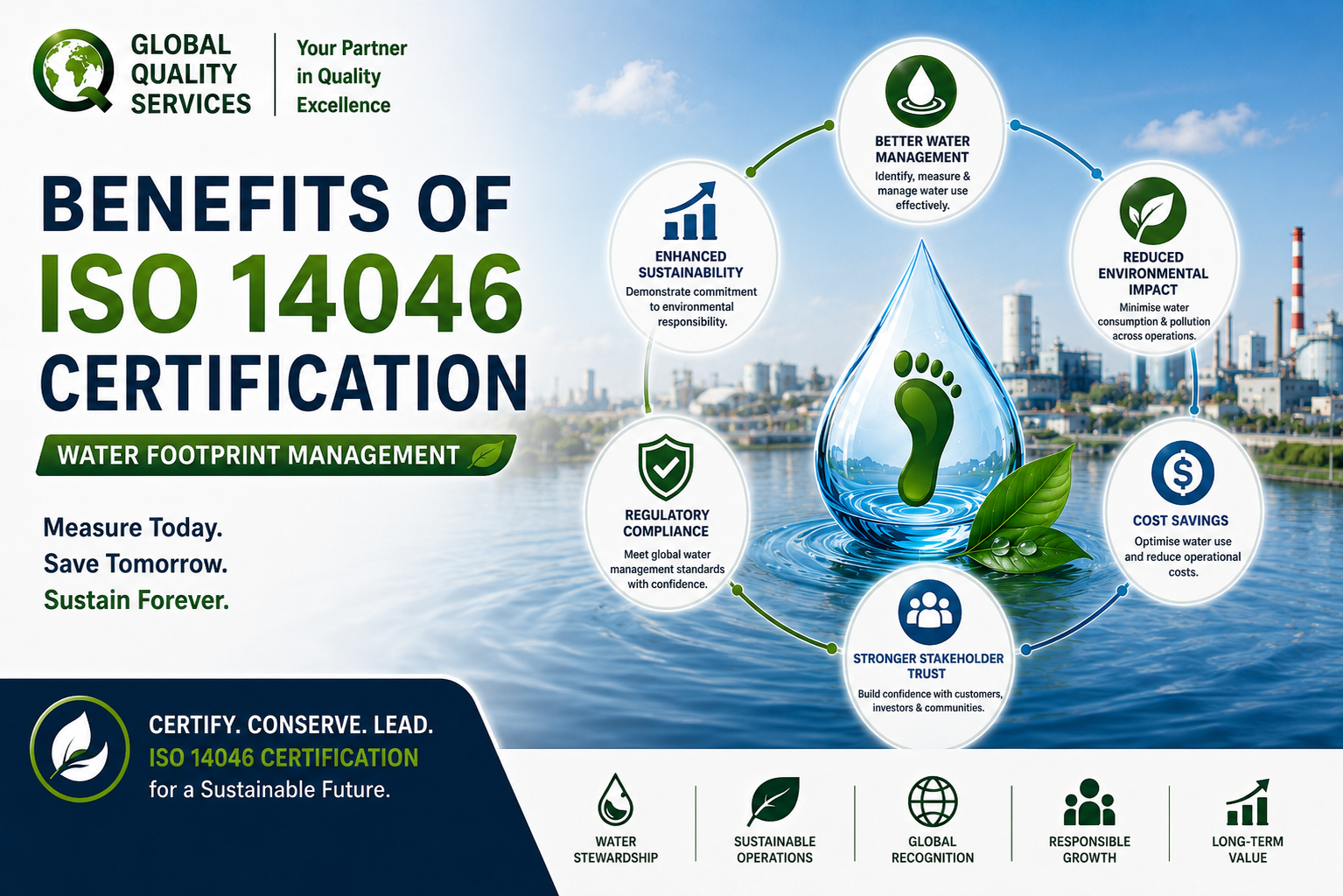
Benefits of ISO 14046 Certification for Singapore Companies
A Verified Number, Not an Estimate
ESG reporting frameworks, buyer due diligence questionnaires, and SGX disclosure requirements are all moving toward third-party verified data rather than self-reported estimates. A verified ISO 14046 water footprint report provides a credible, internationally recognized number rather than a figure that can be challenged in an audit.
Direct Support for PUB Compliance
For companies subject to PUB’s mandatory water-efficiency requirements, an ISO 14046 assessment provides a measurement foundation that quantifies recycling performance, identifies waste streams, and demonstrates compliance in a structured, internationally recognized format.
A Data-Driven Basis for Cost Reduction
With Singapore water prices having risen by 50 cents per cubic meter since 2024, identifying the highest-intensity water use points in a production process has a direct financial return. ISO 14046’s process-level granularity tells you where water is used most intensively, which is where efficiency investments deliver the fastest payback.
Stronger ESG Disclosure and Investor Reporting
Institutional investors, ESG rating agencies, and SGX sustainability reporting requirements all expect quantified water data. ISO 14046 provides the measurement standard that makes that data comparable, credible, and verifiable across reporting periods.
Access to PUB Funding and Innovation Programs
PUB’s Water Efficiency Fund and its new industrial water innovation ecosystem alliances both support companies with documented water use data. A verified ISO 14046 assessment provides exactly that documentation in a format that PUB programs recognize.
Why Choose Global Quality Services
Global Quality Services has supported environmental management and sustainability certification projects across Singapore and the Asia-Pacific region for over two decades. Our ISO 14046 engagements are delivered in direct coordination with your operations, engineering, and sustainability teams, not as a standalone desk exercise disconnected from your actual production processes.
We understand how ISO 14046 sits alongside Singapore’s specific water regulatory requirements, and we regularly integrate water footprint assessment with ISO 14001:2026 environmental management, ISO 46001 water efficiency management, and ESG Reporting for Singapore companies, building a comprehensive environmental management and disclosure picture rather than addressing each standard in isolation.
Contact Global Quality Services to begin your ISO 14046 water footprint assessment in Singapore.
Frequently Asked Questions
What is ISO 14046 and what does it measure?
ISO 14046:2014 is the international standard for water footprint assessment. It measures the potential environmental impacts of water use by a product, process, or organization using a Life Cycle Assessment methodology, covering both water scarcity and water quality degradation impacts.
Is ISO 14046 the same as ISO 46001?
No. ISO 14046 is a water footprint assessment standard that produces a quantified measurement of water impacts. ISO 46001 is a water efficiency management system standard that establishes an ongoing framework for managing water use within an organization. Many Singapore companies benefit from using both together.
Does ISO 14046 help with PUB’s mandatory water efficiency requirements?
Yes. For companies subject to PUB’s mandatory water recycling requirements for wafer fabrication, electronics, and biomedical and pharmaceutical plants, ISO 14046 provides a standardized, internationally recognized measurement framework for quantifying and reporting water consumption and recycling performance.
How long does an ISO 14046 water footprint assessment take?
Most assessments are completed in six to twelve weeks, depending on the scope, the number of products or processes included, and the availability of water consumption data. Organizations with existing water metering and usage records typically move faster.
Is third-party verification of an ISO 14046 water footprint report mandatory?
Third-party verification is not mandated by the standard itself, but it is required for external reporting purposes including ESG disclosures, buyer qualification frameworks, and Singapore sustainability reporting requirements. Global Quality Services coordinates the third-party verification stage as part of every engagement.