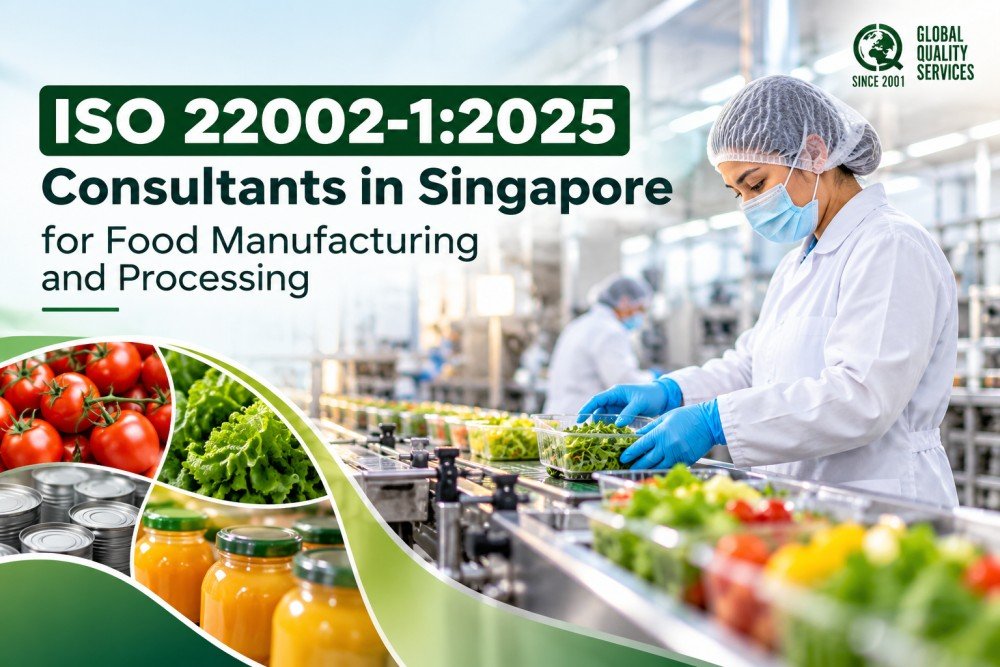
Food manufacturers need to manage risks at every stage of production, from receiving raw ingredients from different suppliers to maintaining hygiene across production lines. ISO 22002-1:2025 Consultants in Singapore can help food manufacturing and processing businesses understand the standard’s prerequisite program requirements and apply suitable controls to prevent contamination.
As per the reports, over 90% of food in Singapore comes from more than 187 countries/regions. Therefore, food manufacturers will want to ensure they are handling ingredients correctly from the suppliers and have good controls in place.
Global Quality Services will work with your food manufacturing and food processing business in Singapore to help you understand the standard and how it can be applied. We will support you to look at your current controls, identify any issues, and ensure your staff are aware of what is required. If your business is looking to improve your food safety controls or get prepared for audits by customers and certification bodies, we can support you to understand what to focus on.
What is ISO 22002-1:2025
ISO 22002-1:2025 provides the requirements for Prerequisite Programs (PRP) for food manufacturing. This includes controls for hygiene in the factory, cleaning, maintenance, pest control, waste management, employee hygiene, and raw material handling. It will depend on the type of food you are manufacturing and the associated risks.
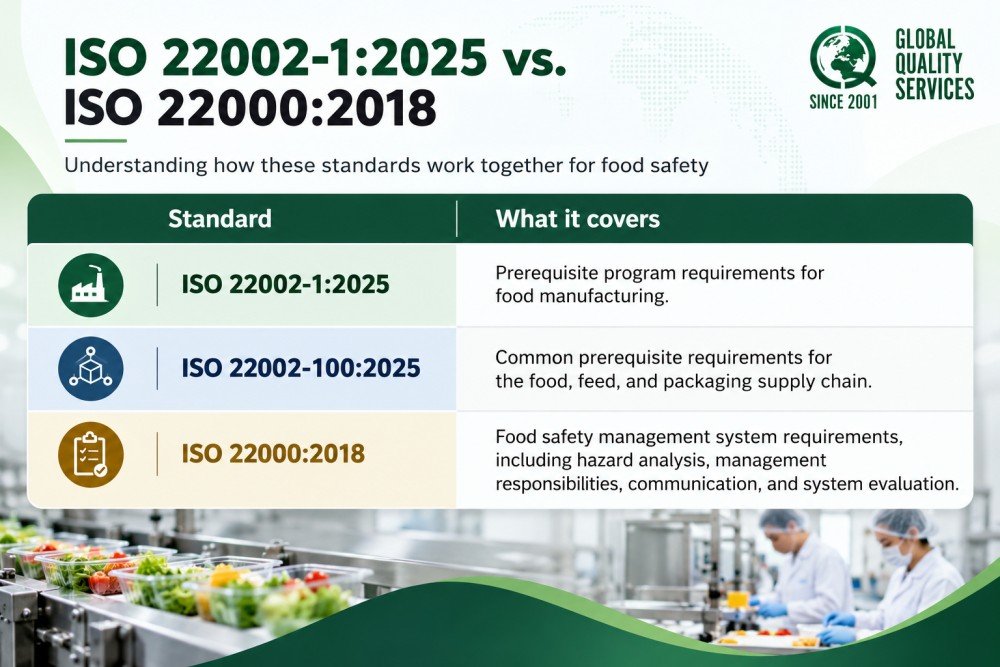
This standard works with ISO 22002-100:2025, which covers general PRP requirements for the food/feed/packaging supply chain. This standard also supports the overall Food Safety Management System under ISO 22000:2018. Understanding the relationship between the standards will help your manufacturing business avoid any issues.
Why Should Food Manufacturers in Singapore Use ISO 22002-1:2025 Certification
Many risks can occur within your production facility. This includes microbiological risk from raw ingredients, cross-contamination from shared equipment, and poor drain maintenance creating hygiene issues. If your staff is not following consistent processes, this can cause additional issues. Using an expert consultant can help you identify any issues. By using Global Quality Services, you can work towards:
- Reducing contamination risks.
- Having clear hygiene and sanitation controls.
- Improved allergen and raw material handling.
- Consistent checks throughout shifts.
- Evidence of controls in place.
- Prepared for customer audits and certification.
- Increased confidence with buyers and distributors.
ISO 22002-1:2025 Certification Requirements in Singapore
This standard focuses on ensuring food safety throughout your manufacturing process. Below are some areas your food business should review when putting together your PRP’s:
1. Layout & Microbiological Zones
The layout of your factory can create risks of contamination between different areas. You will need to consider how your staff, ingredients, equipment, waste, and finished product will move around. Depending on the products you are manufacturing and associated risks, you may need to have controls in place for:
- Raw and ready-to-eat food separated.
- Strict microbiological zones depending on the risk of the product.
- Clearly defined routes for staff, materials and equipment.
- Clean floors, walls, ceilings and work surfaces.
- Correct ventilation.
- Controls to stop contamination between lines.
A raw meat and ready-to-eat food facility may require different zones than a dry stable food product. The controls should be based on the real risks.
2. Cleaning, Sanitation & Maintenance
Microbial growth can occur due to food residue build-up. This is likely to occur in difficult-to-clean areas or where there is moisture build-up. Your cleaning processes should outline what needs to be cleaned, how frequently, and how your staff will check.
Your program may include cleaning schedules, approved chemicals, disassembly of equipment, sanitation checks, and corrective action if cleaning checks fail. Equipment maintenance is also important. Damaged surfaces, loose parts, and poor maintenance can cause contamination risks.
3. Allergens
Cross-contamination of allergens can be a major issue for manufacturers producing a variety of food types. A small amount of an unintentional allergen can make the product unsafe for those with allergies. Your allergen management programme should include:
- Identification and separation of allergens.
- Storage to avoid accidental contact.
- Scheduling to reduce cross-contamination.
- Cleaning and checking of shared equipment.
- Checking ingredients and packaging.
- Accurate labelling of allergens.
4. Physical & Chemical Contamination
Physical contamination can occur from metal, glass, hard plastics, or other foreign objects. Chemical hazards can occur from cleaning products, lubricants, maintenance products, etc.
Manufacturers should consider the risks and put in place controls that work for their equipment and products. This may include checking machinery, having the correct covers, foreign object detection, chemical storage and checks after maintenance. Processes should show how your staff will isolate products.
5. Drainage, Waste & Pest Control
Poor drainage can cause water build-up, bad smells, and encourage microbial growth. Poor waste management can cause pests to be attracted and increase the risk of contamination.
You should consider the direction of drainage and water flow, particularly in wet areas. Ensure the drainage will not cause wastewater to flow into clean areas or exposed products. Waste removal schedules, pest monitoring, building maintenance, and water build-up should be considered as part of your hygienic controls.
6. Receiving Raw Materials & Supplier Controls
You should ensure you have checks in place for your ingredients when they arrive. Poor transportation, damaged packaging, incorrect temperatures, and missing documentation can cause issues. Depending on the type of material, you may have controls in place for:
- Approved suppliers.
- Correct temperatures if applicable.
- Condition of packaging.
- Identification of ingredients and batch numbers.
- Correct documentation from your supplier and test results.
- Reject/suspect separation.
For bulk ingredients, you should have controls in place for access to the receiving area, transfer equipment, and connections to storage. If required, you may need to have locked or secured bulk receiving.
7. Storage, Traceability & Product Handling
Ingredients and finished products should be stored according to their safety and quality requirements. Temperature control, stock rotation, packaging protection and separation should be considered.
Traceability should be in place to help identify affected ingredients and finished batches if there is an issue with your supplier. Having clear batch identification and accurate records will make it easier to answer customer queries and carry out recalls.
ISO 22002-1:2025 Certification Process in Singapore
The amount of work required will depend on your facility, current processes and product risks. We will start by understanding what you currently have. Here is what the complete process looks like:
Step 1: Review Current Processes
We will discuss what products you have, your manufacturing processes, factory layout, current controls, and your certification objectives.
Step 2: Identify Issues
We will review your current processes and documents to identify any gaps in the requirements.
Step 3: Plan Changes
We will help your team prioritise the corrective actions, identify who is responsible, and create a realistic timeframe.
Step 4: Support Implementation & Training
We can support with processes and documentation. We will help your staff understand how to implement the required controls.
Step 5: Review Readiness
We will review the evidence of what has been implemented and any outstanding issues. This means your team can address any gaps prior to the independent certification.
Who Can Benefit From ISO 22002-1:2025 Certification in Singapore
This consultancy will benefit food manufacturers and processors looking to put in place or improve their PRP. This can include:
- Packaged ready-to-eat food manufacturers.
- Meat, poultry & seafood processors.
- Dairy & dairy product manufacturers.
- Bakery & confectionery.
- Beverage manufacturers.
- Frozen & chilled food processors.
- Sauces, spices & ingredients manufacturers.
- Contract & private label manufacturers.
- Suppliers to retailers, distributors and exporters.
We can help identify what areas you need to focus on based on your products, processes, and current food safety processes.
ISO 22002-1:2025 vs ISO 22000:2018
Whilst both standards will help with food safety, they focus on different areas of your management system:
ISO 22002-1:2025 Certification Throughout Singapore
Global Quality Services can provide consultancy support to food manufacturers and processors throughout Singapore. This includes areas such as Jurong, Tuas, Woodlands, Senoko and Changi.
We can discuss what requirements apply to a single production facility or if you have multiple sites. This will depend on your current food safety system, products, and certification objectives. We aim to help your team understand what is required and identify what areas need to be addressed.
How Global Quality Services Experts Can Help You
Global Quality Services is a reputable consultant that can provide management system consultancy, training, assessment, and certification support. We will work with your business to understand what is required and make practical changes. Here are key reasons why you should choose us:
- 26 years of professional consulting experience
- Supported over 1,450 Customers
- Work across 17 locations in Singapore
- Delivered over 1,200 Training Programs
- Experience with multiple management system standards and industries
- Tailored to your business size, operations, and certification objectives
- Support with documentation, staff awareness, and audit preparation
- Practical guidance
We have experience and understand the challenges each facility will face. A food processor with multiple lines may need more support than a smaller manufacturer with a limited range. We will work with your team to identify areas to focus on.
Get Expert Help with Global Quality Services for ISO 22002-1:2025 Certification
If your facility requires a review of your PRP’s, is preparing for a customer assessment, or has food safety certification objectives, Global Quality Services can help you plan what to do next.
Let us know what products you have, your manufacturing processes, current certifications, and target timeframe. We can discuss what level of support your business will require and give you an understanding of what will be required. Our presence across the region means we can support businesses in Singapore, the Philippines, Indonesia, Malaysia, and China. Contact us to discuss your requirements and receive a bespoke proposal.
Frequently Asked Questions
1. What measures can be taken by manufacturers to prevent cross-contact?
Controls can be put in place, such as production planning, separation of ingredients, using validated cleaning processes, and pre-start checks.
2. What should a manufacturer do if there is a failure to control food safety?
The issue needs to be resolved. Affected product needs to be evaluated. Root cause analysis should be completed and corrective actions documented. Affected areas of operation need to be restarted if necessary.
3. Can ISO 22002-1:2025 be used in more than one site?
Yes. A standard process can be used; however, controls will need to be adapted to the products, equipment, and food safety risk of the site.
4. What is the cost of ISO 22002-1:2025 consultancy in Singapore?
The cost depends on the number of facilities, product categories, manufacturing processes, current system, and level of support required. Contact Global Quality Services to discuss your needs and request a quotation.
5. What food safety risks should manufacturers review?
Manufacturers should assess the risks associated with their products and processes. These may include microbial contamination, allergen cross-contact, physical and chemical hazards, poor sanitation, pest activity, and unsuitable storage conditions.