Organizations operating in Cyberjaya rely on digital platforms, connected systems, cloud services, and electronic business records to deliver their products and services. Protecting this information requires more than technical safeguards. Businesses also need clear responsibilities, risk-based controls, and processes to review information security performance.
ISO 27001 Certification in Cyberjaya enables organizations to demonstrate that their Information Security Management System (ISMS) has been assessed against the requirements of ISO/IEC 27001. The standard provides a systematic approach to identifying information security risks, selecting appropriate controls, and continually improving how information is protected.
Global Quality Services provides certification services for organizations seeking an independent assessment of their information security management systems.
Why Cyberjaya Businesses Need a Structured Information Security System
Cyberjaya has developed as a technology hub, with an ecosystem focused on digital businesses, technology development, research, and innovation. This environment creates demand for reliable information security practices among companies that develop software, manage business systems, provide outsourced services, or handle sensitive commercial information.
Security risks can affect organizations of every size. A compromised employee account, an incorrectly configured cloud service, an unavailable business application, or an unprotected backup can disrupt operations and affect customer confidence.
ISO/IEC 27001:2022 helps organizations manage these risks through a formal management system that connects business objectives with information security planning, operational controls, monitoring, and improvement.
The standard may be relevant to:
- IT and software companies protecting source code, product information, development environments, and customer records.
- Cloud and managed service providers responsible for the availability and security of client systems and information.
- Data center operators managing information security risks associated with facilities, systems, personnel, and service continuity.
- Business process outsourcing companies handling customer records, employee information, and confidential business documents.
- Research and development organizations safeguarding intellectual property, project records, and proprietary technical information.
- Corporate and shared service centers managing finance, human resources, procurement, and other internal business information.
- Digital service providers and startups establishing security processes as their operations, customer base, and supplier relationships expand.
The standard is not limited to technology companies. Any organization that needs a systematic way to manage information security risks can consider ISO 27001, regardless of its size or industry.
What Does ISO 27001 Certification Cover?
ISO/IEC 27001:2022 in Cyberjaya, Malaysia specifies requirements for establishing, implementing, maintaining, and continually improving an ISMS. It requires an organization to understand its context, identify relevant risks, set security objectives, and assess whether its management system meets applicable requirements.
The certification scope determines which business activities, locations, systems, and organizational functions are assessed.
Information Security Risk Assessment
Organizations identify risks that could affect the confidentiality, integrity, and availability of information. These risks are evaluated using established criteria, and appropriate treatment actions are selected based on the organization’s circumstances.
Access Control and User Responsibilities
Access to information and systems should reflect legitimate business needs. Organizations establish responsibilities and controls for granting, reviewing, modifying, and removing access as roles and circumstances change.
Asset and Information Management
Information assets need to be identified and managed throughout their lifecycle. Depending on the organization’s operations, these may include databases, laptops, cloud applications, business documents, intellectual property, and backup records.
Supplier and Cloud Security
External service providers can introduce information security risks through their access to systems, data, or business processes. Organizations need suitable processes to assess relevant supplier risks and manage applicable security requirements.
Incident Management and Business Continuity
Organizations establish processes to identify, report, evaluate, and respond to information security incidents. Relevant continuity arrangements help them prepare for disruptions that could affect essential business services.
Monitoring and Continual Improvement
An ISMS needs ongoing evaluation. Internal audits, management reviews, performance monitoring, and corrective actions help determine whether controls remain appropriate and whether identified weaknesses are addressed.
ISO 27001 certification does not mean that every possible security threat has been eliminated. It demonstrates conformity of the assessed management system with the applicable standard requirements within the defined scope.
Benefits of ISO 27001 Certification in Cyberjaya
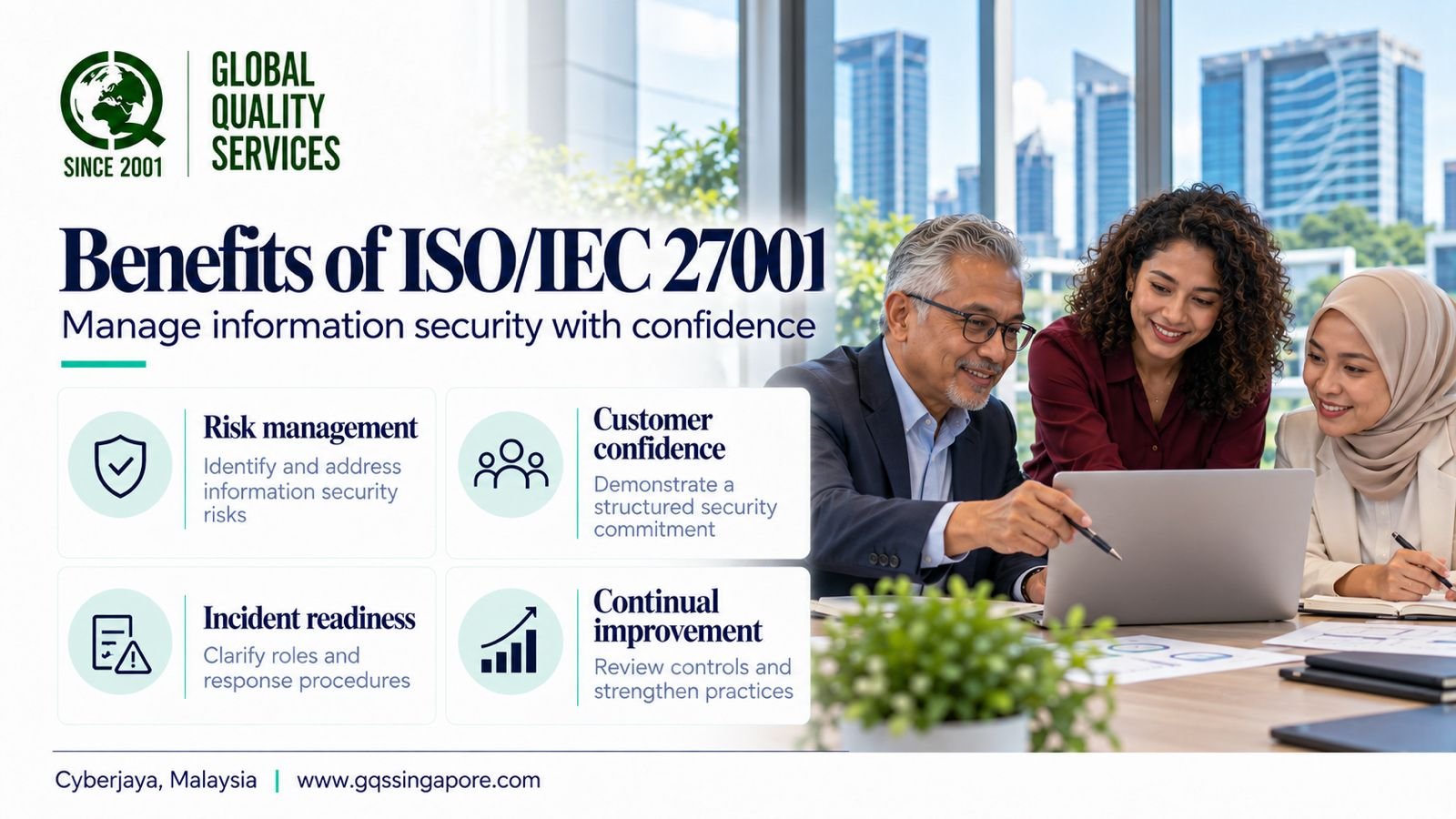
For businesses that depend on digital infrastructure and information-intensive operations, ISO 27001 can provide a consistent framework for managing security responsibilities.
- Structured risk management: A documented process helps organizations identify, assess, and treat information security risks according to defined criteria.
- Protection of business information: Appropriate controls help safeguard confidential records, intellectual property, customer information, and operational data.
- Clear security responsibilities: Defined roles and procedures make accountability more visible across departments and management levels.
- Greater supplier oversight: Organizations can assess risks from external providers and set clear security expectations.
- Customer and partner assurance: A valid certificate can provide evidence that the ISMS within its stated scope has been independently assessed.
- Support for procurement requirements: ISO 27001 certification may be relevant when customers or business partners evaluate information security arrangements during vendor selection.
- Improved operational resilience: Risk assessment and incident planning help organizations prepare for security events and disruptions.
- Continual improvement: Regular monitoring and corrective action help keep the management system aligned with changing business and security risks.
The value of certification depends on the scope selected, the effectiveness of the controls, and the organization’s commitment to maintaining the ISMS after certification.
ISO 27001 and Malaysia’s Personal Data Protection Requirements
Organizations in Cyberjaya that process personal data in commercial transactions should consider the applicable requirements of Malaysia’s Personal Data Protection Act 2010 (Act 709), including relevant amendments and current regulatory requirements.
The Malaysian Personal Data Protection Commissioner identifies principles covering areas such as consent, notice and choice, disclosure, security, retention, data integrity, and access. Organizations should assess which legal requirements apply to their activities and establish appropriate processes to meet them.
ISO/IEC 27001 focuses on information security management. It can help organizations establish risk-based security controls for information they hold or manage, including personal data where relevant. However, ISO 27001 certification does not automatically establish compliance with the PDPA or every other applicable law.
Organizations should review their legal obligations separately and ensure that their information security controls address the risks and responsibilities relevant to their operations.
ISO 27001:2022 and ISO 27001:2013: What Organizations Should Know
ISO/IEC 27001:2022 is the third edition of the standard and replaced the 2013 edition. It includes updated requirements and aligns with the 2022 information security control framework in ISO/IEC 27002.
Organizations establishing a new ISMS should assess their requirements against the 2022 edition. Businesses holding an older certificate should verify its status and any applicable transition or certification-body requirements rather than assuming that an earlier certificate remains valid indefinitely.
The 2022 edition also includes Amendment 1:2024, which introduced climate-action considerations into the harmonized management system standards. Organizations should consider the relevance of climate change to their organizational context and interested parties as required by the amended clauses.
How to Prepare for ISO 27001 Certification in Cyberjaya
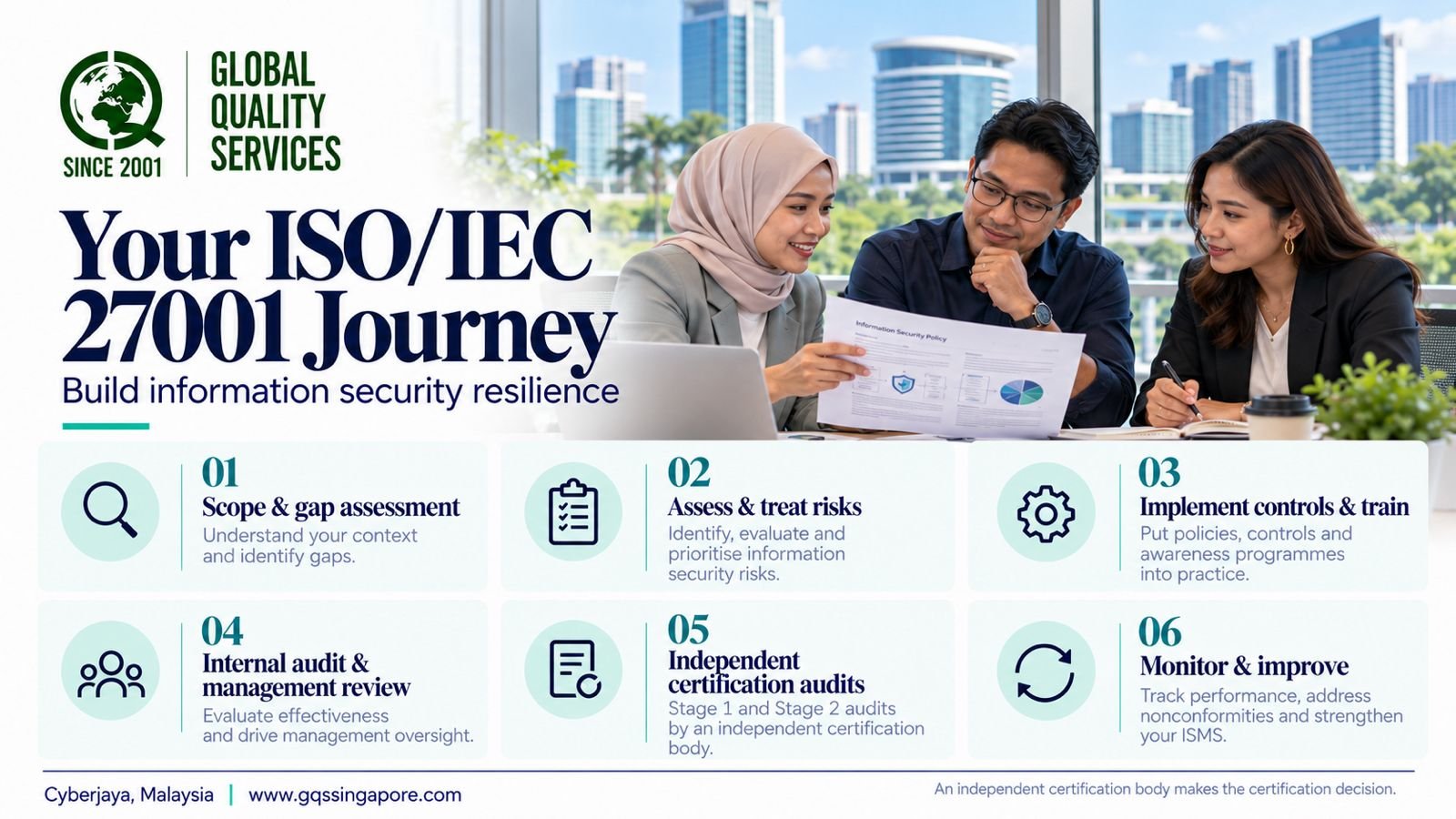
Preparation starts with understanding what the organization needs to protect and setting a realistic ISMS scope.
1. Define the ISMS Scope
Identify the business activities, locations, teams, systems, and information assets to be included. For companies serving clients across multiple locations, clarify the boundaries between the proposed certification scope and activities managed elsewhere.
2. Identify Information Assets and Risks
Determine which information assets are important to the organization and assess the threats and vulnerabilities that could affect them. Consider operational dependencies, supplier relationships, access arrangements, and potential service interruptions.
3. Establish Risk Treatment and Controls
Select suitable measures to address identified risks and document the decisions. The organization should determine which controls are necessary, assign responsibilities, and maintain the required Statement of Applicability and risk treatment information.
4. Implement Policies and Procedures
Develop or update relevant processes covering access management, asset handling, supplier security, incident response, backup, and other applicable information security activities. Procedures should reflect how the organization actually operates.
5. Evaluate ISMS Performance
Conduct internal audits and management reviews as required. Address identified nonconformities and retain appropriate evidence that the management system is implemented and operating effectively.
6. Complete the Certification Assessment
The certification body assesses the ISMS against ISO/IEC 27001 requirements within the agreed scope. Any findings must be addressed through the certification process before certification can be granted.
7. Maintain Certification
After certification, the organization must continue operating the ISMS, review risks, monitor controls, address changes, and meet applicable surveillance and recertification requirements.
Why Choose Global Quality Services for ISO 27001 Certification in Cyberjaya?
Global Quality Services provides certification services for organizations seeking an independent assessment of their management systems. For businesses in Cyberjaya, the ISMS scope should reflect the information assets, operational processes, technology dependencies, and business risks relevant to their activities.
A clear certification scope defines which functions and locations the assessment covers. Organizations should also verify the certification body’s applicable accreditation and scope when choosing a provider.
Contact Global Quality Services to discuss ISO 27001 Certification in Cyberjaya and determine the appropriate certification scope for your organization.
Frequently Asked Questions
1. Can a software company in Cyberjaya include its development and production environments in one ISO 27001 scope?
Potentially, yes. The organization should define the relevant development and production activities, systems, teams, and supporting processes. The proposed scope must be clear enough for the certification body to assess the ISMS and its applicable controls.
2. Does ISO 27001 certification cover a company’s cloud infrastructure automatically?
No. Cloud infrastructure and related services are covered only to the extent that they fall within the defined ISMS scope and are addressed by the organization’s management system. The company should identify its responsibilities, relevant cloud services, supplier arrangements, and associated risks.
3. Is ISO 27001 useful for an outsourcing company handling overseas clients’ data?
It can be relevant. An outsourcing provider may use an ISMS to manage risks involving client information, employee access, service delivery systems, and third-party dependencies. The scope should reflect the actual services and information handled, including applicable contractual security requirements.
4. What is the difference between an ISO 27001 certificate and a cybersecurity assessment?
An ISO 27001 certificate indicates that a defined ISMS has been assessed against the standard’s requirements. A cybersecurity assessment may examine particular systems, vulnerabilities, technical configurations, or security threats. The two activities serve different purposes and are not interchangeable.
5. Can a small business in Cyberjaya apply for ISO 27001 certification?
Yes. ISO/IEC 27001 is designed to be applicable to organizations of different sizes and sectors. A small business should establish a scope that reflects its activities and risks while ensuring that all applicable requirements are addressed.