
Businesses in Changi Business Park depend on connected systems, making cybersecurity essential. Singapore’s Cyber Security Agency reported that almost nine in ten surveyed organisations experienced at least one cyber incident in 2025.
ISO 27032 guidance helps businesses address cyber threats, strengthen security practices, and improve incident response. However, ISO/IEC 27032 is not a standalone certifiable management system standard. Hiring an experienced consultant helps your organisation assess security gaps, apply relevant guidance, and develop practical cybersecurity measures suited to its operations.
What Does ISO/IEC 27032 Mean for Your Business?
ISO/IEC 27032 guides cybersecurity, including the protection of activities and interactions across cyberspace. It addresses security concerns involving people, processes, information systems, and interconnected digital environments.
The standard recognises that cybersecurity requires cooperation between different stakeholders. An organisation may have internal security policies, but cyber threats can also involve suppliers, service providers, networks, and external platforms.
For businesses in Changi Business Park, ISO 27032 consulting can help teams understand these connections and improve how they prevent, identify, and respond to cyber threats.
One important distinction is that ISO/IEC 27032 is guidance rather than a standalone certifiable management system standard. Organisations should verify the applicable assessment or recognition scheme before advertising themselves as ISO 27032 certified. Businesses seeking formal information security management system certification may also consider ISO/IEC 27001.
Why Cybersecurity Matters for Companies in Changi Business Park
Changi Business Park supports businesses across technology, financial services, research, logistics, and other knowledge-intensive sectors. These organisations often exchange confidential information through digital platforms and third-party systems.
A cyber incident can interrupt operations, expose customer information, and damage business relationships. ISO/IEC 27032 consulting helps companies examine how their systems connect and where security weaknesses may emerge.
Here are several reasons to consider cybersecurity guidance for your organisation:
- Protect confidential information: Identify weaknesses in how your teams handle customer records, business documents, and sensitive digital information.
- Strengthen internet security: Review risks associated with websites, online applications, connected systems, and internet-based services.
- Improve incident coordination: Clarify responsibilities when your organisation detects suspicious activity or experiences a cybersecurity incident.
- Manage third-party risks: Examine how vendors, service providers, and external partners affect your security posture.
- Support customer confidence: Demonstrate a structured approach to cybersecurity when discussing security expectations with customers and business partners.
Step by Step Process for ISO 27032 Certification in Changi Business Park
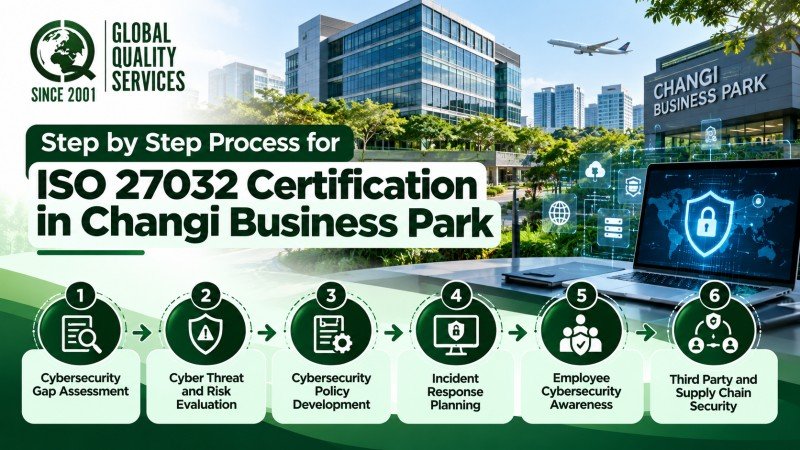
An ISO 27032 consultant can help your organisation interpret the standard’s guidance and apply it to real business operations. The consultant reviews your current security practices and recommends improvements based on your risks, systems, and business objectives.
1. Cybersecurity Gap Assessment
A gap assessment compares your existing cybersecurity practices with relevant ISO/IEC 27032 guidance. Consultants examine your policies, technical safeguards, access controls, and incident response arrangements to identify areas that need attention.
The assessment also helps your team prioritise improvements according to business impact and security exposure.
2. Cyber Threat and Risk Evaluation
Cyber threats can affect different parts of your organisation. A consultant helps identify risks involving phishing, malware, unauthorised access, insecure applications, and third-party connections.
Your team can then evaluate these risks and select appropriate measures to reduce exposure.
3. Cybersecurity Policy Development
Clear policies help employees understand their security responsibilities. Consultants can assist with developing or updating guidelines for acceptable internet use, account security, information handling, incident reporting, and secure communication.
These policies should reflect your actual operations rather than rely on generic documentation.
4. Incident Response Planning
A delayed response can make a cybersecurity incident harder to control. Consultants help organisations define reporting channels, escalation procedures, response responsibilities, and communication arrangements.
Your team can also conduct tabletop exercises to practise its response to realistic cyber incidents.
5. Employee Cybersecurity Awareness
Employees play an important role in protecting business information. Consultants can help develop awareness sessions covering phishing emails, suspicious links, password security, social engineering, and safe handling of confidential information.
Regular training helps employees recognise threats and report suspicious activity promptly.
6. Third Party and Supply Chain Security
Your organisation may depend on cloud providers, software vendors, outsourced IT teams, and other external partners. Consultants can help you assess these relationships and establish suitable security expectations.
This work can include reviewing vendor access, information sharing arrangements, incident notification procedures, and contractual security requirements.
How to Apply ISO 27032 Guidance in Your Organisation
A practical implementation process helps your team turn cybersecurity recommendations into everyday practices. The exact activities depend on your existing controls, business risks, and the standards or regulations relevant to your organisation.
- Understand your business environment: Identify the digital services, information assets, business processes, and external relationships that affect your cybersecurity requirements.
- Review current security practices: Assess existing policies, technical safeguards, employee awareness, incident response arrangements, and third-party security measures.
- Identify gaps and prioritise risks: Document weaknesses and rank them according to potential impact, likelihood, operational importance, and available resources.
- Implement suitable improvements: Update policies, strengthen access controls, improve monitoring, train employees, and establish clear incident reporting procedures.
- Test your response arrangements: Use simulations, internal reviews, and incident response exercises to evaluate how effectively your teams handle security events.
- Review and improve controls: Reassess your cybersecurity measures regularly and update them when your systems, suppliers, threats, or business requirements change.
ISO 27032 and ISO 27001: Which Approach Should You Consider?
Businesses often explore both standards because they address related but different cybersecurity needs.
| Area | ISO/IEC 27032 | ISO/IEC 27001 |
|---|---|---|
| Main focus | Guidance on cybersecurity and internet security | Requirements for an information security management system |
| Primary purpose | Improve understanding and coordination of cybersecurity risks | Establish, maintain, and continually improve an ISMS |
| Certification | Not a standalone certifiable management system standard | Supports formal certification through an appropriate certification body |
| Business application | Helps address internet security concerns and stakeholder coordination | Supports systematic management of information security risks |
The two standards can complement each other. ISO/IEC 27032 can help your organisation address broader cybersecurity concerns, while ISO/IEC 27001 provides a formal management system for information security.
Your organisation should select its approach based on customer requirements, risk exposure, contractual obligations, and business objectives.
What Affects the Cost of ISO 27032 Consulting in Changi Business Park?
The cost of ISO 27032 consulting depends on the scope of work rather than a universal certification fee. Since ISO/IEC 27032 does not offer standalone management system certification, ask consultants to specify the exact deliverables included in their proposal.
Several factors can influence the overall consulting cost:
- Company size: Larger organisations may need more interviews, documentation reviews, and coordination.
- IT infrastructure: Complex networks, cloud environments, and interconnected applications may require additional assessment.
- Existing security controls: Organisations with established policies may need fewer changes than those starting from scratch.
- Consulting scope: A gap assessment costs differently from a wider engagement covering policy development, training, and incident response exercises.
- Additional standards: Organisations pursuing ISO/IEC 27001 certification may need separate implementation and certification activities.
Request a tailored quotation that lists assessment activities, deliverables, implementation support, and any external audit or certification fees separately.
How Long Does ISO 27032 Implementation Take?
The implementation timeline depends on your organisation’s size, security maturity, and the complexity of its IT environment. A business with established security controls may complete a focused assessment and improvement project faster than an organisation that needs extensive policy development and technical changes.
Your consultant should define milestones for the initial assessment, risk prioritisation, policy updates, employee training, and validation exercises.
If your organisation also plans to pursue ISO/IEC 27001 certification, allow additional time for establishing and operating the information security management system and completing the applicable certification audit.
Why Choose Global Quality Services for ISO 27032 Consulting in Changi Business Park
Global Quality Services can support your organisation in understanding relevant cybersecurity guidance and identifying practical improvements. A suitable consulting engagement should reflect your business operations, existing controls, customer expectations, and security priorities.
Whether you operate a financial services company, technology business, logistics organisation, or professional services firm in Changi Business Park, focus on solutions that match your actual security requirements.
Ready to strengthen your cybersecurity practices in Singapore, Malaysia, China, Indonesia and Philippines? Contact Global Quality Services to discuss your requirements and explore a consulting approach tailored to your organisation. Confirm the applicable assessment and certification arrangements before making any certification claims.
Frequently Asked Questions
1. Can a small business in Changi Business Park benefit from ISO 27032 guidance?
Yes. Small businesses can apply relevant guidance to internet security, employee practices, supplier relationships, and incident handling without adopting every measure used by larger enterprises.
2. Does ISO 27032 guidance cover cybersecurity risks involving cloud applications?
Yes. Organisations can use its guidance to examine internet security concerns involving connected services, although specific cloud security requirements may require additional standards and technical controls.
3. Who should oversee ISO 27032 implementation within a company?
A cybersecurity lead, IT manager, or designated risk owner can coordinate the work, involving legal, human resources, procurement, and operational teams whenever their responsibilities affect security.
4. Can a company use ISO 27032 guidance when selecting cybersecurity vendors?
Yes. Procurement teams can use relevant guidance to structure security questions, review vendor practices, and identify risks, alongside contractual requirements and appropriate supplier assessment methods.
5. How often should businesses review their ISO 27032 related cybersecurity practices?
Review practices at planned intervals and after significant system changes, security incidents, supplier changes, or emerging threats to keep controls relevant to your organisation’s evolving risks.