Workplace safety remains a priority for Singapore businesses across industries. According to the Ministry of Manpower, Singapore recorded 21 workplace fatalities in the first half of 2026, while the major injury rate reached 14.6 per 100,000 workers.
ISO 45001:2018 helps organisations identify workplace hazards, control occupational risks, and protect employees. It also strengthens safety procedures and regulatory compliance. However, implementing the standard requires proper planning and documentation. Hiring an experienced ISO 45001 consultant helps your business identify gaps, implement requirements, and prepare for certification audits.
What is ISO 45001:2018 Certification
ISO 45001:2018 is an international standard for Occupational Health and Safety Management Systems (OHSMS). It helps organisations identify workplace hazards, assess safety risks, and prevent work-related injuries and illnesses.
The standard follows a risk-based approach. It encourages businesses to involve employees, strengthen safety procedures, and review workplace conditions regularly.
ISO 45001:2018 applies to organisations of all sizes and industries. Companies in Singapore can use it to improve workplace safety and demonstrate their commitment to employee wellbeing.
Why is ISO 45001:2018 Certification Important in Singapore
Singapore has strict workplace safety expectations across industries. Employers must comply with the Workplace Safety and Health (WSH) Act and take appropriate steps to protect employees.
ISO 45001:2018 helps businesses manage these responsibilities through documented procedures and regular safety assessments.
Here is why certification matters:
- Reduces workplace accidents: Businesses can identify hazards early and introduce suitable controls before incidents occur.
- Supports legal compliance: The standard helps organisations manage applicable workplace safety and health obligations.
- Strengthens employee confidence: Employees feel more confident when employers actively address workplace hazards and safety concerns.
- Improves operational control: Clear safety procedures help teams manage daily activities with fewer disruptions.
- Supports business opportunities: Certification can strengthen your position when clients evaluate suppliers and contractors.
- Builds a safety-focused culture: Employees and management share responsibility for maintaining safer working conditions.
Benefits of ISO 45001:2018 Certification
ISO 45001:2018 offers practical benefits beyond meeting workplace safety expectations. It helps businesses build consistent safety practices and improve their overall performance.
1. Better Workplace Hazard Management
The standard helps organisations identify physical, chemical, biological, and ergonomic hazards. Businesses can assess associated risks and introduce suitable preventive measures.
2. Fewer Workplace Injuries and Incidents
Regular risk assessments and safety inspections help organisations identify unsafe conditions. Employees can follow established procedures and report potential hazards before accidents occur.
3. Improved Employee Participation
ISO 45001 encourages businesses to involve workers in safety discussions. Employees can share concerns, suggest improvements, and participate in workplace safety initiatives.
4. Stronger Regulatory Compliance
Businesses can identify applicable Singapore WSH legislation and monitor their compliance obligations. This approach helps management address regulatory requirements more consistently.
5. Reduced Business Disruptions
Workplace accidents can interrupt operations and increase compensation, investigation, and recovery costs. Better safety controls help businesses reduce these disruptions.
6. Enhanced Business Reputation
ISO 45001 certification demonstrates your commitment to occupational health and safety. It can strengthen customer confidence and improve your credibility with business partners.
7. Better Management Accountability
The standard assigns clear responsibilities to management and employees. Regular reviews help leadership monitor safety performance and take corrective action when necessary.
Step-by-Step Process to Get ISO 45001:2018 Certification in Singapore
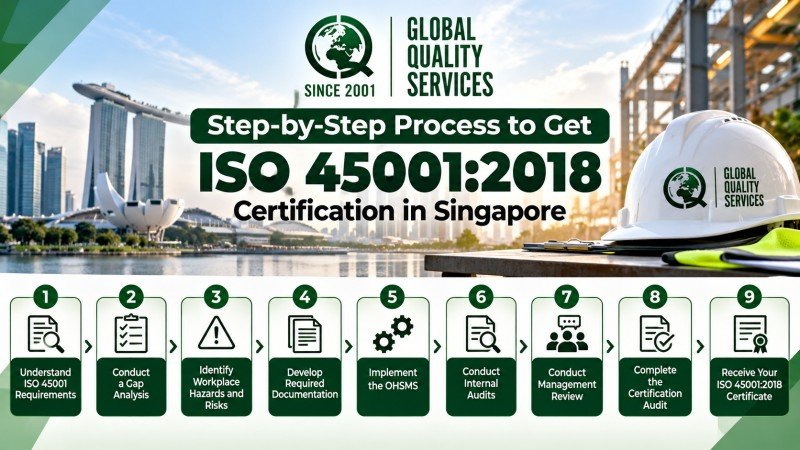
Getting ISO 45001:2018 certified requires proper planning, implementation, and independent assessment. Follow these steps to establish an effective Occupational Health and Safety Management System.
Step 1: Understand ISO 45001 Requirements
Start by reviewing ISO 45001:2018 requirements and understanding how they apply to your business activities. Identify your operational boundaries, employee responsibilities, and occupational health and safety objectives.
Step 2: Conduct a Gap Analysis
Review your existing workplace safety practices against ISO 45001 requirements. Identify missing procedures, weak controls, documentation gaps, and areas that need improvement.
Step 3: Identify Workplace Hazards and Risks
Assess workplace activities to identify potential hazards. Evaluate associated risks, including physical injuries, chemical exposure, equipment failures, and ergonomic issues. Establish appropriate control measures.
Step 4: Develop Required Documentation
Prepare the policies, procedures, registers, and records needed for your OHSMS. Document risk assessments, legal obligations, emergency arrangements, safety responsibilities, and operational controls.
Step 5: Implement the OHSMS
Put the documented procedures into practice across your organisation. Introduce safety controls, communicate responsibilities, conduct employee training, and maintain records of workplace safety activities.
Step 6: Conduct Internal Audits
Evaluate your implemented OHSMS through internal audits. Check whether employees follow established procedures and identify nonconformities that require corrective action.
Step 7: Conduct Management Review
Management should review the OHSMS and assess its overall performance. Discuss audit findings, safety incidents, objectives, employee feedback, and opportunities for improvement.
Step 8: Complete the Certification Audit
An accredited certification body conducts an independent audit to evaluate your OHSMS. The assessment generally includes two stages:
- Stage 1 Audit: Auditors review your documentation, organisational readiness, and understanding of ISO 45001 requirements.
- Stage 2 Audit: Auditors evaluate the actual implementation and effectiveness of your occupational health and safety management system.
Step 9: Receive Your ISO 45001:2018 Certificate
Once your organisation addresses any audit nonconformities and meets certification requirements, the certification body can issue your certificate.
Maintain your OHSMS through regular monitoring, surveillance audits, and continual improvement.
Documents Required for ISO 45001:2018 Certification
Your organisation must maintain relevant documents and records to demonstrate effective implementation of its Occupational Health and Safety Management System.
The following documents commonly support ISO 45001 certification:
- Occupational Health and Safety Policy
- OHSMS scope and boundaries
- Workplace hazard identification and risk assessment records
- Legal and regulatory compliance register
- Occupational health and safety objectives
- Employee roles and responsibilities
- Competence and training records
- Employee consultation and participation records
- Operational control procedures
- Emergency preparedness and response procedures
- Incident investigation reports
- Workplace inspection records
- Monitoring and measurement records
- Internal audit programme and reports
- Management review records
- Nonconformity and corrective action records
- Contractor and supplier safety records
- Equipment maintenance and safety inspection records
Why Choose Global Quality Services for ISO 45001:2018 Certification in Singapore
Choosing the right consultant can make your certification journey easier. Global Quality Services (GQS) works with businesses to develop practical management systems that match their operational requirements.
Here is why businesses should partner with GQS:
1. Experienced Certification Consultants
Our consultants understand ISO 45001 requirements and workplace safety practices. We help businesses identify gaps and develop suitable solutions for their operations.
2. Industry-Specific Guidance
Every industry faces different workplace hazards. We consider your business activities, operational risks, and safety requirements when recommending implementation measures.
3. Complete Implementation Support
We guide your team through gap analysis, documentation, employee training, internal audits, and certification audit preparation.
4. Practical Documentation Assistance
Our team helps prepare relevant policies, procedures, risk assessments, and safety records. We focus on documentation that supports your actual workplace activities.
5. Support During Certification Preparation
We help your organisation understand audit requirements and address identified gaps before the certification assessment.
6. Regional Certification Support
GQS supports businesses across Singapore and other Asian markets. Our regional presence helps organisations access certification consulting services for their operational requirements.
Build a safer workplace with GQS. Contact our consultants today to discuss your ISO 45001:2018 certification requirements in Singapore.
Frequently Asked Questions
1. How long does it take to obtain ISO 45001 certification?
Most organisations take around three to six months, depending on their workforce size, operational complexity, existing safety practices, documentation, and audit readiness.
2. Is ISO 45001 certification mandatory for companies in Singapore?
ISO 45001 certification is generally voluntary. However, Singapore employers must meet applicable Workplace Safety and Health legal obligations regardless of certification status.
3. Can small businesses apply for ISO 45001:2018 certification?
Yes, small businesses can pursue certification. The standard applies to organisations of all sizes, provided they establish and maintain an effective occupational health and safety management system.
4. How long does an ISO 45001:2018 certificate remain valid?
An ISO 45001 certificate typically remains valid for three years. Organisations must undergo surveillance audits during this period and complete recertification before expiry.
5. Can a company integrate ISO 45001 with ISO 9001 and ISO 14001?
Yes, organisations can integrate all three standards through a common management system. This approach helps coordinate quality, environmental, and occupational health and safety processes.