Businesses operating digital platforms, payment systems, and technology services must protect payment card information against unauthorized access, misuse, and security breaches. For organizations that store, process, or transmit cardholder data, the Payment Card Industry Data Security Standard (PCI DSS) establishes security requirements for protecting payment account information.
Cyberjaya’s technology and digital services ecosystem includes IT service providers, software companies, fintech businesses, e-commerce platforms, and organizations delivering services to international clients. Businesses in these sectors may need to demonstrate that their payment environments meet applicable PCI DSS requirements.
Global Quality Services (GQS) provides PCI DSS-related compliance services to help organizations understand applicable requirements, review their existing security arrangements, identify gaps, and prepare for the relevant compliance validation process.
Why Do Businesses in Cyberjaya Need PCI DSS Compliance?
Organizations that handle payment card information must consider how they collect, transmit, store, access, and protect data throughout the payment process. Security weaknesses in applications, networks, access controls, or third-party arrangements can expose payment data to unauthorized access.
For Cyberjaya-based businesses, payment security may be particularly relevant when providing digital products, managing online transactions, hosting customer environments, or processing payments on behalf of other companies.
PCI DSS assessment applies to entities that store, process, or transmit cardholder data or sensitive authentication data, as well as entities whose systems can affect the security of the cardholder data environment. The applicable validation requirements depend on the organization’s role and the compliance program established by the relevant payment brands, acquirer, or other governing entity.
Protect Payment Card Information
PCI DSS establishes technical and operational requirements designed to protect payment account data. These requirements help organizations establish appropriate safeguards for systems and processes involved in payment card handling.
Meet Customer and Payment Partner Requirements
Merchants and service providers may be required to demonstrate PCI DSS compliance by payment partners, acquiring banks, customers, or contractual arrangements. Maintaining the appropriate validation documentation can help organizations meet these expectations.
Address Security Risks in Digital Payment Environments
Online transactions involve applications, networks, access credentials, databases, and external service providers. A structured compliance approach helps organizations assess security controls across the systems relevant to their payment activities.
Strengthen Confidence in Payment Operations
Organizations that can demonstrate appropriate payment security practices are better positioned to explain how they manage payment data risks to clients, business partners, and other stakeholders.
Which Businesses in Cyberjaya Should Consider PCI DSS Compliance?
PCI DSS is relevant to organizations involved in payment card processing or systems that can affect the security of cardholder data. The exact requirements depend on the services provided, the payment environment, and the organization’s role in the payment chain.
Fintech and Digital Payment Providers
Payment technology companies may operate transaction platforms, payment applications, or supporting systems that process cardholder information. These businesses need to understand which PCI DSS requirements apply to their services and infrastructure.
E-Commerce and Online Retail Businesses
Online stores and digital marketplaces may accept card payments directly or use external payment service providers. Their compliance scope depends on how payments are handled, how their websites interact with payment systems, and whether their environments can affect payment security.
IT and Managed Service Providers
Companies managing networks, infrastructure, applications, or security services for payment-related environments may fall within PCI DSS scope when their services can affect the security of cardholder data.
Software and SaaS Companies
Software providers that develop, host, or operate payment-related applications may need to consider PCI DSS requirements applicable to their products and service delivery arrangements. Their responsibilities depend on whether they store, process, transmit, or otherwise affect the security of payment account data.
Data Centres and Cloud Service Providers
Providers supporting payment environments may need to demonstrate compliance with applicable requirements for the services they deliver. Customers and providers should clearly establish their respective responsibilities, particularly where payment systems operate across shared or hosted infrastructure.
Business Process Outsourcing and Contact Centres
Organizations handling payment transactions through customer support, billing, or outsourced operational services may be exposed to cardholder data. They should determine whether their people, processes, and systems fall within the applicable PCI DSS scope.
What Does PCI DSS Compliance Cover?
PCI DSS provides a baseline of technical and operational requirements for protecting payment account data. The current published standard is PCI DSS v4.0.1, which was released in June 2024 as a limited revision of v4.0.
The standard organizes its requirements around six principal security objectives.
1. Build and Maintain Secure Networks and Systems
Organizations must establish and maintain appropriate network security controls and secure configurations for systems within scope. This includes managing the security of network connections and system components that form part of, or affect, the cardholder data environment.
2. Protect Account Data
Requirements address the protection of stored account data and the use of strong cryptography when transmitting cardholder data across open, public networks. Organizations should understand where payment data resides and how it moves through their systems.
3. Maintain a Vulnerability Management Program
Security weaknesses can expose payment environments to attack. PCI DSS addresses malicious software protection, secure software development and maintenance, and vulnerability management activities relevant to the systems in scope.
4. Implement Strong Access Control Measures
Access to system components and cardholder data must be restricted according to business need. Requirements address user identification, authentication, and access control so that permissions are appropriately assigned and managed.
5. Monitor and Test Networks Regularly
Organizations must monitor access to network resources and cardholder data and regularly test the security of their systems and networks. Logging, monitoring, vulnerability scanning, and penetration testing may form part of the applicable assessment requirements.
6. Maintain an Information Security Policy
PCI DSS also requires an information security policy and supporting organizational practices. Responsibilities, risk management activities, personnel awareness, and service provider oversight help maintain security beyond individual technical controls.
The precise requirements applicable to an organization depend on its PCI DSS scope, role, and validation method. The official PCI Security Standards Council documentation should be consulted when determining the controls and evidence required for a specific environment.
Benefits of PCI DSS Compliance
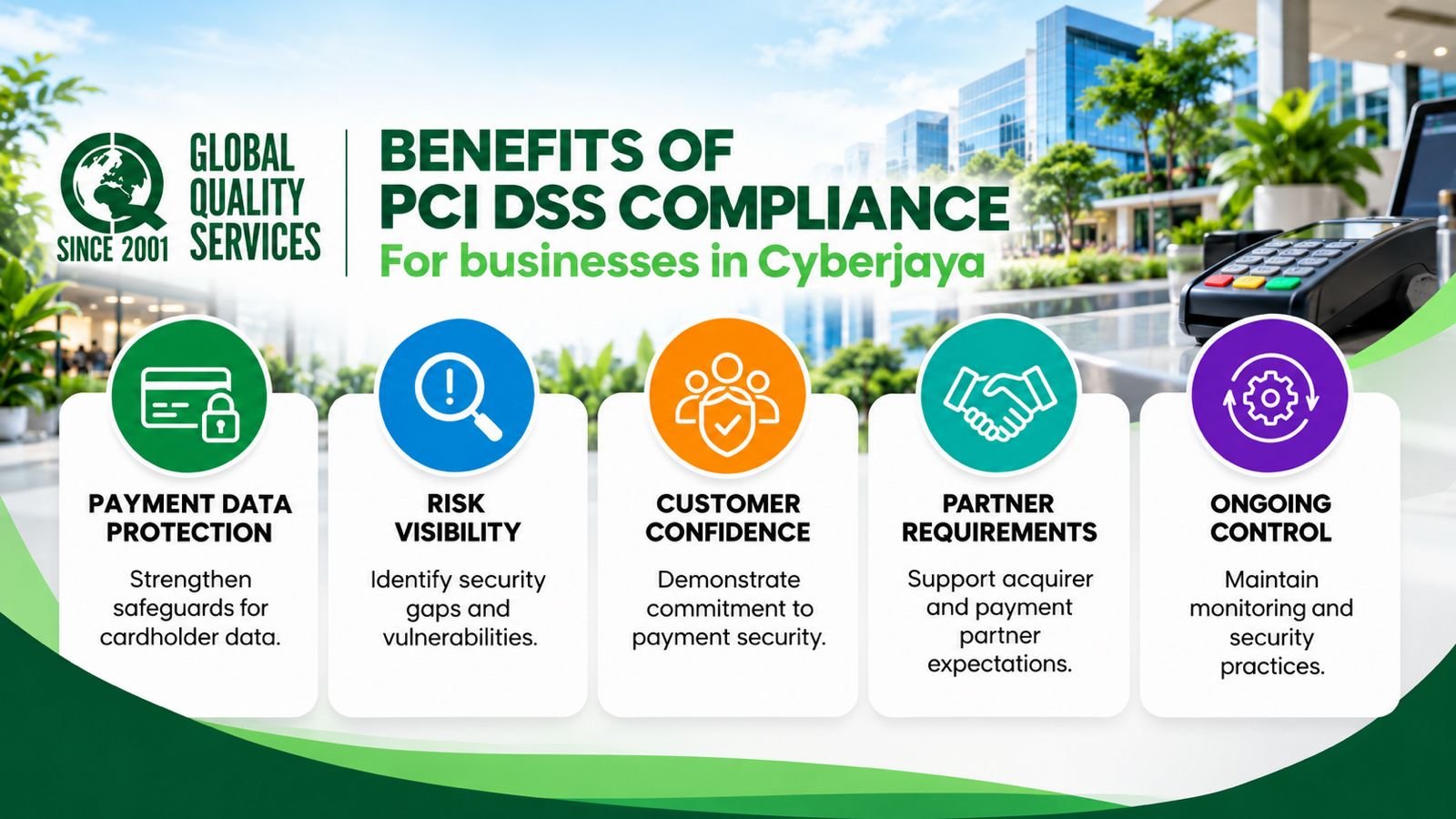
PCI DSS compliance provides organizations with a structured basis for protecting payment account information and demonstrating that applicable security requirements have been addressed. Its value extends beyond a single assessment because payment security depends on controls being maintained as systems, services, and threats change.
1. Reduces Exposure of Payment Data
Appropriate security controls help protect cardholder data against unauthorized access and misuse. Identifying weaknesses in systems, applications, and access arrangements can reduce avoidable exposure within the payment environment.
2. Strengthens Access and Security Controls
PCI DSS establishes requirements for authentication, access restrictions, monitoring, and system security. Implementing these controls helps organizations manage who can access critical systems and how that access is monitored.
3. Supports Payment Partner Requirements
Acquirers, payment brands, customers, and contractual partners may require evidence of compliance. Maintaining the appropriate validation documents can help organizations respond to these requirements and avoid uncertainty about their compliance status.
4. Improves Visibility Across Payment Systems
Determining PCI DSS scope requires organizations to understand where payment data is handled and which systems can affect its security. This process can reveal overlooked connections, third-party dependencies, and areas that require stronger controls.
5. Encourages Ongoing Security Management
PCI DSS includes requirements for monitoring, testing, vulnerability management, and maintaining security policies. These activities help organizations keep payment security under review rather than treating compliance as a one-time exercise.
6. Builds Trust With Customers and Business Partners
Demonstrating that applicable payment security requirements have been validated can provide customers and business partners with greater confidence in an organization’s payment handling arrangements.
Important: PCI DSS compliance does not guarantee that a security incident will never occur. Organizations must maintain effective controls and follow the applicable validation and reporting arrangements.
PCI DSS Compliance Process in Cyberjaya
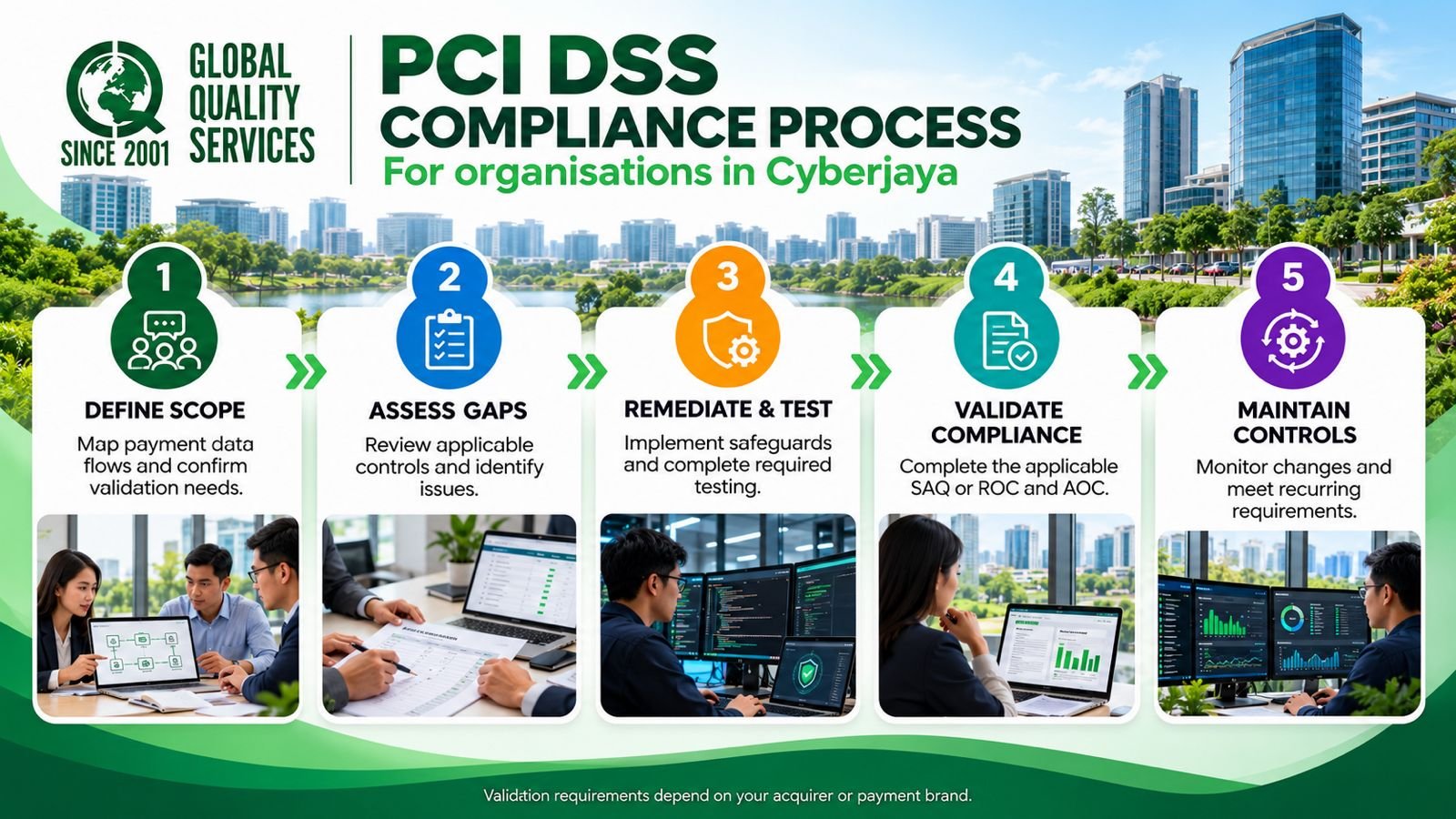
Preparing for PCI DSS compliance requires an understanding of the payment environment, the applicable validation requirements, and the evidence needed to demonstrate that relevant controls are operating effectively. GQS can work with organizations on agreed compliance preparation activities before the applicable validation process.
Step 1: Determine the PCI DSS Scope
Identify the systems, applications, network connections, personnel, and service providers involved in storing, processing, or transmitting cardholder data or affecting the security of the cardholder data environment.
Accurate scoping helps prevent relevant systems from being overlooked and provides a clearer basis for selecting the applicable requirements.
Step 2: Identify the Applicable Validation Method
Confirm the validation requirements with the relevant acquirer, payment brand, or other organization managing the compliance program. Depending on the organization’s circumstances, validation may involve a Self-Assessment Questionnaire (SAQ), a Report on Compliance (ROC), or other applicable procedures.
Where a formal assessment is required, determine whether a PCI Security Standards Council-qualified Qualified Security Assessor (QSA) must conduct it.
Step 3: Conduct a Gap Assessment
Review the existing security arrangements against the applicable PCI DSS requirements. This may involve examining network controls, access management, vulnerability management, system configurations, logging, security policies, and third-party service provider arrangements.
The review identifies gaps that need to be addressed before the relevant compliance validation.
Step 4: Prepare the Required Documentation and Evidence
Compile relevant policies, system records, configuration information, access records, vulnerability scanning results, testing reports, and other evidence required by the applicable validation method.
Documentation should reflect the controls actually implemented in the payment environment.
Step 5: Address Identified Gaps
Develop an action plan for outstanding requirements and prioritize corrective measures according to their relevance and risk. Depending on the findings, this may involve reviewing access permissions, improving monitoring, addressing vulnerabilities, updating policies, or clarifying responsibilities with service providers.
Step 6: Complete the Applicable Compliance Validation
Complete the relevant assessment or self-assessment process and provide the required evidence. Where applicable, a QSA conducts the formal assessment and prepares the required reporting documentation. The validation method and final documentation depend on the organization’s compliance obligations.
Step 7: Maintain Compliance
PCI DSS compliance requires ongoing attention to security controls, changes in the payment environment, vulnerability management, and applicable testing and reporting activities. Organizations should maintain records and follow the validation schedule established by the relevant compliance program.
Common PCI DSS Compliance Challenges
Organizations can face practical difficulties when determining scope, collecting evidence, and maintaining the security controls required for payment environments.
Unclear Cardholder Data Environment
Payment information may pass through multiple applications, networks, databases, and service providers. If the environment is not clearly mapped, relevant systems may be missed during scoping.
Incomplete Security Documentation
An organization may have technical controls in place but lack the records needed to demonstrate that they are operating as required. Evidence collection should be considered throughout compliance preparation.
Inconsistent Access Management
Excessive permissions, outdated user accounts, and unclear access responsibilities can make it difficult to demonstrate that access is restricted appropriately.
Vulnerability and Patch Management Gaps
Organizations need defined processes for identifying, evaluating, and addressing vulnerabilities within the systems relevant to their payment environment. Inconsistent maintenance can create compliance and security concerns.
Third-Party Service Provider Responsibilities
Payment environments frequently depend on external hosting, software, and service providers. Organizations need to understand how those services affect their PCI DSS scope and which responsibilities remain with each party.
Maintaining Compliance After Validation
Systems and business operations change over time. New applications, integrations, infrastructure changes, and revised service arrangements can affect the cardholder data environment and should trigger appropriate scope and security reviews.
What Factors Affect the Cost of PCI DSS Compliance?
PCI DSS compliance costs vary according to the complexity of the payment environment and the validation requirements applicable to the organization. A business with a limited payment environment may have different requirements from a payment processor or service provider operating multiple systems and locations.
Key factors include:
- Scope of the cardholder data environment: The number of systems, applications, network segments, and locations involved.
- Business and service model: Whether the organization operates as a merchant, payment processor, service provider, or another type of entity.
- Existing security controls: The extent to which current processes meet applicable PCI DSS requirements.
- Assessment and validation method: Whether the organization requires a QSA-led assessment, an SAQ, or another validation arrangement.
- Technical testing requirements: Applicable vulnerability scans, penetration tests, and other security testing activities.
- Documentation and evidence: The amount of work needed to compile, review, and maintain the required records.
- Third-party dependencies: The services and responsibilities that need to be evaluated across external providers.
- Ongoing maintenance: Recurring security activities, testing, monitoring, and subsequent validation requirements.
Organizations should confirm their validation obligations with the relevant acquirer or compliance program and obtain a defined scope before estimating the total cost.
How Does Global Quality Services Support PCI DSS Compliance in Cyberjaya?
Global Quality Services provides compliance-related services based on the requirements and scope agreed with each organization. For businesses preparing for PCI DSS validation, the engagement can focus on understanding applicable requirements, reviewing existing controls, identifying gaps, and organizing the documentation needed for the relevant assessment.
Depending on the agreed scope, GQS services may include:
- Requirements review: Identifying the PCI DSS requirements relevant to the organization’s activities and payment environment.
- Scope review: Examining the defined cardholder data environment and identifying systems or dependencies that may need further consideration.
- Gap assessment: Comparing existing security arrangements with applicable requirements and documenting areas that need attention.
- Documentation review: Reviewing relevant security policies, procedures, records, and supporting evidence.
- Action planning: Prioritizing identified gaps and establishing a practical sequence for addressing them.
- Validation preparation: Helping organize the information required for the applicable compliance validation process.
Formal PCI DSS assessments that require a QSA must be performed by an appropriately qualified QSA. GQS’s role should be defined according to the services it is authorized and contracted to provide; compliance preparation does not guarantee a successful validation outcome.
Global Quality Services can discuss your PCI DSS compliance requirements in Cyberjaya, Malaysia, and help establish the next steps based on your payment environment, current security arrangements, and validation needs. Contact GQS to discuss your organization’s PCI DSS requirements and compliance preparation needs.
Frequently Asked Questions
1. Is PCI DSS certification mandatory for businesses in Cyberjaya?
PCI DSS applicability and validation requirements depend on the organization’s role in payment card processing and the compliance program established by the relevant payment brand, acquirer, or other governing entity. Businesses should confirm their specific obligations rather than assume that the same validation method applies to every organization.
2. What is the current version of PCI DSS?
The current published version identified by the PCI Security Standards Council is PCI DSS v4.0.1. Organizations should consult the Council’s official documentation for the applicable requirements and any subsequent updates before beginning an assessment.
3. What is the difference between PCI DSS compliance and PCI DSS certification?
PCI DSS is a payment card data security standard, and compliance is generally validated through the applicable assessment and reporting process. Depending on the organization, this may involve a QSA-led assessment and a Report on Compliance, or a Self-Assessment Questionnaire. It should not automatically be described as a conventional ISO-style certification.
4. Who can conduct a formal PCI DSS assessment?
Where a formal assessment by a Qualified Security Assessor is required, it must be conducted by a QSA qualified by the PCI Security Standards Council. Organizations should verify the assessor’s qualification and confirm which validation method applies to their situation.
5. Does a company that uses an external payment gateway still need to consider PCI DSS?
Yes. Using an external payment gateway may reduce the systems that handle cardholder data, but it does not automatically remove all PCI DSS responsibilities. The organization’s website, integrations, payment flows, and ability to affect payment security must be considered when determining scope and validation requirements.