Orchard Road is one of Singapore’s best-known commercial and lifestyle districts, bringing together major retail developments, hotels, restaurants, entertainment venues, offices and other customer-facing businesses. The area’s commercial environment involves a high volume of digital and card-based transactions, making payment data security an important business priority.
PCI DSS compliance helps organizations that store, process, or transmit payment card data establish appropriate controls to protect cardholder information and reduce payment security risks.
What Is PCI DSS?
The Payment Card Industry Data Security Standard (PCI DSS) is a global security standard designed to protect payment account data. It applies to organizations that store, process, or transmit cardholder data, as well as certain service providers that support payment environments.
PCI DSS v4.0.1 places greater emphasis on risk-based security, continuous protection, documented responsibilities, multi-factor authentication, vulnerability management, payment-page security and regular monitoring.
PCI DSS is not an ISO-style certification standard. Depending on the organization’s validation requirements, it may be demonstrated through a Report on Compliance (ROC), Self-Assessment Questionnaire (SAQ), Attestation of Compliance (AOC), or another applicable validation method.
Latest PCI DSS Updates for 2026
PCI DSS v4.0.1 is the current active version of the standard. The revision was introduced as a limited update to PCI DSS v4.0, with clarifications, corrections, and updated guidance. It did not add or remove requirements.
An important change already in effect is the implementation of the 51 future-dated requirements introduced with PCI DSS v4.x. These requirements became effective on 31 March 2025 and must now be considered during applicable PCI DSS assessments.
PCI SSC is also preparing for the next evolution of PCI DSS. In June 2026, the Council opened a request for comments on PCI DSS v4.0.1, inviting stakeholder feedback on how the standard should evolve to address future technologies and AI innovation. This does not mean that a new PCI DSS version has already been released.
For Orchard Road businesses, these developments make it important to assess current payment environments against the applicable v4.0.1 requirements rather than relying on older PCI DSS practices.
Why PCI DSS Matters for Businesses in Orchard Road
Orchard Road is predominantly a commercial and lifestyle district, with retail, hotels, F&B and other active uses forming an important part of its business environment. URA identifies Orchard Road as a major retail belt and tourist destination, with sub-precincts including Tanglin, Orchard, Somerset and Dhoby Ghaut.
These businesses increasingly rely on payment terminals, online booking systems, e-commerce platforms, mobile applications, digital wallets and integrated point-of-sale systems.
A compromise involving payment card information can affect customer trust, business operations, and relationships with payment processors, acquiring banks, and other partners. PCI DSS provides a structured framework to reduce these risks and protect payment data throughout its lifecycle.
Who Should Consider PCI DSS Certification in Orchard Road?
It is beneficial for the following industries to consider PCI DSS certification in Orchard Road
Retail Stores and Shopping Businesses
Retailers handling card payments through point-of-sale terminals, online stores, or integrated payment platforms need appropriate controls to protect payment account data.
Hotels and Hospitality Businesses
Hotels may process card information through reservations, check-in, payment terminals, room services and online booking systems. PCI DSS can help establish controls across these interconnected payment environments.
Restaurants and F&B Businesses
Restaurants, cafés and other F&B businesses increasingly use POS terminals, QR-based ordering, online reservations and integrated payment systems. The applicable PCI DSS scope depends on how they handle payment data.
E-Commerce and Digital Businesses
Businesses accepting card payments through websites, mobile applications or online marketplaces need to consider payment-page security, third-party services and the technologies involved in processing transactions.
Payment and Technology Service Providers
Technology providers supporting Orchard Road merchants may fall within PCI DSS requirements depending on the services they provide and whether they store, process or transmit payment account data.
PCI DSS and E-Commerce Payment Security
For Orchard Road retailers, hotels and F&B businesses operating online booking or e-commerce platforms, payment-page security deserves particular attention.
PCI DSS v4.x introduced requirements to detect and prevent unauthorized changes and e-skimming risks on payment pages. The Council has highlighted the growing threat of malicious scripts targeting e-commerce environments.
Businesses should therefore understand which scripts, third-party services, and technologies are present on payment pages and determine how to implement and validate applicable PCI DSS requirements.
PCI DSS Scope and Cardholder Data Environment
One of the most important parts of a PCI DSS assessment is determining the actual scope.
The assessment may need to consider payment terminals, servers, applications, networks, databases, cloud services, websites, mobile applications and third-party providers depending on how payment transactions are handled.
Businesses that outsource payment processing may be able to reduce certain elements of their PCI DSS scope, but outsourcing does not automatically remove their responsibilities. The organization still needs to understand its relationship with relevant third-party service providers and applicable PCI DSS requirements.
PCI DSS Compliance for Retail and Hospitality Businesses
Retail and hospitality businesses often have payment environments that extend beyond a single POS terminal.
A hotel, for example, may connect reservations, booking platforms, payment gateways, front-desk systems, and third-party services. A retailer may operate physical stores alongside e-commerce platforms and customer-facing applications.
Understanding these connections is essential to establish an accurate PCI DSS scope and avoid unnecessary exposure of payment account data.
Benefits of PCI DSS Compliance in Orchard Road
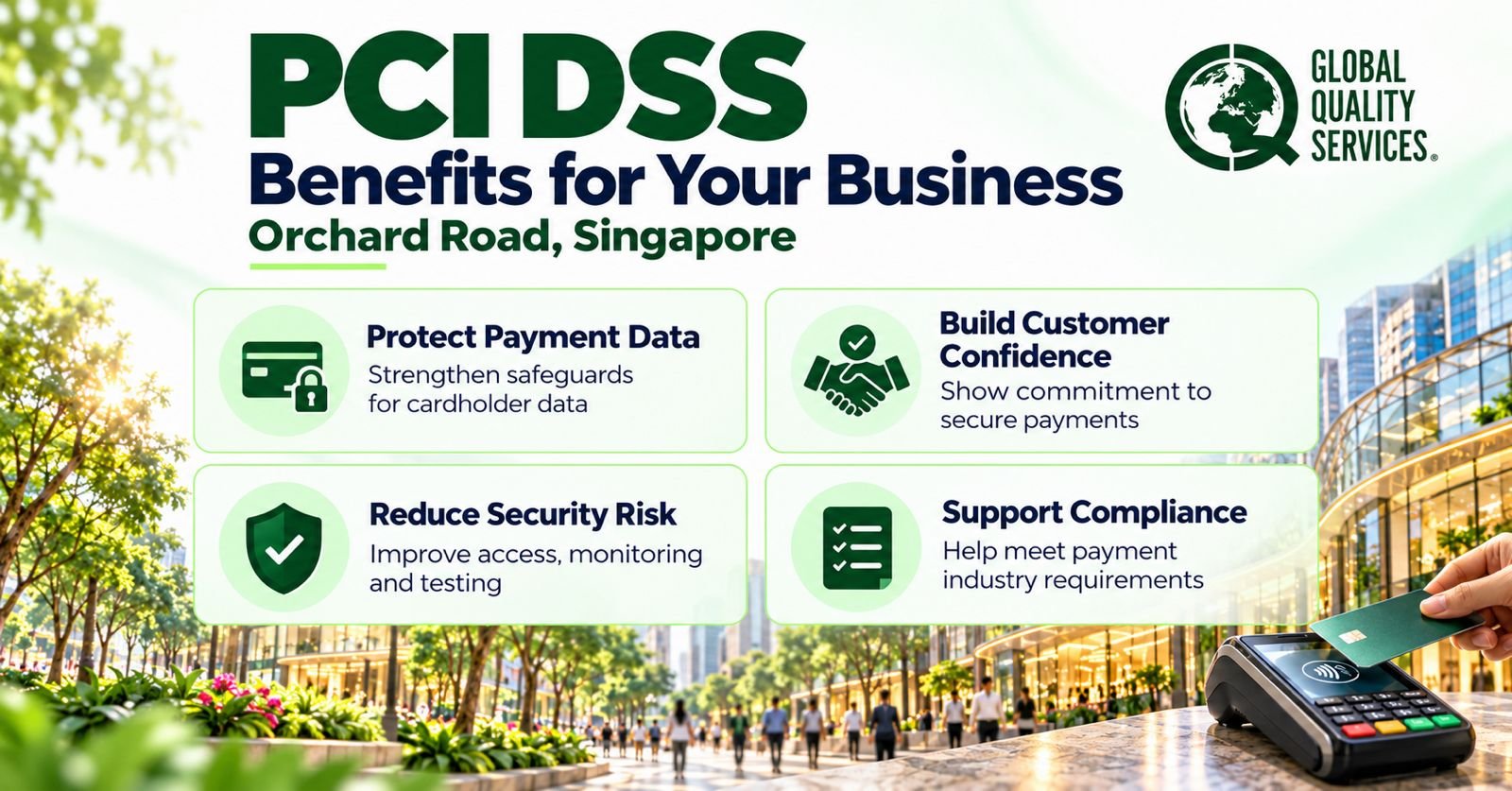
Protect Payment Card Data
PCI DSS provides controls designed to reduce the risk of unauthorized access to payment account data and strengthen the protection of cardholder information.
Reduce Payment Security Risks
The standard addresses areas such as network security, access control, authentication, vulnerability management, monitoring and security testing.
Strengthen Customer Confidence
Customers expect businesses handling their payment information to maintain appropriate security safeguards. Demonstrating PCI DSS compliance can provide additional assurance to customers and business partners.
Support Relationships With Payment Partners
Acquirers, payment brands, processors, and business partners may require organizations to validate PCI DSS compliance. Maintaining the appropriate validation documentation can help support these relationships.
Improve E-Commerce Security
PCI DSS v4.x places particular emphasis on securing payment pages and addressing risks associated with scripts and web-based attacks. These controls are especially relevant to businesses accepting payments through online channels.
What Does PCI DSS v4.0.1 Cover?
PCI DSS v4.0.1 includes requirements to protect payment account data and secure systems connected to the cardholder data environment.
Network Security Controls
Organizations need appropriate controls to pprotect the stems and network enenvironments that supportayment processing.
Secure Configuration
Securely configure and maintain systems and security technologies to reduce unnecessary exposure.
Account Data Protection
PCI DSS addresses the protection of stored account data and requirements relating to transmission and retention.
Access Control
Restrict access to payment environments based on business need, with appropriate authentication and authorization controls.
Vulnerability Management
Organizations need processes to identify and address vulnerabilities, including regular security testing where applicable.
Logging and Monitoring
Security events and access activities need appropriate logging and monitoring to support detection and investigation.
Security Testing
PCI DSS includes requirements for vulnerability scanning, penetration testing, and other security assessments, depending on the organization’s environment.
Policies and Security Responsibilities
Organizations must establish appropriate information security policies, define responsibilities, and maintain processes for managing PCI DSS requirements.
PCI DSS Compliance Process in Orchard Road
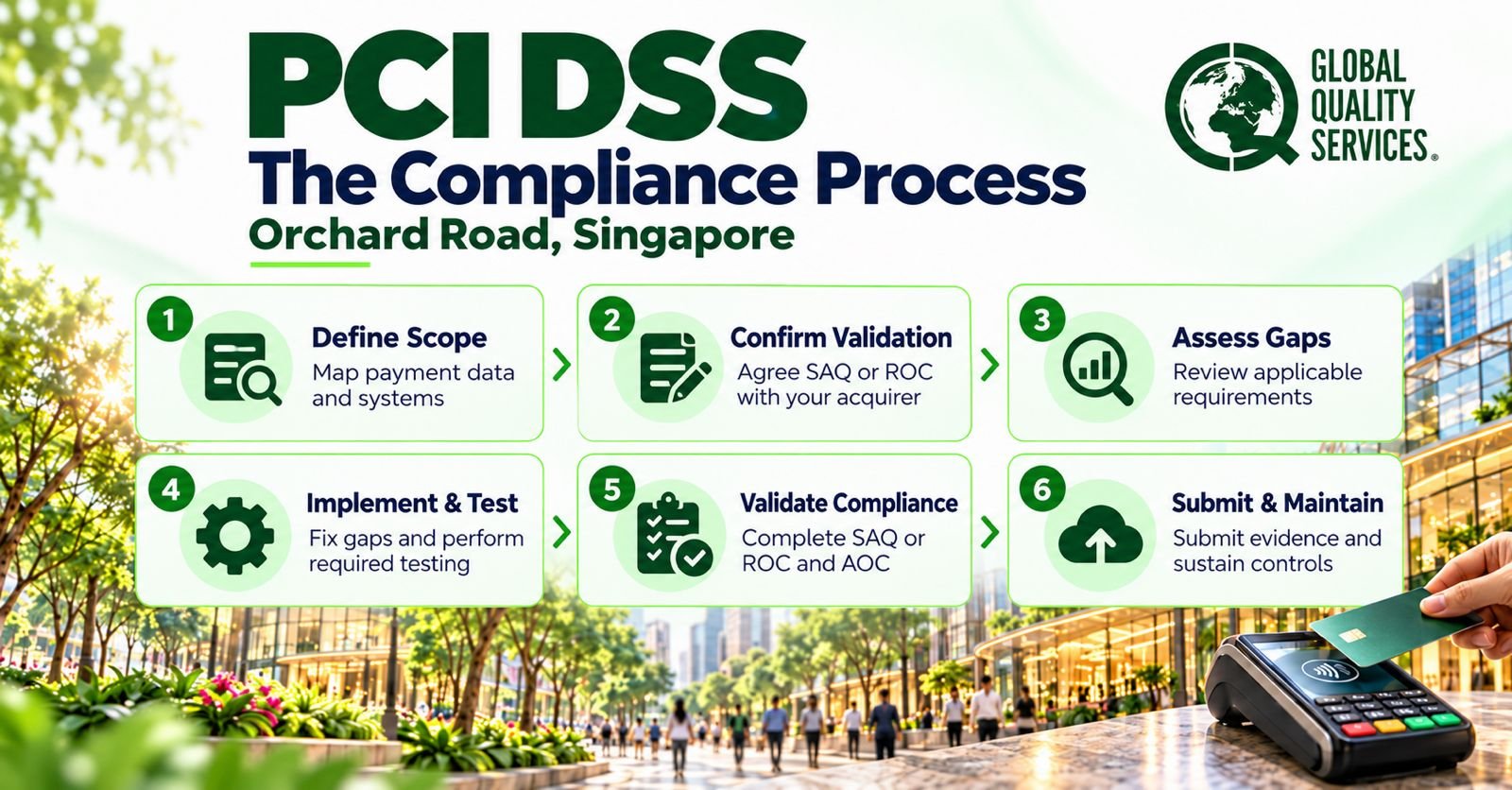
1. Define the Payment Environment
Identify how payment transactions are accepted, processed, transmitted and stored across physical and digital channels.
2. Determine PCI DSS Scope
Map systems, applications, networks, payment terminals and third-party services connected to the cardholder data environment.
3. Conduct a Gap Assessment
Review existing security controls against the applicable PCI DSS v4.0.1 requirements and identify areas requiring attention.
4. Address Security Gaps
Strengthen controls covering access management, authentication, vulnerability management, logging, monitoring, security testing and other applicable requirements.
5. Collect Evidence
Maintain policies, configurations, logs, scan reports, testing records and other evidence needed to demonstrate that applicable controls are operating as required.
6. Complete the Applicable Validation
Depending on the organisation and its validation obligations, compliance may involve an SAQ, ROC or other applicable PCI DSS validation method.
7. Maintain Ongoing Compliance
PCI DSS should not be treated as a one-time exercise. Organisations need processes for monitoring controls, addressing vulnerabilities and responding to changes in their payment environment.
How Can GQS Help With PCI DSS in Orchard Road?
Global Quality Services can support organizations with PCI DSS readiness through scope assessment, gap assessment, documentation support, control review, evidence preparation,n and assessment readiness.
GQS can help businesses understand applicable PCI DSS v4.0.1 requirements and identify areas requiring improvement across their payment environment. Where independent validation or assessment is required, the applicable qualified assessor or compliance-accepting entity remains responsible for the formal validation process.
Frequently Asked Questions
Is PCI DSS mandatory for businesses in Singapore?
PCI DSS is not a Singapore government law or general business license. However, payment brands, acquirers, processors, or other contractual parties may require applicable organizations to validate compliance.
Is PCI DSS v4.0.1 the current version?
Yes. PCI DSS v4.0.1 is the current published version of the PCI DSS. The earlier v4.0 version was retired at the end of 2024.
Are the future-dated PCI DSS v4 requirements now mandatory?
The future-dated requirements became effective on 31 March 2025. Where applicable, they must now be considered as part of PCI DSS assessments.
Does PCI DSS apply to small retailers and restaurants?
It can. Applicability and validation requirements depend on how the business accepts, processes, transmits, or stores payment account data and on the requirements imposed by the relevant payment ecosystem.
Can outsourcing payment processing remove PCI DSS responsibilities?
No. Outsourcing certain payment functions may affect the scope of an organization’s environmen. However, thee organization still needs to understand its PCI DSS responsibilities and its relationship with third-party service providers.