Tanjong Pagar is a prominent mixed-use precinct at the gateway of Singapore’s Central Business District, combining corporate offices, hotels, restaurants, conserved shophouses and modern commercial developments. The area is also connected to Singapore’s wider financial and business ecosystem.
For organizations that accept, process, transmit, or support payment card transactions, PCI DSS provides a framework for protecting payment account data and managing security risks across the cardholder data environment.
Latest PCI DSS Updates in 2026
PCI DSS v4.0.1 remains the current version of the Payment Card Industry Data Security Standard. However, the payment security landscape continues to evolve.
In October 2026, PCI SSC published additional guidance on securing AI in payment environments, addressing emerging security considerations as artificial intelligence becomes increasingly integrated into payment technologies and business processes. Organizations using AI in or around payment environments should consider how these technologies affect data protection, access, monitoring and other security controls.
Another important 2026 development is PCI SSC’s Guidance for Compensating Controls and the Customized Approach, published in June 2026. The guidance explains how organizations and assessors can appropriately use these flexible approaches when implementing and validating PCI DSS requirements.
Role of PCI DSS and AI in Payment Environments
The increasing use of AI introduces additional considerations for organizations operating payment systems. AI may be used in fraud detection, customer service, transaction monitoring, analytics, software development or other payment-related processes.
PCI SSC’s October 2026 guidance on securing AI in payment environments reflects the need to consider emerging AI-related risks alongside existing payment security controls. Organizations should evaluate how AI affects data access, system security, third-party services, monitoring and governance.
AI does not create a separate PCI DSS certification. Organizations should instead determine which existing PCI DSS requirements apply to the technologies and processes within their payment environment.
Why PCI DSS Matters for Businesses in Tanjong Pagar
Tanjong Pagar is part of Singapore’s Central Business District and is being developed into a more diverse mixed-use neighborhood with offices, hotels, retail, dining, and other amenities. URA identifies Tanjong Pagar and the surrounding Anson area as part of the CBD’s ongoing transformation. (ura.gov.sg)
This creates a varied payment environment. Businesses may use physical payment terminals, online payment gateways, mobile applications, reservation platforms, e-commerce systems and third-party payment providers.
For organizations serving corporate customers, international visitors or large transaction volumes, protecting payment information is not limited to the point-of-sale terminal. Payment applications, networks, cloud systems, web pages and third-party providers may all need to be considered when determining PCI DSS scope.
Who Should Consider PCI DSS Compliance in Tanjong Pagar?
These industries must consider PCI DSS certification in Tanjong Pagar
Financial and Professional Services Businesses
Companies supporting financial services or handling payment-related information may need strong controls around systems, access and third-party technology.
Hotels and Hospitality Businesses
Hotels in and around Tanjong Pagar may process payment information through reservations, booking platforms, front-desk systems, restaurants, room services and other guest-facing channels.
Restaurants and F&B Businesses
Restaurants and food businesses using POS systems, integrated payment terminals, online ordering or reservation platforms need to understand how payment information flows through their environment.
Retail and Commercial Businesses
Businesses accepting card payments through physical stores, websites, or mobile applications need appropriate safeguards for their payment environment.
Technology and Payment Service Providers
Service providers supporting merchants with payment processing, hosting, applications, or other payment-related functions may have PCI DSS responsibilities, depending on their role and services.
Benefits of PCI DSS Compliance in Tanjong Pagar
Protect Payment Account Data
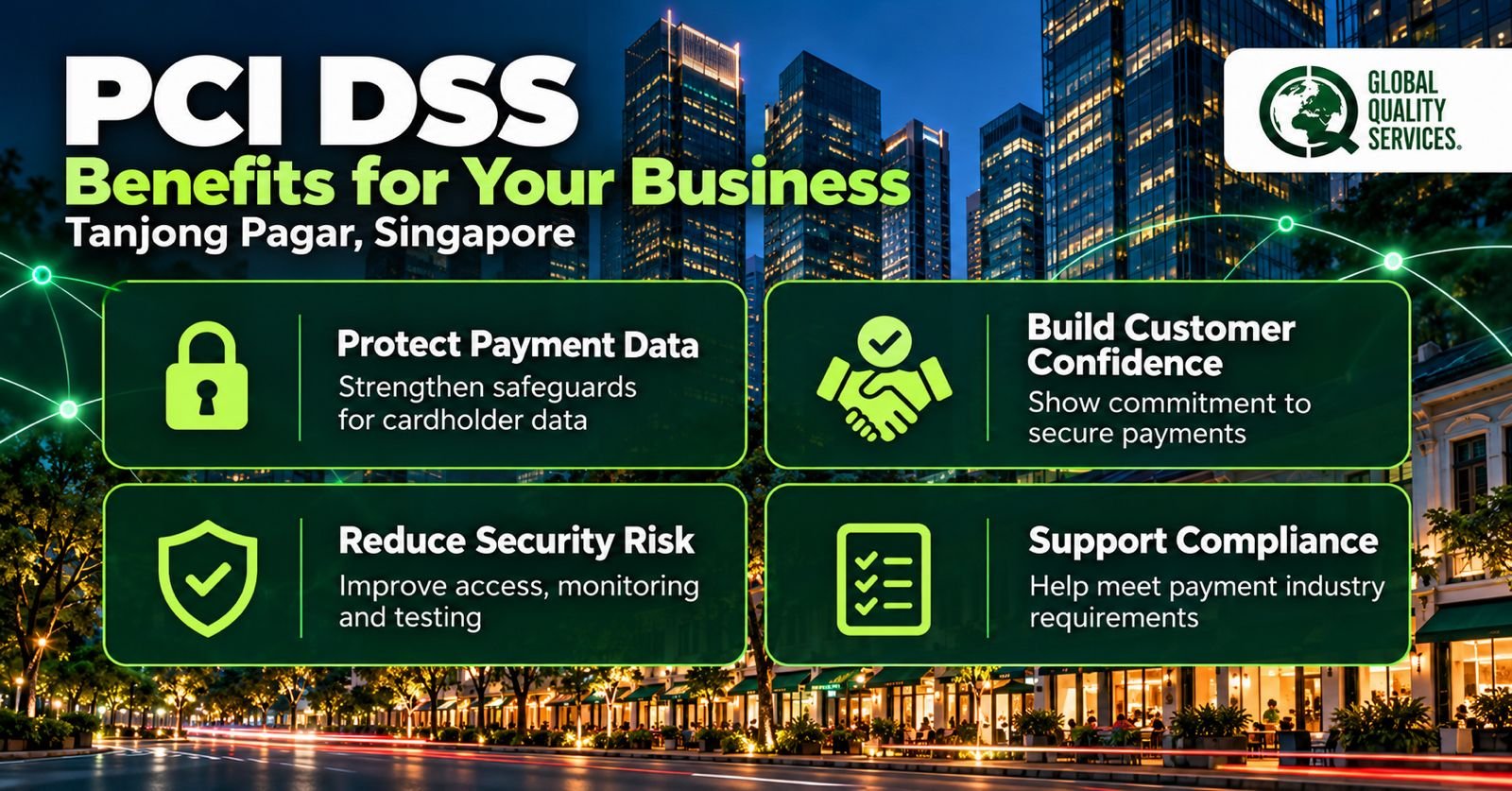
PCI DSS establishes controls designed to protect payment account data from unauthorized access, disclosure, alteration or misuse.
Strengthen Payment Security
The standard addresses security areas including authentication, access control, vulnerability management, monitoring and security testing.
Support Customer Confidence
Demonstrating appropriate payment security practices can provide customers and business partners with greater confidence when transactions involve sensitive payment information.
Strengthen Third-Party Relationships
PCI DSS validation may support due diligence with payment processors, acquirers, technology providers, enterprise customers and other business partners.
Improve Security Governance
Preparing for PCI DSS can help organizations formalize security responsibilities, document processes, and establish more consistent monitoring and risk management practices.
Support Digital Payment Channels
PCI DSS v4.x includes requirements relevant to modern e-commerce environments, making the standard particularly relevant to organizations operating websites, applications and digitally integrated payment systems.
What Does PCI DSS v4.0.1 Cover?
PCI DSS v4.0.1 contains requirements designed to protect payment account data and the systems that support payment processing.
Network and System Security
Organizations need controls to protect networks and systems within, or connected to, the cardholder data environment.
Secure Configuration
Systems should be configured and maintained securely to minimize vulnerabilities and unnecessary exposure.
Account Data Protection
Controls address the protection of stored payment account data and its secure transmission across networks.
Access Control and Authentication
Access to payment environments should be restricted according to business requirements, with appropriate identification and authentication mechanisms.
Vulnerability Management
Organizations need processes to identify, evaluate, and address vulnerabilities in relevant systems and applications.
Logging and Monitoring
Security events and access activities need appropriate monitoring to support timely detection and investigation of potential incidents.
Security Testing
Depending on applicable requirements and the environment, organizations may need vulnerability scanning, penetration testing, and other security testing activities.
Information Security Policies
Organizations must maintain appropriate security policies, procedures, and assigned responsibilities that support PCI DSS requirements.
PCI DSS Compliance Process in Tanjong Pagar
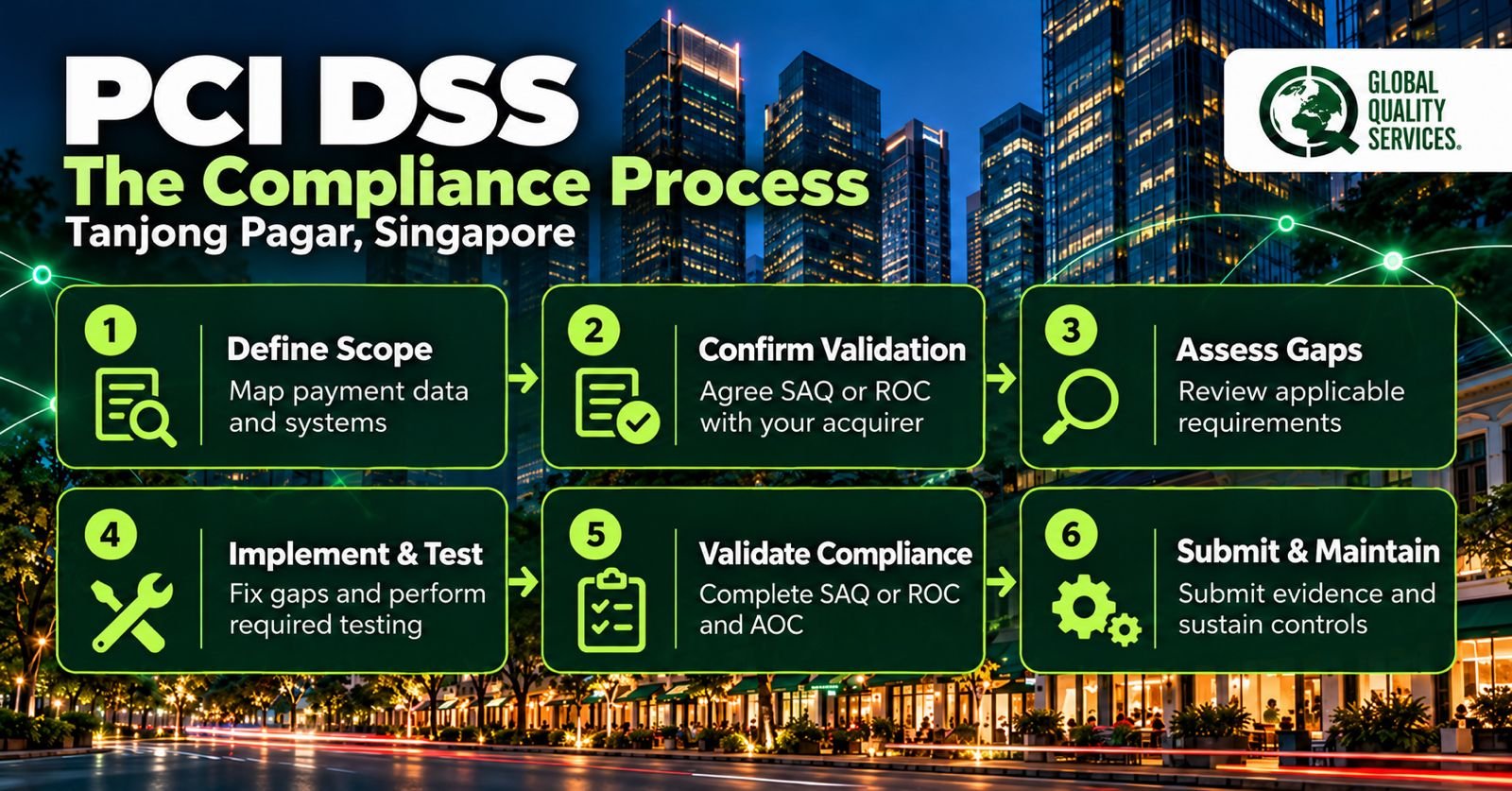
1. Identify Payment Flows
Map how payment transactions enter, move through and leave the organisation’s systems.
2. Determine the PCI DSS Scope
Identify relevant applications, networks, databases, payment terminals, websites, cloud services, and third-party providers.
3. Conduct a Gap Assessment
Compare the existing security environment against the applicable PCI DSS v4.0.1 requirements.
4. Address Identified Gaps
Strengthen controls relating to access, authentication, vulnerability management, monitoring, data protection, and other applicable areas.
5. Prepare Documentation and Evidence
Maintain policies, procedures, system configurations, logs, scan results, testing records and other evidence required for validation.
6. Complete the Applicable Validation
Depending on the organization’s requirements, complete the relevant SAQ, ROC, or other applicable PCI DSS validation process.
7. Maintain Compliance
PCI DSS compliance requires ongoing attention to security controls, vulnerabilities, system changes, monitoring and payment environment changes.
How much does it cost to achieve PCI DSS Compliance in Singapore?
The cost of PCI DSS compliance can vary greatly and is influenced by several factors. The type of business you run, whether it’s a large corporation, a small company, or a service provider, plays a significant role. Larger businesses with more employees, systems, and data typically face higher compliance costs due to the complexity and scale of their operations.
Your organization’s security culture also matters. If your management prioritizes data security, budgeting for compliance is usually less of an issue. However, if there’s less awareness or emphasis on security, convincing leadership to allocate funds can be challenging.
The technical environment of your organization, including your network setup and the types of systems and devices in use, also impacts the cost. While a dedicated PCI team helps, most organizations still need external expertise to ensure full compliance. Lastly, some businesses might have part of their compliance costs covered by their acquiring banks, but this is not a common practice.
How Can GQS Help With PCI DSS in Tanjong Pagar?
Global Quality Services can support organizations with PCI DSS readiness through scope assessment, gap assessment, documentation support, control review, evidence preparation and assessment readiness.
GQS can help organizations understand applicable PCI DSS v4.0.1 requirements and identify areas requiring improvement across payment systems, applications, networks and third-party services. Where formal validation is required, the applicable qualified assessor or recognized validation mechanism remains responsible for the assessment and compliance validation.
Frequently Asked Questions
Is PCI DSS mandatory for businesses in Tanjong Pagar?
PCI DSS is not a Singapore government law that applies uniformly to every business. However, payment brands, acquirers, processors, or contractual partners may require applicable organizations to validate PCI DSS compliance.
Is PCI DSS v4.0.1 the current standard?
Yes. PCI DSS v4.0.1 is the current version supported by PCI SSC. PCI DSS v4.0 was retired on 31 December 2024. (pcisecuritystandards.org)
Are PCI DSS v4.x future-dated requirements now effective?
Yes. The future-dated requirements became effective on 31 March 2025. Organizations need to consider applicable requirements as part of their current PCI DSS validation.
Does outsourcing payment processing remove PCI DSS obligations?
No. Outsourcing payment functions may reduce certain elements of an organization’s technical scope, but it does not automatically remove its PCI DSS responsibilities.
Does PCI DSS apply to online payment pages?
It can. PCI DSS v4.x includes requirements relevant to e-commerce payment pages, scripts, and web-based payment security. The exact requirements depend on how the payment environment is implemented.
Has PCI DSS been updated to a 2026 version?
No. PCI DSS v4.0.1 remains the current version. PCI SSC has continued publishing guidance in 2026, including guidance on AI in payment environments and the customized approach, but these do not constitute a new PCI DSS 2026 version.