Singapore’s industrial sector accounted for approximately 67.7% of the country’s total final energy consumption in 2024, according to data from the Singapore Department of Statistics and the Energy Market Authority. This makes energy management an important operational priority for manufacturers and other energy-intensive businesses. (Source: Singapore Department of Statistics, 2024 energy consumption data.)
For businesses, high energy consumption affects operating costs, production efficiency, and environmental performance. Without proper monitoring, it can be difficult to identify energy waste or measure the results of efficiency improvements.
GQS Singapore provides ISO 50001 consultancy services to help organisations establish an Energy Management System (EnMS), improve energy performance and prepare for certification. Our consultants support gap assessments, energy reviews, EnMS documentation, employee training and certification audit preparation.
What is ISO 50001
ISO 50001 is an international standard for Energy Management Systems. It provides a framework for organisations to monitor energy consumption, improve energy efficiency and measure energy performance.
The standard requires businesses to establish an energy policy, identify significant energy uses, set measurable targets and review their progress. It also requires management to assign responsibilities and provide resources for energy improvement.
ISO 50001:2018, including Amendment 1:2024, applies to organisations of all sizes and industries. In Singapore, the adopted standard is SS ISO 50001:2018+A1:2024.
Certification demonstrates that your organisation has implemented an Energy Management System that meets the standard’s requirements. It does not guarantee a fixed reduction in energy costs. Actual improvements depend on your operations, energy targets, and implementation.
Is ISO 50001 Mandatory in Singapore?
ISO 50001 certification is voluntary in Singapore. However, certain energy-intensive industrial corporations must follow the energy management requirements under the Energy Conservation Act (ECA), administered by the National Environment Agency (NEA). A corporation falls under the ECA registration requirements when its business activity:
- Consumes at least 54 terajoules (TJ) of energy per calendar year in at least two of the three preceding calendar years.
- Operates at a single site.
- Falls under a specified industrial sector.
What Must Registered Corporations Do
Companies that qualify as registrable corporations must register with NEA within six months of meeting the requirements. They must also:
- Appoint an energy manager holding the Singapore Certified Energy Manager (Professional Level) qualification.
- Submit annual energy use reports.
- Submit annual energy efficiency improvement plans.
- Implement an Energy Management System for each relevant business activity.
- Submit either an EnMS report or a valid, accredited ISO 50001 certificate to meet the applicable EnMS reporting requirement.
For registered corporations, an accredited ISO 50001 certificate can replace the prescribed EnMS report. The certificate must meet NEA’s accreditation and validity conditions.
Benefits of ISO 50001 Certification
ISO 50001 helps organisations manage energy consumption through measurable targets and defined operational controls. Its main business benefits include:
- Lower energy costs: Identify energy-intensive processes, equipment, and facilities. Use the findings to prioritise improvements and control unnecessary consumption.
- Better operational control: Establish procedures for equipment operation, maintenance and energy monitoring. This helps teams manage energy use more consistently.
- Regulatory readiness: Build an EnMS that supports applicable energy management requirements under Singapore’s Energy Conservation Act.
- Stronger ESG reporting: Maintain documented energy performance data to support environmental reporting, sustainability targets and carbon management programmes.
- Improved procurement decisions: Include energy performance when purchasing equipment, replacing machinery or planning facility upgrades.
- Better supplier credibility: Demonstrate your commitment to energy management when responding to customer assessments, tenders and supply chain requirements.
Which Industries Need ISO 50001 Certification?
ISO 50001 is relevant to organisations that want to improve energy performance. It is particularly useful for businesses with high energy consumption or energy-intensive equipment:
- Manufacturing
- Data centres
- Commercial buildings
- Hotels and hospitals
- Utilities
- Food processing
- Warehousing and logistics
Manufacturing and industrial facilities in areas such as Jurong also benefit from a structured approach to energy management, particularly when managing production equipment, utilities, and high energy-consuming processes.
What Are the Requirements of ISO 50001
ISO 50001 requires organisations to establish an Energy Management System with defined responsibilities, documented processes, and measurable energy performance objectives. The main requirements include:
1. Energy Management Policy
Develop an energy policy approved by top management. It must establish the organisation’s commitment to improving energy performance and providing the resources required to achieve its objectives.
2. Energy Review
Identify energy sources, consumption patterns, and significant energy uses across your operations. Assess the factors that affect energy consumption and identify opportunities to improve efficiency.
3. Energy Baseline and EnPIs
Establish an energy baseline to measure performance against a defined reference period. Set Energy Performance Indicators (EnPIs) to track changes.
Examples include energy consumed per unit of production, electricity used per square metre, and fuel consumption per operating hour.
4. Energy Objectives and Action Plans
Set measurable energy targets and assign responsibilities for achieving them. Each action plan should identify the required resources, activities, timelines, and methods for evaluating results.
5. Operational Controls
Establish controls for activities that affect significant energy uses. These may include equipment operation, preventive maintenance, energy-efficient procurement, and facility design.
6. Monitoring and Measurement
Monitor energy consumption and performance indicators at planned intervals. Maintain reliable records and investigate significant deviations from expected performance.
7. Competence and Training
Ensure employees who influence energy performance have the required skills and knowledge. Provide training on energy procedures, equipment operation, and individual responsibilities.
8. Internal Audit and Management Review
Conduct internal audits to check whether the EnMS meets ISO 50001 requirements. Management must review audit findings, energy performance, objectives, and improvement plans.
9. Corrective Action and Continual Improvement
Investigate nonconformities, identify their causes, and implement corrective actions. Review the effectiveness of those actions and continue improving the Energy Management System.
Our ISO 50001 Certification Process in Singapore
Global Quality Services provides implementation and audit preparation support through the following stages:
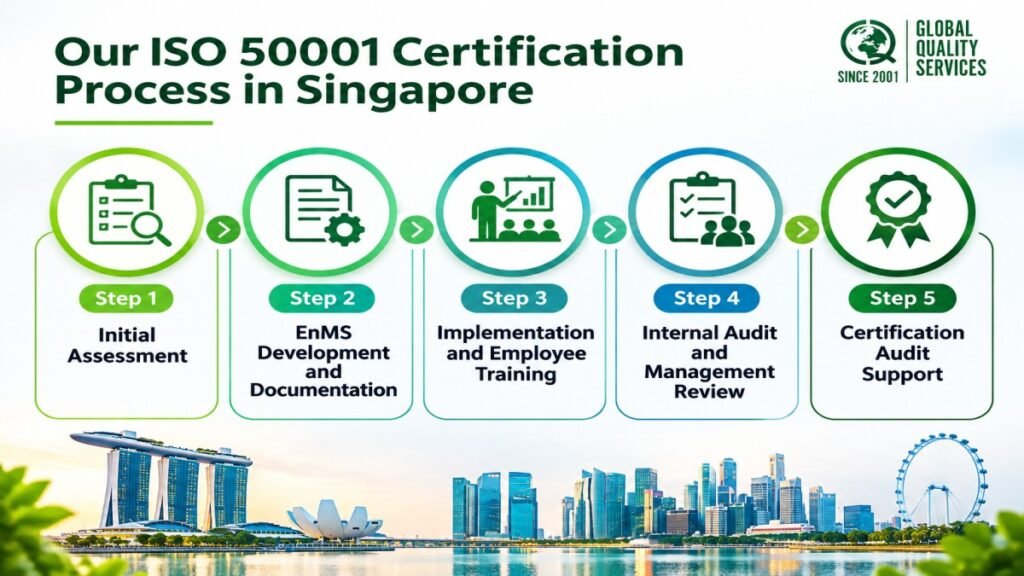
Step 1: Initial Assessment
We review your existing energy management practices, operational activities, and documentation against ISO 50001 requirements. Our consultants identify gaps and define the implementation scope.
Step 2: EnMS Development and Documentation
We help establish your Energy Management System, including the energy policy, energy review, baseline, EnPIs, objectives, targets, and operational controls.
Step 3: Implementation and Employee Training
We guide your team in applying the documented procedures across relevant operations. We also provide employee awareness and internal auditor training based on your organisation’s requirements.
Step 4: Internal Audit and Management Review
We help conduct an internal audit to assess system effectiveness and identify nonconformities. We also support management reviews and corrective actions before the external audit.
Step 5: Certification Audit Support
We prepare your organisation for the independent certification audit, including Stage 1 documentation review and Stage 2 implementation assessment. Our consultants guide your team through audit preparation and the closure of any identified gaps.
We also support businesses operating in industrial locations such as Loyang, helping them implement Energy Management Systems based on their operational requirements and certification scope
Why Choose Global Quality Services for ISO 50001 Certification in Singapore
GQS Singapore helps organisations implement management systems that meet certification requirements and support their business operations. Our ISO 50001 consultancy covers:
- 26 Years of Experience: We bring extensive experience in management system consulting and certification support across industries.
- Experienced Team: Our consultants understand ISO requirements and work closely with your team to address implementation challenges.
- Practical Approach: We focus on building management systems that work in daily operations, not just on preparing audit documents.
- Industry-Specific Solutions: We tailor our consulting approach to your business activities, energy requirements, and existing systems.
- Client-Focused Philosophy: We believe in clear communication, practical guidance, and working closely with clients at every stage.
- Continued Support: We assist with internal audits, surveillance audit preparation, and ongoing system improvements.
Our consultants work with your team to define the implementation scope and prepare an approach based on your organisation’s size, operations, and existing systems.
Get ISO 50001 Consultancy Support in Singapore
Establish an Energy Management System that gives your organisation better control over energy consumption and performance.
Global Quality Services provides ISO 50001 consultancy and implementation support, from the initial assessment to certification audit preparation. Contact our consultants to discuss your ISO 50001 requirements and plan the implementation process.
Frequently Asked Questions
1. How long does ISO 50001 certification take?
The timeline depends on the organisation’s size, number of facilities, energy consumption patterns, and existing management systems. GQS Singapore can assess your current arrangements and recommend an implementation schedule.
2. Does ISO 50001 certification reduce electricity bills?
ISO 50001 helps identify energy waste and establish measurable improvement targets. It provides a system for managing consumption, but actual savings depend on the improvements implemented and their effectiveness.
3. Can small businesses apply for ISO 50001?
Yes. ISO 50001 applies to organisations of all sizes. Small businesses can use the standard to monitor energy consumption, improve equipment efficiency and control operating costs.
4. Who can issue ISO 50001 certification?
An independent certification body with appropriate accreditation can issue an ISO 50001 certificate. ISO itself does not certify organisations. For ECA submissions in Singapore, the certification body must meet NEA’s accreditation requirements.
5. What is the difference between ISO 50001 and ISO 14001?
ISO 50001 focuses on energy management and energy performance. ISO 14001 covers broader environmental management, including waste, pollution, resource use, and environmental impacts. Organisations can implement both standards together.