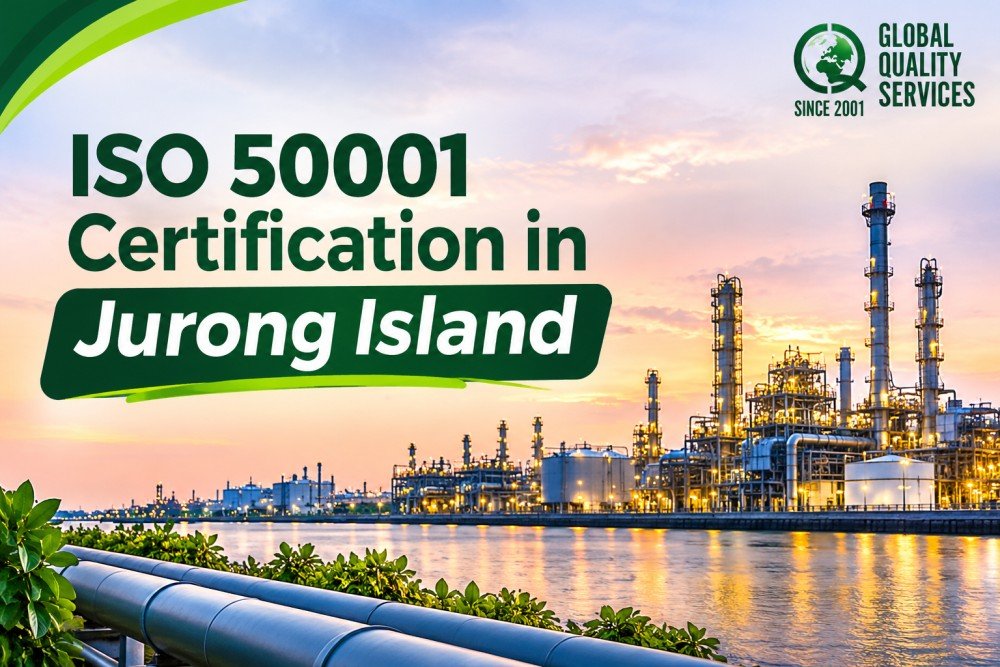
Jurong Island runs on complex industrial operations, where energy use affects production costs, plant reliability, and environmental performance. For manufacturers, refineries, petrochemical companies, and utility providers, better energy management is a business priority, not just a sustainability target. ISO 50001 certification gives your organization a clear system to measure energy use, set performance goals, and improve how facilities consume power and fuel.
Singapore’s Economic Development Board reports that more than 100 global companies operate on Jurong Island. At the same time, the energy and chemicals sector contributes 20% of the country’s manufacturing output. That scale brings a strong focus on efficient, responsible operations.
Global Quality Services helps businesses build an energy management system that fits their operations and supports certification readiness, without adding unnecessary work to daily operations. Read on to see what the standard requires, which businesses benefit, and how our reputed consultants can guide your team.
What is ISO 50001 Certification
ISO 50001 certification is an international standard for Energy Management Systems (EnMS). It provides your organization with guidelines to manage its energy consumption effectively, enhance energy performance, and optimize associated costs using a structured management process.
The standard requires your company to document its energy consumption patterns, identify critical consumption points, establish performance improvement objectives, and document outcomes. The benefit to your management is gaining insight into the overall energy performance of each department, machinery, and manufacturing operation.
It’s important for companies based in Jurong Island to implement ISO 50001 because it enables your team to evaluate cost implications associated with energy consumption and manufacturing processes. Your decision-making will become easier when backed up with reliable data.
Why Do Businesses on Jurong Island Need ISO 50001 Certification?
Jurong Island hosts Singapore’s biggest plants for energy, chemicals, and manufacturing. The site relies heavily on equipment, processes, production lines, utilities, cooling, boilers, and other energy-intensive activities. Small gains in efficiency translate into significant savings. ISO 50001 improves performance in your organization:
- Identify equipment and processes that consume the most energy.
- Set measurable energy performance targets.
- Track electricity, fuel, steam, and other energy consumption.
- Reduce avoidable energy waste and operating expenses.
- Improve control over energy-intensive operations.
- Support environmental and carbon reduction targets.
- Meet customer and supply chain expectations for responsible energy management.
- Strengthen energy performance reporting with reliable records.
Which Industries on Jurong Island Benefit from ISO 50001?
ISO 50001 applies to organizations of different sizes and industries. However, it offers particular value to businesses that depend on large amounts of energy to maintain their operations:
- Petrochemical and chemical manufacturers
- Oil and gas companies
- Refineries
- Power and utility providers
- Industrial manufacturing facilities
- Storage and logistics facilities
- Engineering and industrial service providers
Key Requirements of ISO 50001 Certification
ISO 50001 requires your organization to establish an Energy Management System that supports measurable and ongoing improvements. Your team must address the following areas:
- Energy Policy: Define management’s commitment to responsible energy use and better energy performance.
- Energy Review: Identify major energy uses, consumption patterns, and improvement opportunities.
- Energy Baseline: Establish a reference point to measure future energy performance.
- Energy Performance Indicators: Select suitable measures to track energy efficiency and consumption.
- Energy Objectives and Targets: Set clear, measurable goals for energy performance.
- Operational Controls: Establish controls for activities and equipment that affect energy use.
- Monitoring and Measurement: Track energy consumption and review performance data.
- Internal Audits: Check whether your energy management system meets ISO 50001 requirements.
- Management Review: Evaluate results and decide where your organization needs further improvements.
- Continual Improvement: Review energy performance regularly and take action when results fall short of targets.
How Global Quality Services Experts Help You with ISO 50001 Certification in Jurong Island
Global Quality Services has been operating for 21 years as consultants, successfully assisting many companies in meeting international requirements and complying with necessary regulations. Our consultants work with clients from various sectors to develop management systems tailored to their specific needs:
Why businesses choose Global Quality Services:
- 26 years of management consultancy experience.
- 1,450 happy customers across different industries.
- Presence across 17 locations.
- 1,200 training programs delivered.
- Singapore Certified Management Consultant (SCMC) credentials.
- Experience with multiple international ISO standards and industry-specific requirements.
From our background working with management system standards, we know what certification entails in terms of documentation, responsibility, and control. Our approach will be to give your team clear guidance without drowning your staff in paperwork.
Our ISO 50001 Certification Process in Jurong Island
Global Quality Services follows a structured approach to help your organization prepare for ISO 50001 certification:
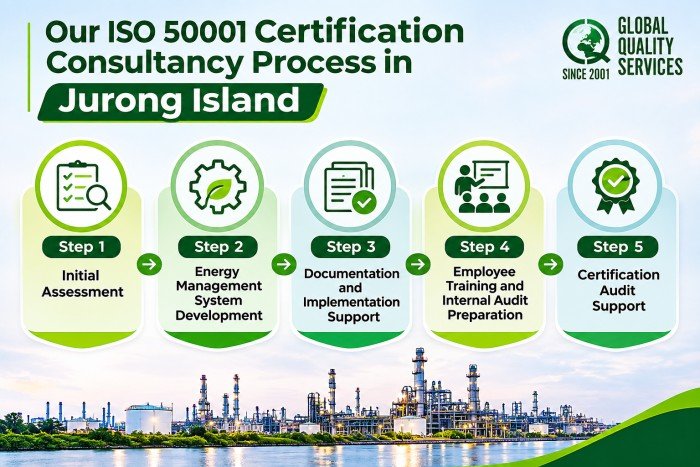
Step 1: Initial Assessment
We will assess your current processes for managing energy, operations, and documentation. Our consultants will pinpoint any deficiencies relative to ISO 50001 criteria and map out the steps required to achieve compliance.
Step 2: Energy Management System Development
Energy management system implementation services will help your company implement an EMS that is tailored to its operations. An EMS consists of several components, such as the energy policy, goals, energy review, performance indicators, and continuous improvement strategies.
Step 3: Documentation and Implementation Support
We train your staff on how to document processes, maintain proper recordkeeping, implement controls, and monitor compliance. We ensure your staff comprehends his/her roles within this framework.
Step 4: Employee Training and Internal Audit Preparation
We train employees in energy management responsibilities based on ISO 50001 standards. Our consultants support you and your team with internal audits and implementing corrective actions.
Step 5: Certification Audit Support
We will guide your organization through the certification audit preparation process, document management, and remediation of any remaining gaps. The certification audit and certification determination are performed by an independent third-party certifier.
ISO 50001 and Other Management System Certifications
Businesses that already maintain environmental management systems can benefit from aligning their energy management practices with existing controls. Global Quality Services also provides ISO 14001 Environmental Management System Certification consultancy, which can complement ISO 50001 and support wider environmental management goals.
Organizations looking to measure and manage their greenhouse gas emissions alongside energy performance can also benefit from ISO 14064 Certification Services, which help businesses quantify, monitor, and report their greenhouse gas emissions.
An integrated approach can help your organization reduce duplicated documentation, coordinate internal audits, and manage related responsibilities more efficiently.
Get Expert ISO 50001 Certification Support in Jurong Island
Gain mastery of your company’s energy performance through expert advice provided by Global Quality Services. Our consultants work with organizations to comprehend ISO 50001 standards, implement effective energy management systems, and pass third-party certification assessments.
Contact Global Quality Services to discuss your certification requirements. Share your industry, facility size, and current energy management practices with our team. We will help you understand the next steps and plan a consultancy engagement that suits your business.
Frequently Asked Questions
1. Can a company with multiple facilities on Jurong Island apply for one ISO 50001 certificate?
Yes. An organization can include multiple facilities within one certification scope if they meet the applicable certification body’s requirements. The company must define the locations, activities, and energy management responsibilities that the system covers.
2. Does ISO 50001 certification require a dedicated energy manager?
ISO 50001 requires your organization to assign responsibilities and provide suitable resources for energy management. It does not require every business to hire a full-time energy manager. Your organization can assign suitable responsibilities to existing employees with the right knowledge and authority.
3. What energy records should a business prepare before contacting a consultant?
Start with electricity and fuel bills, energy consumption reports, equipment details, production data, maintenance records, and any existing energy audit reports. These records help consultants understand your current energy management practices and identify areas that need attention.
4. Can an organization maintain ISO 50001 certification after changing its production equipment?
Yes. Your organization can maintain certification after equipment or production changes. However, your team must review how those changes affect energy consumption, performance indicators, energy baselines, and operational controls. You should also update relevant records and management system arrangements.
5. Does ISO 50001 certification guarantee a fixed percentage of energy savings?
No. ISO 50001 does not promise a fixed level of energy savings. Actual results depend on your facility, equipment, production activities, energy use, and improvement measures. The standard gives your organization a system to identify opportunities, set targets, and measure actual performance.