
Businesses in Changi Business Park rely on cloud platforms to manage data, applications, and daily operations. However, cloud adoption also brings security risks that companies cannot ignore. According to Singapore’s Cyber Security Agency, almost nine in 10 organisations reported at least one cybersecurity incident in 2025.
This highlights the need for stronger cloud security practices. ISO 27017 helps businesses address cloud-specific risks and manage shared security responsibilities. An experienced consultant can simplify implementation, identify security gaps, and guide your team through the assessment process.
What is ISO 27017 Certification
ISO/IEC 27017:2015 is an international standard that provides guidelines for information security controls in cloud services. It builds on ISO/IEC 27002 and offers additional guidance for cloud service providers and cloud service customers.
Traditional information security practices may not address every security challenge associated with cloud computing. Cloud environments involve shared infrastructure, remote access, virtual machines, and responsibilities divided between providers and customers.
ISO 27017 addresses these challenges by recommending additional controls for cloud security. It helps organisations understand who manages specific security activities and how they should protect information within cloud environments.
The standard covers areas such as:
- Shared responsibilities: Defines security responsibilities between cloud providers and customers.
- Cloud asset management: Helps organisations manage information and assets stored in cloud environments.
- Virtual machine security: Addresses security considerations when creating, managing, and removing virtual machines.
- Administrative operations: Guides cloud administrator access and responsibilities.
- Virtual environment protection: Addresses risks associated with cloud infrastructure and virtual networks.
- Customer data protection: Helps organisations manage and protect information stored or processed through cloud services.
Both cloud service providers and cloud service customers can use ISO 27017 guidance. Organisations can also integrate these controls into their existing ISO 27001 Information Security Management System (ISMS).
Why is ISO 27017 Certification Important for Businesses in Changi Business Park
Changi Business Park supports businesses operating across technology, finance, professional services, and other commercial sectors. Many organisations in this business hub depend on cloud platforms to manage business applications and confidential information.
As cloud adoption grows, companies must take greater responsibility for information security. ISO 27017 helps them address cloud-specific risks through clearly defined security practices.
Here are some reasons businesses should consider implementing ISO 27017 controls.
1. Protect Confidential Business Information
Cloud platforms often hold customer details, financial records, employee information, and business documents. A security incident can expose this information to unauthorised users.
ISO 27017 provides additional cloud security guidance. Businesses can use it to review access permissions, administrative activities, and data protection practices.
2. Address Shared Cloud Security Responsibilities
Cloud security involves both service providers and customers. However, businesses sometimes assume that their cloud provider handles every security requirement.
This assumption can leave important gaps. ISO 27017 helps both parties understand their responsibilities and manage security activities more effectively.
3. Strengthen Cloud Risk Management
Cloud environments face several security challenges, including unauthorised access, insecure configurations, and data exposure.
ISO 27017 helps organisations identify these risks and select suitable controls. This approach supports better security decisions across cloud operations.
4. Build Customer and Business Partner Confidence
Clients want to know how businesses protect their information. This becomes particularly important when companies handle confidential customer records or provide cloud-based services.
Implementing ISO 27017 controls demonstrates a structured approach to cloud security. It also gives customers greater confidence when evaluating your security practices.
5. Support Existing ISO 27001 Practices
Companies that already follow ISO 27001 may need additional controls for their cloud operations.
ISO 27017 complements ISO 27001 by addressing security considerations specific to cloud services. Businesses can use both standards together to strengthen their information security practices.
Benefits of ISO 27017 Certification for Businesses
Implementing ISO 27017 controls can help businesses improve cloud security and manage their responsibilities. It also supports better coordination between internal IT teams and external cloud providers.
Here are some practical benefits.
1. Better Control Over Cloud Environments
Businesses gain a clearer understanding of their cloud infrastructure. They can review configurations, access permissions, and administrative activities to identify security weaknesses.
2. Improved Data Protection
ISO 27017 encourages organisations to apply suitable safeguards to information stored in cloud environments. These practices help protect business and customer data from unauthorised access.
3. Stronger Relationships With Cloud Providers
Businesses often depend on third-party providers for cloud infrastructure and applications. Clear security requirements help both parties discuss responsibilities, service expectations, and security arrangements.
4. Better Preparation for Client Security Reviews
Large clients often ask suppliers about their information security practices before signing contracts. A structured cloud security programme helps businesses answer these questions with greater confidence.
5. More Effective Security Monitoring
Organisations can improve their visibility into cloud activities. They can establish suitable monitoring practices, review security events, and investigate unusual activities.
6. Support for Regulatory and Contractual Requirements
Businesses may need to meet contractual, industry, and data protection requirements. ISO 27017 controls can support these efforts by improving cloud security practices.
7. Stronger Business Continuity
Cloud security also involves maintaining service availability and managing operational risks. Better controls help businesses prepare for security incidents and service disruptions.
Step-by-Step Process to Get ISO 27017 Certification in Changi Business Park
Getting started with ISO 27017 requires more than preparing security documents. Your organisation must understand its cloud environment, review existing practices, and address gaps.
Here is how businesses in Changi Business Park can approach the implementation process.
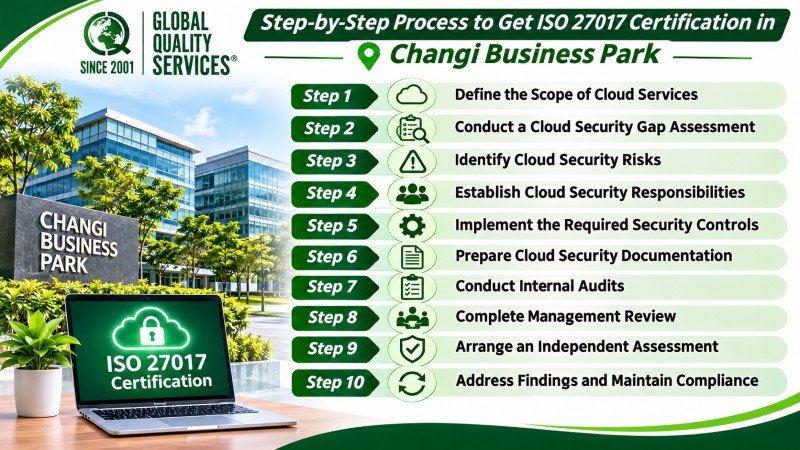
Step 1: Define the Scope of Cloud Services
Start by identifying the cloud services your organisation provides or uses. Include relevant applications, platforms, infrastructure, business processes, and third-party providers. A clear scope helps you identify which security controls apply.
Step 2: Conduct a Cloud Security Gap Assessment
Review your existing cloud security practices against the applicable ISO 27017 requirements. Examine access management, data protection, virtual environments, cloud configurations, and administrative procedures. Record the gaps that need attention.
Step 3: Identify Cloud Security Risks
Assess the risks associated with your cloud operations. Consider data exposure, unauthorised access, insecure configurations, service interruptions, and third-party dependencies. Prioritise risks based on their potential business impact.
Step 4: Establish Cloud Security Responsibilities
Define the responsibilities of your organisation and its cloud service providers. Review service agreements and shared responsibility arrangements. Make sure everyone understands who manages access, infrastructure, incident reporting, and data protection.
Step 5: Implement the Required Security Controls
Select and implement controls based on your risk assessment and cloud environment. Update access permissions, administrative procedures, monitoring practices, and virtual environment protection measures. Keep evidence of the controls you implement.
Step 6: Prepare Cloud Security Documentation
Document the policies, procedures, responsibilities, and operational practices related to cloud security. Maintain relevant records, including risk assessments, access reviews, incident reports, and supplier agreements.
Step 7: Conduct Internal Audits
Review the implemented controls to check whether they work as intended. Internal audits help identify remaining weaknesses and allow your team to correct issues before an external assessment.
Step 8: Complete Management Review
Present the audit findings, risk assessment results, and implementation progress to senior management. Discuss unresolved issues and agree on the corrective actions your organisation needs to complete.
Step 9: Arrange an Independent Assessment
Engage a competent certification or assessment body to evaluate your organisation’s implementation, where an applicable certification scheme is available. The assessment will examine your documented practices and supporting evidence.
Step 10: Address Findings and Maintain Compliance
If the assessment identifies nonconformities, take corrective action within the agreed timeframe. Maintain the controls, review cloud risks regularly, and update your practices when your services or infrastructure change.
Why Choose Global Quality Services for ISO 27017 Certification in Changi Business Park?
Cloud security requirements can become difficult to manage when your organisation uses multiple platforms and service providers. You need a clear plan that connects security requirements with your actual business operations.
Global Quality Services (GQS) helps businesses approach ISO certification and compliance projects with practical guidance.
Here is how our team can support your ISO 27017 journey:
- Understanding your business: We review your cloud services, business activities, and security requirements before recommending an implementation approach.
- Gap assessment support: We help identify weaknesses in your existing cloud security practices and highlight areas that need attention.
- Documentation assistance: Our consultants guide you in preparing relevant security policies, procedures, and supporting records.
- Control implementation guidance: We help your team understand the applicable controls and put suitable security practices into operation.
- Audit preparation: We assist with internal audit preparation, evidence reviews, and corrective action planning.
- Ongoing compliance guidance: We help your organisation review its security practices as cloud services and business requirements change.
Our goal is to make the implementation process easier to understand and manage. We work with your team to address practical security requirements rather than simply prepare documents for an audit.
If your organisation operates from Changi Business Park, speak with Global Quality Services about your cloud security requirements. Contact Global Quality Services to make your certification journey smooth and reliable.
Frequently Asked Questions About ISO 27017 Certification
1. Can a company using multiple cloud providers implement ISO 27017?
Yes. Organisations using AWS, Microsoft Azure, Google Cloud, or other platforms can apply relevant controls across their cloud environments. The scope should cover applicable services and responsibilities.
2. Does ISO 27017 address security risks during cloud service termination?
Yes. It addresses the handling of customer assets when cloud contracts end. Businesses should establish procedures for retrieving information, removing access, and managing data securely.
3. How should businesses manage cloud security when employees work remotely?
Businesses should establish access restrictions, authentication requirements, and monitoring practices. They should also review remote access permissions regularly and restrict access to authorised users.
4. Can a business change its cloud provider after implementing ISO 27017?
Yes. However, changing providers requires a fresh review of security risks, contractual responsibilities, data migration arrangements, and applicable controls. Organisations should update their documentation accordingly.
5. What happens when a cloud provider changes its security arrangements?
Your organisation should review the provider’s updated security policies, service agreements, and operational controls. Reassess potential risks and update internal procedures whenever these changes affect your security responsibilities.