
ISO/IEC 27017 addresses these concerns with security guidance for cloud service providers and cloud service customers. It builds on information security management practices and addresses risks linked to cloud-based services. Singapore’s growing focus on cybersecurity makes these controls especially relevant. The Cyber Security Agency of Singapore reported 284,300 infected systems in 2025, more than double the 117,300 recorded in 2024. This increase reinforces the need for stronger security practices across connected business environments.
What is ISO 27017 Certification
ISO/IEC 27017:2015 is an international code of practice that provides information security controls and implementation guidance for cloud services. It addresses security responsibilities that apply to both cloud service providers and cloud service customers.
Unlike general information security controls, ISO 27017 focuses on risks that arise from cloud computing. It gives organizations guidance on areas such as virtual environments, cloud administration, access management, and the division of security responsibilities between providers and customers.
The standard builds on ISO/IEC 27002 and complements an ISO 27001 Information Security Management System (ISMS). It is not a standalone management system standard. Organizations generally apply its cloud-specific controls within their broader information security arrangements.
For businesses in One-North, this distinction matters. A company may use a cloud platform without managing the infrastructure itself, but it still needs to understand its own security duties. ISO 27017 helps both parties define and manage those responsibilities.
Why Do Businesses in One-North Need ISO 27017
Businesses in One-North rely on cloud platforms to store data, run applications, and manage daily operations. These services make work easier, but they also create security responsibilities. A weak access policy, unclear provider responsibilities, or poor cloud configuration can expose sensitive business information.
ISO 27017 gives cloud service providers and customers practical guidance for managing these risks. It helps organizations define security responsibilities, control access, protect virtual environments, and manage cloud assets. For technology companies, SaaS providers, research organizations, and IT service firms in One-North, these controls can strengthen cloud security practices and build customer confidence. ISO 27017 also supports vendor assessments by giving clients a clearer picture of how an organization manages cloud-related security risks.
Key Requirements of ISO 27017
ISO 27017 addresses security issues that arise when organizations use or deliver cloud services. Its guidance covers responsibilities on both sides of the cloud service relationship.
1. Shared roles and responsibilities
Cloud providers and customers need a clear understanding of who manages each security activity. Organizations should document responsibilities for infrastructure, applications, user access, and information protection.
2. Cloud service administration
Providers should define and control administrative operations within their cloud environments. Customers should understand the provider’s responsibilities and manage their own administrative access appropriately.
3. Virtual machine security
Organizations should apply suitable security measures to virtual machines. These include controlling access, managing configurations, and addressing risks associated with virtualized environments.
4. Separation of cloud environments
Cloud providers should address risks linked to shared infrastructure and multi-tenant environments. Appropriate controls help prevent one customer’s activities or data from affecting another customer’s environment.
5. Protection of cloud customer assets
Organizations should identify the assets they use in cloud services and establish suitable protection measures. This includes managing information, applications, accounts, and other resources hosted in the cloud.
6. Removal and return of cloud assets
Cloud service arrangements should address what happens to customer assets when a service ends. Providers and customers need clear procedures for returning, transferring, or securely removing relevant information and resources.
7. Monitoring and access management
Organizations should control access to cloud services and review activity where appropriate. Access rights should match business responsibilities, while monitoring practices should support the detection of suspicious or unauthorized activity.
8. Security incident responsibilities
Cloud service agreements should clarify how the provider and customer handle security incidents. Both parties need to understand their reporting duties, communication channels, and responsibilities during incident response.
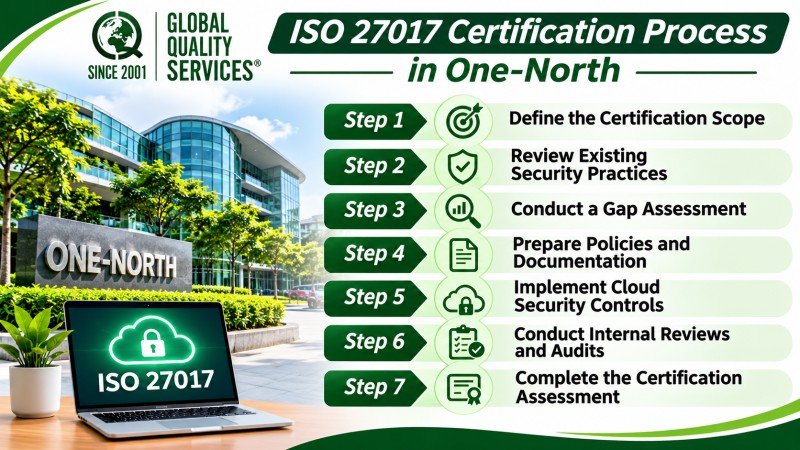
ISO 27017 Certification Process in One-North
Preparing for ISO 27017 requires more than reviewing cloud security policies. Your organization needs to identify its cloud services, understand its responsibilities, and apply the relevant controls. Global Quality Services can support your team with consulting and certification readiness.
Step 1: Define the Certification Scope
Identify the cloud services, systems, business units, and locations covered by your information security arrangements. Set clear boundaries for the assessment and identify the cloud service providers involved.
Step 2: Review Existing Security Practices
Examine your current information security policies, cloud contracts, access controls, and operational procedures. This review helps identify how your existing practices address cloud-specific security requirements.
Step 3: Conduct a Gap Assessment
Compare your current controls with the applicable ISO 27017 guidance. Identify missing controls, unclear responsibilities, and areas that need improvement before the certification assessment.
Step 4: Prepare Policies and Documentation
Develop or update the required policies, procedures, cloud service agreements, access records, and security documentation. Keep the documents relevant to your actual cloud services and business operations.
Step 5: Implement Cloud Security Controls
Apply the required controls across your cloud environment. Address administrative access, virtual machine security, separation of environments, asset management, and responsibilities shared with cloud providers.
Step 6: Conduct Internal Reviews and Audits
Review the implemented controls and check whether employees follow the documented procedures. Record audit findings, address gaps, and prepare supporting evidence for the external assessment.
Step 7: Complete the Certification Assessment
An independent certification body assesses the applicable information security management system and cloud-related controls. Your organization must address any findings before the certification body makes its certification decision.
How Global Quality Services Experts Help You with ISO 27017 Certification in One-North
Selecting an experienced consultant can make a difference when your organization works with multiple cloud platforms, providers, and customer security requirements. Global Quality Services is a reputed consultant in Singapore, offering ISO certification consulting, management system support, training, and assessment preparation.
The company identifies itself as a Singapore Certified Management Consultant and an ISO 27001 consulting firm. Its services cover information security and other management system standards. This background gives businesses access to consulting support that connects cloud security requirements with wider information security practices.
Choose Global Quality Services for ISO 27017 Certification in One-North
Are you looking to strengthen cloud security or meet customer requirements for your services in One-North? Discuss your certification plans with Global Quality Services. Our consultants can review your current arrangements, explain the applicable requirements, and help your team prepare for the assessment. Contact Global Quality Services to discuss your scope and request consulting support.
Frequently Asked Questions
1. Is ISO 27017 a standalone certification?
ISO 27017 provides cloud-specific security guidance and controls. Organizations generally apply it alongside ISO 27001 rather than treating it as a separate management system certification.
2. Does ISO 27017 apply to cloud service customers as well as providers?
Yes. The guidance addresses both parties. Cloud providers manage service-side security, while customers remain responsible for controls assigned to them under their cloud service arrangements.
3. Can a SaaS company in One-North benefit from ISO 27017?
Yes. SaaS companies can use its guidance to address cloud administration, virtual environments, access management, and responsibilities shared with infrastructure providers.
4. What is the difference between ISO 27001 and ISO 27017?
ISO 27001 specifies requirements for an Information Security Management System. ISO 27017 adds cloud-specific security guidance that organizations can apply alongside their broader ISMS controls.
5. Does ISO 27017 cover public, private, and hybrid cloud environments?
Its guidance addresses cloud computing services and the security responsibilities of providers and customers. Organizations should assess which controls apply to their particular cloud service models and arrangements.
6. Who conducts the ISO 27017 certification assessment?
An independent certification body conducts the formal assessment and makes the certification decision. A consultant such as Global Quality Services can support your preparation but does not issue the certificate.