Jurong East is a key commercial centre in western Singapore, connecting corporate offices, business parks, technology companies, and industrial operations. With nearby business and innovation clusters supporting manufacturing, engineering, research and digital services, organisations in this part of Singapore may handle personal information across customer platforms, employee systems, supplier networks and regional business operations.
For these organisations, ISO/IEC 27701:2025 Certification in Jurong East provides a recognised framework for establishing and maintaining a Privacy Information Management System (PIMS). Published on 14 October 2025, ISO/IEC 27701:2025 sets out requirements for managing personally identifiable information (PII) and addressing privacy responsibilities within an organisation’s operations.
Global Quality Services provides ISO/IEC 27701:2025 certification services for businesses in Jurong East, Singapore, seeking to demonstrate conformity with the standard and establish a structured approach to privacy management.
Privacy Management Certification for Businesses in Jurong East
Privacy risks are not limited to financial institutions or companies that collect customer information online. Manufacturing companies, technology providers, research organisations and business service firms may also process employee records, supplier contacts, visitor details, customer databases and other personal information.
ISO/IEC 27701:2025 provides a management system framework to identify relevant privacy responsibilities, establish appropriate controls, and evaluate the effectiveness of privacy management arrangements.
Why Jurong East Is a Relevant Location for Privacy Certification
Jurong East’s business environment provides a distinct context for privacy management. The wider western Singapore corridor includes commercial developments and industrial and innovation ecosystems where organisations may coordinate activities across offices, factories, research facilities and external service providers.
Business and Commercial Activity Around Jurong Gateway
Jurong Gateway is a major commercial and transport hub within the Jurong East area. Businesses operating in and around this district may maintain customer databases, employee records, vendor information and digital business systems across multiple departments.
A formal privacy management framework can establish consistent responsibilities for handling this information and maintaining appropriate documentation.
Nearby International Business Park
International Business Park is relevant to companies operating regional offices, technology functions and business services in western Singapore. Organisations with regional responsibilities may need to manage personal information across teams, vendors and business locations.
ISO/IEC 27701:2025 provides a framework for defining privacy responsibilities and evaluating relevant risks across the activities included in the certification scope.
Connection to Jurong Innovation District
JTC’s Jurong Innovation District supports advanced manufacturing, precision engineering, autonomous mobility and clean technology. These activities can involve connected production systems, workforce platforms, research processes and third-party technology providers.
For organisations in these sectors, privacy management can be relevant wherever personally identifiable information is processed. The standard addresses privacy management, not the certification of industrial equipment or the technical security of every connected system.
Business Areas Relevant to a Jurong East Certification Search
Organisations seeking ISO/IEC 27701:2025 Certification in Jurong East may operate in or around:
- Jurong Gateway and the Jurong East commercial centre
- International Business Park
- Jurong Town Hall Road and nearby business premises
- Nearby industrial and innovation clusters in western Singapore
The precise locations and facilities included in a certificate depend on the agreed scope and applicable certification requirements.
What Makes ISO/IEC 27701:2025 Different From ISO/IEC 27001?
Although ISO/IEC 27701:2025 and ISO/IEC 27001 both address management systems, they have different primary purposes.
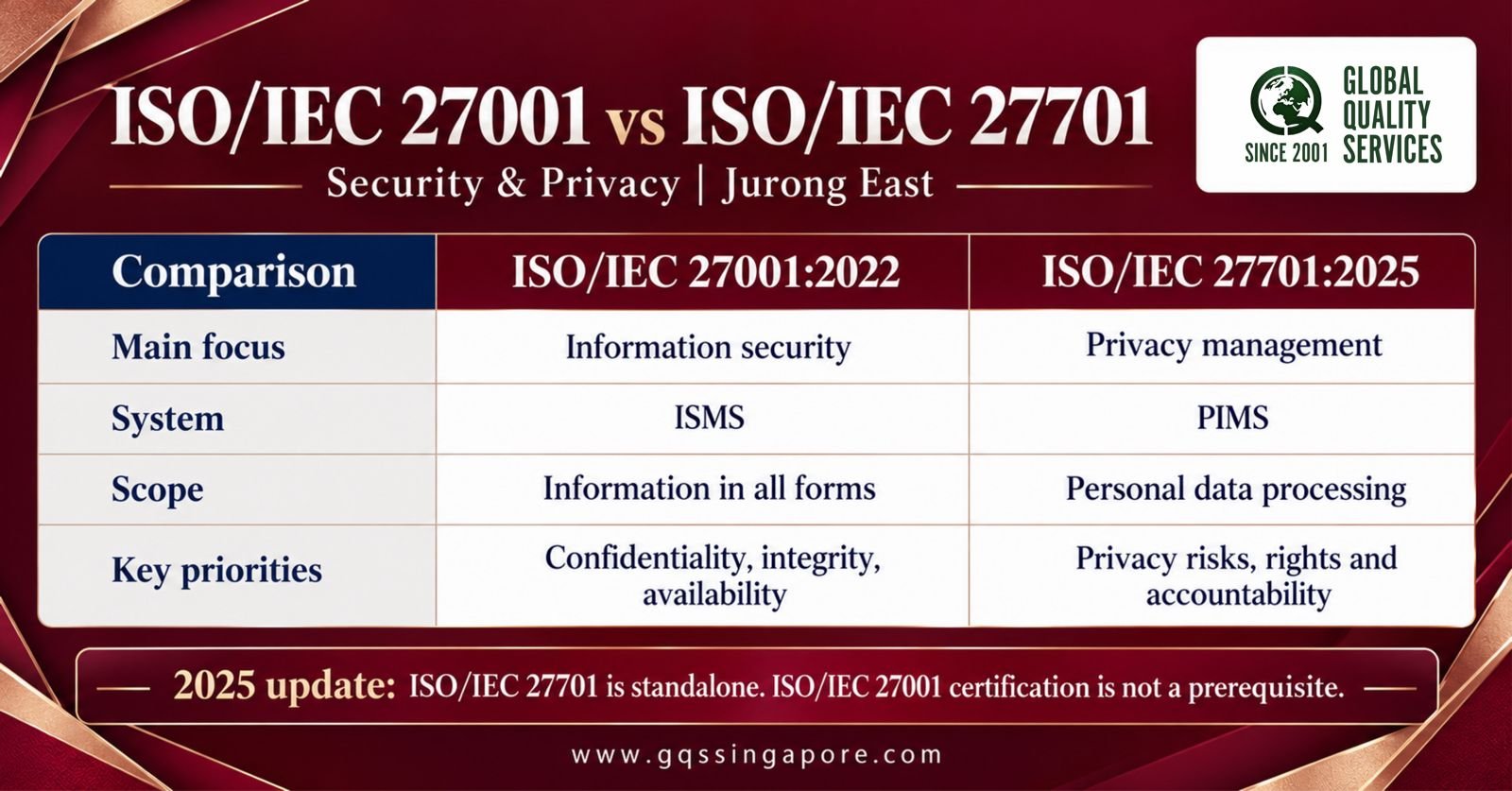
The two standards can complement each other when an organisation needs to manage both privacy and wider information security risks. However, an ISO/IEC 27001 certificate does not automatically establish conformity with ISO/IEC 27701:2025.
Which Jurong East Businesses Can Pursue ISO/IEC 27701:2025 Certification?
The standard can be relevant to organisations that determine the purposes and means of processing personal information, process it on behalf of other organisations, or perform both roles.
Potential applicants include:
- Manufacturing and engineering companies: Businesses managing employee records, customer contacts, contractor information and supplier databases.
- Technology and software providers: Companies processing personal information through cloud services, enterprise applications and digital platforms.
- Research and innovation organisations: Businesses handling participant details, employee information and personal data associated with research activities.
- Logistics and supply chain companies: Organisations managing delivery contacts, workforce records, customer details and business partner information.
- Corporate and professional service firms: Companies processing client records, recruitment information, payroll data and confidential business documentation.
- Healthcare-related and life sciences businesses: Organisations handling personal information within their relevant operational and regulatory requirements.
Certification is based on the agreed scope of the Privacy Information Management System. The organisation must identify the relevant activities, locations and processing responsibilities rather than assume that every business function is automatically covered.
Benefits of ISO/IEC 27701:2025 Certification in Jurong East
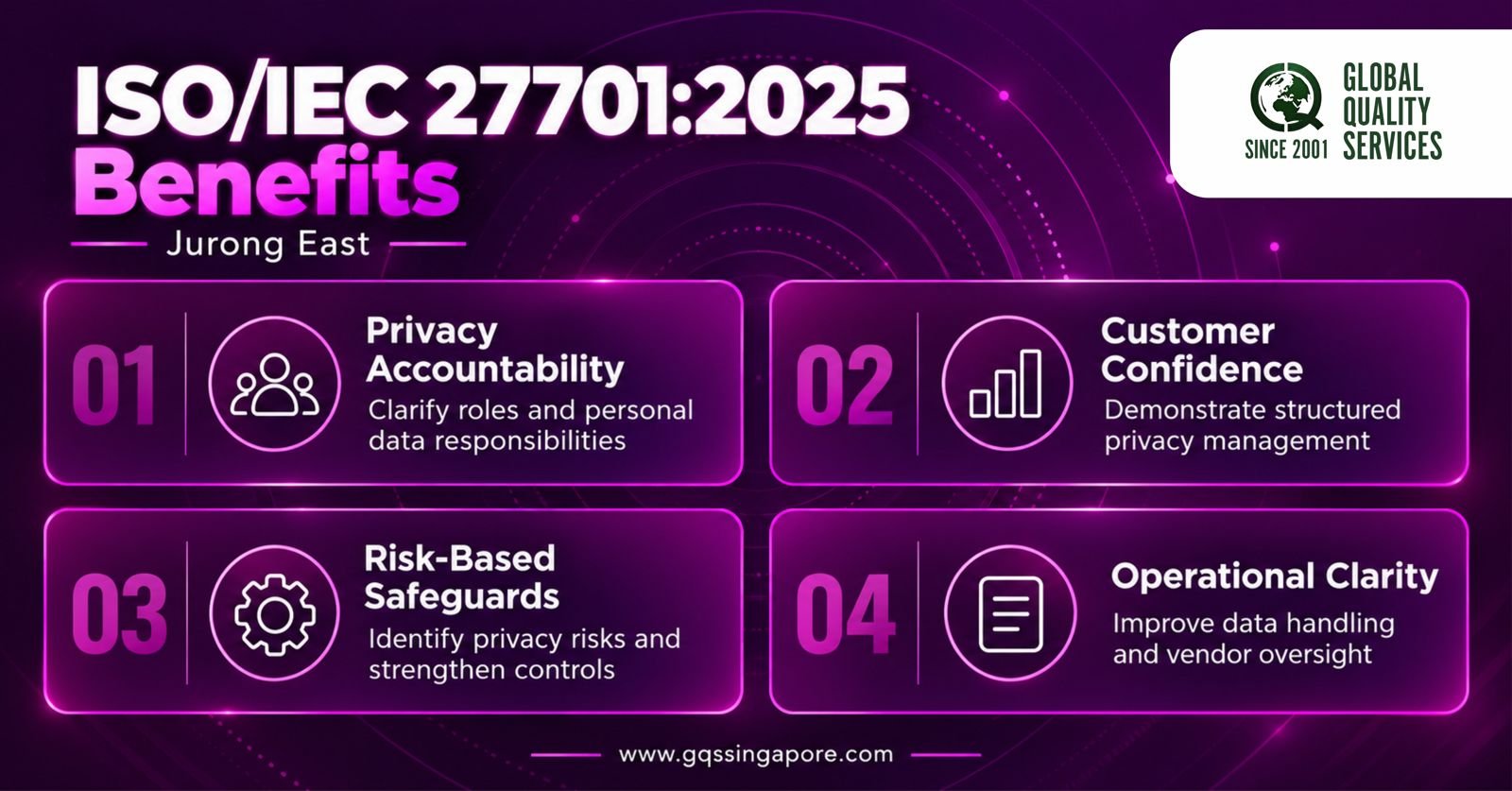
For businesses in manufacturing, technology, research, and professional services, privacy management can affect internal governance and external business relationships. The key benefits include:
More Consistent Handling of Personal Information
A documented PIMS establishes defined responsibilities and processes for managing personal information. This can reduce inconsistencies between departments and make privacy-related activities easier to monitor.
Greater Visibility Into Third-Party Data Processing
Organisations often rely on external payroll providers, software vendors, cloud platforms and outsourced service providers. A structured privacy management approach helps establish oversight of relevant processing arrangements and associated responsibilities.
Stronger Evidence for Customer and Supplier Reviews
Certification can provide independent evidence that the organisation’s PIMS has been assessed against ISO/IEC 27701:2025 within its stated scope. This can be useful when responding to privacy-related supplier assessments, enterprise procurement requirements and customer enquiries.
Better Management of Privacy Risks During Business Expansion
When companies introduce new services, expand operations or adopt new digital platforms, their personal information processing activities may change. A management system provides a repeatable approach to evaluating privacy risks and reviewing relevant processes.
Clearer Accountability for Privacy Responsibilities
Defined roles, documented procedures and management reviews help establish ownership of privacy-related activities. This can improve coordination between business teams, IT functions, management and external processors.
Certification does not guarantee that privacy incidents will never occur or automatically establish compliance with every applicable law. Its value depends on effectively implementing and maintaining the management system.
ISO/IEC 27701:2019 Certificate Holders: Preparing for the 2025 Edition
Organisations already certified to ISO/IEC 27701:2019 should review their existing management system and certification arrangements against ISO/IEC 27701:2025.
The 2025 edition is a standalone management system standard, unlike the 2019 edition, which extended ISO/IEC 27001 and ISO/IEC 27002 requirements to privacy information management.
Before planning a transition or new certification assessment, organisations should:
- Review the requirements of the 2025 edition and identify changes needed to existing documentation and processes.
- Reassess the certification scope to reflect current business activities and PII processing responsibilities.
- Determine how existing information security management arrangements relate to the privacy management system.
- Confirm applicable transition, audit and certification requirements with the relevant certification provider.
An existing ISO/IEC 27001 certificate does not automatically establish conformity with ISO/IEC 27701:2025. Transition planning should follow the applicable certification and accreditation requirements.
How Global Quality Services Approaches ISO/IEC 27701:2025 Certification
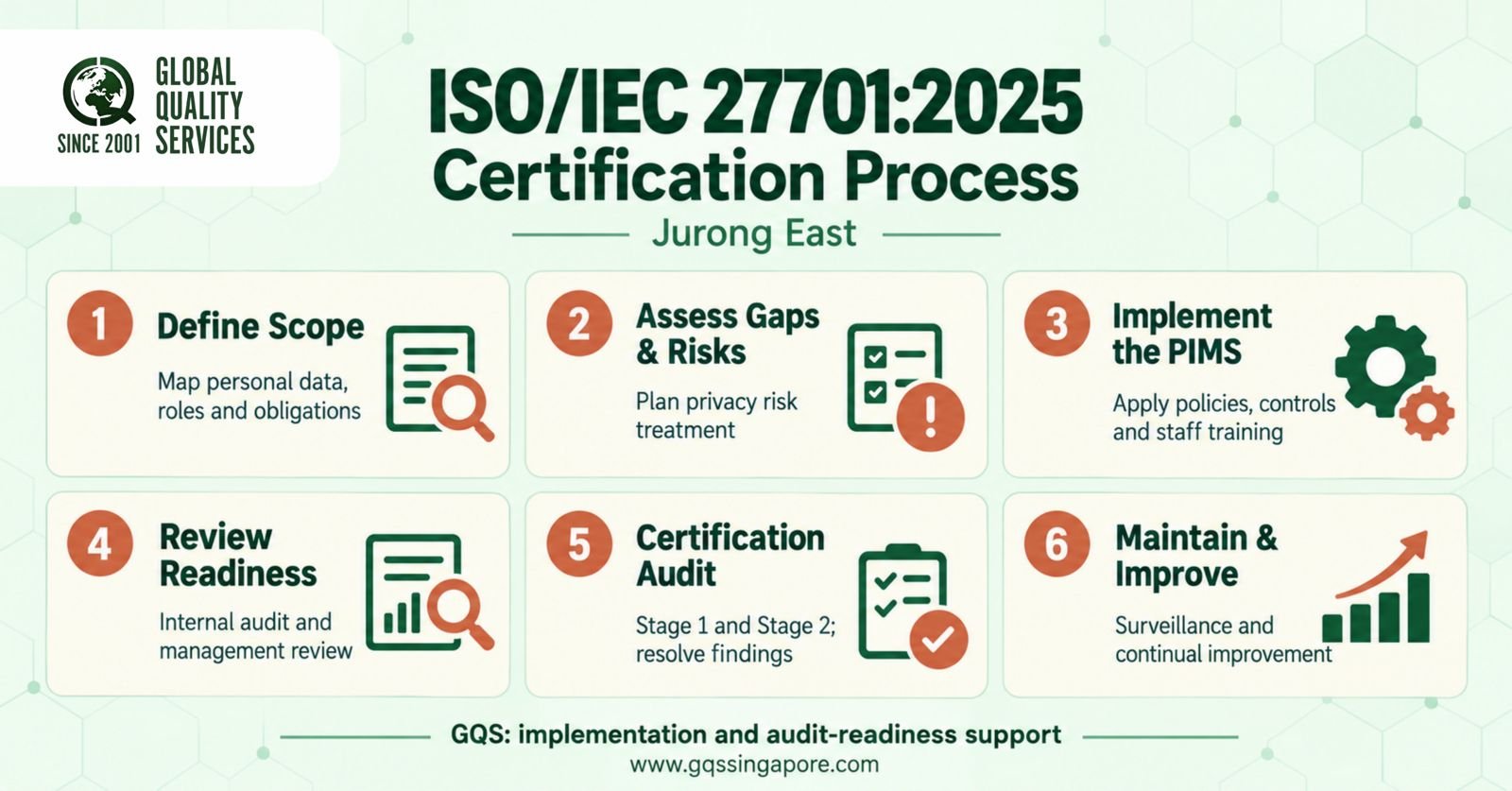
Global Quality Services offers certification services for organisations seeking to demonstrate conformity with applicable management system requirements. For applicants in Jurong East, the certification engagement should reflect the organisation’s activities, privacy responsibilities and intended scope.
Step 1: Establish the Certification Boundary
Identify the business functions, operating locations, services and personal information processing activities that will be covered. Organisations with both office-based and industrial operations should ensure the proposed scope accurately represents the activities included.
Step 2: Evaluate the Existing Privacy Management System
Review the organisation’s current policies, risk assessment arrangements, assigned responsibilities, processing records and relevant operational controls against the applicable requirements of ISO/IEC 27701:2025.
Step 3: Assess Conformity Through an Audit
The certification audit evaluates the management system against the applicable requirements. The assessment considers documented information and objective evidence relevant to the agreed scope.
Step 4: Resolve Identified Nonconformities
Where nonconformities are identified, the organisation must address them through appropriate corrective action and provide evidence for review in accordance with the certification process.
Step 5: Complete the Certification Decision
Certification can be granted after the applicable requirements have been satisfied and the required certification decision has been completed. Any ongoing surveillance and follow-up activities are determined by the relevant certification arrangements.
ISO/IEC 27701:2025 and Singapore’s PDPA
Organisations in Jurong East should consider their privacy management arrangements alongside Singapore’s Personal Data Protection Act 2012 (PDPA). The PDPA sets out obligations for organisations handling personal data within its scope, subject to applicable provisions and exceptions.
Depending on their activities, businesses may need to address requirements relating to consent, purpose limitation, protection, retention, access and correction, and transfers of personal data outside Singapore.
ISO/IEC 27701:2025 provides a framework for organising privacy responsibilities and maintaining a systematic management approach. It does not replace a legal assessment of PDPA obligations or other privacy laws that may apply to cross-border operations.
For businesses working with overseas customers, regional offices, or external processors, assess the relevant legal requirements separately from the certification process.
Begin Your ISO/IEC 27701:2025 Certification Journey in Jurong East
Businesses in Jurong East operate across a varied commercial and industrial landscape, from corporate offices and technology services to engineering and innovation activities. A well-defined Privacy Information Management System can establish a consistent approach to managing personal information across these different operating environments.
Global Quality Services provides certification services for organisations seeking to demonstrate conformity with ISO/IEC 27701:2025. The appropriate scope depends on the organisation’s activities, the information it processes and the applicable certification requirements.
Contact Global Quality Services to discuss ISO/IEC 27701:2025 Certification in Jurong East, Singapore, and establish the next steps for your organisation.
Frequently Asked Questions
1. Can a manufacturing company in Jurong East obtain ISO/IEC 27701:2025 certification without being a technology company?
Yes. The standard is not restricted to technology businesses. A manufacturing company may process employee information, contractor details, customer records and supplier contact information. Its suitability for certification depends on the organisation’s privacy responsibilities and the scope of its proposed PIMS.
2. Can ISO/IEC 27701:2025 certification cover our office and factory at different locations?
Potentially, yes. Multiple facilities may be included if permitted by the applicable certification arrangements and accurately defined in the scope. The assessment should account for the activities conducted at each location and how the organisation manages privacy responsibilities across them.
3. Will ISO/IEC 27701:2025 certification make our company compliant with Singapore’s PDPA?
No. Certification demonstrates conformity with the applicable requirements of the standard within the certified scope. Organisations must separately assess their legal obligations under the PDPA and implement the measures needed to meet those obligations.
4. Can our company obtain ISO/IEC 27701:2025 certification before completing an ISO/IEC 27001 certification?
ISO/IEC 27701:2025 is a standalone management system standard, so ISO/IEC 27001 certification is not a prerequisite under the 2025 edition. The organisation must nevertheless meet the applicable ISO/IEC 27701:2025 requirements and the certification provider’s relevant arrangements.
5. How should we select the scope of ISO/IEC 27701:2025 certification for a business with several departments?
Start by identifying the personal information processing activities, business functions, operating locations and privacy responsibilities that need to be covered. Consider how information moves between departments and external processors, then define a scope that accurately reflects the intended management system. The final scope should be reviewed against the applicable standard and certification requirements.