
Tanjong Pagar is a mixed-use business precinct at the gateway to Singapore’s Central Business District, bringing together office towers, hotels, professional service firms, and commercial establishments. As companies manage client records, employee information, business contacts, and data shared with external service providers, privacy management becomes an important part of operational governance.
For organizations seeking ISO/IEC 27701:2025 Certification in Tanjong Pagar, the standard provides a structured framework for managing personally identifiable information (PII) and establishing accountability for privacy-related activities. Published on October 14, 2025, ISO/IEC 27701:2025 specifies requirements for establishing, implementing, maintaining, and continually improving a Privacy Information Management System (PIMS).
Global Quality Services provides certification services for businesses in Tanjong Pagar, Singapore, that want to demonstrate conformity with this international standard and strengthen their approach to privacy information management.
Privacy Information Management for Organizations in Tanjong Pagar
Organizations often exchange personal information across departments, business partners, customer platforms, and outsourced service providers. Managing these activities requires more than a privacy policy. Businesses need defined responsibilities, documented processes, and a systematic way to evaluate whether their privacy management arrangements meet applicable requirements.
ISO/IEC 27701:2025 establishes a management system framework for organizations that determine how personal information is processed, those that process it on behalf of others, and businesses that perform both roles.
Which Organizations Should Consider ISO/IEC 27701:2025 Certification?
The standard applies to organizations of different sizes and across industries. In Tanjong Pagar, it may be relevant to:
- Corporate and professional service firms: Organizations managing client files, contact databases, recruitment records, and confidential business correspondence.
- Financial and fintech businesses: Companies processing customer identification information, account records, and other personal financial data.
- Technology and software providers: Businesses handling personal information through cloud platforms, enterprise applications, and outsourced digital services.
- Hotels and hospitality companies: Organizations managing guest details, reservation records, and customer service information.
- Property and facilities management companies: Businesses processing tenant information, contractor records, employee details, and visitor data.
- Regional headquarters and multinational companies: Organizations coordinating privacy responsibilities across departments, subsidiaries, and international business operations.
Certification scope should reflect the organization’s actual processing activities, operating locations, and privacy responsibilities. The standard is not restricted to a particular industry or company size.
Why Tanjong Pagar Businesses Need a Structured Privacy Framework
Tanjong Pagar combines established commercial activity with newer mixed-use developments. The Urban Redevelopment Authority’s planning initiatives for the Anson-Tanjong Pagar area include new homes, public spaces, and changes to existing office developments. This evolving business environment makes it useful for organizations to establish privacy processes that can accommodate changing operations and service arrangements.
Managing Information Across Business Relationships
Companies in Tanjong Pagar may work with customers, regional offices, payroll providers, cloud vendors, and external processors. A formal PIMS helps define privacy responsibilities and establish processes for reviewing relevant data processing arrangements.
Maintaining Accountability Across Departments
Human resources, finance, sales, customer service, and IT departments may handle different categories of personal information. A structured management system helps clarify responsibilities and establish consistent procedures across the functions included in the certification scope.
Addressing Customer and Contractual Expectations
Enterprise clients and business partners may request evidence of privacy controls before entering into commercial agreements. Certification can demonstrate that the organization’s PIMS has been assessed against ISO/IEC 27701:2025 within the scope stated on its certificate.
Supporting Business Changes
Organizations may introduce new digital services, change vendors, expand their workforce, or establish operations in other markets. A documented privacy management framework provides a consistent basis for reviewing relevant risks and updating processes when business activities change.
Benefits of ISO/IEC 27701:2025 Certification in Tanjong Pagar
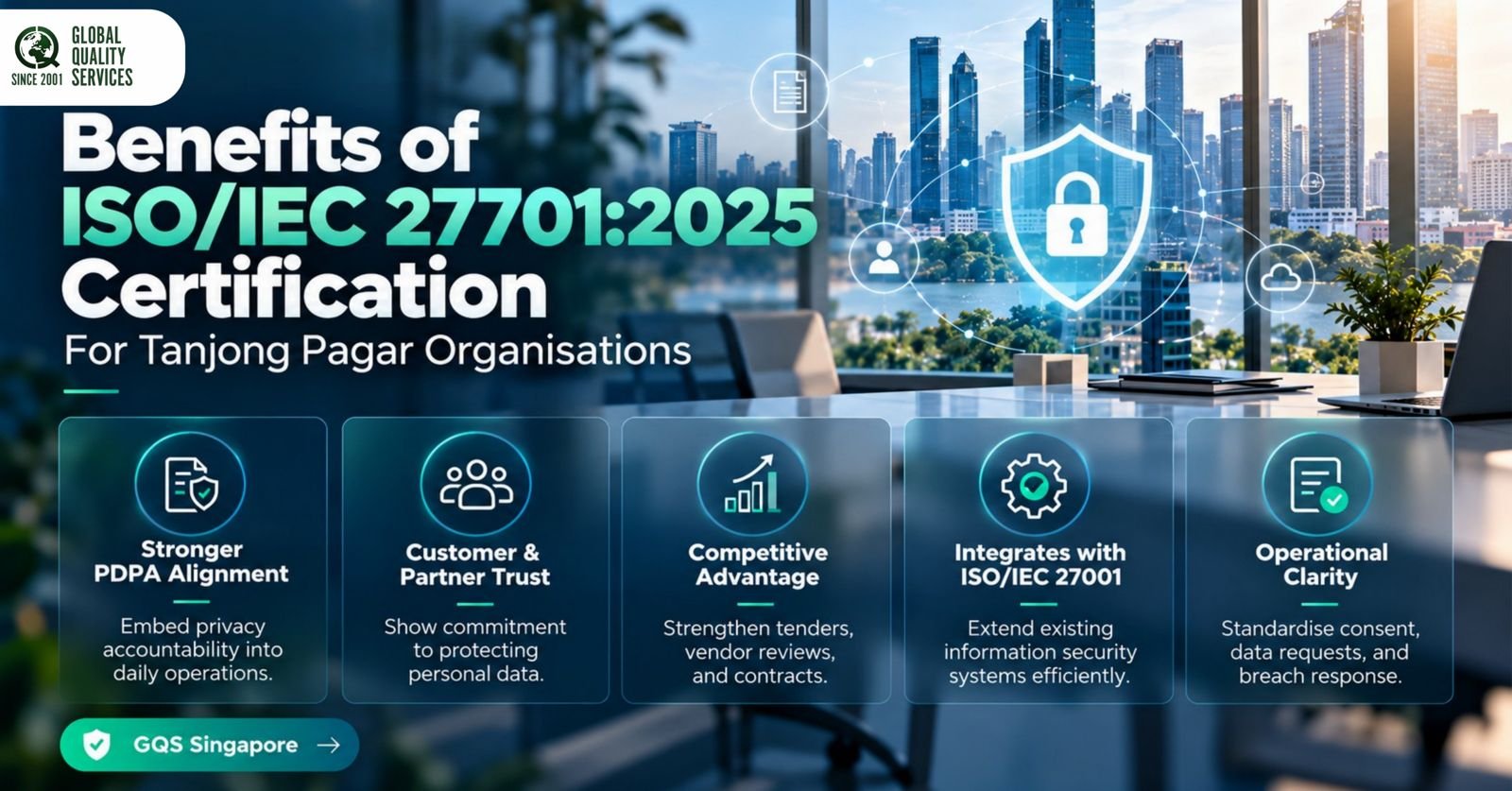
Certification can provide both operational and commercial value when privacy management is integrated into an organization’s regular business activities.
Improved Oversight of Personal Information
A PIMS helps organizations establish visibility into how personal information is handled, which responsibilities apply, and what processes govern its use. This can make privacy-related activities easier to monitor and review.
More Defensible Privacy Management Decisions
Documented responsibilities, risk assessments, and management reviews create evidence of how privacy-related decisions are made. This supports accountability and provides a clearer basis for reviewing the effectiveness of established processes.
Better Coordination With External Processors
Organizations often rely on third parties to host systems, maintain customer databases, administer payroll, or provide outsourced services. A structured framework helps businesses evaluate relevant relationships and clarify privacy responsibilities.
Support for Client Due Diligence
A valid certificate can provide independent evidence of conformity with the standard within the certified scope. This may be useful when responding to supplier evaluations, privacy questionnaires, and contractual requirements.
A Repeatable Approach to Continual Improvement
A management system establishes a process for reviewing performance, identifying gaps, and implementing corrective actions. This allows organizations to evaluate their privacy arrangements as their activities and processing risks evolve.
Certification does not guarantee that privacy incidents will not occur or automatically establish compliance with every applicable data protection law.
ISO/IEC 27701:2025 Certification Requirements: What Should Organizations Evaluate?
Preparing for certification involves evaluating the organization’s existing management arrangements against the requirements relevant to its PIMS.
Organizational Context and Leadership
The organization should determine the relevant internal and external factors affecting its PIMS, establish applicable responsibilities, and define the scope and objectives of its management system.
Privacy Risk Assessment and Treatment
Relevant privacy risks should be identified and evaluated, with appropriate measures determined according to the organization’s circumstances and applicable requirements.
Personal Information Processing Responsibilities
The organization should establish how its responsibilities as a personal information controller, processor, or both are addressed within the management system. Relevant processes and documented information should reflect the activities included in scope.
Monitoring, Evaluation, and Corrective Action
The PIMS should include appropriate arrangements for evaluating performance, reviewing management system effectiveness, and addressing identified nonconformities.
The precise requirements and evidence needed depend on the standard, the organization’s activities, and the defined certification scope.
How to Prepare for ISO/IEC 27701:2025 Certification in Tanjong Pagar
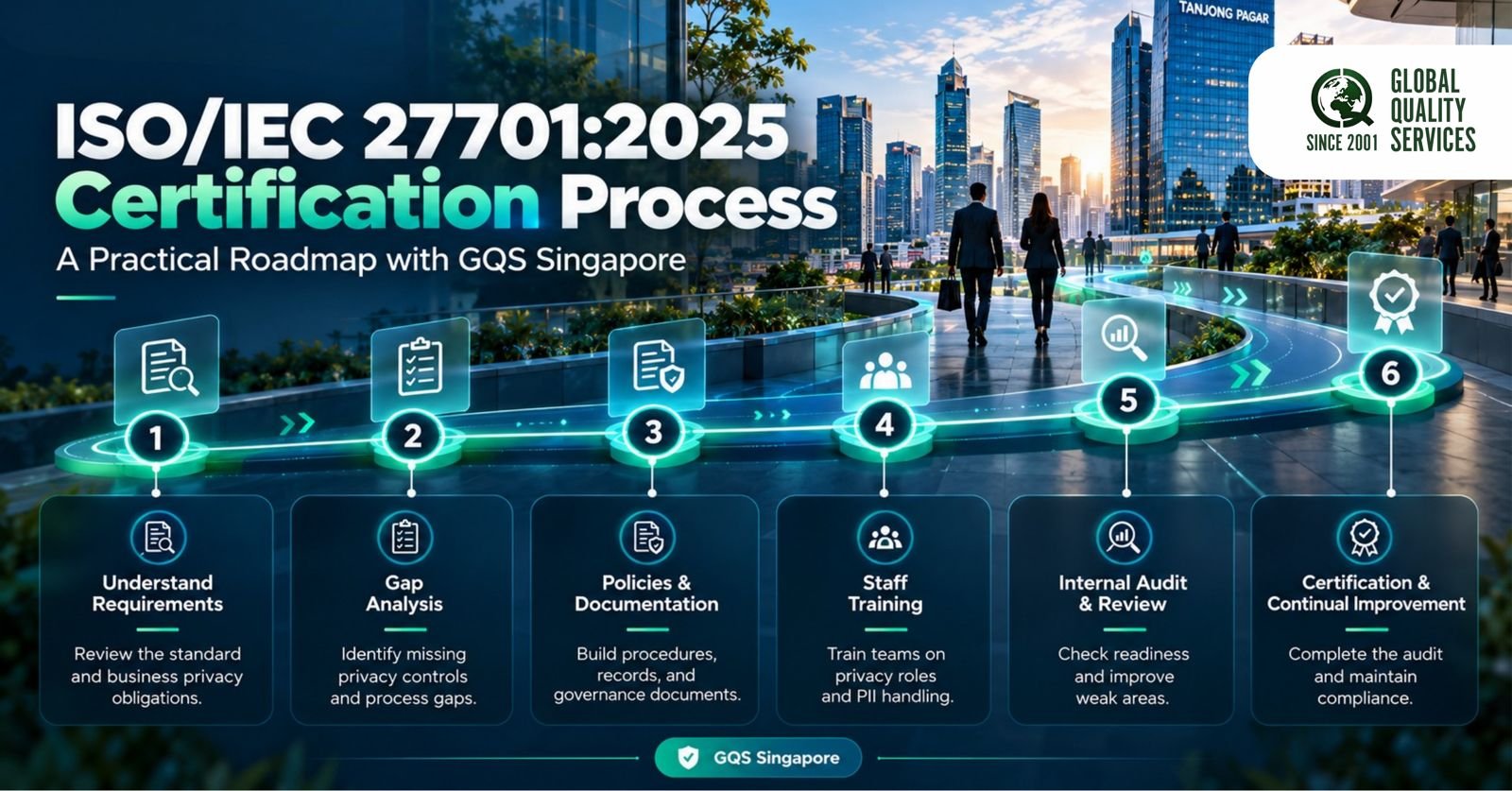
A well-defined preparation process helps organizations understand their current position before the certification audit.
- 1. Define the certification scope. Identify the business functions, services, locations, and personal information processing activities to be covered.
- 2. Review existing privacy processes. Evaluate relevant policies, responsibilities, risk assessments, processing records, and third-party arrangements against the applicable requirements.
- 3. Identify gaps. Determine where existing arrangements do not meet the requirements of ISO/IEC 27701:2025 and establish appropriate corrective actions.
- 4. Maintain objective evidence. Keep relevant records demonstrating how the PIMS is established, operated, monitored, and reviewed.
- 5. Arrange the certification audit. Discuss the proposed scope and assessment arrangements with Global Quality Services. The audit evaluates conformity with the applicable requirements.
- 6. Complete corrective actions and certification review. Address any nonconformities identified during the assessment. Certification is granted only after the applicable requirements have been satisfied and the required certification decision has been completed.
ISO/IEC 27701:2025 and Singapore’s Personal Data Protection Act
Organizations operating in Tanjong Pagar should evaluate their privacy management arrangements alongside Singapore’s Personal Data Protection Act 2012 (PDPA).
The PDPA establishes obligations relating to personal data handled by organizations within its scope, subject to applicable provisions and exceptions. Depending on their activities, businesses may need to address consent, purpose limitation, protection, retention, access and correction, and transfers of personal data outside Singapore.
ISO/IEC 27701:2025 provides a management system framework for organizing privacy responsibilities and managing relevant risks. It does not replace legal advice or automatically demonstrate compliance with every PDPA obligation.
Businesses with overseas customers, regional offices, or international service providers should also evaluate the privacy laws applicable to their activities in other jurisdictions.
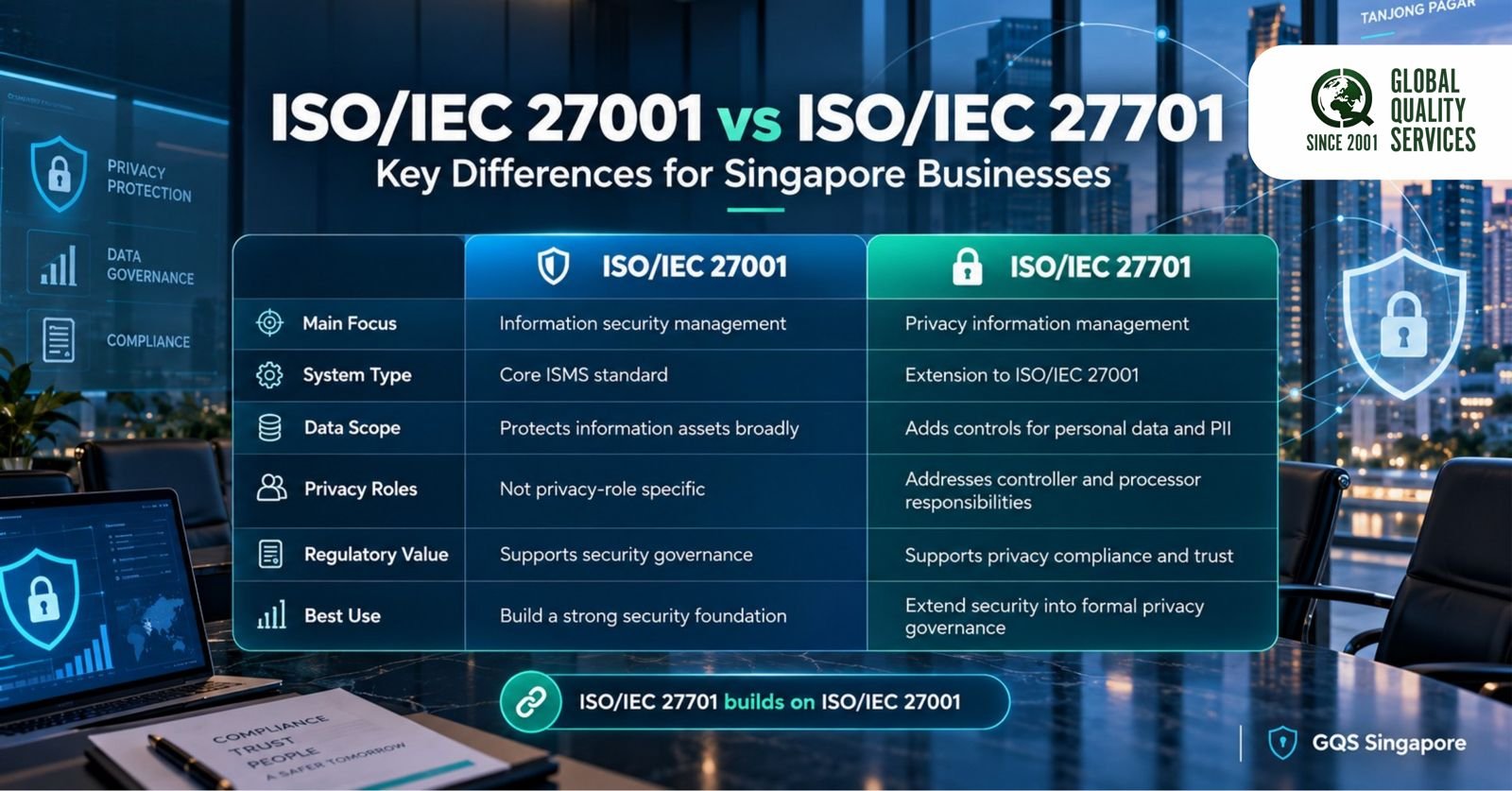
ISO/IEC 27701:2025 vs. ISO/IEC 27001
Organizations evaluating privacy certification may also be considering ISO/IEC 27001. Although the standards can complement each other, they address different management system objectives.
Why Choose Global Quality Services for ISO/IEC 27701:2025 Certification in Tanjong Pagar?
Global Quality Services provides certification services for organizations seeking to demonstrate conformity with applicable management system standards.
For businesses in Tanjong Pagar, the certification engagement should reflect the organization’s processing activities, privacy responsibilities, and intended scope. This is particularly relevant to businesses with multiple departments, outsourced operations, or regional business relationships.
Organizations can discuss their existing management arrangements, current certifications, proposed scope, and assessment requirements with Global Quality Services before proceeding.
Contact Global Quality Services to discuss ISO/IEC 27701:2025 Certification in Tanjong Pagar, Singapore, and determine the appropriate certification scope for your organization.
Frequently Asked Questions
1. Can a company in Tanjong Pagar include its overseas operations in an ISO/IEC 27701:2025 certification scope?
Potentially, yes. The proposed scope may include multiple locations or operations where permitted by the applicable certification arrangements. The organization must clearly define the activities covered and demonstrate how the PIMS applies across those operations. The final scope is subject to the relevant assessment and certification requirements.
2. Does ISO/IEC 27701:2025 certification cover employee personal information as well as customer data?
It can cover both, provided the relevant processing activities fall within the defined PIMS scope. Organizations should consider employee records, recruitment information, payroll data, customer details, and other personal information handled within the business functions being assessed.
3. Can we pursue ISO/IEC 27701:2025 certification if our company outsources most of its IT operations?
Yes. Outsourcing IT operations does not automatically prevent an organization from obtaining certification. The organization must evaluate its own privacy responsibilities and relevant relationships with external providers. The certification scope and assessment should account for applicable processing activities and associated responsibilities.
4. What happens if our business changes its services after obtaining ISO/IEC 27701:2025 certification?
Changes to services, processing activities, locations, or organizational structure may affect the certified scope or the PIMS. The organization should evaluate the changes and notify its certification provider when required. Any necessary scope review or additional assessment will depend on the nature of the change and the applicable certification arrangements.
5. How can we confirm that a certification provider is accredited for ISO/IEC 27701:2025?
Ask the provider for details of its certification scope and relevant accreditation. Verify the accreditation directly through the issuing accreditation body’s official records, checking that it covers ISO/IEC 27701:2025 and the proposed scope where accreditation is required. A general accreditation statement should not be treated as proof that every standard is covered.