Food warehouses in Jurong East must maintain proper storage conditions, hygiene controls, and stock handling practices to protect food quality. Businesses that overlook these requirements risk contamination, product spoilage, stock losses, and regulatory concerns. Singapore’s food safety framework makes good warehousing practices an important part of responsible food storage.
According to the National Environment Agency (NEA), Singapore generated 790,000 tonnes of food waste in 2025, while the recycling rate remained at 18%. Poor storage conditions and inadequate stock management can add to avoidable food losses. For food importers, distributors, wholesalers, and warehouse operators, effective GWP controls help protect inventory and maintain product quality.
Jurong East connects businesses to Singapore’s growing western commercial and industrial region. As food supply chains expand, warehouses need reliable systems to manage storage risks. Global Quality Services provides specialized GWP consultancy in Jurong East to help businesses meet SFA guidelines and strengthen warehouse operations. Read on to understand the requirements and how our consultants can support your business.
What is GWP and Why Does It Matter for Food Warehouses
Good Warehousing Practices (GWP) refers to guidelines that help food businesses maintain hygienic storage facilities and protect products during warehousing. The Singapore Food Agency (SFA) provides GWP guidelines for food storage warehouse operators.
GWP covers the physical condition of storage facilities, food handling practices, temperature management, pest prevention, cleaning, and stock control. These requirements help businesses prevent contamination and maintain suitable conditions throughout storage.
For businesses in Jurong East, GWP compliance supports:
- Better control over food storage conditions.
- Reduced risk of contamination and spoilage.
- Consistent warehouse hygiene.
- Improved stock rotation and inventory management.
- Clear responsibilities for warehouse employees.
- Stronger food safety practices across storage operations.
Who Needs GWP Consultancy in Jurong East
GWP applies to businesses that store and handle food products. Our consultancy supports:
- Food importers and distributors.
- Registered food storage warehouse operators.
- Chilled and frozen food storage facilities.
- Dry food warehouses.
- Food wholesalers and suppliers.
- Supermarket distribution centers.
- Third-party logistics providers handling food.
- Food supply chain businesses.
Whether you manage a dedicated food warehouse or operate a storage facility as part of a wider distribution business, suitable warehousing controls help protect your products and customers.
Key SFA Good Warehousing Practices Requirements
SFA’s GWP guidelines address several important areas of food warehouse management. Businesses should review these requirements against their actual storage activities.
1. Warehouse Premises and Layout
Maintain suitable storage space, cleanable surfaces, proper ventilation, adequate lighting, and facilities that prevent pest entry and contamination.
2. Cleaning and Sanitation
Establish cleaning schedules, housekeeping controls, sanitation procedures, and records for storage areas and equipment.
3. Temperature and Storage Conditions
Maintain suitable chiller and freezer temperatures according to food requirements. Monitor storage conditions and retain temperature records.
4. Pest Prevention
Control pest entry through suitable barriers, inspections, housekeeping, and pest management arrangements.
5. Food Handling and Stock Rotation
Separate food from non-food materials, protect products from contamination, and follow FIFO or FEFO stock rotation practices.
6. Employee Hygiene
Set clear hygiene rules for employees who handle, move, and store food products. Provide relevant training and supervision.
7. Documentation and Records
Maintain cleaning schedules, temperature logs, pest control reports, stock records, and other documents that demonstrate consistent warehouse practices.
GWP Implementation Process for Businesses in Jurong East
Global Quality Services follows a five-step approach to help businesses improve their warehouse practices:
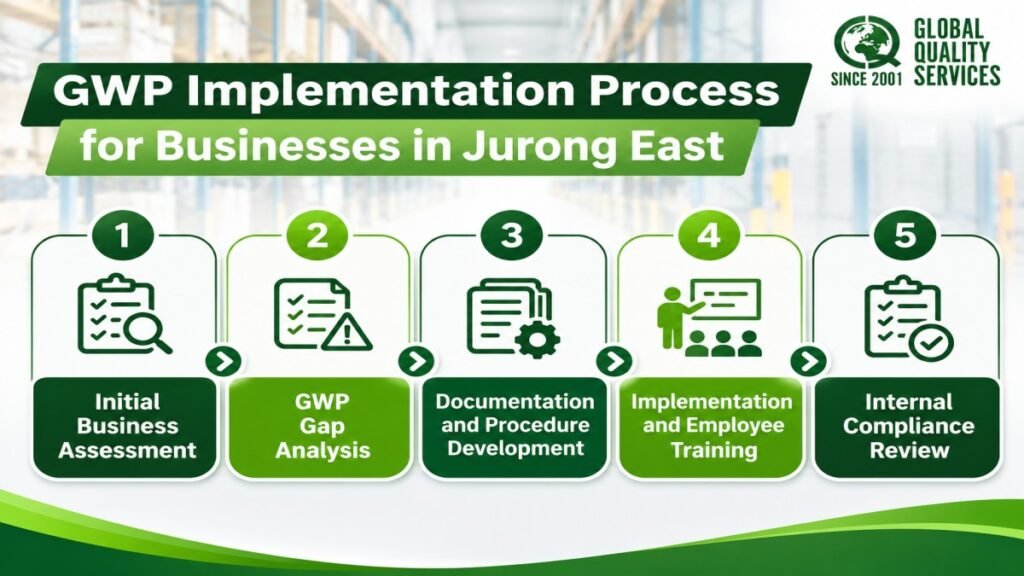
Step 1: Initial Business Assessment
We review your business activities, food categories, warehouse layout, storage conditions, and existing operating procedures.
Step 2: GWP Gap Analysis
Our consultants compare your current practices with applicable SFA guidelines and identify areas that need attention.
Step 3: Documentation and Procedure Development
We help prepare relevant warehouse procedures, cleaning schedules, temperature records, pest control records, and stock management documents.
Step 4: Implementation and Employee Training
We guide your team on warehouse hygiene, food storage, temperature monitoring, stock rotation, and employee responsibilities.
Step 5: Internal Compliance Review
We review your warehouse practices and supporting records. Our consultants help address outstanding gaps and prepare your team for applicable compliance checks.
GWP Compliance Considerations for Businesses in Jurong East
Jurong East forms part of Singapore’s western growth region, where Jurong Lake District, Jurong Innovation District, and the wider Tuas industrial area support business and industrial development. This creates a relevant operating context for companies involved in manufacturing, distribution, and supply chain services. Food businesses in this region should pay particular attention to:
- Multiple storage requirements: Businesses handling dry, chilled, and frozen products need suitable arrangements for each category.
- Inventory movement: Frequent receiving and dispatch activities require clear stock identification and rotation controls.
- Cold chain continuity: Chilled and frozen products need suitable temperature conditions during storage and transfer.
- Shared warehouse responsibilities: Businesses using third-party storage facilities should define hygiene, handling, and record-keeping responsibilities.
- Product traceability: Clear batch identification and stock records help businesses investigate complaints and manage product withdrawals.
GWP and ISO 22000: How Do They Support Food Safety?
GWP focuses on hygienic food storage and warehouse management. However, businesses that want a broader food safety management framework can also consider ISO 22000 certification.
ISO 22000 covers food safety hazards, management responsibilities, operational controls, and supply chain communication. It provides a wider management system for organizations involved in food production, storage, and distribution.
Businesses can assess both frameworks based on their activities, customer expectations, and food safety objectives. Global Quality Services also provides consultancy for ISO 22000 to help food businesses strengthen their food safety management systems.
Documents Required for GWP Compliance
Good warehouse practices need clear records that employees can maintain during normal operations. SFA also provides guidance on the warehouse layout information that applicants should prepare for food storage warehouse registration. Your documentation should cover:
- Warehouse floor plan with company details and full address.
- Unit numbers, storage rooms, office, toilets, and entrances.
- Rack, pallet, and shelving positions.
- Total warehouse floor area.
- Ambient or air-conditioned storage details.
- Chiller and freezer locations with temperature details.
- Cleaning and sanitation schedules.
- Temperature monitoring records.
- Pest control reports.
- Stock movement and rotation records.
- Equipment maintenance records.
- Employee hygiene and training records.
How Global Quality Services Experts Help You with GWP Certification in Jurong East
Global Quality Services is a reputed consultant in management system consultancy, food safety, and compliance support. With more than 21 years of consultancy experience, we help businesses address industry requirements through practical guidance and professional expertise. Our strengths include:
- 26 Years of Experience: Established expertise in management system consultancy and compliance services.
- 17 Locations: International presence supporting clients across different markets.
- 1,450+ Customers: Experience serving businesses across multiple industries.
- Industry-Specific Expertise: Consultants with experience in food safety and management system requirements.
- Practical Consultancy: Recommendations based on actual business operations and compliance needs.
- End-to-End Client Support: Assistance with assessments, documentation, training, and audit preparation.
Speak with a GWP Consultant in Jurong East Today
Your warehouse practices directly affect food quality, inventory condition, and business reliability. Do not let gaps in hygiene, temperature control, or stock management create avoidable problems.
Choose Global Quality Services for professional GWP consultancy in Jurong East. Our reputed consultants will help you understand SFA requirements, assess your current warehouse practices, and identify the improvements your business needs. Contact Global Quality Services today to discuss your GWP requirements and request a consultancy proposal.
Frequently Asked Questions
1. Does GWP apply to warehouses that store packaged food?
Yes. Packaged food warehouses also need suitable hygiene, pest prevention, storage, and stock management controls. Packaging does not remove the risk of contamination or product deterioration.
2. Can a business outsource food storage and remain responsible for GWP practices?
Yes. Businesses should clearly define responsibilities with their third-party warehouse providers and verify that storage arrangements protect food quality and meet applicable requirements.
3. Can one warehouse store dry, chilled, and frozen food products?
Yes, where the facility provides suitable storage conditions and segregation for each product category. Businesses should prevent cross-contamination and maintain the required temperature conditions.
4. What should a warehouse do when its temperature monitoring equipment fails?
The warehouse should follow its documented contingency procedure, assess the affected products, record the incident, and take appropriate corrective action before releasing potentially affected stock.
5. Does GWP compliance replace food storage warehouse registration in Singapore?
No. GWP guidelines and SFA registration requirements serve different purposes. Businesses must check their applicable registration obligations and maintain the relevant food safety practices.