Wuhan has become a major industrial and commercial centre in Central China, with manufacturing spanning automotive production, electronics, machinery, electrical equipment, and advanced industrial technologies. Its position as a transportation and logistics hub also makes it an important sourcing destination for international buyers purchasing goods from Chinese manufacturers.
However, receiving products that do not match approved specifications can create serious challenges for importers. Manufacturing defects, incorrect quantities, inconsistent product quality and inadequate export packaging can affect delivery schedules and increase the cost of international trade.
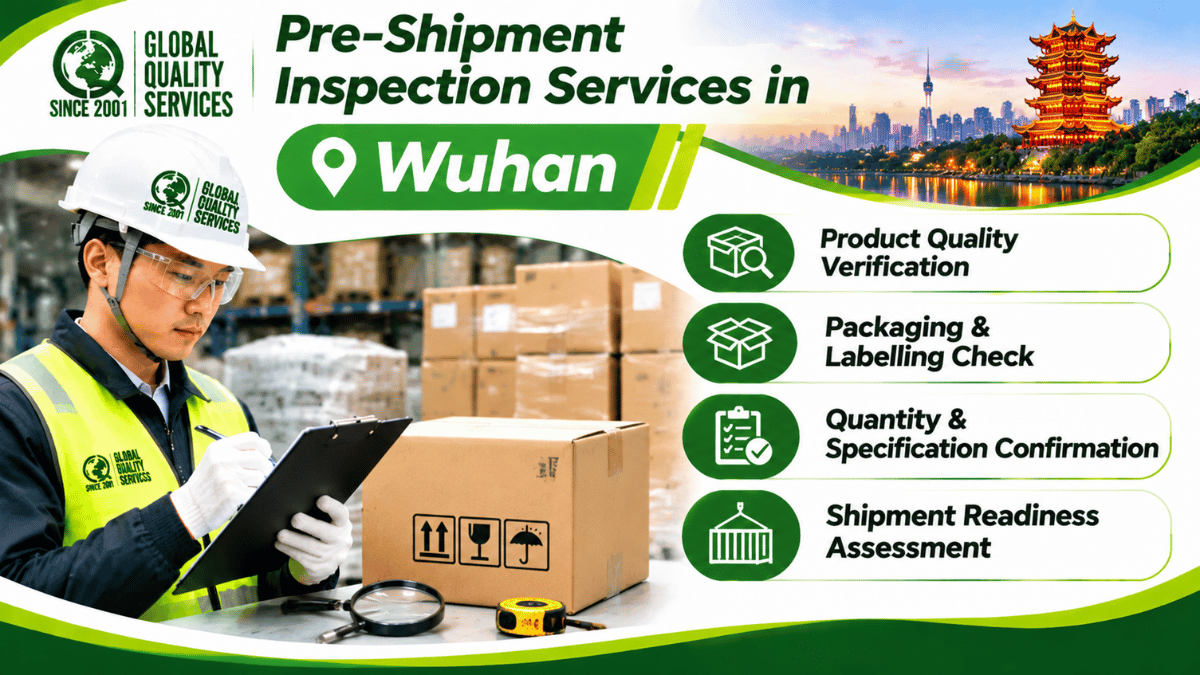
Global Quality Services Pte Ltd offers independent Pre-Shipment Inspection Services in Wuhan, China, helping international buyers assess finished products before shipment. Our third-party inspection services focus on evaluating goods against agreed purchase specifications, approved samples and buyer-defined quality requirements.
Whether your business imports automotive components, industrial machinery, electrical products, or general manufactured goods, an independent pre-shipment inspection provides documented information about your order’s condition before dispatch.
Why Importers Need Pre-Shipment Inspection in Wuhan
Working with manufacturers in another country involves quality considerations that may not be immediately visible during production. Even when suppliers follow established manufacturing procedures, individual orders can differ in workmanship, product specifications, finishing, and packaging.
A pre-shipment inspection provides buyers with an opportunity to evaluate completed products before they leave the factory. Some important reasons to arrange an inspection include:
- Verify finished product quality: Identify visible defects, poor workmanship and inconsistencies before shipment.
- Check purchase order compliance: Compare finished goods against the agreed specifications, quantities and product descriptions.
- Identify production discrepancies: Detect incorrect models, dimensions, materials or product configurations.
- Evaluate export packaging: Check whether cartons, protective materials and shipping labels meet the buyer’s requirements.
- Maintain supplier accountability: Share documented inspection findings with manufacturers when corrective action is required.
- Make informed shipment decisions: Use inspection results to evaluate whether goods meet the agreed acceptance criteria.
An inspection does not replace production quality control. Instead, it provides an additional quality verification stage before the completed order is dispatched.
Pre-Shipment Inspection Services We Provide in Wuhan
Our inspection services can be arranged for different product categories and manufacturing requirements. The inspection scope is established based on the buyer’s purchase order, product specifications, and agreed acceptance criteria.
1. Finished Product Quality Inspection
The inspection involves examining finished goods for visible defects, manufacturing inconsistencies and workmanship issues. Depending on the product, checks may include surface condition, assembly quality, finishing, product appearance and construction.
2. Product Specification and Measurement Inspection
Products are evaluated against approved specifications and reference samples. Measurements may include length, width, height, thickness, weight and other relevant dimensions.
This is particularly important for industrial components, automotive parts, fabricated products and equipment where dimensional accuracy affects compatibility and performance.
3. Quantity and Model Verification
We verify the number of finished products against the purchase order and packing details. The inspection can also cover model numbers, product variants, colours, sizes and other identification requirements.
This helps buyers identify shortages, incorrect assortments and discrepancies before shipment.
4. Functional Inspection and Basic Operational Testing
Where applicable, products undergo basic functional checks based on the agreed inspection requirements. These may include power-on checks, switching operations, movement, assembly verification and other relevant product functions.
For machinery and electrical products, the inspection scope can be defined according to the equipment type and available testing procedures.
5. Packaging Quality Inspection
Packaging plays an important role in protecting goods during storage, transportation and handling. We examine packaging conditions, carton strength, internal protection, product arrangement and visible packaging damage.
The inspection also considers whether the packaging meets the buyer’s agreed requirements.
6. Labelling and Shipping Mark Inspection
Product labels, carton markings, barcodes, handling instructions and shipping marks are checked against the provided packaging specifications.
Correct identification helps reduce confusion during cargo handling, warehouse receiving and distribution.
How Our Pre-Shipment Inspection Process Works
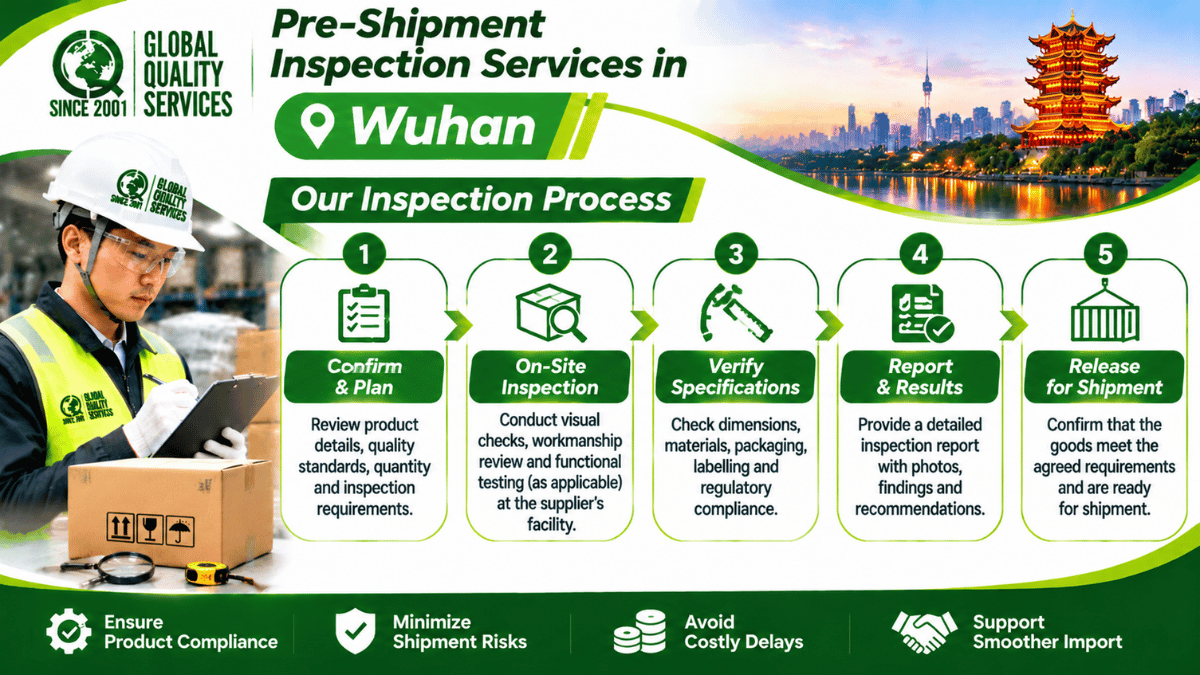
A clearly defined inspection procedure helps buyers and suppliers understand what will be evaluated and how the findings will be documented.
-
Understanding Your Inspection Requirements
We begin by reviewing the purchase order, product specifications, approved samples, inspection checklist and other relevant documents. This helps establish the inspection scope and acceptance requirements.
-
Coordinating with the Supplier
Inspection arrangements are coordinated with the manufacturing facility in Wuhan. The inspection date is scheduled according to production completion and product availability.
-
Conducting the On-Site Inspection
The inspector evaluates the finished goods against the agreed criteria. This may involve visual checks, dimensional measurements, quantity verification, functional checks and packaging assessment.
-
Recording Inspection Findings
Any identified defects, deviations or discrepancies are documented. Relevant observations and photographs are included where applicable to provide a clearer understanding of the findings.
-
Preparing the Inspection Report
A report is prepared summarising the inspection activities and results. It provides buyers with documented information to assess product conformity and determine the next course of action.
Quality Parameters Evaluated During Inspection
Different products require different inspection approaches. However, several quality parameters are commonly considered during pre-shipment evaluation.
- Visual Appearance: Examination of scratches, dents, cracks, stains, surface irregularities and other visible defects.
- Workmanship: Assessment of assembly, finishing, joining, fitting and overall manufacturing quality.
- Dimensions and Measurements: Verification of product dimensions against approved drawings, samples or specifications.
- Product Functionality: Basic operational checks wherever applicable and included in the inspection scope.
- Quantity and Assortment: Verification of product counts, model numbers, sizes, colours and variations.
- Packaging Condition: Examination of cartons, protective materials, internal arrangements and visible damage.
- Product Identification: Verification of labels, barcodes, product codes and shipping marks against the supplied requirements.
Benefits of Pre-Shipment Inspection Services in Wuhan China
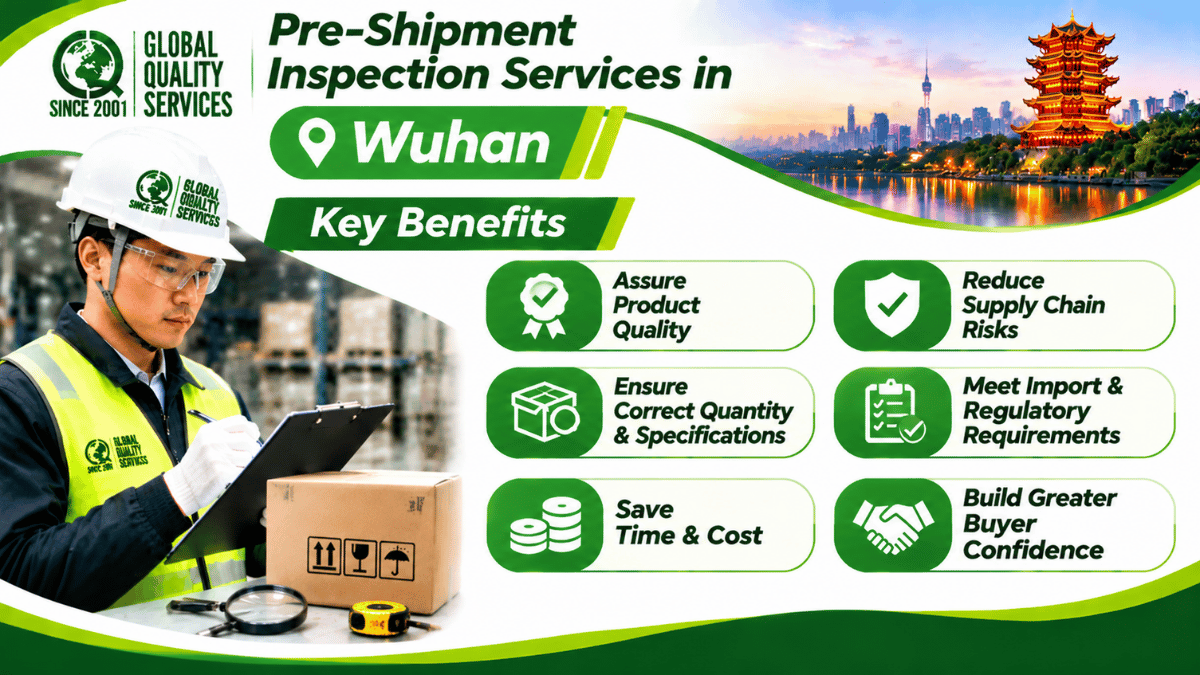
Arranging an independent pre-shipment inspection helps businesses importing from Wuhan maintain better control over product quality and supplier performance. By evaluating finished goods before dispatch, buyers can identify potential issues and make informed decisions about shipment approval.
- Early Detection of Product Defects: Identify visible defects, poor workmanship, incorrect assembly and product inconsistencies before goods leave the factory.
- Verification of Purchase Specifications: Ensure finished products match the approved samples, technical specifications, drawings and purchase order requirements.
- Reduced Import and Shipment Risks: Detect quality discrepancies before dispatch to minimise the possibility of receiving non-conforming products.
- Better Packaging and Labelling Control: Verify carton conditions, protective packaging, product labels, barcodes and shipping marks against buyer requirements.
- Improved Supplier Accountability: Share documented inspection findings with manufacturers and establish clearer expectations regarding product quality.
- Greater Transparency in Sourcing: Obtain an independent assessment of finished goods rather than relying entirely on supplier-provided quality updates.
- Informed Shipment Release Decisions: Use inspection reports and documented observations to determine whether products meet the agreed acceptance criteria before shipment approval.
- Consistent Quality Across Orders: Apply defined inspection parameters across repeat purchases and different suppliers to maintain more consistent product quality.
Why Choose Global Quality Services Pte Ltd for Inspection in Wuhan?
Selecting an independent inspection provider is an important consideration for businesses that want greater visibility into supplier quality and shipment readiness. Global Quality Services Pte Ltd provides third-party inspection services for international buyers, manufacturers and sourcing businesses across different industries. Our approach focuses on the purchase order requirements and the characteristics of the products being inspected. Businesses working with us can benefit from:
- Independent inspection arrangements: Product assessments based on agreed inspection requirements.
- Product-specific checklists: Inspection parameters suited to the type of goods being evaluated.
- Practical quality verification: Checks covering workmanship, specifications, quantity and packaging.
- Documented findings: Inspection reports that communicate observations and identified discrepancies.
- Multiple industry coverage: Inspection arrangements for automotive, electrical, mechanical and general manufactured products.
- Buyer-focused reporting: Information that helps importers communicate quality concerns and evaluate shipment readiness.
We recognise that every purchase order has different quality expectations. Therefore, we establish inspection requirements based on the buyer’s product specifications rather than relying on a single standard checklist for every order.
Frequently Asked Questions
1. What is the purpose of pre-shipment inspection in Wuhan?
Pre-shipment inspection helps buyers evaluate finished goods before they are dispatched from the supplier’s premises. It checks whether products meet agreed requirements relating to quality, workmanship, quantity, specifications and packaging.
2. Can pre-shipment inspection identify manufacturing defects?
Yes. An inspection can identify visible manufacturing defects, poor finishing, incorrect assembly, dimensional discrepancies and other issues within the agreed inspection scope. It provides buyers with an opportunity to raise concerns before shipment.
3. Can I request inspection of multiple product models in one order?
Yes. Multiple product models or variations can be included in an inspection request. The buyer should provide the relevant product specifications, quantities, model details and approved samples so that suitable inspection criteria can be established.
4. What is the difference between pre-shipment inspection and factory inspection?
Factory inspection evaluates aspects of the manufacturing facility, production capabilities, quality management practices and operating conditions. Pre-shipment inspection focuses on finished goods from a particular order before dispatch. Both serve different purposes in supplier quality management.
5. What information is required to arrange a pre-shipment inspection in Wuhan?
Buyers should provide the factory address, product description, purchase order, order quantity, technical specifications, approved samples or reference photographs, packaging requirements and preferred inspection date. These details help establish the inspection scope and schedule.