
Suzhou is one of China’s major manufacturing and export centers, with a strong industrial presence in electronics, electrical equipment, machinery, automotive components, precision engineering, medical technology, and advanced materials. Its extensive manufacturing network supplies products to international buyers across multiple industries.
For importers and international businesses sourcing products from Suzhou, verifying product quality before shipment is an important part of supply chain management. Manufacturing defects, incorrect quantities, packaging issues, and specification deviations can lead to rejected shipments, customer complaints, and additional costs.
Pre-Shipment Inspection Services in Suzhou, China help buyers evaluate finished products before they leave the manufacturer’s facility. Global Quality Services provides third-party inspection services to assess product quality, workmanship, quantity, functionality, labeling, and packaging against agreed specifications.
What Are Pre-Shipment Inspection Services?
A Pre-Shipment Inspection (PSI), also known as a final random inspection, is a quality assessment conducted when production is substantially complete and goods are packed or ready for shipment.
Inspectors select samples from the finished batch according to the agreed sampling plan. These samples are examined against the buyer’s specifications, approved samples, drawings, and quality requirements.
The inspection helps buyers identify visible defects and deviations before goods are dispatched from the supplier’s facility.
Why Are Pre-Shipment Inspections Important for Businesses Sourcing from Suzhou?
Suzhou’s manufacturing sector serves diverse international markets, where buyers often work with multiple factories and suppliers. Checking finished goods before shipment provides an additional quality control checkpoint.
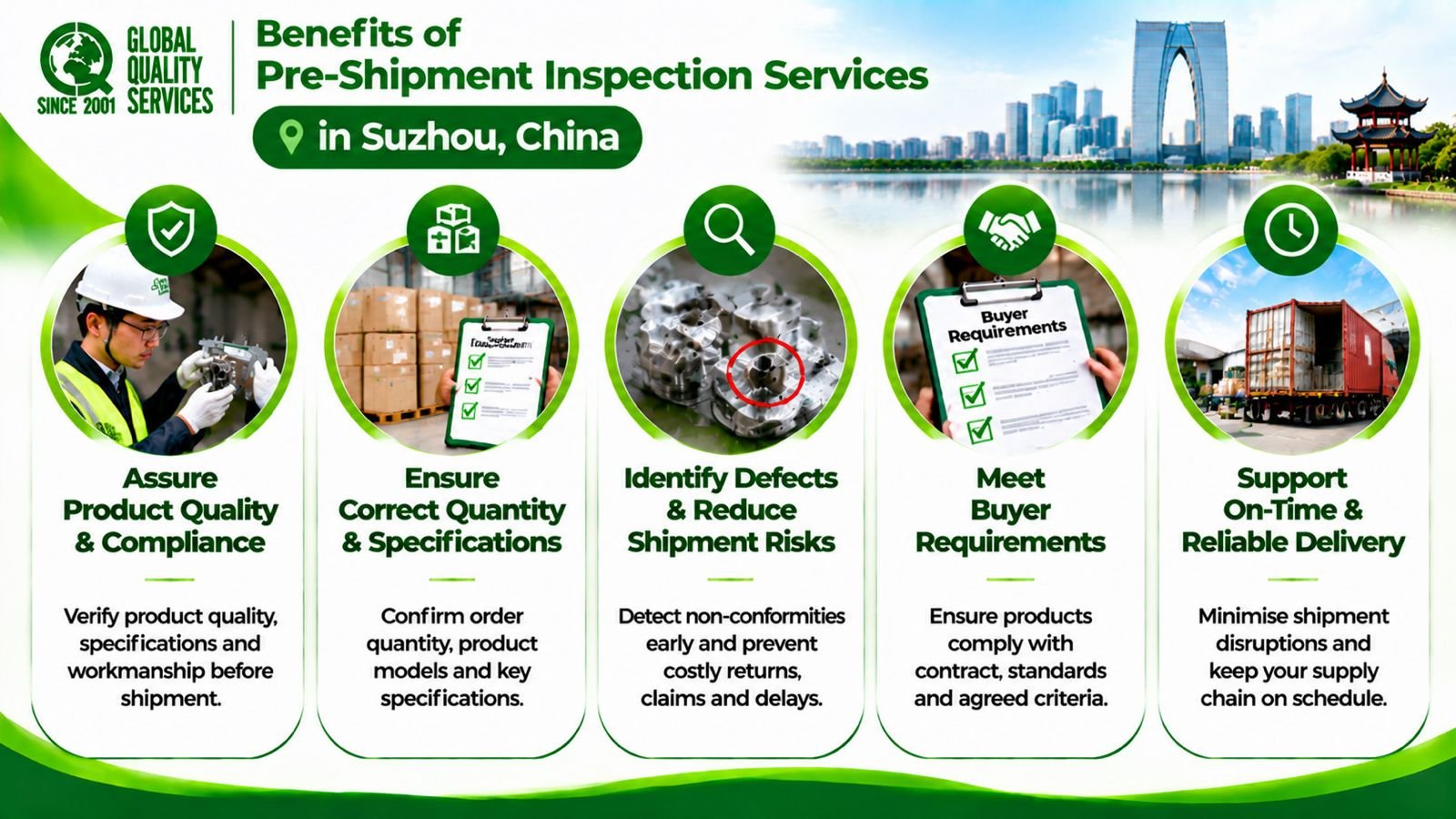
Pre-shipment inspections offer several benefits:
Early Detection of Product Defects
Inspectors examine finished products for visible damage, poor workmanship, incorrect assembly, and other quality issues. Identifying these problems before dispatch gives suppliers an opportunity to address them.
Verification of Product Specifications
Inspection findings are compared with approved samples, technical drawings, purchase orders, and product specifications. This helps buyers identify deviations in dimensions, materials, appearance, and product configuration.
Reduced Shipping and Rework Costs
Discovering defects after delivery can involve returns, replacement shipments, repair expenses, and delays. A pre-shipment inspection helps identify concerns while the goods are still at the manufacturing or packing facility.
Improved Supplier Accountability
Independent inspection records provide buyers with documented observations about the finished batch. These findings can also support discussions with manufacturers regarding corrective actions and quality expectations.
Better Packaging and Labeling Control
Incorrect carton markings, missing accessories, or inadequate packaging can affect shipments even when the products themselves meet specifications. PSI checks help verify these details before dispatch.
Greater Confidence in International Orders
A documented inspection report gives importers additional information about the condition of their goods before approving shipment.
Industries Covered by Pre-Shipment Inspection Services in Suzhou
Global Quality Services provides inspection services for a range of products manufactured in Suzhou and surrounding industrial areas.
Electronics and Electrical Equipment
Inspections can cover electronic devices, electrical components, control panels, cables, connectors, and related products. Checks may include appearance, assembly quality, specifications, basic functionality, and labeling.
Automotive Components and Machinery
Automotive suppliers and machinery manufacturers require consistent product quality and dimensional accuracy. Inspections may examine component specifications, machining quality, assembly, surface finish, and packaging.
Medical Devices and Healthcare Products
Healthcare-related products require careful verification against approved specifications. Depending on the product and agreed inspection scope, checks may include product identification, physical condition, labeling, accessories, and packaging.
Precision Engineering and Industrial Equipment
Precision components, fabricated parts, tools, and industrial equipment can be inspected for dimensions, workmanship, material identification, and visible manufacturing defects.
Textiles, Consumer Goods, and Home Products
Finished textiles, clothing, furniture, household products, and other consumer goods can be examined for appearance, dimensions, stitching, assembly, quantity, and packaging requirements.
Key Checks Included in Pre-Shipment Inspections
The inspection scope is established according to the product type, purchase requirements, and buyer’s quality standards.
Visual and Workmanship Inspection
Products are examined for scratches, dents, stains, cracks, poor finishing, incorrect assembly, and other visible defects. Workmanship is compared with the approved quality expectations.
Quantity Verification
The inspection includes checking the total production quantity, packed cartons, and sample quantities against the purchase order and packing list.
Dimensional and Specification Checks
Relevant product dimensions, weight, materials, construction, and other measurable characteristics are checked against the buyer’s specifications or approved drawings.
Functional Testing
Basic product functions are tested according to agreed inspection procedures. This may include operating checks, switching functions, movement, connectivity, or other product-specific tests where applicable.
Packaging and Labeling Inspection
Cartons, protective materials, shipping marks, barcodes, product labels, and packaging configurations are checked against the agreed requirements.
Accessories and Documentation Verification
Inspectors check whether the required accessories, components, manuals, warranty information, and other specified items are included. Available product documents and markings may also be reviewed.
Our Pre-Shipment Inspection Process in Suzhou
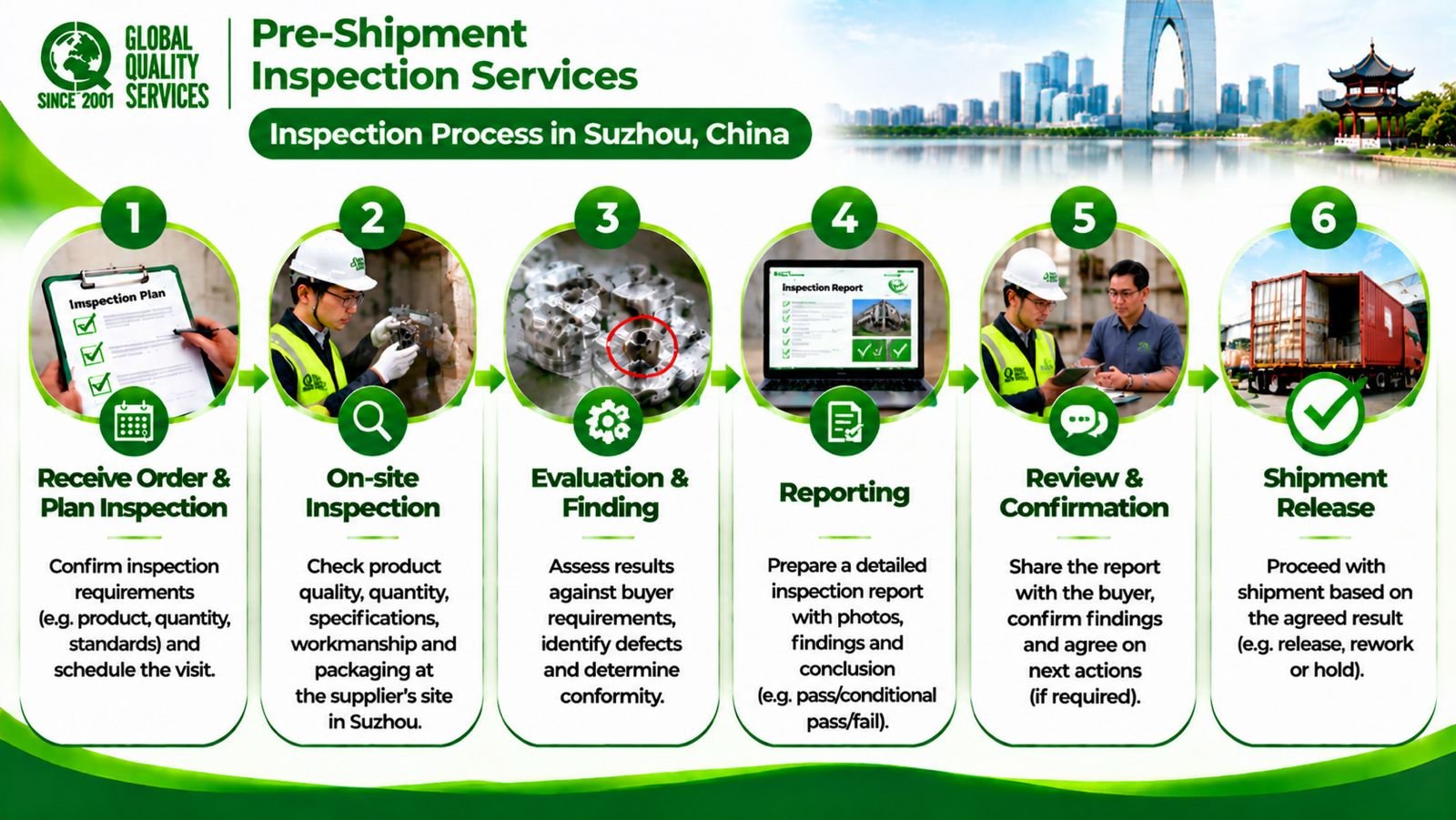
Global Quality Services follows a structured inspection process to ensure that findings are recorded clearly and compared with the buyer’s requirements.
1. Inspection Request and Scope Confirmation
The buyer shares product details, purchase order information, specifications, approved samples, and inspection requirements. The inspection scope and acceptance criteria are confirmed before scheduling.
2. Factory Visit and Production Readiness Check
The inspection is scheduled at the manufacturer’s facility once the agreed percentage of production is complete and the required quantity is packed or ready for packing.
3. Random Sample Selection
Samples are selected from the available finished goods according to the agreed sampling plan. Where applicable, the sampling method may follow ISO 2859-1 and the specified Acceptance Quality Limit (AQL).
4. Product Inspection and Testing
Selected samples undergo visual, dimensional, functional, quantity, and packaging checks according to the approved inspection criteria.
5. Findings and Photographic Documentation
Inspectors record defects, measurements, test observations, and relevant photographs. Findings are categorized according to the agreed defect classification.
6. Inspection Report Submission
A structured inspection report presents the results, supporting photographs, and identified nonconformities. The buyer can use this information to make an informed shipment decision.
Latest Update: ISO 2859-1:2026 for AQL Sampling
An important development for pre-shipment inspection in 2026 is the publication of ISO 2859-1:2026 in January 2026.
The revised third edition replaces ISO 2859-1:1999 and its associated amendments. It introduces skip-lot sampling procedures and updated guidance for applying acceptance sampling strategies.
For buyers sourcing products from Suzhou, this makes it important to review the sampling standard and edition specified in their purchase agreements. The applicable sampling plan, inspection level, AQL, and acceptance criteria should be agreed upon before the inspection begins.
How Global Quality Services Conducts Pre-Shipment Inspections in Suzhou
Global Quality Services provides third-party inspection services based on the buyer’s product specifications and agreed inspection requirements.
Our inspection activities focus on:
- Finished product quality and workmanship.
- Product specifications and dimensional verification.
- Quantity and packaging checks.
- Basic functional testing where applicable.
- Labeling, markings, and accessory verification.
- Photographic evidence and inspection reporting.
Our objective is to provide buyers with clear inspection findings before their products are released for shipment.
Areas We Serve Around Suzhou
Global Quality Services provides Pre-Shipment Inspection Services for manufacturing and export facilities in Suzhou and nearby industrial locations, including:
- Suzhou Industrial Park (SIP)
- Suzhou New District (SND)
- Wujiang Economic Development Zone
- Xiangcheng District
- Wuzhong District
- Kunshan
- Taicang
- Changshu
- Zhangjiagang
Arrange Pre-Shipment Inspection Services in Suzhou with Global Quality Services
Verifying product quality before dispatch helps international buyers make informed decisions and manage supplier-related risks.
Whether you are sourcing electronics, machinery, automotive components, industrial equipment, or consumer products, Global Quality Services provides third-party Pre-Shipment Inspection Services in Suzhou, China. Contact Global Quality Services to discuss your inspection requirements and schedule a factory inspection before shipment.
Frequently Asked Questions
1. When should a pre-shipment inspection be conducted?
A PSI is generally conducted when production is substantially complete and at least 80% of the goods are packed or ready for packing, unless the buyer specifies a different readiness requirement.
2. What is AQL in pre-shipment inspection?
AQL stands for Acceptance Quality Limit. It is a parameter used in statistical sampling plans to determine sample sizes and acceptance or rejection criteria. The applicable AQL values should be agreed upon between the buyer and supplier.
3. Can Global Quality Services inspect products at factories in Suzhou Industrial Park?
Yes. Inspection requests can cover manufacturing facilities in Suzhou Industrial Park and other surrounding industrial areas, subject to scheduling and service availability.
4. What happens if products fail the pre-shipment inspection?
The inspection report documents identified defects and nonconformities against the agreed criteria. The buyer can discuss corrective action, rework, or reinspection with the supplier before deciding whether to release the shipment.
5. Does a pre-shipment inspection guarantee that every product is defect-free?
No. A PSI generally uses random sampling rather than examining every unit. It provides an assessment of the selected samples and the inspected batch against the agreed criteria, but it cannot guarantee that every product is free from defects.