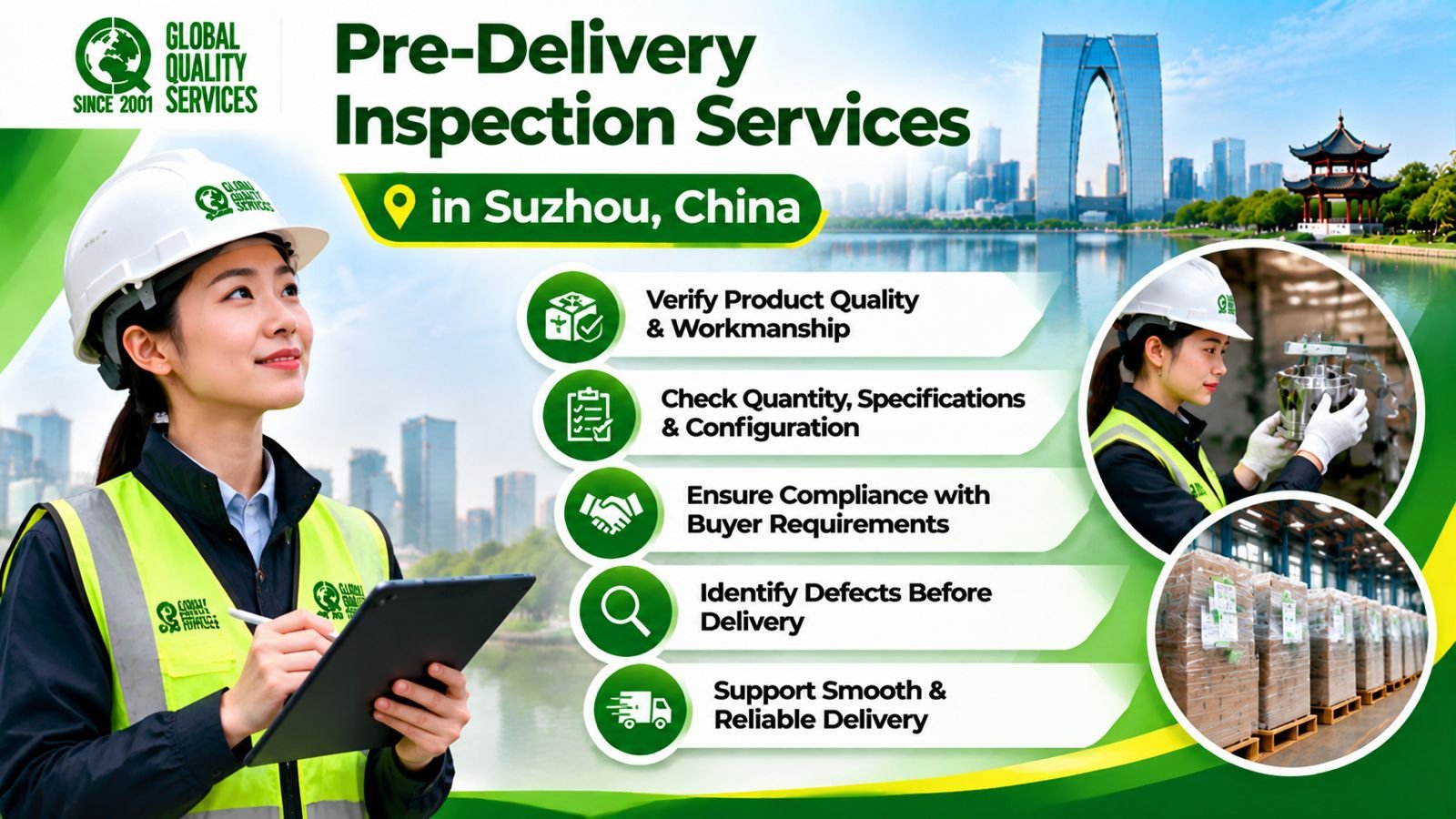
Products and equipment should meet the agreed specifications before they are delivered to customers, project sites, or distribution facilities. A pre-delivery inspection (PDI) provides a final opportunity to check the supplied items, identify visible defects, verify important features, and review delivery documentation before handover.
Global Quality Services provides Pre-Delivery Inspection Services in Suzhou, China, for buyers, manufacturers, importers, and businesses sourcing products from local suppliers. The inspection scope is determined by the product type, purchase requirements, technical specifications, and agreed acceptance criteria.
Whether you are purchasing industrial equipment, automotive components, electronic products, machinery, or manufactured goods, a structured PDI can provide documented information about the condition and conformity of the items before delivery.
What Are Pre-Delivery Inspection Services?
Pre-Delivery Inspection is a quality verification activity conducted before products or equipment are formally handed over to the buyer or end user. It checks whether the supplied items correspond with the purchase order, approved specifications, drawings, samples, and other agreed requirements.
Depending on the product, a PDI may include visual examination, identification checks, dimensional verification, selected functional tests, accessory checks, and a review of accompanying documents.
The inspection is particularly relevant when products are supplied directly from a manufacturing facility, prepared for installation, or delivered to a customer’s premises. The findings are recorded in an inspection report for the buyer’s review.
Why Is Pre-Delivery Inspection Important for Businesses in Suzhou?
Suzhou is an important manufacturing and technology center in Jiangsu Province. Its industrial activities include biomedicine, advanced materials, nanotechnology, artificial intelligence, digital technology, electronics, and automotive-related manufacturing. Suzhou Industrial Park alone reported substantial industrial output and exports in 2025, reflecting the scale of its manufacturing and supply-chain activity.
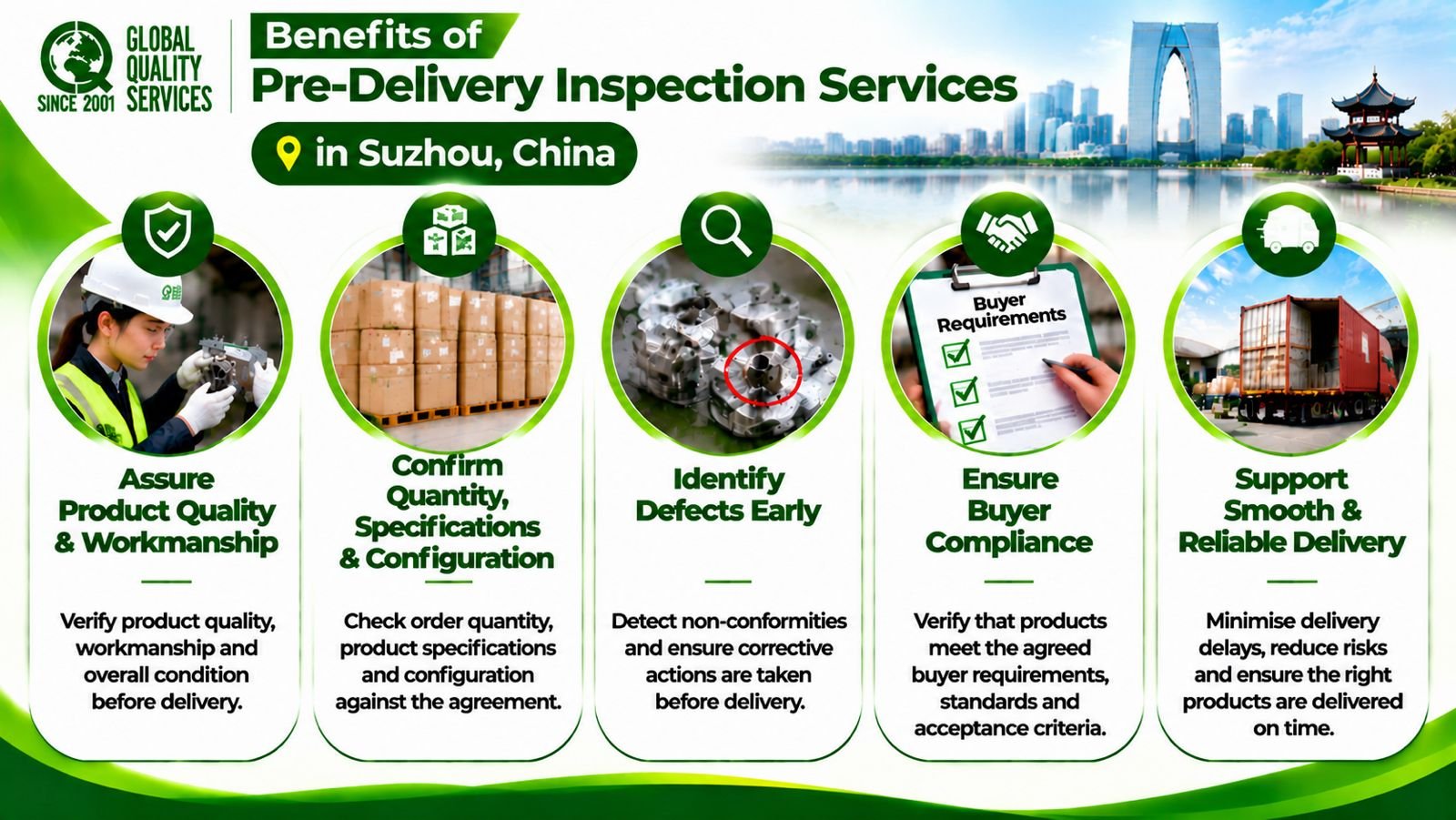
For businesses purchasing from this market, checking products before delivery can reduce uncertainty about their condition and conformity.
Identify Visible Defects Before Handover
Scratches, dents, damaged components, poor finishing, missing parts, and assembly issues can affect product acceptance. PDI records observable defects before the goods are handed over, giving the buyer and supplier an opportunity to review outstanding issues.
Verify Product Specifications
A delivered product may look correct but still differ from the agreed configuration. Checking model numbers, dimensions, ratings, materials, components, and other specified attributes helps identify discrepancies before acceptance.
Check Functional Readiness
Where the product and inspection scope allow, selected operational checks can be performed to assess whether the specified functions work under the agreed test conditions. This is relevant for equipment, electrical products, machinery, and other products with functional requirements.
Confirm Accessories and Documentation
Missing accessories, operating manuals, warranty documents, test records, or installation instructions can delay the handover process. A PDI can include a review of the items and documents specified in the purchase agreement.
Maintain Better Delivery Records
A documented inspection provides a record of the product condition and checks performed at the time of inspection. Buyers can use the findings when discussing discrepancies, arranging corrections, or reviewing delivery acceptance.
Common Issues Identified Before Product Delivery
A product may be manufactured and packed but still have discrepancies that affect its acceptance or intended use. Some issues are not immediately obvious without comparing the supplied goods with the approved requirements.
Examples include:
- Model or configuration mismatch: The delivered product has a different model, rating, component arrangement, or configuration from the approved order.
- Unapproved component substitution: A supplier has used an alternative component or material without the buyer’s documented approval.
- Incomplete product supply: Required accessories, cables, fasteners, spare parts, or installation components are missing.
- Drawing revision mismatch: The supplied item reflects an older drawing or specification instead of the approved revision.
- Incomplete traceability: Serial numbers, batch identification, material references, or other required records are missing or inconsistent.
- Unverified functional requirements: The product has not undergone one or more agreed functional checks, or the available test evidence is incomplete.
- Packaging and handling damage: The product has dents, scratches, moisture exposure, damaged protective materials, or other visible signs of poor handling.
Recording these issues before handover gives the buyer and supplier a documented basis for deciding whether correction, replacement, additional testing, or re-inspection is required.
PDI, Factory Acceptance Testing and Site Acceptance Testing: Understanding the Difference
PDI is sometimes confused with factory acceptance testing and site acceptance testing. Although these activities may form part of the same procurement quality plan, they have different purposes.
| Activity | When It Takes Place | Main Purpose |
|---|---|---|
| Pre-Delivery Inspection (PDI) | Before product handover or delivery | Verify product condition and agreed requirements |
| Factory Acceptance Test (FAT) | At the manufacturer’s facility | Witness or verify contract-defined functional and performance tests |
| Pre-Shipment Inspection (PSI) | Before dispatch | Examine finished goods, quantity, workmanship, packaging, and shipment requirements |
| Site Acceptance Test (SAT) | At the buyer’s site after installation | Verify specified performance under site conditions |
For example, a machine may undergo a FAT at the manufacturer’s facility to demonstrate its agreed operating functions. A separate PDI may verify its configuration, accessories, identification, and physical condition before handover. Once installed, a SAT may verify its operation within the buyer’s facility.
The purchase agreement should define which activities are required, who witnesses them, what evidence is recorded, and who has authority to accept the equipment.
What Does Our Pre-Delivery Inspection Cover?
The inspection checklist is prepared according to the product category and the buyer’s requirements. The following areas may be included in a PDI assignment.
1. Product Identification and Order Verification
Inspectors compare the supplied items with the purchase order and approved product details. Checks may include:
- Product name, model, and type
- Manufacturer and brand identification
- Serial numbers and batch references
- Quantity and product configuration
- Nameplates, labels, and identification markings
2. Visual Condition and Workmanship
The product is examined for visible defects that may affect its appearance, condition, or usability. This can include scratches, dents, cracks, corrosion, damaged surfaces, loose fittings, poor finishing, and missing components.
The inspection findings are documented with photographs where appropriate.
3. Dimensions and Specification Checks
Selected measurements and product characteristics are checked against the approved drawings, technical specifications, or purchase requirements. Depending on the item, this may cover dimensions, weight, material identification, ratings, tolerances, and other measurable attributes.
4. Assembly and Component Verification
For assembled products and equipment, the inspection may include checks of accessible components, fittings, joints, fasteners, connections, and assembly condition. Specified parts can also be compared with the approved bill of materials or component list.
5. Functional and Operational Checks
Where applicable, inspectors perform agreed functional checks to assess selected product operations. For example, this may include checking control buttons, indicators, movement, switching functions, or basic operating responses.
Complex performance testing, load testing, electrical safety testing, and specialized technical examinations must be defined separately and carried out using suitable personnel, equipment, and test arrangements.
6. Safety Features and Product Markings
The inspection may cover observable safety-related features specified for the product. These can include guards, warning labels, operating instructions, emergency-stop devices, and other accessible features.
A visual PDI does not automatically establish compliance with every applicable safety regulation or technical standard.
7. Accessories and Supplied Components
Inspectors can verify whether the required accessories and supplied components are present. These may include cables, connectors, tools, spare parts, mounting components, remote controls, and other items listed in the purchase agreement.
8. Documentation Review
The agreed documentation can be reviewed for availability and consistency with the supplied products. This may include:
- Product manuals and operating instructions
- Technical specifications and drawings
- Warranty documents
- Test reports and inspection records
- Installation and maintenance instructions
- Certificates and other specified records
9. Packaging and Delivery Condition
Where included in the assignment, the inspection may cover packaging condition, protective materials, product labels, handling instructions, and visible signs of damage. This helps document the condition of the goods before they leave the supplier or are handed over to the customer.
Our Pre-Delivery Inspection Process in Suzhou
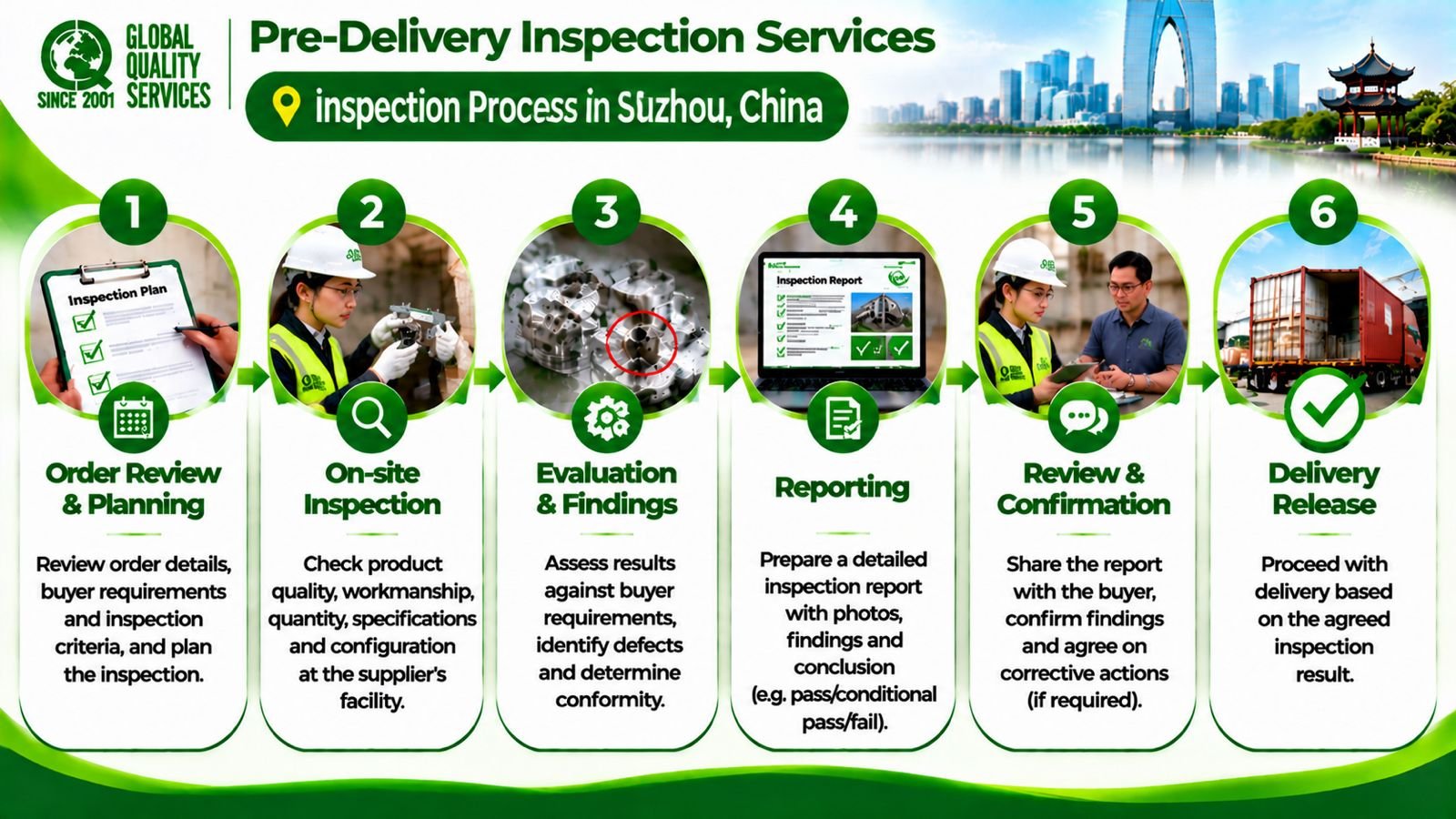
Global Quality Services establishes the inspection scope in advance so that the checks are relevant to the product and the buyer’s acceptance requirements.
Step 1: Review the Inspection Requirements
The process begins with reviewing the purchase order, product specifications, approved drawings, reference samples, and inspection checklist. The required checks and acceptance criteria are clarified before the inspection.
Step 2: Confirm Product and Site Readiness
The supplier’s location, product availability, inspection date, and access arrangements are confirmed. Products should be available in a condition that allows the agreed checks to be completed.
Step 3: Conduct the Physical Inspection
Inspectors examine the supplied products for identification, visible condition, workmanship, assembly, and other agreed characteristics. Photographs and relevant observations are recorded.
Step 4: Perform Agreed Measurements and Functional Checks
Where required, selected dimensions, specifications, and product functions are checked using suitable methods and equipment. Any test limitations or checks that cannot be completed are recorded.
Step 5: Verify Accessories and Documentation
The inspection includes checking the specified accessories, components, manuals, labels, and supporting documents against the agreed list.
Step 6: Prepare the Inspection Report
The report records the inspection scope, checks performed, observations, identified discrepancies, and supporting photographs where applicable. Any limitations or outstanding items are also documented.
Step 7: Review Findings and Arrange Follow-Up
The buyer and supplier can review the findings and determine whether corrective action, additional testing, or re-inspection is required. The final acceptance decision remains with the buyer or the party responsible under the purchase agreement.
Pre-Delivery Inspection vs. Pre-Shipment Inspection
Although both inspections take place before products reach their final destination, their primary objectives can differ.
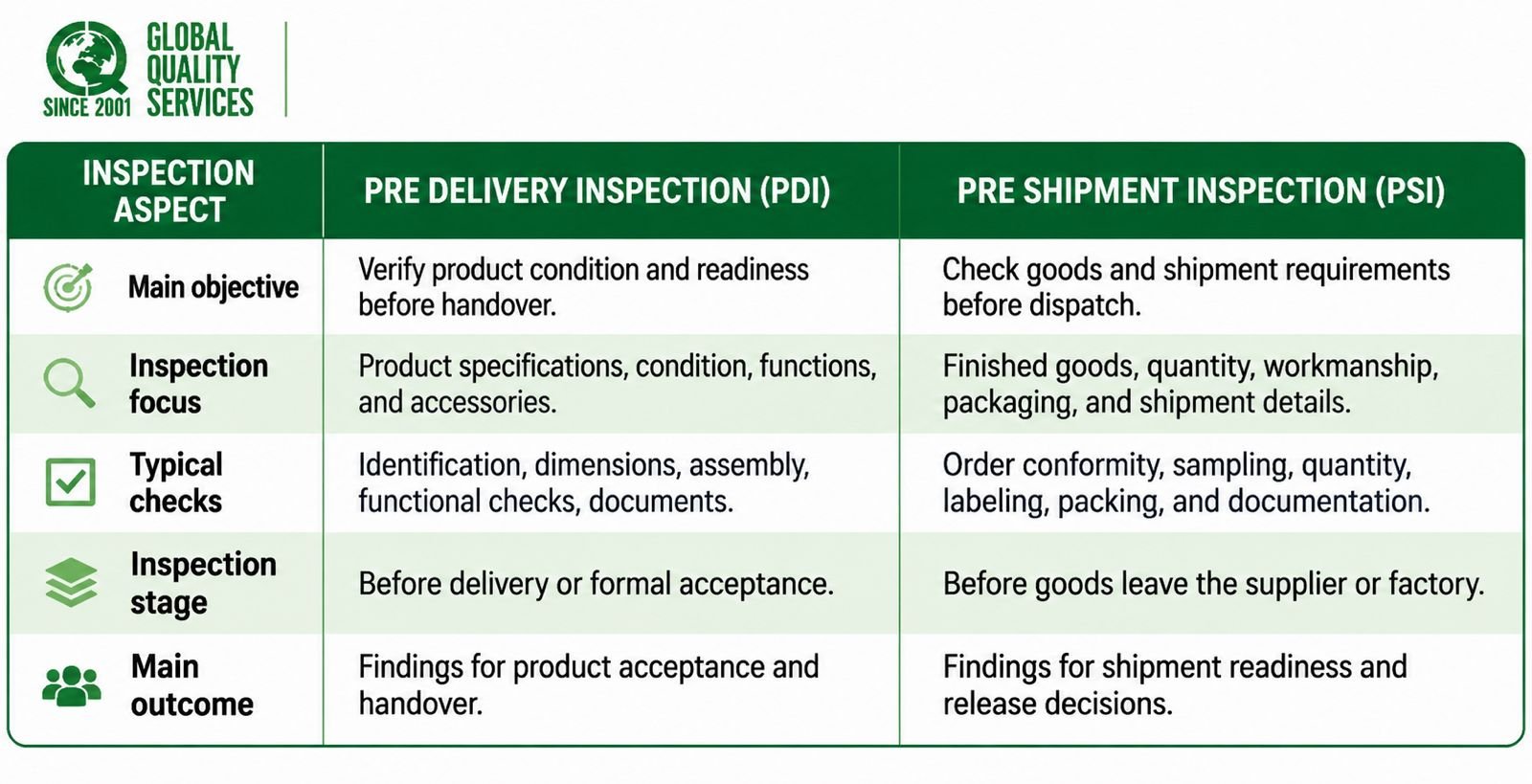
The exact scope depends on the purchase agreement. Some projects may require both inspections at different stages.
Industries We Serve in Suzhou
Suzhou’s manufacturing base includes a range of industries where product condition, technical specifications, and delivery requirements are important. Global Quality Services can establish PDI assignments for products and equipment associated with:
- Automotive and automotive components: Selected vehicle components, assemblies, electrical parts, and related manufactured products.
- Electronics and electrical equipment: Electronic devices, control units, electrical components, panels, and associated products.
- Industrial machinery: Production equipment, mechanical assemblies, pumps, motors, and other machinery supplied against technical specifications.
- Advanced materials: Manufactured materials and components requiring checks against defined physical or product requirements.
- Biomedicine and healthcare products: Applicable non-clinical equipment, components, and manufactured items, subject to the agreed inspection scope.
- Automation and digital technology: Automation equipment, control systems, and related hardware.
The scope is determined by the product and the inspection criteria. Specialized laboratory, regulatory, or performance testing is not assumed to be part of a standard PDI.
Why Choose Global Quality Services for PDI in Suzhou?
Global Quality Services provides third-party inspection services based on the buyer’s requirements and the characteristics of the products being supplied. Each PDI assignment is planned around an agreed checklist, applicable specifications, and defined acceptance criteria.
The inspection can cover product condition, identification, dimensions, assembly, selected functional checks, accessories, and documentation. Findings are recorded in an inspection report so that buyers have a clearer understanding of the checks performed and any discrepancies identified.
The inspection scope and limitations are established before the assignment. This helps ensure that the report reflects the actual inspection activities rather than implying tests or approvals that were not part of the agreed work.
Areas Covered in and Around Suzhou
Pre-Delivery Inspection Services can be arranged for supplier facilities and relevant business locations across Suzhou, subject to scheduling and site access.
Coverage may include:
- Suzhou Industrial Park (SIP)
- Suzhou New District (SND)
- Wujiang Economic Development Zone
- Wuzhong District
- Xiangcheng District
- Kunshan
- Taicang
- Changshu
- Zhangjiagang
Arrange Pre-Delivery Inspection Services in Suzhou, China
A product inspection before handover provides buyers with a documented view of the supplied goods against agreed requirements. It can identify visible defects, missing components, specification differences, and outstanding documentation before the acceptance process is completed.
Contact Global Quality Services to discuss your PDI requirements in Suzhou, China. Share product details, supplier location, purchase specifications, the inspection checklist, and the expected delivery date to establish the appropriate inspection scope.
Frequently Asked Questions
1. What is checked during a Pre-Delivery Inspection in Suzhou?
A PDI may cover product identification, quantity, visible condition, workmanship, dimensions, assembly, selected functional checks, accessories, labels, and supporting documentation. The exact checks depend on the product and the buyer’s agreed requirements.
2. When should I arrange a Pre-Delivery Inspection?
A PDI should be scheduled when the products are available and ready for the agreed inspection, but before formal handover or acceptance. Allow sufficient time for any identified discrepancies to be reviewed and corrected.
3. Is Pre-Delivery Inspection the same as Pre-Shipment Inspection?
No. PDI primarily focuses on product condition and readiness before handover, while PSI generally focuses on finished goods, quantity, packaging, marking, and shipment readiness before dispatch. The two services can be arranged at separate stages of a purchase or supply process.
4. Can functional testing be included in a PDI?
Yes, selected functional checks can be included when they are relevant to the product and agreed in advance. Complex performance tests, load tests, and specialized electrical or safety tests may require separate arrangements, qualified personnel, and suitable testing facilities.
5. Does a PDI report guarantee that the product is defect-free?
No. An inspection report records the checks performed and the findings identified within the agreed scope. It cannot guarantee that every possible defect has been detected, particularly where only selected samples or accessible product features are examined. The buyer should review the report and make the acceptance decision based on the contractual requirements.