
Businesses operating in MRANTI Park, Kuala Lumpur, that store, process, transmit, or influence the security of payment card data must consider the Payment Card Industry Data Security Standard (PCI DSS). The standard sets technical and operational requirements to protect payment account information and reduce the risk of payment data breaches.
MRANTI Park is an innovation and technology hub in Bukit Jalil, Kuala Lumpur, focused on technology development and commercialisation. Businesses working in digital services, software, technology infrastructure and related sectors may need to assess whether their systems fall within PCI DSS requirements, particularly when they handle payment transactions or provide services to organisations that process cardholder data.
GQS provides PCI DSS compliance-related services for organisations seeking to understand applicable requirements, review their security arrangements and prepare for the appropriate compliance validation process. The scope of work depends on the organisation’s payment environment, business role and assessment requirements.
What Is PCI DSS Compliance?
PCI DSS is a security standard developed by the PCI Security Standards Council (PCI SSC). It establishes requirements for protecting payment account data across systems, networks, applications and operational processes.
The standard applies to entities that store, process or transmit cardholder data or sensitive authentication data. It can also apply to systems and service providers that could affect the security of the cardholder data environment.
PCI DSS is not a conventional ISO-style certification scheme. Depending on the organisation’s role and the requirements set by its acquiring bank, payment brand or other compliance programme, validation may involve a Self-Assessment Questionnaire (SAQ), a Report on Compliance (ROC), an Attestation of Compliance (AOC), or other applicable evidence. Formal assessments requiring a Qualified Security Assessor must be performed by a PCI SSC-qualified QSA.
Why Do Businesses in MRANTI Park Need PCI DSS Compliance?
Technology companies and digital businesses may rely on online payment platforms, customer portals, cloud infrastructure, software applications and third-party payment services. If these systems store, process or transmit payment account data, or can affect the security of the cardholder data environment, determining PCI DSS applicability becomes an important security consideration.
PCI DSS compliance can be relevant to:
- Technology companies developing payment-related applications.
- E-commerce businesses accepting card payments.
- Software providers whose products affect payment security.
- Payment service providers and payment processing businesses.
- Managed service providers with access to payment environments.
- Businesses operating customer databases or systems connected to cardholder data environments.
- Organisations supplying technology services to payment industry clients.
Not every company in MRANTI Park automatically falls within PCI DSS scope. Applicability depends on the services provided, how payment data flows through the environment, system connectivity and the organisation’s role in payment processing.
PCI DSS Requirements for Payment Data Security
PCI DSS establishes technical and operational controls intended to protect payment account data. The applicable requirements should be assessed against the organisation’s actual environment and the relevant PCI DSS version.
1. Network Security Controls
Organisations must maintain appropriate network security controls to protect systems that store, process or transmit payment account data. Network segmentation, access restrictions and configuration reviews may form part of the assessment, depending on the environment.
2. Secure System Configuration
Systems and devices within scope must be configured securely. This includes addressing insecure default settings, managing system configurations and maintaining appropriate security standards for infrastructure.
3. Protection of Stored Payment Account Data
Businesses must assess whether payment account data is stored and whether that storage is necessary. Applicable controls may include data minimisation, encryption, masking and secure data retention and disposal practices.
4. Encryption During Transmission
Payment account data transmitted across open or public networks must be protected using appropriate security measures. The assessment should consider the transmission paths, protocols and configurations used by the organisation.
5. Vulnerability Management
Systems in scope require appropriate protection against malicious software and known vulnerabilities. Relevant measures can include vulnerability identification, security updates, scanning and remediation according to applicable requirements.
6. Secure Application Development
Businesses developing or maintaining payment-related applications need appropriate processes for secure development, change control, testing and protection against common application vulnerabilities.
7. Access Control and Authentication
Access to systems and payment account data should be restricted according to business need. Applicable controls include unique user identification, authentication, least-privilege access and review of user permissions.
8. Logging, Monitoring and Security Testing
Organisations need suitable mechanisms to record relevant security events, monitor activity and test security controls. The required monitoring and testing activities depend on the applicable PCI DSS requirements and system architecture.
9. Security Policies and Responsibilities
Documented security policies, defined responsibilities and employee awareness practices help establish consistent management of payment data security. Organisations should maintain evidence that relevant controls are implemented and operating as required.
Benefits of PCI DSS Compliance
PCI DSS compliance provides a structured basis for managing payment card data security. For businesses in MRANTI Park, the benefits can extend to technical risk management, customer confidence and relationships with payment industry partners.
Strengthen Payment Data Protection
Applying relevant PCI DSS controls helps organisations identify weaknesses in systems and processes used to handle payment account data. This can reduce exposure to common security risks when controls are properly implemented and maintained.
Identify Security Gaps
Reviewing the applicable requirements helps organisations identify missing controls, insecure configurations, access weaknesses and documentation gaps before a formal compliance validation.
Improve Security Management
PCI DSS encourages organisations to establish repeatable processes for vulnerability management, access control, security monitoring, incident response and ongoing maintenance of security controls.
Support Payment Partner Requirements
Acquirers, payment brands and business partners may require specific PCI DSS validation evidence. Keeping the right documentation helps organisations meet these requirements and manage payment-related business relationships.
Establish Clearer Security Responsibilities
PCI DSS-related processes help define who is responsible for system access, security reviews, vulnerability remediation, evidence collection, and maintaining relevant controls.
Maintain Compliance Evidence
Appropriate records, assessment documents and control evidence help organisations demonstrate the status of their security arrangements to relevant stakeholders. The specific evidence required depends on the validation method and applicable compliance programme.
Important: PCI DSS compliance does not guarantee that a business will never experience a data breach. Its effectiveness depends on the implementation, operation and ongoing maintenance of applicable controls.
Who Needs PCI DSS Compliance in MRANTI Park?
PCI DSS applicability depends on an organisation’s involvement in handling payment card data and securing the payment environment.
Businesses that may need to assess their obligations include:
- Digital payment businesses: Organisations providing payment-related products or services.
- Software and technology providers: Companies whose applications or services affect the security of payment account data.
- E-commerce businesses: Merchants accepting payment cards through websites or digital platforms.
- IT and managed service providers: Providers with access to, or responsibility for, systems within a payment environment.
- Cloud and hosting providers: Service providers whose infrastructure or services are relevant to a customer’s PCI DSS scope.
- Fintech businesses: Companies that develop or operate financial technology products that involve payment card data.
- Technology-enabled service providers: Businesses whose systems connect to or influence the security of payment processing environments.
Organisations should confirm their responsibilities with the relevant payment partners and assessors rather than assuming that all businesses in the same sector have identical requirements.
PCI DSS Compliance Process in MRANTI Park, Kuala Lumpur
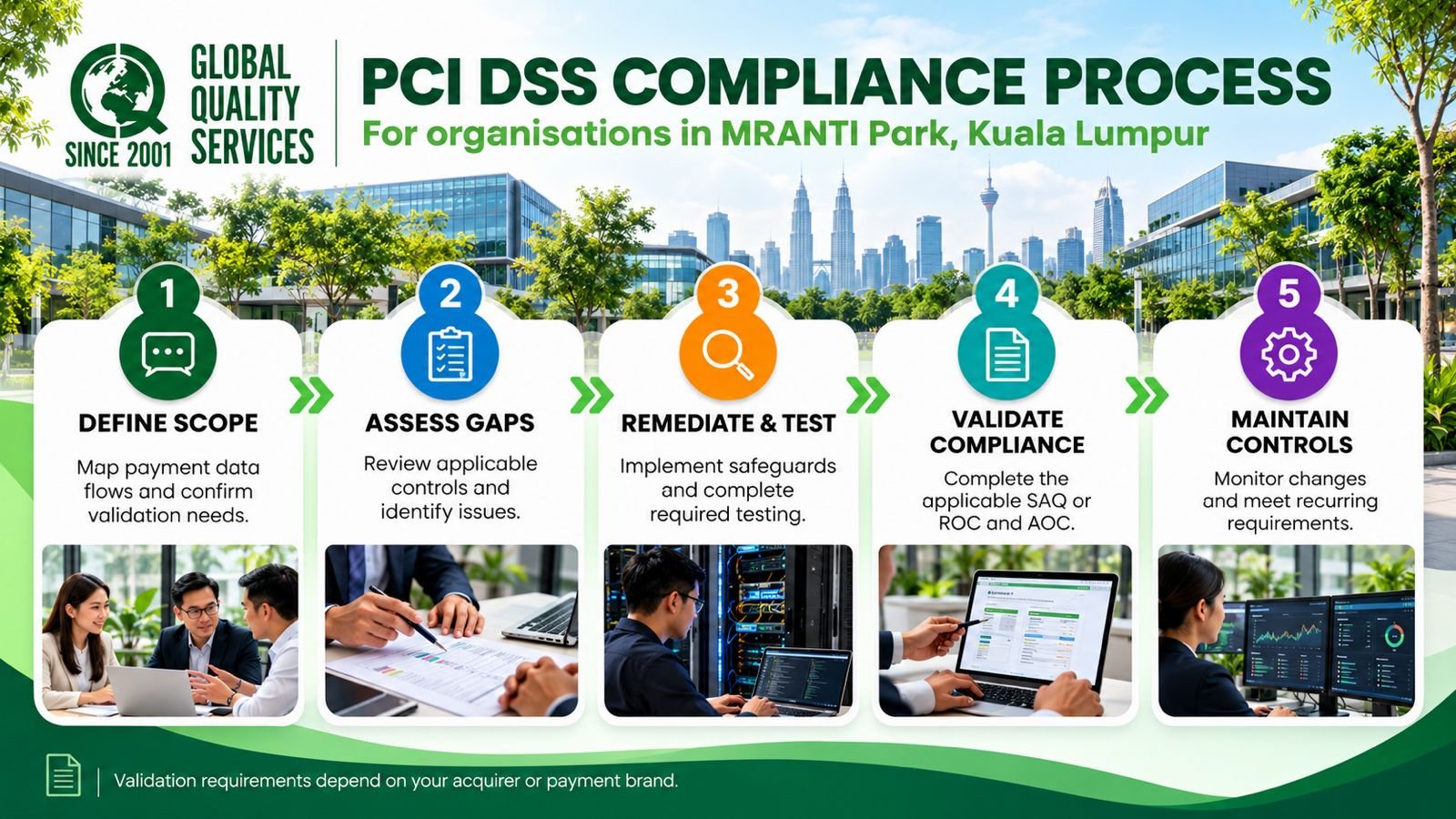
The process for determining and validating PCI DSS compliance depends on the organisation’s payment environment, applicable requirements and required validation method.
Step 1: Understand the Business and Payment Environment
Identify how the organisation accepts payments, handles cardholder data and connects to payment processing systems. Review relevant applications, infrastructure, service providers and business processes.
Step 2: Determine the Scope
Identify the cardholder data environment and the systems, networks, personnel and service providers that are in scope or could affect its security. Appropriate segmentation and documented data flows can help establish a clear assessment boundary.
Step 3: Identify Applicable Requirements
Determine the PCI DSS requirements relevant to the organisation’s role, environment and validation method. The applicable SAQ or formal assessment route should be confirmed with the relevant acquiring bank, payment brand or compliance programme where necessary.
Step 4: Review Existing Security Controls
Evaluate applicable controls, including access management, network security, data protection, vulnerability management, logging, monitoring and security policies. Review available evidence to identify gaps against the relevant requirements.
Step 5: Address Identified Gaps
Develop a remediation plan for control deficiencies. Depending on the findings, actions may involve configuration changes, access restrictions, vulnerability remediation, improved documentation or changes to operational procedures.
Step 6: Prepare Assessment Evidence
Organise relevant policies, system configurations, scan results, testing records, access reviews and other supporting evidence. The documentation should correspond to the selected validation method and the requirements being assessed.
Step 7: Complete the Required Validation
Complete the applicable validation process. Depending on the organisation’s obligations, this may involve submitting an SAQ and AOC or undergoing a formal assessment by a PCI SSC-qualified QSA, resulting in the applicable reporting and attestation documents.
Step 8: Maintain Compliance
PCI DSS compliance requires ongoing attention to security controls. Organisations should maintain relevant policies, review access, address vulnerabilities, monitor security events and complete recurring validation activities as required.
Common PCI DSS Compliance Challenges
Unclear Assessment Scope
Businesses may find it difficult to determine which applications, systems, network connections and service providers fall within scope. An inaccurate scope can result in missed controls or unnecessary assessment work.
Incomplete Security Documentation
Policies, configuration records, access reviews and security testing evidence may be missing, outdated or inconsistent with actual practices.
Vulnerabilities in Systems and Applications
Outdated software, insecure configurations and unresolved vulnerabilities can create compliance gaps that require technical remediation.
Third-Party Service Dependencies
Organisations using cloud platforms, payment gateways or managed services need to understand each provider’s role and responsibility. Using a third-party provider does not automatically remove the customer’s own PCI DSS obligations.
Ongoing Control Maintenance
PCI DSS compliance is not limited to a single assessment. Security controls, evidence and operational practices need to remain appropriate as systems, applications and business processes change.
Factors That Affect PCI DSS Compliance Costs
The cost of PCI DSS-related work varies according to the complexity of the payment environment and the validation required.
Key factors include:
- Number of systems, applications and network segments in scope.
- Volume and types of payment account data handled.
- Complexity of the organisation’s payment architecture.
- Number of locations and third-party service providers involved.
- Existing security controls and documentation.
- Vulnerability assessment and security testing requirements.
- Remediation work needed to address identified gaps.
- Whether an SAQ-based validation or formal QSA assessment is required.
- Ongoing monitoring and recurring validation requirements.
A defined scope and review of existing controls can help an organisation understand the likely work involved before proceeding with formal validation.
PCI DSS Compliance Services by Global Quality Services in MRANTI Park
Global Quality Services provides compliance-related services for businesses seeking to assess PCI DSS requirements and prepare their payment security arrangements for the relevant validation process. The work can be scoped around the organisation’s systems, existing controls, documentation and identified compliance gaps.
For businesses in MRANTI Park, Kuala Lumpur, the first step is to establish how payment account data is handled and determine which PCI DSS requirements and validation route apply. The scope of GQS’s engagement should be confirmed before any formal assessment is arranged.
Where formal PCI DSS validation by a Qualified Security Assessor is required, the assessment must be undertaken by a PCI SSC-qualified QSA. GQS should only be presented as performing that assessment if its applicable QSA qualification is verified.
Is your business in MRANTI Park, Kuala Lumpur, reviewing its payment data security requirements? Contact GQS to discuss your business activities, payment environment and compliance objectives. A preliminary discussion can help establish the scope of the work, identify relevant security considerations and determine the appropriate next steps toward PCI DSS validation.
Frequently Asked Questions
1. Is PCI DSS certification mandatory for every business in MRANTI Park?
No. PCI DSS applicability depends on whether the business stores, processes or transmits payment card data or can affect the security of the cardholder data environment. Requirements may also depend on the organisation’s payment partners and compliance programme.
2. What is the current PCI DSS version?
PCI DSS v4.0.1 is listed in the PCI Security Standards Council’s official document library. Organisations should consult the official PCI SSC resources for the applicable standard, supporting documents and current validation requirements.
3. Does PCI DSS provide an official certification certificate?
PCI SSC does not issue a conventional PCI DSS compliance certificate. Depending on the applicable validation route, organisations may need an SAQ and AOC or a ROC and AOC. They should confirm the required evidence with their acquiring bank, payment brand or relevant compliance programme.
4. Can a technology company in MRANTI Park be subject to PCI DSS?
Yes, depending on its role. A technology company may fall within scope if it handles payment account data or provides systems or services that can affect the security of the cardholder data environment. The exact scope requires an assessment of its activities and architecture.
5. What is the difference between an SAQ and a ROC?
A Self-Assessment Questionnaire is used for applicable self-assessment validation routes. A Report on Compliance is associated with a formal PCI DSS assessment. The appropriate route depends on the organisation’s circumstances and the validation requirements imposed by its payment partners.