

PCI DSS certification-related services help businesses understand payment card security requirements, assess existing controls and prepare for the applicable compliance validation process. Organisations that store, process or transmit payment card data, or whose systems can affect the security of payment account information, need to determine their obligations under the Payment Card Industry Data Security Standard (PCI DSS).
Located in Shah Alam, Selangor, i-City is an integrated business and technology-oriented development with commercial spaces and digital infrastructure. Businesses operating in this environment may include technology companies, digital service providers, online retailers and other organisations using electronic payment systems. For companies handling payment card data, evaluating PCI DSS requirements can be an important part of managing information security risks.
GQS provides compliance-related services for organisations seeking to review their payment security arrangements and prepare for applicable PCI DSS validation. The scope depends on the business model, payment environment, existing controls and assessment requirements.
What Is PCI DSS Certification?
The Payment Card Industry Data Security Standard (PCI DSS) is a security standard developed by the PCI Security Standards Council (PCI SSC). It establishes technical and operational requirements intended to protect payment account data and reduce exposure to payment security risks.
PCI DSS applies to entities that store, process or transmit cardholder data or sensitive authentication data. It can also apply to service providers and systems that could affect the security of the cardholder data environment.
Although businesses commonly search for PCI DSS certification, PCI DSS compliance is not a conventional ISO-style certification process. Depending on the organisation’s circumstances and the requirements set by its acquiring bank, payment brand or compliance programme, validation may involve a Self-Assessment Questionnaire (SAQ), a Report on Compliance (ROC), an Attestation of Compliance (AOC) or other applicable evidence.
Where a formal assessment by a Qualified Security Assessor (QSA) is required, it must be conducted by a PCI SSC-qualified QSA.
Why Do Businesses in i-City Need PCI DSS Compliance?
Businesses using online platforms, digital payment gateways, customer portals and connected applications may need to assess whether their systems fall within PCI DSS scope.
For organisations in i-City, the relevance of PCI DSS depends on how payment transactions are handled and whether business systems store, process or transmit payment account data or can affect its security. PCI DSS compliance may be relevant to:
- Digital businesses: Companies accepting card payments through websites, applications or online platforms.
- Technology service providers: Businesses whose services can affect the security of a payment environment.
- E-commerce companies: Merchants processing customer card payments.
- Software providers: Organisations developing or maintaining applications connected to payment processing.
- IT infrastructure providers: Service providers with access to systems within a cardholder data environment.
- Payment-related businesses: Organisations involved in payment processing or related services.
Not every business operating in i-City automatically needs the same validation. Applicability and scope must be determined according to the organisation’s activities, systems and payment industry obligations.
Key PCI DSS Security Requirements
PCI DSS assessment covers multiple areas of payment data protection. The applicable requirements depend on the organisation’s environment and the relevant version of the standard.
1. Network Security
Organisations must maintain appropriate network security controls to protect systems within the cardholder data environment. Network configurations, segmentation and access restrictions may be reviewed as part of the assessment.
2. Secure System Configuration
Systems must be configured securely, with appropriate controls for managing configurations and addressing insecure default settings.
3. Protection of Stored Payment Data
Businesses should determine whether storing payment account data is necessary and implement applicable safeguards for data that must be retained.
4. Encryption During Transmission
Payment account data transmitted over open or public networks must be protected using appropriate security measures.
5. Vulnerability Management
Organisations must maintain relevant processes for identifying vulnerabilities, applying security updates and protecting systems against malicious software where applicable.
6. Access Control and Authentication
Access to payment systems and data must be restricted according to business need. Relevant controls include user identification, authentication and appropriate access permissions.
7. Security Monitoring and Testing
Applicable requirements address security logging, monitoring, vulnerability scanning and testing of security controls.
8. Security Policies and Responsibilities
Organisations need appropriate security policies, defined responsibilities and processes for maintaining payment data protection controls.
Benefits of PCI DSS Compliance
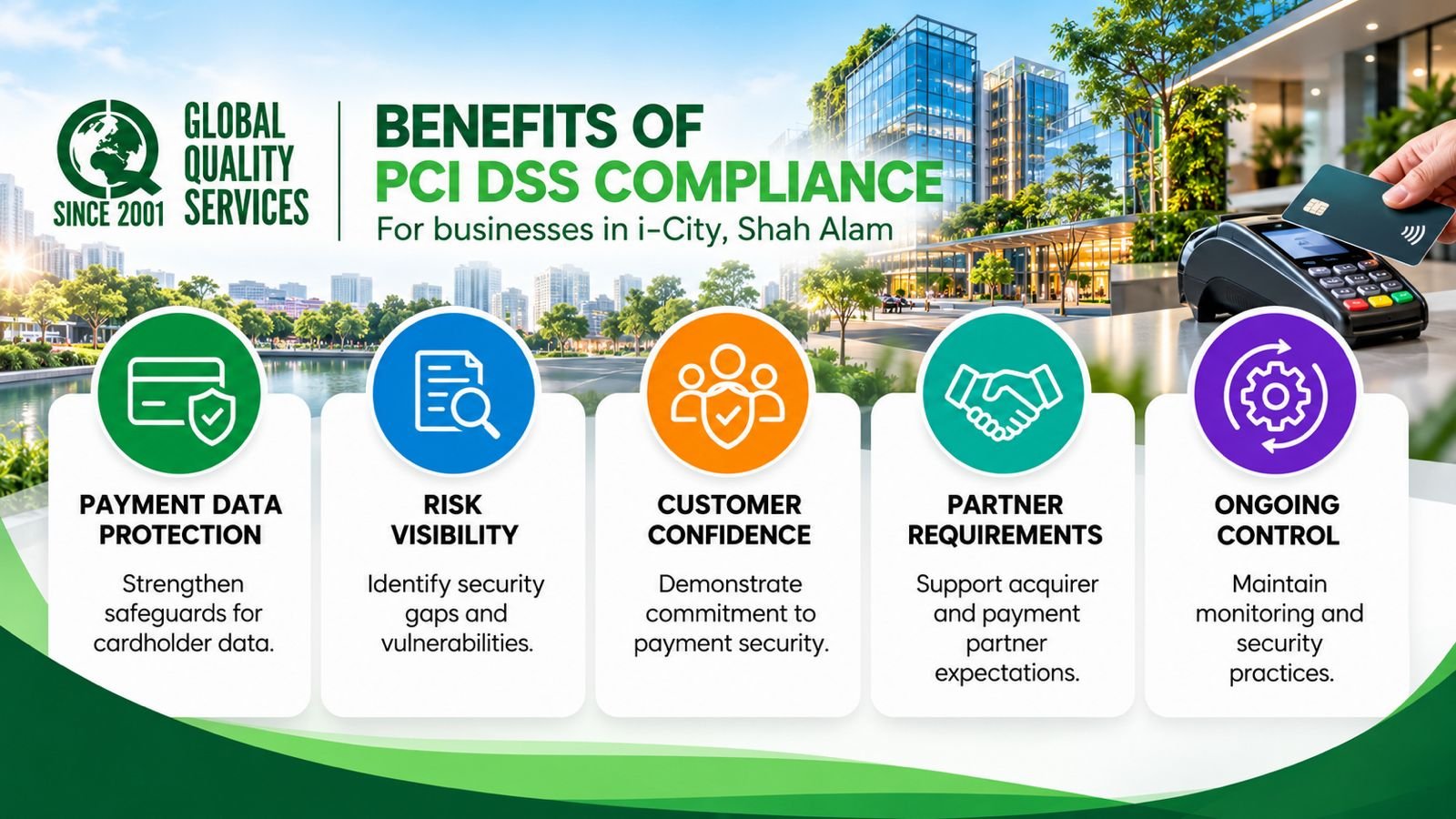
Strengthen Payment Data Security
Implementing applicable PCI DSS controls helps organisations address weaknesses in systems and processes used to handle payment account data.
Identify Control Gaps
A structured review can reveal missing controls, insecure configurations, access issues and documentation deficiencies before the required validation process.
Improve Customer and Partner Confidence
Demonstrating that relevant payment security requirements are being addressed can help organisations respond to questions from customers, payment partners and other stakeholders.
Support Payment Business Relationships
Acquiring banks, payment brands and business partners may require specific PCI DSS validation evidence. Understanding these requirements helps organisations prepare the appropriate documentation.
Establish Consistent Security Practices
PCI DSS encourages structured processes for access management, vulnerability remediation, monitoring and ongoing maintenance of security controls.
Maintain Compliance Records
Appropriate records and assessment evidence help organisations demonstrate the status of relevant controls and manage recurring validation requirements.
PCI DSS compliance does not guarantee that a data breach will never occur. Its effectiveness depends on how applicable controls are implemented, maintained and monitored.
PCI DSS Compliance Process in i-City, Shah Alam
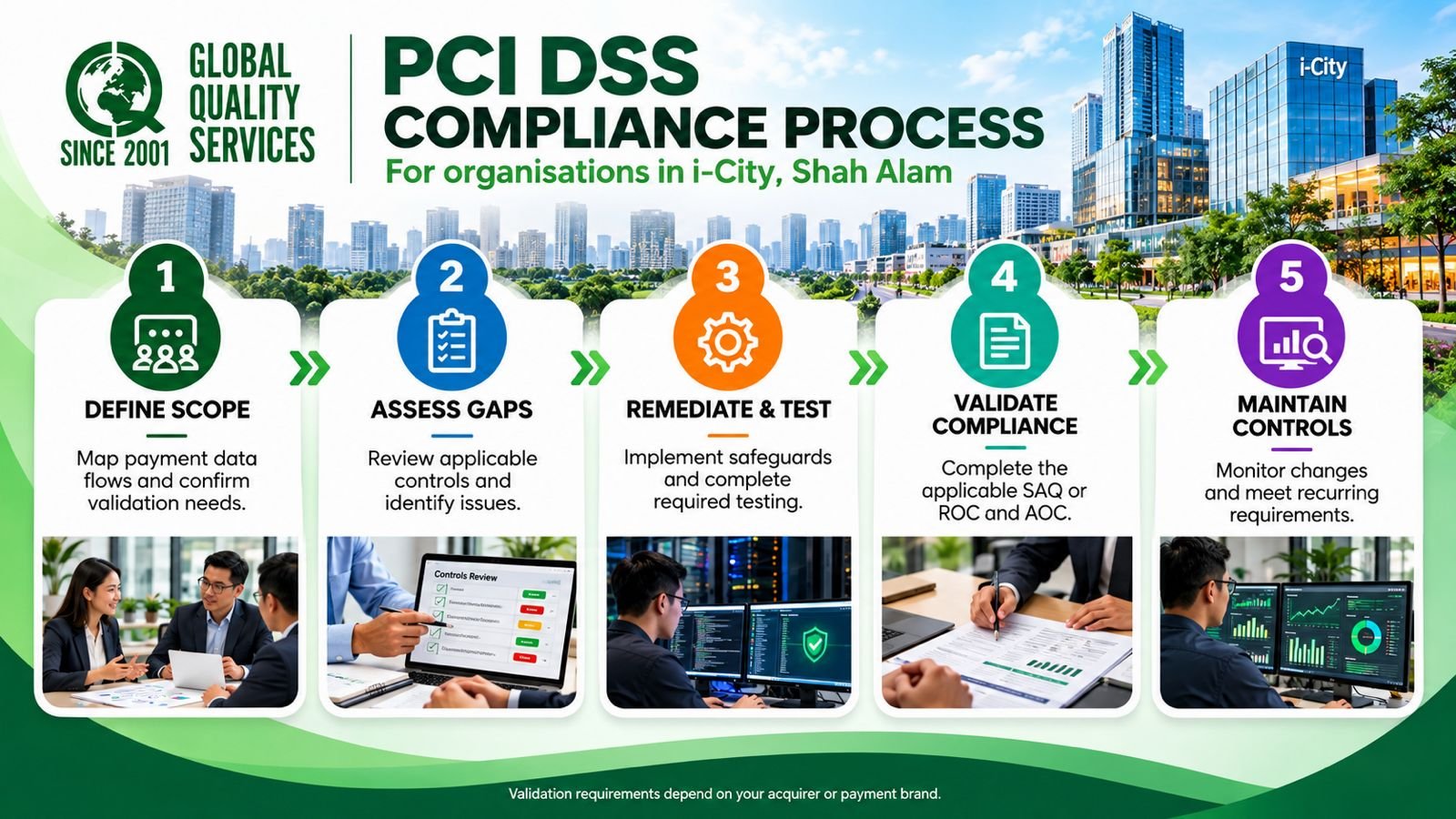
Step 1: Understand the Payment Environment
Identify how the organisation accepts payments, handles payment account data and connects to payment processing systems. Review relevant applications, infrastructure and third-party services.
Step 2: Determine the Scope
Identify the systems, networks, applications and service providers within scope or capable of affecting the security of the cardholder data environment.
Step 3: Identify Applicable Requirements
Determine the relevant PCI DSS requirements and validation route. Confirm whether an SAQ-based approach or formal assessment is required under the organisation’s payment industry obligations.
Step 4: Review Existing Controls
Evaluate relevant controls for network security, access management, data protection, vulnerability management, monitoring and security documentation.
Step 5: Address Identified Gaps
Develop a remediation plan for deficiencies identified during the review. Depending on the findings, actions may involve configuration changes, access restrictions, vulnerability remediation or improved procedures.
Step 6: Prepare Validation Evidence
Organise the required policies, technical records, testing results and other evidence according to the applicable validation method.
Step 7: Complete the Required Validation
Complete the applicable process, which may involve submitting an SAQ and AOC or undergoing a formal assessment resulting in the relevant ROC and AOC. Where a QSA assessment is required, the assessor must hold the appropriate PCI SSC qualification.
Step 8: Maintain Security Controls
Continue reviewing access permissions, addressing vulnerabilities, monitoring systems and maintaining relevant documentation to meet ongoing requirements.
Common PCI DSS Compliance Challenges
Businesses may encounter several issues while preparing for PCI DSS validation:
- Unclear scope: Difficulty identifying all systems and connections that affect payment data security.
- Incomplete documentation: Missing or outdated policies, access records and security evidence.
- Technical vulnerabilities: Unresolved weaknesses in applications, systems or network configurations.
- Third-party dependencies: Unclear responsibilities between the business and its payment or technology service providers.
- Ongoing maintenance: Difficulty keeping controls and evidence current as systems and business processes change.
Identifying these issues early helps organisations plan remediation and prepare for the applicable validation process.
Factors Affecting PCI DSS Compliance Costs
The cost of PCI DSS-related work varies according to the organisation’s environment and validation requirements. Factors may include:
- Number of systems and applications within scope.
- Complexity of the payment environment.
- Number of locations and third-party service providers.
- Existing security controls and documentation.
- Vulnerability assessment and testing requirements.
- Remediation work needed to address deficiencies.
- Whether formal QSA assessment is required.
- Ongoing monitoring and validation obligations.
Defining the scope and reviewing existing controls can help establish the likely requirements before proceeding.
PCI DSS Compliance Services by Global Quality Services in i-City
Global Quality Services provides compliance-related services for businesses seeking to understand PCI DSS requirements, review security arrangements and prepare for applicable validation. The engagement should be defined according to the organisation’s payment environment, business objectives and confirmed service requirements.
For businesses in i-City, Shah Alam, the initial step is to determine how payment data is handled and identify the applicable compliance obligations. GQS can discuss the intended scope of work and the requirements that need to be considered before formal validation.
Where a formal QSA assessment is required, it must be performed by a PCI SSC-qualified QSA. GQS should only be represented as conducting such assessments if its relevant qualification is confirmed.
Does your business in i-City, Shah Alam, need to review its payment data security requirements? Contact GQS to discuss your payment environment, compliance objectives and the appropriate next steps. A preliminary discussion can help clarify the intended scope, identify relevant control areas and establish the validation route that applies to your organisation.
Frequently Asked Questions
1. Does every company in i-City need PCI DSS compliance?
No. PCI DSS applicability depends on how a business handles payment account data and whether its systems can affect the security of the cardholder data environment. Requirements may also depend on its role in the payment ecosystem and the obligations set by relevant payment partners.
2. Is PCI DSS certification mandatory for an e-commerce business in Shah Alam?
An e-commerce business accepting payment cards generally needs to determine its PCI DSS obligations. The applicable validation method depends on its payment arrangements, systems and requirements imposed by its acquiring bank or payment programme.
3. Can a business using a third-party payment gateway avoid PCI DSS requirements?
Not automatically. A third-party payment gateway may affect the scope of the merchant’s environment, but it does not necessarily eliminate the merchant’s PCI DSS responsibilities. The business must assess its payment process and system connections.
4. What documents may be required for PCI DSS validation?
Depending on the validation method, required evidence may include security policies, network diagrams, access records, vulnerability scanning results, testing reports and other technical documentation. The exact requirements depend on the organisation’s scope and assessment route.
5. Does PCI DSS compliance guarantee protection against payment data breaches?
No. PCI DSS establishes security requirements intended to protect payment account data, but no framework can eliminate every security risk. Organisations must continue maintaining and monitoring their controls.