Food manufacturers, ingredient suppliers and food packaging businesses in Pulau Indah Industrial Park must maintain consistent food safety controls throughout their operations. From handling raw materials and processing food products to packaging, storage, and distribution, each stage requires procedures that address potential food safety hazards.
FSSC 22000 certification provides a recognized framework for establishing and maintaining a Food Safety Management System (FSMS). It combines ISO 22000 requirements, applicable sector-specific prerequisite programs (PRPs), and additional FSSC requirements to assess how organizations manage food safety across their operations.
GQS provides FSSC 22000 certification-related services for organizations in Pulau Indah Industrial Park, Malaysia. The certification journey is planned based on the organization’s activities, food chain category, operational risks, and applicable scheme requirements.
Why Is FSSC 22000 Certification Important in Pulau Indah Industrial Park?
Pulau Indah Industrial Park is an established industrial location in Selangor, with businesses involved in food and beverage manufacturing, logistics, packaging, and other manufacturing activities. Its proximity to Port Klang and Westports also makes it relevant for businesses involved in import, export, and supply chain operations.
Food manufacturers in this industrial area may handle products such as processed foods, bakery products, dairy products, edible oils, food ingredients and food-contact packaging materials. Each operation has specific requirements for hygiene, contamination prevention, process control and traceability.
FSSC 22000 certification can be relevant to:
- Food processing and manufacturing companies.
- Manufacturers of dairy products, beverages and bakery products.
- Producers of edible oils, fats and food ingredients.
- Businesses involved in frozen and ready-to-eat food production.
- Food packaging manufacturers supplying food-contact materials.
- Organizations involved in food storage and related supply chain activities, where their operations fall within the scheme’s eligible categories.
A properly implemented FSMS helps these organizations establish consistent food safety procedures, identify hazards, and maintain documented evidence of their controls.
What Is FSSC 22000 Certification?
FSSC 22000 is a food safety certification scheme developed by the Foundation FSSC. It is based on three main elements:
- ISO 22000: Requirements for a Food Safety Management System.
- Sector-specific prerequisite programs: Applicable hygiene and operational requirements for the relevant food chain category.
- Additional FSSC requirements: Further scheme requirements addressing areas such as food safety culture, food defense, food fraud mitigation and other applicable controls.
The scheme is recognized by the Global Food Safety Initiative (GFSI) and is used by organizations across the food supply chain.
FSSC 22000 certification involves an independent audit of the organization’s food safety management system. The certification body evaluates whether the system meets the applicable scheme requirements before making a certification decision.
FSSC 22000 Requirements for Businesses in Pulau Indah
Organizations must establish controls that address their food safety risks, processing activities and applicable sector requirements. The exact requirements depend on the organization’s food chain category and the nature of its operations.
1. Food Safety Management System
The organization must establish, implement, maintain, and continually improve an FSMS based on ISO 22000. This includes defining the system’s scope, assigning responsibilities, maintaining documented information and evaluating its performance.
2. Hazard Analysis and Critical Control Points
Businesses must identify potential biological, chemical, physical and allergen-related hazards associated with their products and processes.
Hazard analysis determines which control measures are necessary, including prerequisite programs, operational prerequisite programs and critical control points where applicable.
3. Prerequisite Programs
PRPs establish the basic conditions required for hygienic food production and handling. Depending on the sector, these may address:
- Facility layout and infrastructure.
- Equipment design and maintenance.
- Cleaning and sanitation.
- Pest control.
- Personal hygiene and employee facilities.
- Waste management.
- Prevention of cross-contamination.
- Storage and transportation conditions.
4. Food Safety Culture
The organization must demonstrate management commitment and promote food safety awareness throughout its workforce. Responsibilities, communication, training arrangements and employee involvement should support the implementation of food safety practices.
5. Food Defense and Food Fraud Prevention
Organizations must assess relevant food safety threats and identify vulnerabilities to food fraud. Appropriate measures should be established to address intentional contamination, substitution, adulteration and other identified risks.
6. Supplier and Raw Material Control
Businesses must establish procedures to evaluate suppliers and manage incoming materials. This includes defining purchasing requirements, checking supplier information and maintaining suitable records for raw materials, ingredients and packaging materials.
7. Traceability and Product Recall
The FSMS must include traceability arrangements that allow relevant products, materials and processing records to be identified. Organizations must also establish procedures for handling potentially unsafe products, withdrawals and recalls.
8. Monitoring, Verification and Continual Improvement
Food safety controls must be monitored and evaluated to determine whether they are effective. Internal audits, management reviews, corrective actions, and performance evaluations contribute to continual improvement.
Benefits of FSSC 22000 Certification
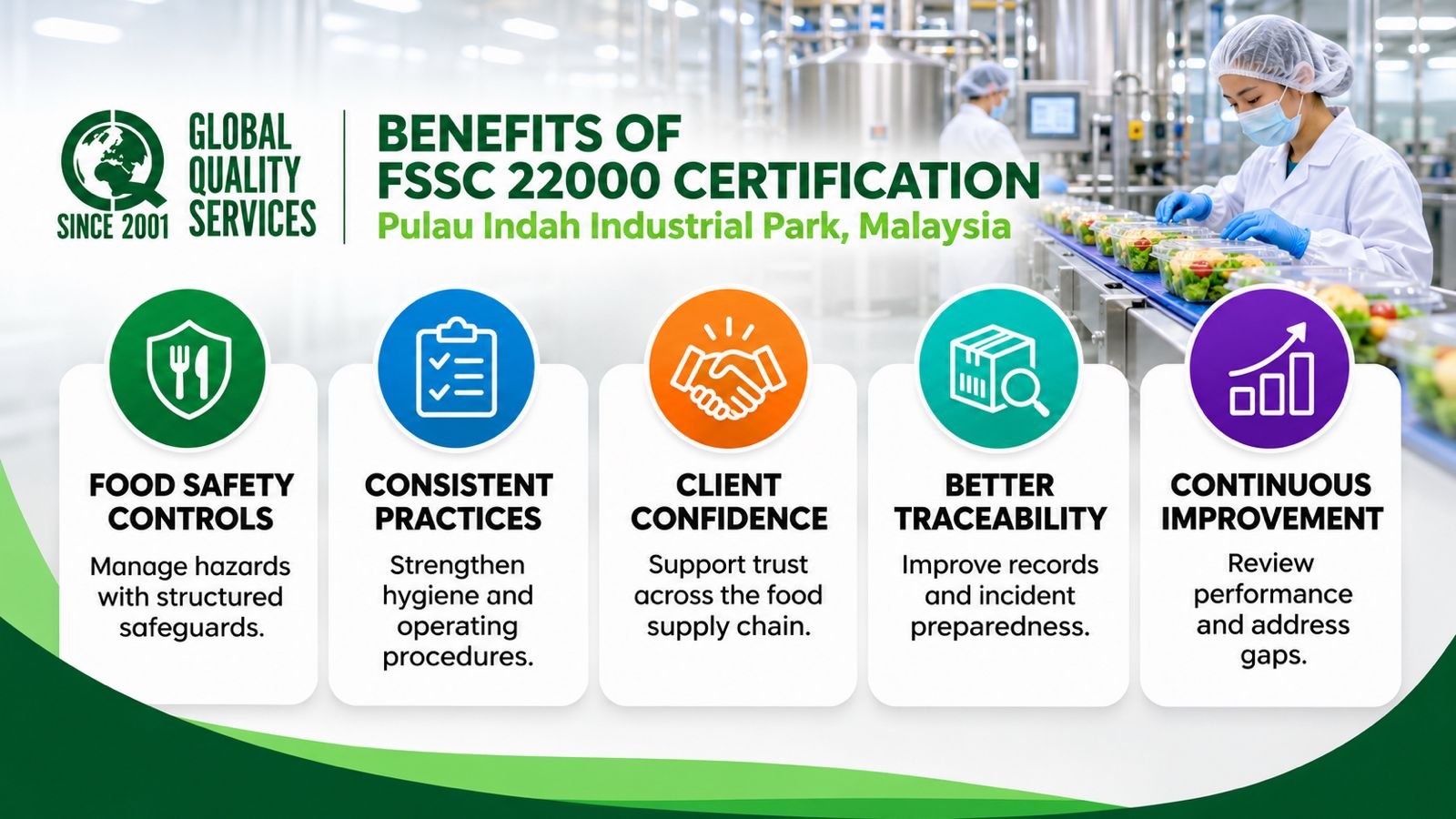
Strengthen Food Safety Controls
FSSC 22000 provides a structured framework for identifying hazards and establishing appropriate control measures. This helps organizations maintain consistent food safety practices across production and related operations.
Improve Customer and Buyer Confidence
Certification provides independent evidence that an organization’s FSMS has been assessed against the applicable FSSC 22000 scheme requirements. This can be valuable when supplying food products or packaging materials to customers with defined food safety expectations.
Establish Better Supplier Management
The scheme encourages organizations to evaluate suppliers, define purchasing requirements and maintain controls over incoming materials. This supports more consistent management of ingredients, raw materials and food-contact packaging.
Improve Traceability Across Operations
Documented traceability procedures help organizations identify relevant materials, production batches and distribution records. This information is important when investigating quality or food safety concerns.
Support Access to Supply Chain Opportunities
Some retailers, food manufacturers and international buyers prefer or require suppliers to maintain recognized food safety certifications. FSSC 22000 can therefore support supplier qualification and business relationships, subject to individual customer requirements.
Promote Continual Food Safety Improvement
Internal audits, corrective actions, and management reviews help organizations identify weaknesses and evaluate whether their food safety controls remain effective as products, processes, and business operations change.
FSSC 22000 Certification Process in Pulau Indah Industrial Park
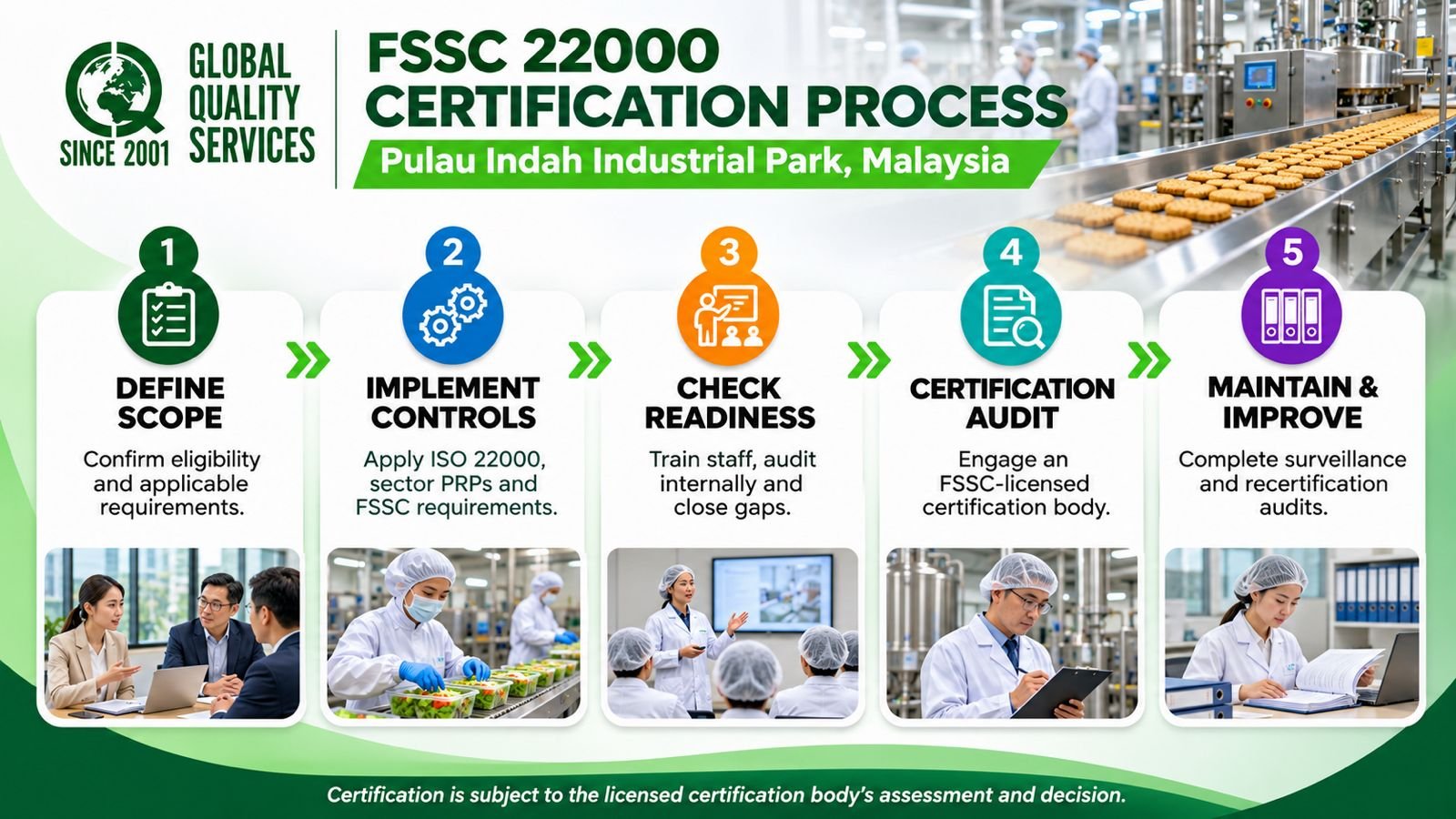
The certification process involves establishing the required food safety management system, evaluating its implementation,n and undergoing an independent certification audit.
Step 1: Define the Certification Scope
The organization’s products, processes, facilities, and activities are reviewed to establish the appropriate certification scope and food chain category.
Step 2: Conduct a Gap Assessment
Existing food safety procedures, hazard analysis, PRPs, records and operational controls are evaluated against the applicable FSSC 22000 requirements. Areas requiring improvement are identified.
Step 3: Develop and Document the FSMS
The organization establishes or updates its food safety policy, hazard analysis, procedures, monitoring arrangements, responsibilities, and supporting documentation.
Step 4: Implement Food Safety Controls
The documented procedures are implemented across relevant operations. Employees must understand their responsibilities, and records should demonstrate that established controls are being followed.
Step 5: Conduct Internal Audits
Internal audits evaluate whether the FSMS conforms to the applicable requirements and is effectively implemented. Identified nonconformities should be addressed through appropriate corrective actions.
Step 6: Complete Management Review
Top management reviews the performance of the food safety management system, including audit results, food safety objectives, nonconformities, corrective actions and improvement opportunities.
Step 7: Undergo the Certification Audit
An independent certification body conducts the certification audit to evaluate the organization’s FSMS. The audit examines relevant documentation, processes, facilities, records and implementation evidence.
Step 8: Certification Decision
The certification body reviews the audit findings and determines whether the organization meets the applicable certification requirements. The certificate is issued only after the certification decision has been approved.
FSSC 22000 Version 7: What Businesses Need to Know
FSSC 22000 Version 7 was released on 1 May 2026. The update changes the scheme’s requirements and aligns its structure with developments in food safety management and prerequisite programs.
A significant change is the incorporation of the updated ISO 22002-x:2025 series. These standards provide sector-specific prerequisite program requirements alongside a common foundation for relevant food chain activities.
Version 7 also aligns the scheme with the Global Food Safety Initiative (GFSI) Benchmarking Requirements 2024 and introduces updates to food chain categories and other scheme provisions.
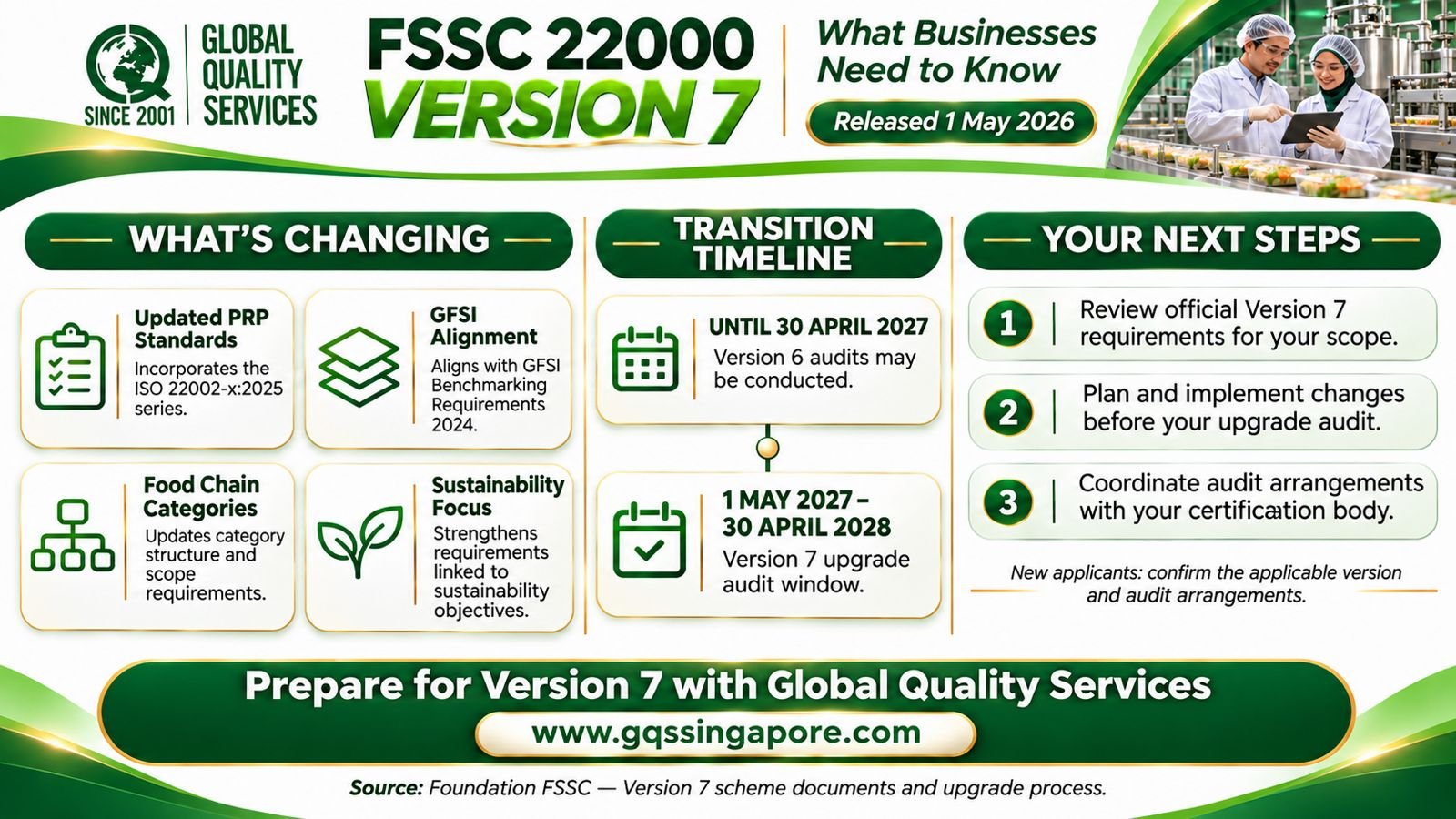
Organisations currently certified to Version 6 should review their existing food safety management systems and plan the required changes. The transition may involve updating prerequisite programmes, reviewing hazard analysis, revising documentation and addressing the additional Version 7 requirements applicable to the organisation.
Businesses in Pulau Indah should confirm the applicable transition arrangements and audit schedule with their certification body.
Why Choose Global Quality Services for FSSC 22000 Certification?
Global Quality Services provides certification-related services for organizations seeking to establish and maintain food safety management systems in line with FSSC 22000 requirements.
For businesses in Pulau Indah Industrial Park, the certification approach considers the organisation’s food chain category, product range, manufacturing processes, facility arrangements and existing food safety controls.
The certification journey is planned around the applicable scheme requirements, with attention to system readiness, audit preparation and the evidence required for independent assessment. The relevant certification body remains responsible for certification decisions.
A structured food safety management system helps organisations establish consistent controls across production, storage, packaging and related operations. FSSC 22000 certification provides an internationally recognised way to demonstrate that the system has been independently assessed against the scheme’s requirements.
Frequently Asked Questions
1. Which food chain categories are relevant to businesses in Pulau Indah Industrial Park?
The applicable category depends on the organisation’s actual activities. Food manufacturing, ingredient processing and food packaging may fall under different FSSC food chain categories. The scope must be determined using the current scheme requirements rather than the company’s general industry description.
2. Does a food packaging manufacturer need FSSC 22000 certification?
FSSC 22000 includes requirements for eligible manufacturers of food packaging materials. Whether a particular organisation qualifies depends on the materials it produces, their intended use and the applicable food chain category.
3. Can a company apply for FSSC 22000 certification if it already has HACCP or ISO 22000?
Yes. Existing HACCP or ISO 22000 systems can provide a foundation for FSSC 22000. However, the organisation must also meet the applicable sector-specific PRP and additional FSSC scheme requirements before certification can be granted.
4. What should a business do before its first FSSC 22000 certification audit?
It should define its certification scope, complete hazard analysis, implement applicable PRPs, maintain required documentation and records, conduct internal audits and complete a management review. The system should be operating effectively before the independent certification audit.
5. Does FSSC 22000 certification replace Malaysian food safety or Halal requirements?
No. FSSC 22000 is a food safety management system certification scheme. It does not replace applicable Malaysian food safety laws, regulatory approvals or Halal certification requirements. Organisations must address these obligations separately where they apply.