
Organizations operating in Orchard Road handle personal information across customer services, financial transactions, employee records, digital platforms, and business operations. Managing this information responsibly requires defined privacy controls, clear accountability and consistent procedures for handling personal data.
ISO/IEC 27701 certification provides an internationally recognized way to demonstrate that an organization has established and maintains a Privacy Information Management System (PIMS). It sets requirements for managing personally identifiable information (PII), including the responsibilities of organizations acting as PII controllers and processors.
GQS provides ISO 27701 certification-related services for organizations in Orchard Road, Singapore, seeking a structured approach to privacy information management. The work is aligned with the organization’s activities, data-processing responsibilities, and applicable privacy requirements.
Why Is ISO 27701 Certification Important for Businesses in Orchard Road?
Orchard Road is a prominent commercial and business location in Singapore, with office developments, professional services, technology businesses, and organizations serving local and international customers. Businesses operating in this environment may process personal information through customer databases, online services, employee systems, payment platforms and third-party service providers.
A structured privacy management system helps organizations define how personal information is collected, used, stored, shared, retained, and disposed of.
ISO 27701 certification can be particularly relevant to:
- Retail and customer-facing businesses managing customer profiles and transaction records.
- Professional service providers processing client and employee information.
- Technology and software companies handling personal data through digital platforms.
- Financial and business service organizations managing confidential customer information.
- Regional offices processing personal information across multiple jurisdictions.
- Organizations acting as data processors for external clients and business partners.
For businesses in Orchard Road, a PIMS can provide a consistent framework for managing privacy responsibilities across departments, systems and external service relationships.
What Is ISO/IEC 27701?
ISO/IEC 27701 is an international standard for establishing, implementing, maintaining and continually improving a Privacy Information Management System. It applies to organizations that determine how personally identifiable information is processed and those that process PII on behalf of other organizations.
The 2025 edition, published on 14 October 2025, introduced an important structural change: ISO/IEC 27701 became a standalone management system standard rather than an extension of ISO/IEC 27001 and ISO/IEC 27002.
Singapore has also adopted the standard as SS ISO/IEC 27701:2026, based on ISO/IEC 27701:2025.
This means organizations can establish a PIMS independently of an ISO/IEC 27001-certified Information Security Management System. However, integrating the two systems may still be useful where their processes and controls overlap.
ISO 27701 and Singapore’s Personal Data Protection Act (PDPA)
The Personal Data Protection Act (PDPA) sets requirements for organizations in Singapore on the collection, use, disclosure, and care of personal data. It also gives individuals rights over their personal data.
ISO 27701 offers a management system framework that organizations can use to structure privacy responsibilities and demonstrate how personal information is managed.
For businesses in Orchard Road, this relationship is relevant when managing:
- Consent and notification procedures.
- Access to and use of personal information.
- Data accuracy and retention practices.
- Requests from individuals concerning their personal data.
- Disclosure and sharing of information with third parties.
- Personal data protection and security arrangements.
- Data breach response and incident management.
- Responsibilities assigned to employees and service providers.
ISO 27701 certification does not automatically establish compliance with every PDPA obligation. Organizations must assess their actual processing activities against applicable Singapore legal requirements.
Key Requirements of ISO 27701 Certification
An organization seeking ISO 27701 certification must establish a PIMS that addresses its privacy responsibilities, operational risks, and information-processing activities.
1. Context of the Organization
The organization must identify internal and external factors that affect its privacy management system. This includes understanding its business activities, interested parties, legal obligations and the scope of personal information processing.
2. Leadership and Accountability
Top management must demonstrate commitment to privacy management by establishing relevant policies, assigning responsibilities, and ensuring the PIMS is supported across the organization.
3. Privacy Risk Assessment and Treatment
Organizations need to identify risks associated with processing personally identifiable information. Appropriate measures must be selected to address risks relating to unauthorized access, disclosure, loss, misus,e and other privacy-related issues.
4. PII Processing Responsibilities
The organization must identify whether it operates as a PII controller, a PII processor or performs both roles. Its privacy responsibilities and controls must reflect the activities it carries out.
5. Operational Privacy Controls
Privacy requirements must be incorporated into business processes. This can include procedures for collecting, using, storing, transferring, retaining, and disposing of personal information.
6. Monitoring and Evaluation
The PIMS must be monitored to determine whether established processes and controls are operating as intended. Internal audits, performance evaluations and management reviews contribute to this assessment.
7. Continual Improvement
Organizations must address nonconformities, evaluate corrective actions and improve the privacy management system as business operations, risks and processing activities change.
Benefits of ISO 27701 Certification
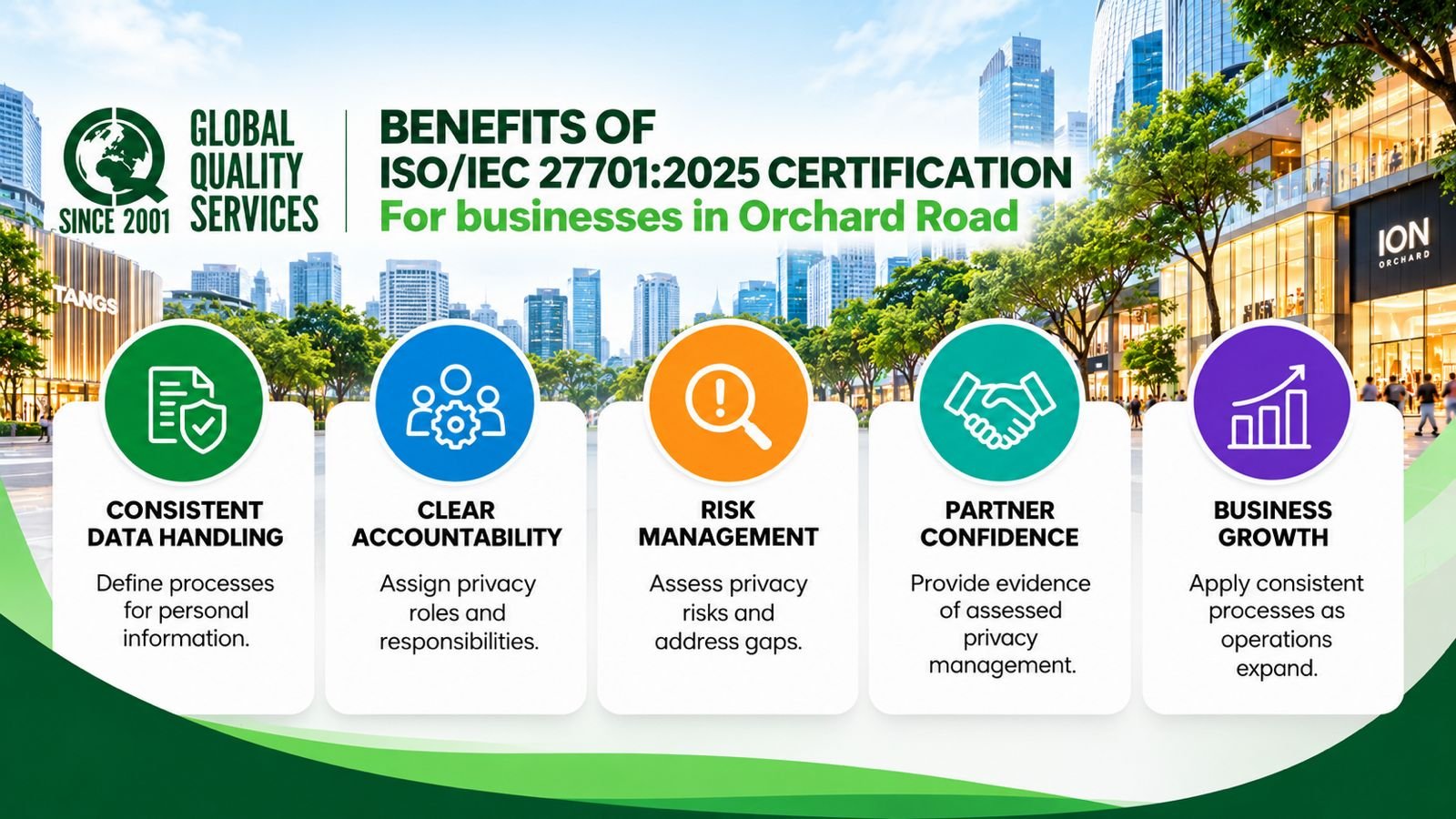
Establish Structured Privacy Management
A PIMS defines how personal information is handled across business operations. It helps establish consistent responsibilities and procedures rather than relying on informal privacy practices.
Strengthen Customer and Business Partner Confidence
Independent certification provides evidence that an organization’s privacy management system has been assessed against an internationally recognized standard. This can be valuable when working with clients, suppliers and business partners that place importance on responsible data handling.
Improve Personal Data Accountability
The standard encourages organizations to define responsibilities for handling PII. Employees and relevant departments can work within documented procedures for managing personal information.
Support Privacy Risk Management
A structured approach to identifying and addressing privacy risks helps organizations identify weaknesses in their data-processing activities and determine appropriate controls.
Improve Third-Party Data Management
Organizations often share personal information with cloud providers, technology vendors, service partners and other external parties. ISO 27701 encourages clear management of privacy responsibilities associated with these relationships.
Support International Business Relationships
Businesses that process personal information across borders may need to demonstrate how they manage privacy responsibilities. ISO 27701 provides a recognized framework that can support discussions with international customers and business partners.
ISO 27701 Certification Process in Orchard Road
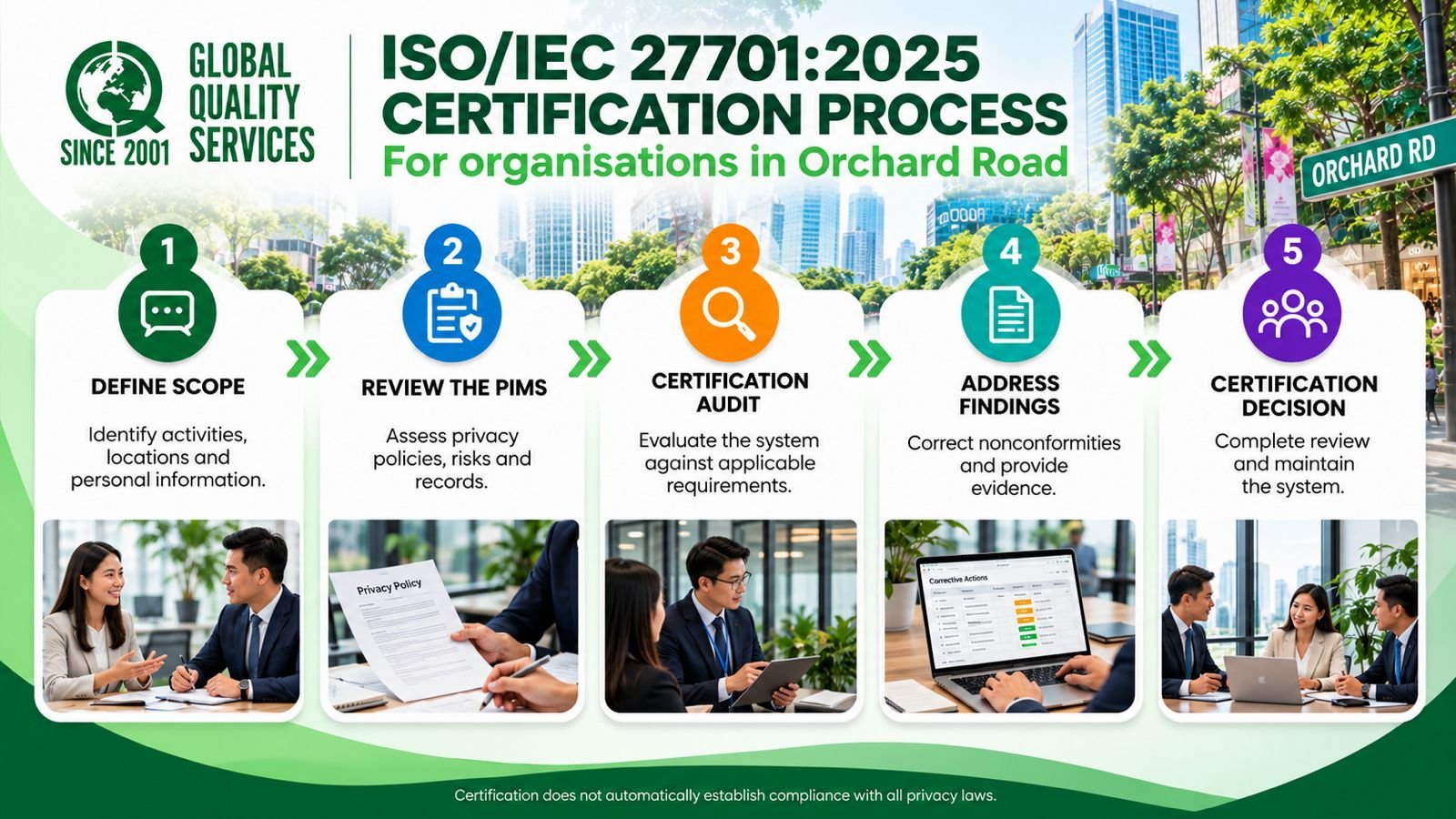
The certification journey involves establishing the PIMS, evaluating its effectiveness, and completing an independent certification audit.
Step 1: Understand theOrganization’ss Requirements
The organization’s business activities, personal data processing operations, regulatory obligations, and certification objectives are reviewed to determine the appropriate PIMS scope.
Step 2: Conduct a Gap Assessment
The organization evaluates existing privacy policies, procedures, risk assessments, and operational controls against the applicable ISO/IEC 27701 requirements. Any gaps requiring attention are identified.
Step 3: Establish the Privacy Management System
The organization develops or updates its privacy policies, procedures, responsibilities, risk-treatment measures, and supporting documentation within the defined scope.
Step 4: Implement Privacy Controls
The approved processes and controls are incorporated into relevant business operations. Employees and responsible teams must understand their assigned privacy responsibilities.
Step 5: Conduct Internal Audits
Internal audits evaluate whether the PIMS conforms to the standard and whether established procedures are being followed. Identified nonconformities must be addressed.
Step 6: Complete Management Review
Top management reviews the PIMS, including audit findings, performance, risks, corrective actions, and opportunities for improvement.
Step 7: Undergo the Certification Audit
An independent certification body evaluates the PIMS against the applicable requirements. The audit process may include documentation review, interviews and examination of operational evidence.
Step 8: Certification Decision
The certification body reviews the audit findings and determines whether the organizationn meets the certification requirements. Certification is granted only after the applicable requirements have been satisfied and the certification decision has been approved.
ISO 27701:2019 vs ISO/IEC 27701:2025
The transition from the 2019 edition to the 2025 edition is an important consideration for organizations that already maintain a privacy information management system.
| Area | ISO/IEC 27701:2019 | ISO/IEC 27701:2025 |
|---|---|---|
| Standard structure | Extension to ISO/IEC 27001 and ISO/IEC 27002 | Standalone management system standard |
| ISO 27001 dependency | Designed to extend an existing ISMS | Independent PIMS certification is possible |
| Management system structure | Based on the earlier extension approach | Aligned with the harmonized structure for management system standards |
| Certification approach | Privacy certification linked to the ISMS framework | Separate PIMS certification framework |
| Publication status | Withdrawn in October 2025 | Published in October 2025 |
Organizations certified against the 2019 edition should review the applicable transition arrangements with their certification body. The transition timetable and any accreditation-related requirements should be confirmed before planning an upgrade.
Why Choose Global Quality Services for ISO 27701 Certification?
Global Quality Services provides certification services for organizations seeking a structured approach to privacy information management. The approach considers the organization’s data-processing activities, existing management systems, operational responsibilities and applicable requirements.
ISO 27701 certification provides a structured framework for demonstrating privacy management practices to customers, business partners and other interested parties.
Contact GQS to discuss ISO 27701 certification requirements for your organization in Orchard Road, Singapore. Share your business activities, existing ISO certifications and privacy management objectives to determine the appropriate certification scope.
Frequently Asked Questions
1. Can a company in Orchard Road obtain ISO 27701 certification without ISO 27001?
Yes. ISO/IEC 27701:2025 is a standalone management system standard. Organizations can pursue PIMS certification without first obtaining ISO/IEC 27001 certification, provided they meet the applicable requirements.
2. Does ISO 27701 certification apply to companies that outsource data processing?
Yes. The standard is relevant to both PII controllers and PII processors. Organizations that outsource data processing can use a PIMS to define their responsibilities and manage privacy-related activities involving external service providers.
3. Does ISO 27701 certification cover customer and employee information?
It can cover both, provided the relevant personal information processing activities are included within the organization’s defined PIMS scope. The scope should identify the information, processes, departments, and locations covered by the system.
4. Can a business use ISO 27701 certification to demonstrate its privacy practices to international clients?
Yes. Certification provides independent evidence that theorganization’ss PIMS has been assessed against the standard. International clients may consider this evidence when evaluating suppliers and data-processing partners, although it does not replace their own contractual or regulatory assessments.
5. What should an organization do if it already holds ISO 27701:2019 certification?
It should contact its certification body to establish the applicable transition arrangements for ISO/IEC 27701:2025. The organization should review the revised standard, assess changes to its existing PIMS, and plan the necessary updates and audit activities.