
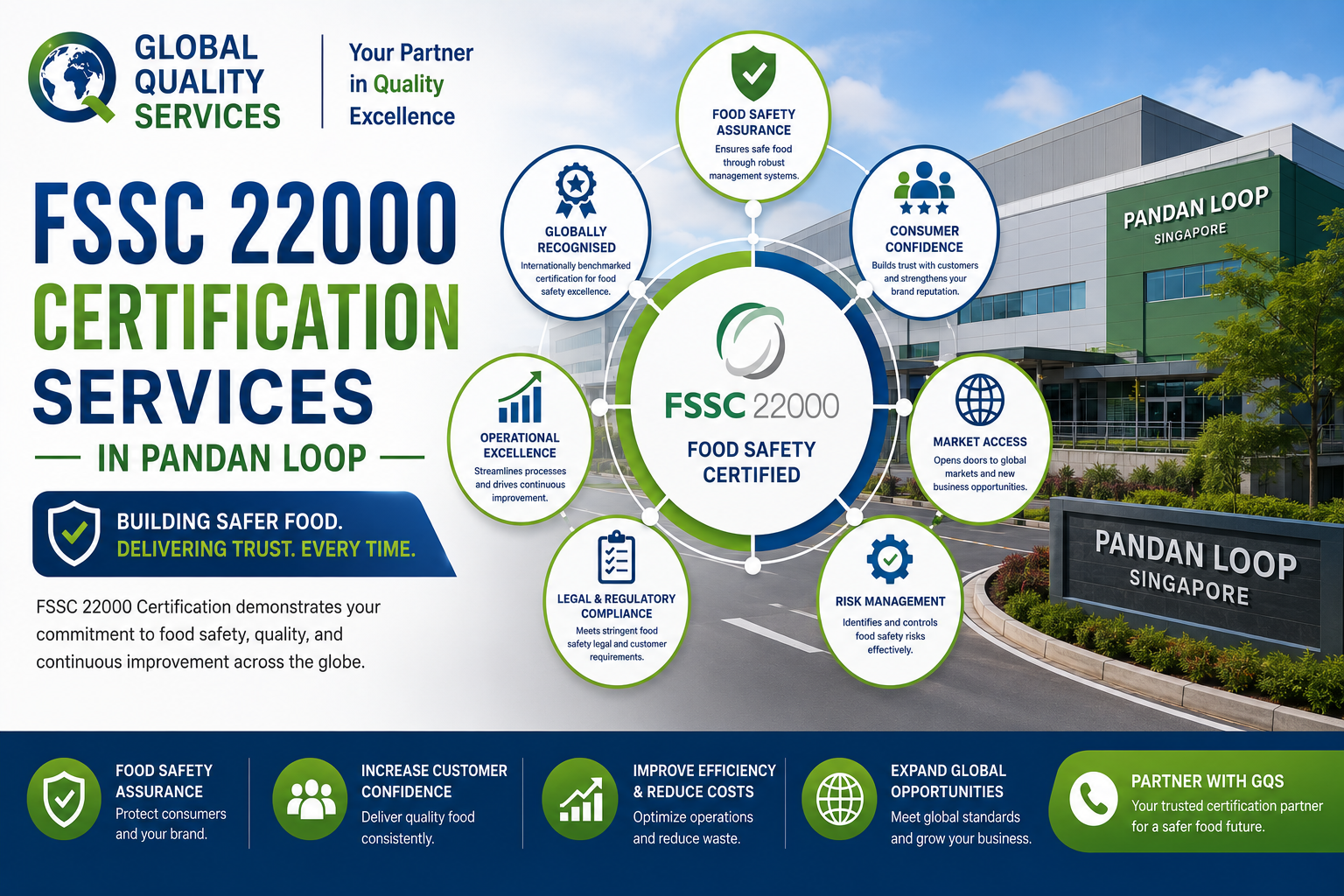
Global Quality Services provides end-to-end FSSC 22000 consultancy for food manufacturers and processors in Pandan Loop. We cover gap analysis, food safety management system (FSMS) implementation, HACCP documentation, internal audit, and full certification readiness. Our approach is aligned with Singapore Food Agency (SFA) requirements and Global Food Safety Initiative (GFSI) benchmarks.
Pandan Loop is part of Singapore’s established Pandan Food Zone in the West Region. It sits five minutes from the Ayer Rajah Expressway (AYE) and is close to major business hubs including one-north and Mapletree Business City. The estate includes JTC Pandan Loop Terrace Workshops, CT FoodChain at 200 Pandan Loop, Singapore Food Industries at 234 Pandan Loop, and a concentration of food processing, repacking, and distribution businesses. For operators here, FSSC 22000 certification is a buyer qualification standard, an SFA recognition pathway, and a direct market access tool for retail and export channels.
What Is FSSC 22000
FSSC 22000 is the Food Safety System Certification scheme developed by the Foundation FSSC. It is benchmarked by the Global Food Safety Initiative (GFSI) and recognized by major retailers, foodservice distributors, and export market buyers worldwide.
The scheme has three layers:
- ISO 22000: The international standard for Food Safety Management Systems. Covers hazard analysis, HACCP principles, operational prerequisite programs, and continual improvement.
- Sector-Specific Prerequisite Programs (PRPs): Technical specifications covering hygiene and operational requirements. For food manufacturers, the applicable standard is ISO/TS 22002-1.
- Additional FSSC Requirements: Cover food fraud prevention, food defense, allergen management, environmental monitoring, quality culture, supplier control, and food loss and waste.
FSSC 22000 Version 6 is the current active version. It took effect for audits on 1 April 2024. Key changes under Version 6:
- Quality control is now mandatory, not a voluntary add-on
- Food safety and quality culture is a standalone requirement with a documented plan and measurable objectives
- Allergen management, equipment management, and food loss and waste requirements are strengthened
- Organizations must notify their certification body within three working days of serious incidents affecting food safety or certification integrity
Why Pandan Loop Food Manufacturers Need FSSC 22000
Pandan Loop is not a general industrial estate. It is part of the designated Pandan Food Zone. The businesses here are in food processing, food manufacturing, food repacking, and food distribution. That means food safety certification is a baseline commercial expectation, not an optional upgrade.
Three things are pushing Pandan Loop operators toward FSSC 22000 right now.
Retail and export buyers require it.
Operators in the Pandan Food Zone supply Cold Storage, FairPrice, Giant, foodservice distributors, and regional export buyers. These buyers operate GFSI-recognized certification requirements. FSSC 22000 is the most widely accepted GFSI-benchmarked scheme globally. Without it, Pandan Loop food manufacturers are cut off from significant buyer programs.
SFA’s SAFE framework recognizes it.
The SFA Safety Assurance for Food Establishments (SAFE) framework recognizes FSSC 22000 as an accredited FSMS. Category 1 food establishments with a certified FSMS can fast-track to an SFA ‘A’ grade. This is a direct operational benefit for Pandan Loop manufacturers supplying Singapore’s retail and foodservice market.
Co-manufacturing and contract customers require it.
Pandan Loop hosts repacking operations and co-manufacturers supplying to brand owners. Brand owners with their own FSSC 22000 certification routinely require all co-manufacturers in their network to hold the same certification. This makes FSSC 22000 a contract condition, not a commercial choice.
Who in Pandan Loop Needs FSSC 22000
FSSC 22000 applies across the food supply chain. In Pandan Loop, that covers:
- Food processors and manufacturers producing packaged, chilled, frozen, or ambient products for retail or foodservice distribution
- Food repacking operations handling pre-packaged goods for redistribution or relabeling
- Co-manufacturers producing under third-party brand specifications
- Food ingredient and flavoring producers supplying downstream food manufacturers
- Cold chain and temperature-controlled storage operators where food safety management is within scope
- Food distribution and logistics operators managing food handling as part of their operations
If your facility is SFA-licensed and supplying retail, foodservice, or export buyers, FSSC 22000 is either already required or will be required in your next contract cycle.
Key Requirements of FSSC 22000
These apply to all food manufacturers pursuing FSSC 22000 certification:
- Management System Foundation: Establish a documented FSMS aligned to ISO 22000. Covers food safety policy, objectives, roles, responsibilities, and management review.
- Hazard Analysis and HACCP: Conduct a full hazard analysis covering biological, chemical, physical, and allergen hazards. Establish Critical Control Points (CCPs) with defined monitoring limits, corrective action procedures, and verification activities.
- Prerequisite Programs (PRPs): Implement and document operational PRPs covering infrastructure, cleaning and sanitation, pest control, personnel hygiene, allergen management, and cross-contamination prevention, aligned to ISO/TS 22002-1.
- Food Safety Culture: Document a food safety culture plan with defined objectives and measurable evidence of implementation. This is a standalone Version 6 requirement.
- Food Fraud Prevention: Conduct a documented food fraud vulnerability assessment. Establish a mitigation plan covering adulteration, substitution, mislabeling, and counterfeiting risks relevant to your supply chain.
- Food Defense: Assess intentional contamination threats. Establish a food defense plan with access control, personnel screening, and monitoring measures.
- Allergen Management: Implement a documented allergen management program covering raw material control, segregation, labeling verification, and cleaning validation.
- Supplier Control: Establish an approved supplier program covering all direct and indirect food material suppliers.
- Traceability: Maintain a system that traces raw materials forward to finished product and backward to supplier within a defined timeframe.
- Internal Audit: Conduct planned internal audits against FSSC 22000 requirements to verify system effectiveness and close non-conformances before certification.
Steps to Get FSSC 22000 Certified in Pandan Loop
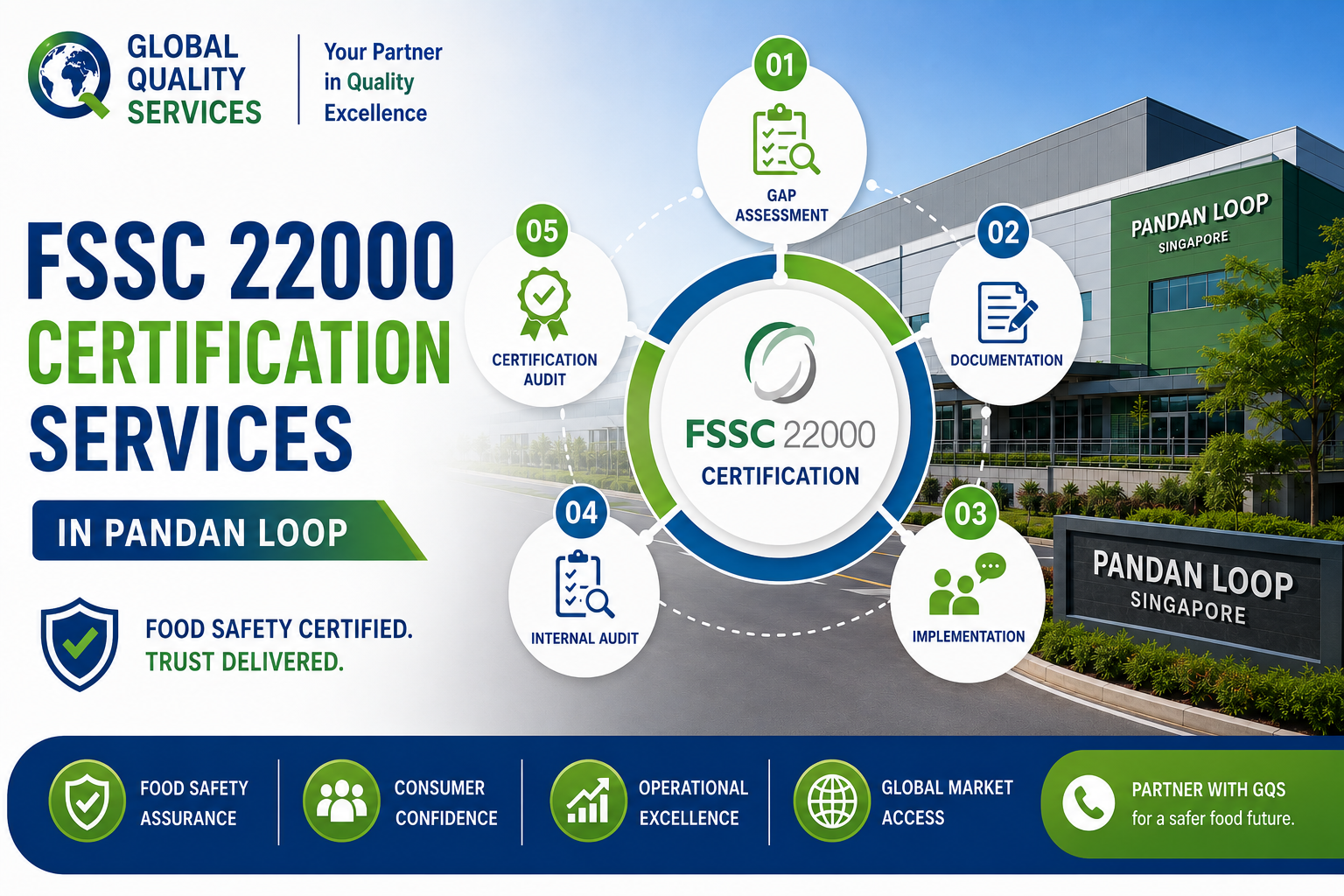
Let us understand the steps that FSSC certification requires:
Step 1: Gap Analysis
Compare your current food safety practices against FSSC 22000 Version 6 requirements. Identify what is in place, what needs updating, and what must be built. Produce a prioritized action plan specific to your Pandan Loop facility.
Step 2: FSMS Documentation
Develop or update your Food Safety Manual, HACCP plan, PRP documentation, food fraud vulnerability assessment, food defense plan, allergen management program, and supplier control procedures. Every document must reflect your actual processes and products, not a generic template.
Step 3: Prerequisite Program Implementation
Put PRPs into practice across your facility. Cleaning schedules, pest control arrangements, personnel hygiene protocols, allergen segregation systems, and facility maintenance programs must all align to ISO/TS 22002-1.
Step 4: HACCP Implementation
Implement your HACCP plan on the production floor. Train all relevant staff on CCP monitoring, corrective action procedures, and documentation requirements.
Step 5: Food Safety Culture Rollout
Develop and implement your food safety culture plan. Collect measurable evidence. This requires visible leadership commitment and employee engagement at all levels, not just a policy on the wall.
Step 6: Internal Audit
Conduct a full internal audit against FSSC 22000 Version 6. Identify non-conformances. Close all gaps before approaching your certification body.
Step 7: Management Review
Conduct a management review covering food safety performance data, customer feedback, audit results, and improvement actions. Document it fully before the certification audit.
Step 8: Certification Audit
Engage an accredited FSSC 22000 certification body. The audit runs in two stages: a documentation review followed by an on-site audit of your Pandan Loop facility.
Step 9: Post-Certification Maintenance
Sustain certification through annual surveillance audits, ongoing HACCP monitoring, management reviews, and continual improvement activities. Recertification audits occur every three years.
Singapore Regulatory Context
Pandan Loop food manufacturers operate within a clear regulatory framework:
- Singapore Food Agency Act 2019: Established SFA as the lead food safety regulator. Governs licensing, inspection, and enforcement for all food manufacturers and processors in Singapore, including Pandan Loop operators.
- SFA SAFE Framework: SFA’s grading and assurance system for food establishments. Recognizes FSSC 22000 as an accredited FSMS. Category 1 establishments with FSSC 22000 can fast-track to grade ‘A’.
- SFA Licensed Food Manufacturing and Storage Areas: Pandan Loop addresses appear on SFA’s licensed areas list. Operating here requires SFA licensing. FSSC 22000 directly supports and strengthens that licensed status.
- Environmental Public Health Act: Enforced by the National Environment Agency (NEA). Covers cleaning, sanitation, and pest control obligations for licensed food premises. FSSC 22000 PRP requirements support NEA compliance directly.
- Personal Data Protection Act (PDPA): Enforced by the Personal Data Protection Commission (PDPC). Applies to Pandan Loop operators processing employee and customer data within traceability and supplier management systems.
- Wholesome Meat and Fish Act: Applies to Pandan Loop processors handling meat and fish products. FSSC 22000 hazard analysis and CCP documentation support compliance with SFA’s species-specific requirements under this Act.
Industries at Pandan Loop That Benefit from FSSC 22000
Here is the list of the Industries at Pandan Loop That Benefit from FSSC 22000:
Food Processing and Manufacturing
This is the core business of Pandan Loop. Singapore Food Industries at 234 Pandan Loop is one of Singapore’s largest integrated food companies. CT FoodChain at 200 Pandan Loop is a purpose-built B2 food factory with 98 units designed for food manufacturing and processing. Retail buyers supplying major supermarket chains require GFSI-recognized certification from their manufacturing partners. FSSC 22000 is the scheme most commonly specified.
Food Repacking Operations
Repacking businesses at Pandan Loop handle pre-packaged goods for redistribution, relabeling, or retail format conversion. Brand owners and importers requiring repackers to hold FSSC 22000 are increasingly common. Without certification, Pandan Loop repackers are excluded from these supply chain relationships.
Co-Manufacturing and Contract Production
Co-manufacturers producing under third-party brand specifications are directly affected by their brand owner clients’ FSSC 22000 scope. Most brand owners with FSSC 22000 certification require all production partners in their network to hold the same standard. This makes it a contractual requirement for Pandan Loop co-manufacturers.
Food Ingredient and Flavoring Production
Ingredient suppliers at Pandan Loop feed into other manufacturers’ supply chains. Downstream food manufacturers with FSSC 22000 certification apply the same requirement to their ingredient suppliers. Certification is a supply chain access condition, not just a compliance activity.
Cold Chain and Temperature-Controlled Storage
Pandan Loop operators managing chilled or frozen product handling work within SFA’s strict temperature control and hygiene requirements. FSSC 22000 PRP and traceability requirements directly map onto those obligations and support ongoing SFA compliance.
Distribution and Logistics with Food Handling
Pandan Loop’s proximity to the AYE and major business districts makes it a distribution hub. Logistics operators that handle food products as part of their scope are within FSSC 22000’s applicability. GFSI recognition matters to food brand owners when qualifying logistics partners.
FSSC 22000 Version 7 Transition: Your 18-Month Window Has Already Started
Version 7 of FSSC 22000 was released in May 2026. The 18-month transition clock started the same day. For Singapore food businesses currently certified to Version 6, that means your migration deadline falls in November 2027 at the latest, and your next scheduled audit, whether surveillance or recertification, is almost certainly the only practical window to complete it without incurring an additional audit fee.
Here is what the timeline looks like in practice.
Now to Month 3. Conduct a gap assessment against the five areas Version 7 changes: allergen management plan, food loss and waste policy, updated food fraud and food defense plans, food safety culture objectives, and ISO 22002-100:2025 alignment. Most Version 6 facilities have partial coverage of these areas already. The gap assessment confirms exactly what needs updating and what does not.
Month 3 to Month 9. Update documentation, embed changes into daily operations, and run your next internal audit cycle against Version 7 requirements, not Version 6. Certifying bodies will not accept a Version 6 internal audit as evidence of Version 7 readiness. This stage also includes a top management briefing on the new measurable food safety culture objectives, which is an audited requirement in Version 7.
Month 9 to Month 18. Your Stage 1 or Stage 2 audit, whether a scheduled surveillance visit or a recertification, is conducted against Version 7. If your documentation and internal audit are already aligned, this is a normal audit cycle with an updated scope rather than an additional visit.
Miss this window and your options narrow. A lapsed Version 6 certificate that cannot be transitioned in time means re-entering the certification process from Stage 1, an outcome that affects your buyer qualifications, your SFA SAFE framework grade, and any EDG grant claims tied to your active certificate.
Global Quality Services plans and executes your Version 7 transition around your existing audit schedule so the migration is completed on time, within budget, and without an unplanned lapse in your certification status.
Contact Global Quality Services to start your FSSC 22000 Version 7 transition now.
Why Global Quality Services
GQS has delivered FSSC 22000 certification projects across Singapore’s food manufacturing and processing sector. Our consultants work directly inside your Pandan Loop facility. We do not apply generic templates to your operations.
Every facility in Pandan Loop is different. Your HACCP plan, PRP documentation, and food fraud assessment must reflect your specific products, processes, and supply chain. A copied document from another site will not pass a certification audit.
With GQS, Pandan Loop food manufacturers receive:
- Gap analysis against FSSC 22000 Version 6, mapped to your specific products and processes
- Full FSMS documentation covering ISO 22000, sector PRPs, and all FSSC additional requirements
- HACCP plan development and CCP verification specific to your Pandan Loop facility
- Food fraud vulnerability assessment and mitigation plan
- Food defense plan aligned to your site layout and supply chain
- Allergen management program implementation
- Food safety culture plan with measurable objectives and evidence collection
- Internal audit facilitation against FSSC 22000 Version 6
- Certification audit coordination with your chosen accredited certification body
- Post-certification surveillance support and continual improvement planning
- Scope extension to ISO 9001, ISO 14001, or HACCP certification for Pandan Loop operators consolidating quality, environmental, and food safety compliance under one engagement
Contact Global Quality Services to start your FSSC 22000 certification in Pandan Loop.
Frequently Asked Questions
What is FSSC 22000 and is it required for Pandan Loop food manufacturers?
FSSC 22000 is a GFSI-recognized food safety certification scheme built on ISO 22000, sector-specific PRPs, and additional requirements covering food fraud, food defense, and quality culture. No Singapore law currently mandates it for all food manufacturers. However, retail buyers, foodservice distributors, brand owners, and export partners increasingly require it as a supply chain qualification condition. For Pandan Loop operators in the Pandan Food Zone, it is effectively a market access requirement.
How is FSSC 22000 different from HACCP or ISO 22000?
HACCP is the core food safety methodology. ISO 22000 builds a full management system around HACCP. FSSC 22000 adds a third layer: sector-specific PRPs, food fraud prevention, food defense, allergen management, quality culture, and supplier control. FSSC 22000 is GFSI-benchmarked, making it globally recognized by major buyers. ISO 22000 and HACCP certification alone are not GFSI-recognized.
Which version of FSSC 22000 is current?
FSSC 22000 Version 6 is the current active version. It became the audit basis on 1 April 2024. Version 6 made quality control mandatory, added food safety culture as a standalone requirement, and strengthened allergen management and food loss and waste requirements. All GQS engagements are aligned to Version 6.
How long does FSSC 22000 certification take for a Pandan Loop facility?
Most Pandan Loop food manufacturers complete gap analysis through to certification audit in four to nine months. The timeline depends on your product range, process complexity, and the maturity of existing food safety practices. Facilities with documented HACCP systems and SFA-compliant PRPs already in place typically move faster. GQS provides a timeline assessment during the initial gap analysis.
Can FSSC 22000 work alongside SFA licensing requirements?
Yes. FSSC 22000 does not replace SFA licensing. It operates alongside it. The FSSC 22000 PRP requirements for cleaning, sanitation, pest control, and hygiene directly support SFA’s licensing conditions. The SAFE framework recognizes FSSC 22000 as an accredited FSMS, which benefits Category 1 establishments in their grade assessment. GQS aligns all FSSC 22000 work to SFA expectations from the first session.