Chongqing is one of China’s major manufacturing and export centres, with strong industrial activity across automotive, motorcycle, electronics, machinery, chemicals and consumer goods. Its manufacturing base supports domestic supply chains as well as international trade.
According to the Chongqing Municipal Statistics Bureau, the city’s total foreign trade reached RMB 800.68 billion in 2025, increasing by 12% year on year. Exports accounted for RMB 558.73 billion, while automotive exports, including chassis, reached RMB 53.04 billion. The city’s automobile production also reached approximately 2.79 million units during the year.
For overseas buyers sourcing products from Chongqing, checking quality before shipment is an important part of procurement control. Defects, incorrect specifications, quantity shortages, packaging problems and missing documentation can create disputes after goods leave the manufacturer’s facility.
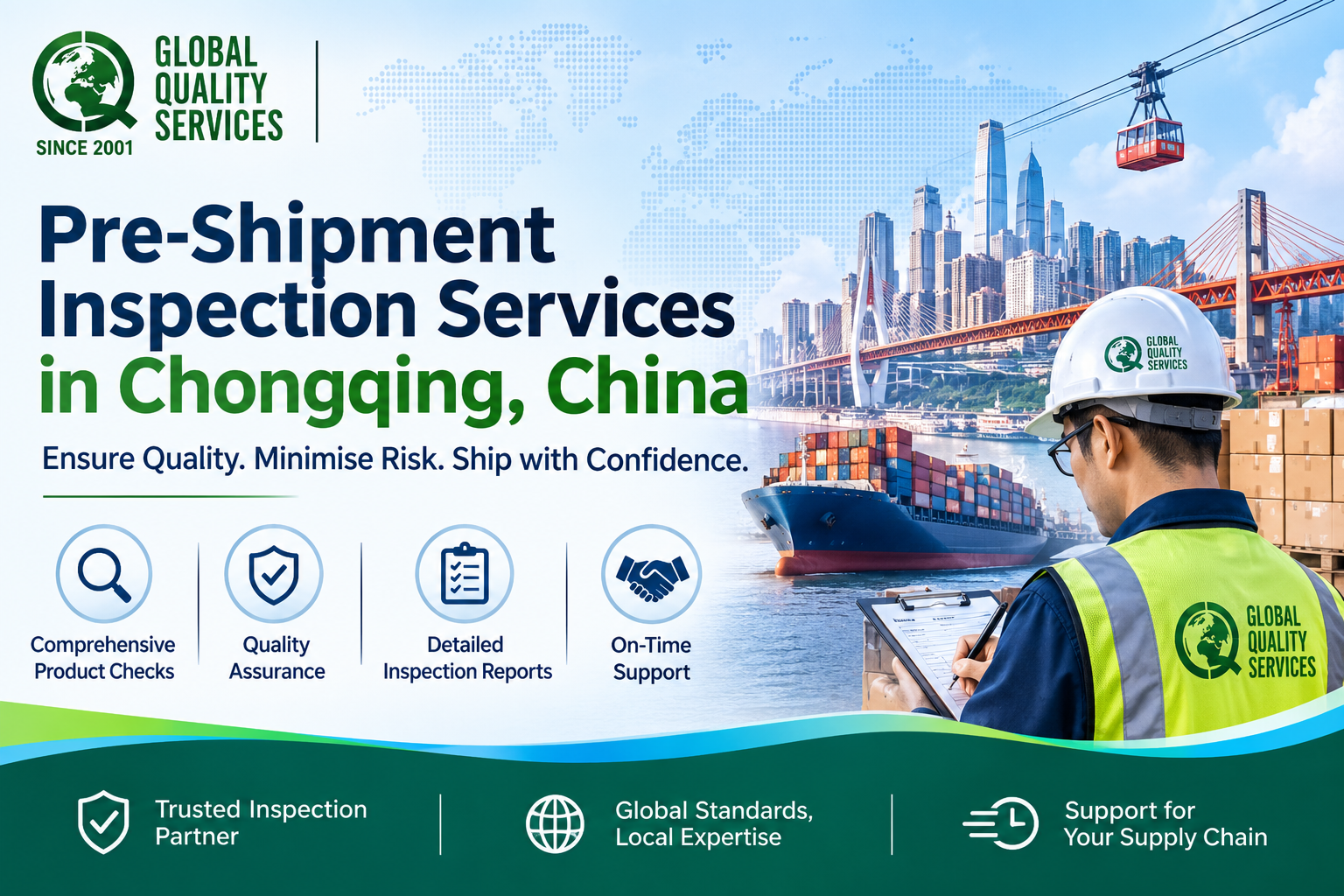
Global Quality Services provides Pre-Shipment Inspection Services in Chongqing, China, to help importers, exporters, manufacturers and purchasing teams verify finished goods against agreed specifications before dispatch.
What Are Pre-Shipment Inspection Services?
Pre-Shipment Inspection (PSI) is a quality control activity carried out before goods are shipped from the supplier or manufacturer’s facility. It evaluates whether the finished products meet the buyer’s purchase order, approved samples, technical specifications and agreed inspection criteria.
A typical pre-shipment inspection may cover:
- Product quantity and assortment verification.
- Visual appearance and workmanship.
- Dimensions, weight and product specifications.
- Functional and performance checks.
- Packaging and shipping carton condition.
- Product labelling, markings and barcodes.
- Accessories and supplied components.
- Shipping documentation and packing lists.
The inspection findings help buyers decide whether the goods are ready for dispatch, require correction or need further examination.
Why Pre-Shipment Inspection is Beneficial in Chongqing
Chongqing’s manufacturing industry supplies a wide range of products, including vehicles, mechanical components, electrical equipment, consumer products and industrial materials. These products often involve different technical specifications and acceptance requirements.
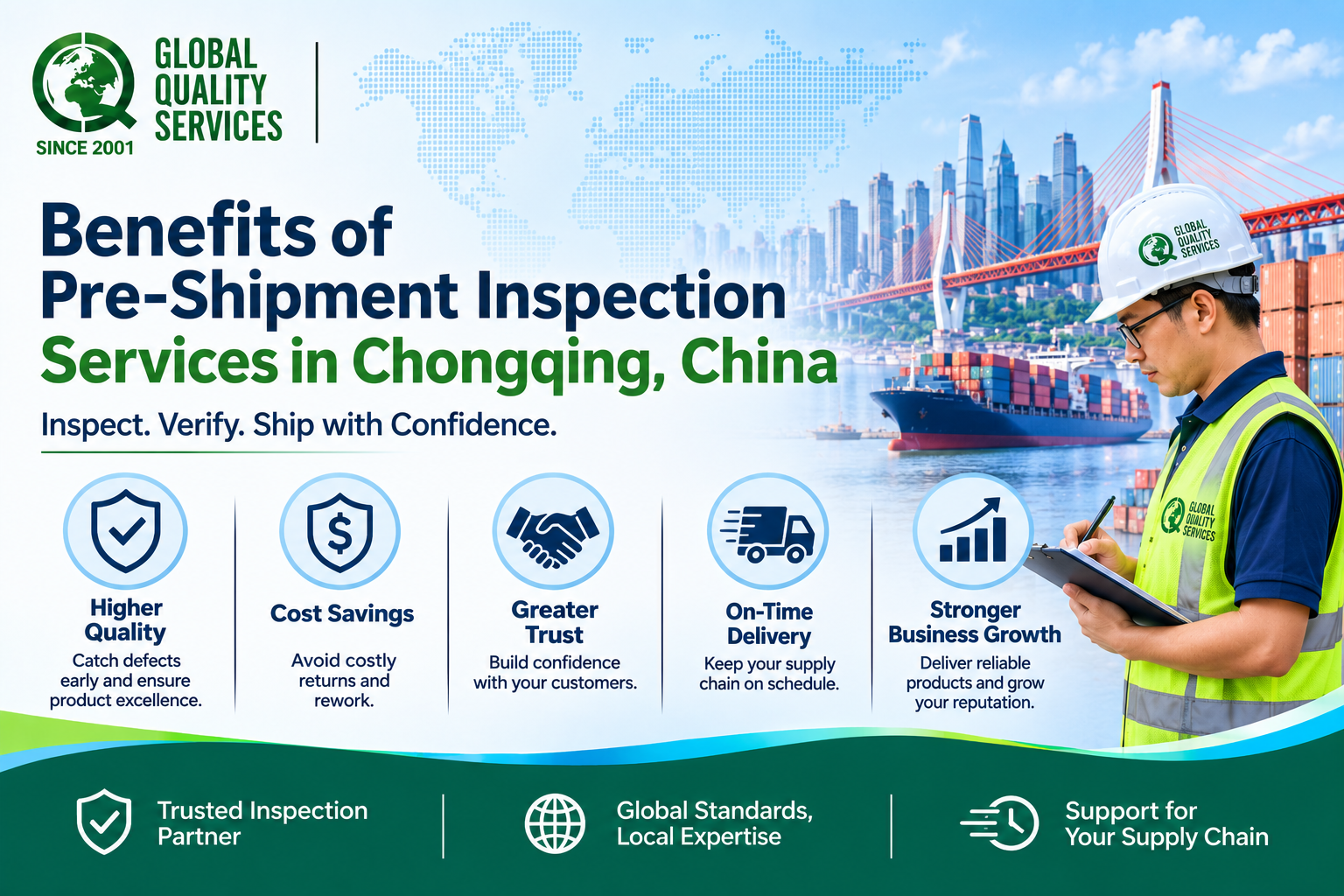
A pre-shipment inspection gives buyers an opportunity to identify discrepancies while the goods are still accessible at the supplier’s premises.
Identifying Product Defects Before Dispatch
Manufacturing defects can include surface damage, incorrect assembly, dimensional variations, poor finishing, missing components and inconsistent product specifications.
Inspecting finished goods before shipment helps identify these issues before products enter international transportation. It also gives the supplier an opportunity to investigate and address reported problems.
Verifying Quantity and Product Assortment
A shipment may contain several product models, sizes, colours or configurations. Incorrect quantities or mixed assortments can affect inventory planning and customer orders.
Inspection can verify carton quantities, product counts, model numbers, assortment details and packing list information against the purchase order.
Reducing Packaging and Transportation Risks
Products may be damaged during transit if cartons are unsuitable, protective materials are inadequate or goods are packed incorrectly.
PSI examines the condition of shipping cartons, internal protection, sealing, palletisation and shipping marks. For fragile, heavy or sensitive products, the inspection can also assess whether the agreed packaging requirements have been followed.
Checking Compliance with Buyer Specifications
Suppliers may manufacture goods according to approved samples, drawings or technical data sheets. Changes in materials, components, dimensions or product configurations can create quality concerns if they are not approved by the buyer.
Pre-shipment inspection compares selected product characteristics with the agreed acceptance criteria and records any deviations.
What Does a Pre-Shipment Inspection Cover?
The inspection scope depends on the product category, order quantity, buyer requirements and applicable quality standards.
Product Quantity and Identification
The inspection begins with verification of the shipment and product identity. Inspectors may check product descriptions, model numbers, serial numbers, batch details, sizes, colours and other identification information.
Carton counts and selected product quantities are compared with the purchase order and packing list. Any shortages, excess quantities or assortment discrepancies are documented.
Visual Quality and Workmanship
Products are examined for visible defects that may affect appearance, usability or compliance with the buyer’s requirements.
Common observations include:
- Scratches, dents, cracks and surface damage.
- Discolouration and inconsistent finishes.
- Poor stitching, welding, bonding or assembly.
- Loose components and damaged fittings.
- Missing parts and accessories.
- Incorrect labels, printing or markings.
- Contamination and visible manufacturing residue.
Defects are recorded according to the agreed classification, such as critical, major or minor, where the inspection plan uses these categories.
Dimensions and Product Specifications
Selected product measurements are checked against approved drawings, technical specifications and reference samples.
Depending on the product, this may include length, width, height, thickness, weight, diameter, fitment, tolerances and other critical dimensions.
Measurement equipment should be suitable for the required accuracy, with calibration status reviewed where relevant. Results are recorded so that deviations can be evaluated against the agreed tolerances.
Functional and Performance Testing
Functional checks help establish whether products operate as intended under the agreed test conditions.
Depending on the product category, testing may include:
- Switching and operating controls.
- Power-on and basic electrical functions.
- Movement and mechanical operation.
- Assembly and fitting checks.
- Leakage or sealing checks.
- Load or performance checks where specified.
- Safety features and alarm functions.
- Operation of supplied accessories.
The inspection plan should identify which tests are required, how many units will be tested and what results constitute acceptance. Specialized laboratory tests and regulatory certification are separate activities unless specifically included in the agreed scope.
Packaging and Carton Inspection
Packaging is examined to determine whether products are adequately protected for storage and transportation.
Checks may cover carton dimensions, material condition, internal cushioning, protective wrapping, sealing, strapping and pallet arrangements.
For products that are sensitive to moisture, impact or vibration, the inspection can verify whether the specified protective packaging has been used.
Labelling and Shipping Marks
Product labels and shipping marks are checked against the buyer’s requirements and approved artwork.
The review may include product names, model numbers, quantities, barcodes, country-of-origin information, handling symbols, batch identification and destination details.
Incorrect markings can cause receiving, inventory or customs documentation problems. Any identified discrepancy should be recorded before shipment.
Documentation Review
The inspection may include a review of relevant shipment and product documents, such as:
- Purchase orders and packing lists.
- Product specifications and approved drawings.
- Quality inspection records.
- Test reports and certificates supplied by the manufacturer.
- Product manuals and warranty documents.
- Serial number and batch records.
- Shipping labels and carton markings.
The document review is limited to the agreed scope. It does not independently authenticate every certificate or establish regulatory compliance unless a specific verification activity is included.
Pre-Shipment Inspection Standards: AQL and ISO 2859-1:2026
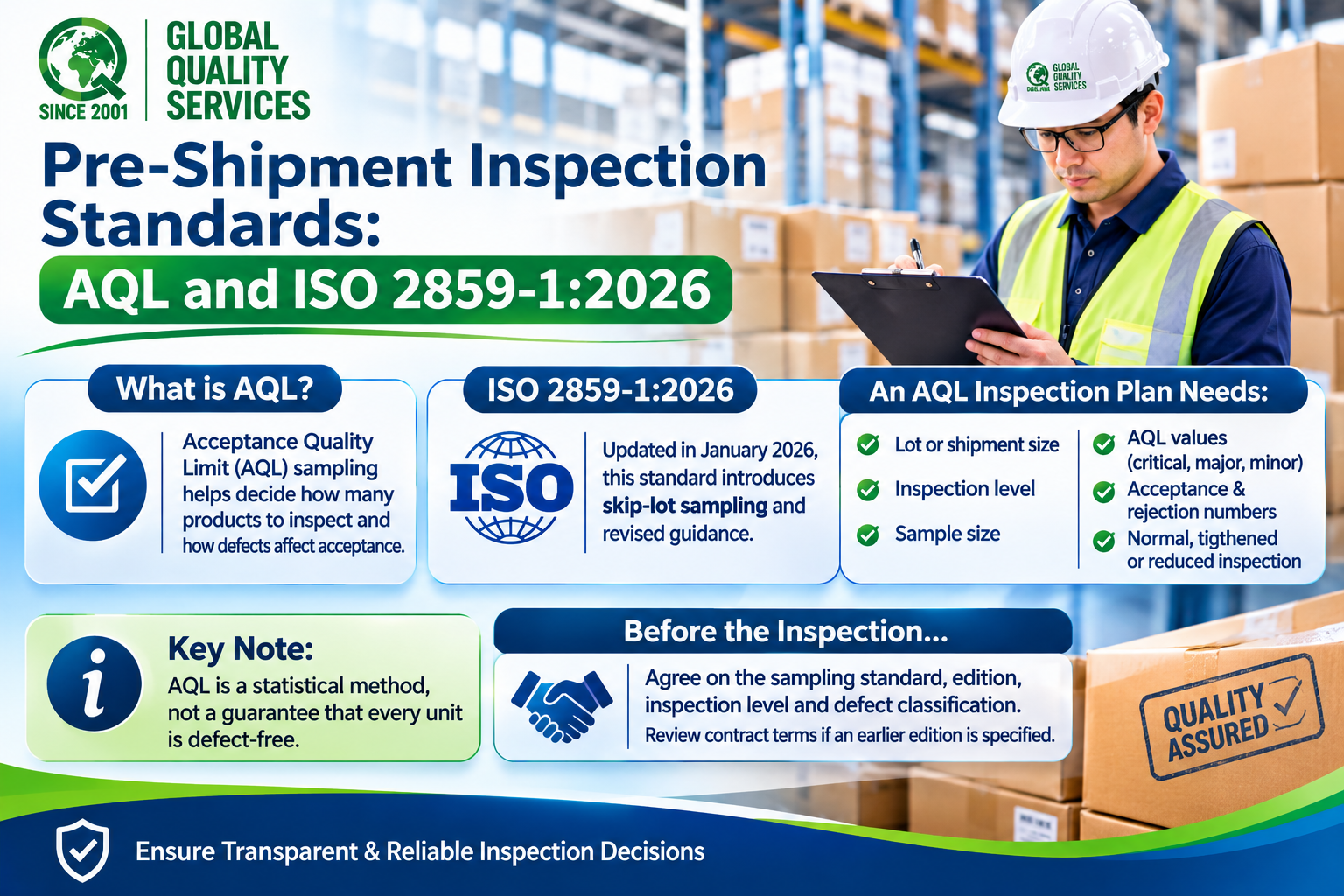
Many buyers use Acceptance Quality Limit (AQL) sampling to establish how many products should be inspected from a shipment and how defects affect lot acceptance.
AQL-based inspection is commonly associated with ISO 2859-1, which provides sampling schemes indexed by acceptance quality limit for lot-by-lot inspection by attributes.
The third edition, ISO 2859-1:2026, was published in January 2026, replacing the previous 1999 edition and its associated amendments. The updated standard introduces skip-lot sampling procedures and revised guidance for applying sampling strategies.
An AQL inspection plan generally requires agreement on:
- Lot or shipment size.
- Inspection level.
- Sample size.
- AQL values for critical, major and minor defects, where applicable.
- Acceptance and rejection numbers.
- Normal, tightened or reduced inspection conditions, where relevant.
AQL is not a guarantee that every unit in a shipment is defect-free. It is a statistical sampling method used to make a lot acceptance decision based on the selected inspection plan.
For this reason, buyers should agree on the sampling standard, edition, inspection level and defect classification before the inspection takes place. Where a contract specifically refers to an earlier edition, the contractual requirements should be reviewed before applying the newer standard.
When Should a Pre-Shipment Inspection Be Conducted?
PSI is generally scheduled when production is substantially complete and the goods are available for inspection. A common industry practice is to arrange inspection when at least 80% of the order is completed and the goods are packed or ready for packing.
However, this is a conventional readiness guideline, not a universal requirement under ISO 2859-1. The buyer may specify a different completion threshold or require inspection before final packing.
The timing should allow enough time for defect correction, reinspection and shipment scheduling. Conducting the inspection too early may result in incomplete findings if additional products are manufactured or packing arrangements change afterward.
Product-Specific Pre-Shipment Inspection in Chongqing
Different manufacturing sectors require different inspection priorities. Chongqing’s industrial profile makes product-specific inspection particularly relevant.
Automotive Components and Accessories
Inspection may cover component identification, dimensions, surface finish, assembly, fitment, packaging and traceability information.
For automotive parts, checks can also include part numbers, material specifications, coating condition and selected functional characteristics according to the buyer’s drawings and acceptance criteria.
Electrical and Electronic Products
Electrical and electronic goods may require checks for model identification, housing condition, cable connections, accessories, labels and basic functional operation.
Depending on the product, inspection can include power-on testing, control response, indicator functions and verification of supplied components. Electrical safety testing and regulatory certification should be handled under their applicable technical requirements.
Industrial Machinery and Equipment
For machinery, the inspection may cover equipment identification, dimensions, assembly, visible workmanship, accessories, control panels, operating functions and protective packaging.
Where machinery requires factory acceptance testing, the performance parameters and test procedures should be defined before the inspection.
Motorcycle and Automotive Products
Chongqing has a substantial automotive and motorcycle manufacturing base. Inspection of related products may include component identification, assembly quality, finish, dimensions, functional operation, accessories and packaging.
For complete vehicles or specialized components, the scope should be aligned with the relevant technical specifications and acceptance requirements.
Consumer Goods and Household Products
For consumer products, inspection may focus on appearance, construction quality, dimensions, colour consistency, functionality, labelling, accessories and retail packaging.
The checks should reflect the product’s intended use and the buyer’s approved reference sample.
Common Problems Identified During Pre-Shipment Inspection
A pre-shipment inspection may identify problems that are not always apparent during routine production monitoring.
- Specification mismatches: Products may differ from approved drawings, samples, materials or technical data sheets.
- Incorrect product assortment: Cartons may contain the wrong models, sizes, colours or quantities.
- Incomplete orders: Missing units, accessories, components or documentation may affect the shipment.
- Packaging deficiencies: Weak cartons, inadequate cushioning, incorrect labels and poor pallet arrangements can increase transportation risks.
- Inconsistent workmanship: Different production batches may show variations in finishing, assembly or product appearance.
- Unresolved defects: Products may be packed despite known non-conformities or incomplete corrective actions.
Recording these findings before dispatch helps buyers communicate specific concerns to suppliers and determine the appropriate next step.
Our Pre-Shipment Inspection Process
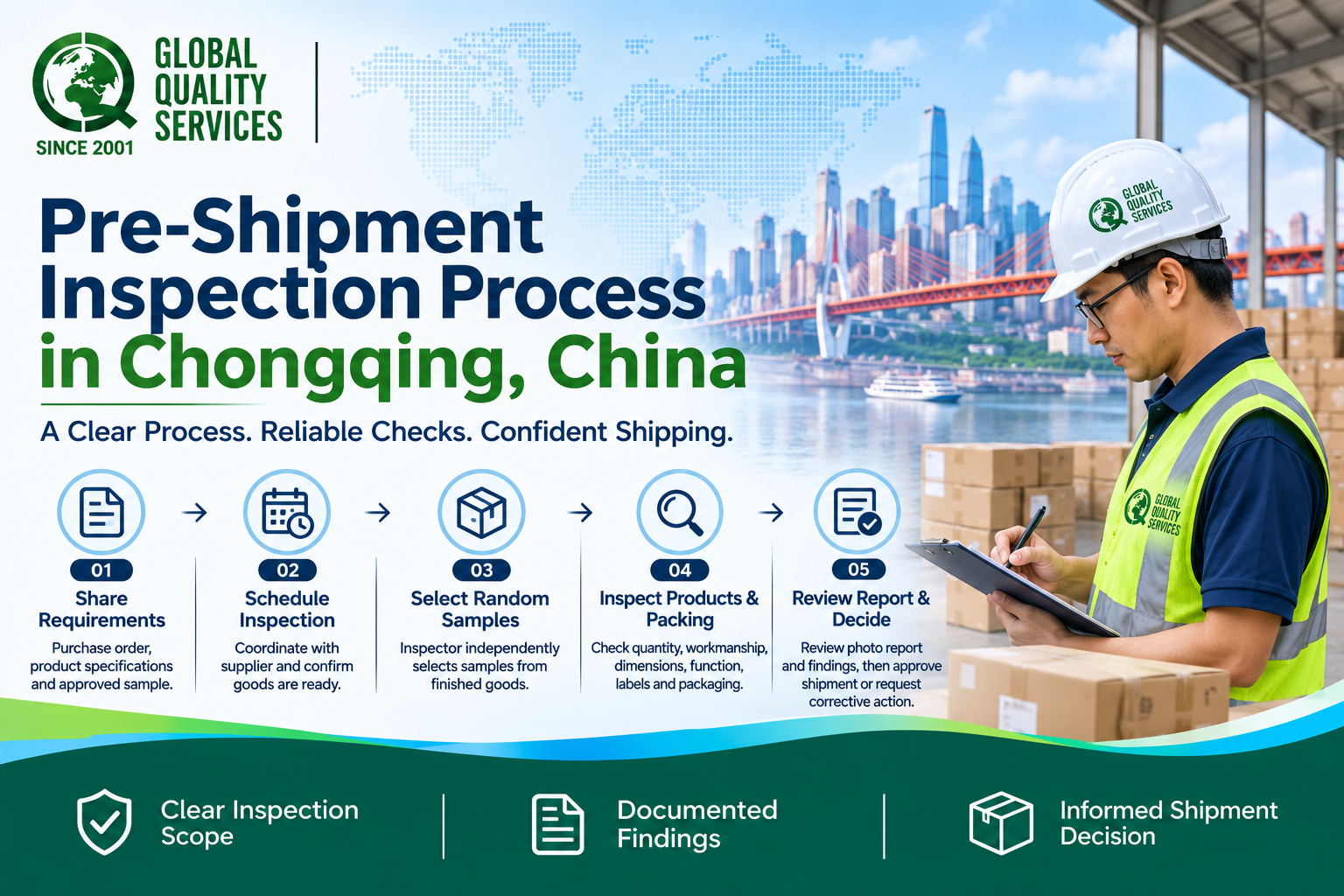
Global Quality Services follows a structured inspection process based on the product category and buyer’s requirements.
1. Purchase Order and Specification Review
The process begins with a review of the purchase order, product specifications, approved samples, drawings, packing requirements and inspection criteria.
The buyer’s requirements are used to establish the inspection checklist and acceptance conditions.
2. Inspection Planning
The inspection plan defines the inspection date, factory location, lot size, sampling method, inspection level, AQL values and required functional tests.
The supplier is informed of the inspection requirements and the readiness conditions for the goods.
3. On-Site Inspection
The inspection team examines the selected products and shipment details according to the agreed plan. Visual checks, measurements, functional tests, quantity verification, packaging checks and document reviews are performed where applicable.
Photographs and inspection observations are recorded to support the findings.
4. Inspection Report
The results are compiled into a structured report covering the inspected shipment, sample details, observations, test results and identified defects.
The report provides the buyer with information about whether the inspected lot meets the agreed acceptance criteria.
5. Corrective Action and Reinspection
If defects or discrepancies are identified, the buyer can review the findings and decide whether the goods should be held, repaired, replaced or subjected to further inspection.
A reinspection can be arranged after the supplier completes the agreed corrective actions.
Why Choose Global Quality Services?
Global Quality Services provides independent inspection services for businesses sourcing products from manufacturers and suppliers in Chongqing and surrounding industrial areas.
Our pre-shipment inspection approach focuses on verifying finished goods against agreed purchase requirements, recording product defects and documenting shipment readiness.
Inspection scopes can be adapted to different product categories, order quantities and buyer specifications. Reports provide structured observations and supporting evidence to help buyers make informed shipment decisions.
A shipment should be checked against the buyer’s requirements before it leaves the manufacturer’s facility. Verifying product quality, quantity, packaging and documentation can help identify problems while there is still an opportunity to address them.
Contact Global Quality Services to discuss Pre-Shipment Inspection Services in Chongqing, China. Share the product category, factory location, order quantity and inspection requirements to establish a suitable inspection scope.
Frequently Asked Questions
1. What is checked during a pre-shipment inspection in Chongqing?
A PSI may cover product quantity, appearance, workmanship, dimensions, specifications, functionality, packaging, labelling, accessories and shipping documentation. The exact checks depend on the product and buyer’s acceptance criteria.
2. When should pre-shipment inspection be arranged?
PSI is generally conducted when production is substantially complete and the goods are available for inspection. Buyers commonly arrange it when at least 80% of the order is complete and packed or ready for packing, although the required threshold should be agreed with the supplier.
3. What is AQL in pre-shipment inspection?
AQL stands for Acceptance Quality Limit. It is used in statistical sampling plans to determine sample sizes and acceptance or rejection criteria for a shipment. It does not mean that every product is inspected or that the entire shipment is guaranteed to be defect-free.
4. Does pre-shipment inspection include functional testing?
Functional testing can be included when required by the buyer. Depending on the product, it may cover basic operation, switching, movement, assembly, performance parameters and selected safety features. Test methods and acceptance limits should be agreed before inspection.
5. What happens if a shipment fails pre-shipment inspection?
If the inspection identifies defects or discrepancies beyond the agreed acceptance criteria, the findings are reported to the buyer. The buyer can decide whether to hold the shipment, request repairs, replace defective products or arrange reinspection after corrective action.