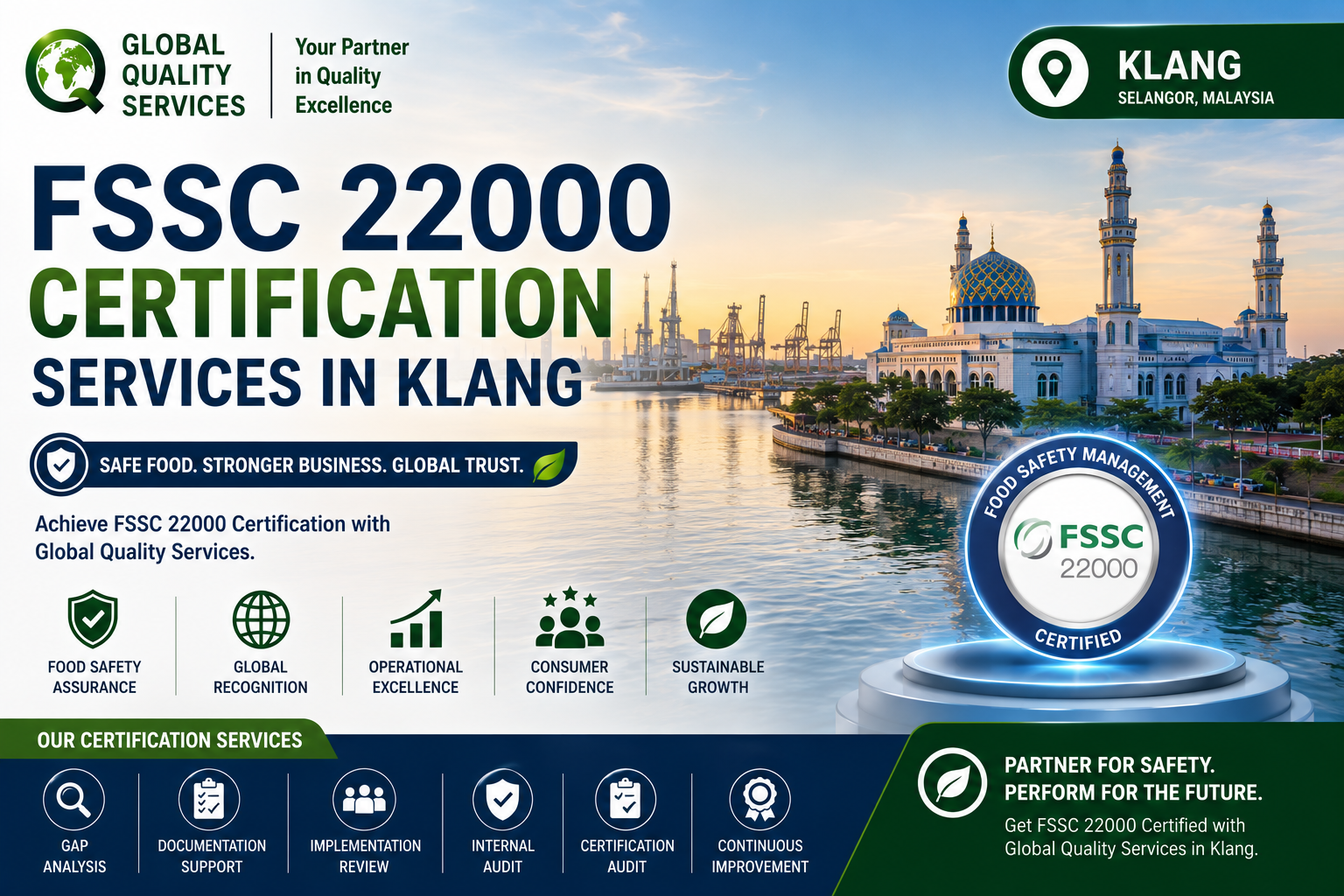
Klang food manufacturers occupy a position in Malaysian trade that almost no other location can match. Port Klang — Westport and Northport combined — handled a record 15.14 million TEUs in 2025, ranking among the world’s ten busiest container ports and connecting Malaysian exporters to more than 200 ports across 120 countries. For a food manufacturer based in Klang, the gap between production and international export shipping is measured in minutes of road time, not days of logistics planning.
But proximity to the port is only commercially useful if your products can clear the buyer qualification requirements of the markets the port connects you to. Japan, the European Union, the United States, and the Gulf Cooperation Council countries all have major retail and food service buyers that list GFSI-benchmarked certification as a vendor qualification baseline. FSSC 22000 is the most widely accepted GFSI scheme across those markets. A Klang food manufacturer without a current FSSC 22000 certificate is standing at the edge of one of Asia’s great export gateways without the document that gets its products through the door at the other end.
Global Quality Services provides end-to-end FSSC 22000 certification consultancy for food manufacturers, halal producers, food ingredient distributors, and cold-chain operators in Klang and across Selangor, from the initial gap assessment through system implementation, internal audit, and final third-party certification, with every engagement scoped around the specific products, processes, and export market requirements of your facility.
What Is FSSC 22000?
FSSC 22000 (Food Safety System Certification 22000) is the world’s most widely adopted GFSI-benchmarked food safety management system certification scheme, currently held by more than 42,000 certified organizations in 140 countries. It is built on three interlocking elements: ISO 22000:2018 for food safety management, the ISO 22002 series of sector-specific Prerequisite Programs, and the FSSC 22000 Additional Requirements covering food defense, food fraud, allergen management, environmental monitoring, and food loss and waste.
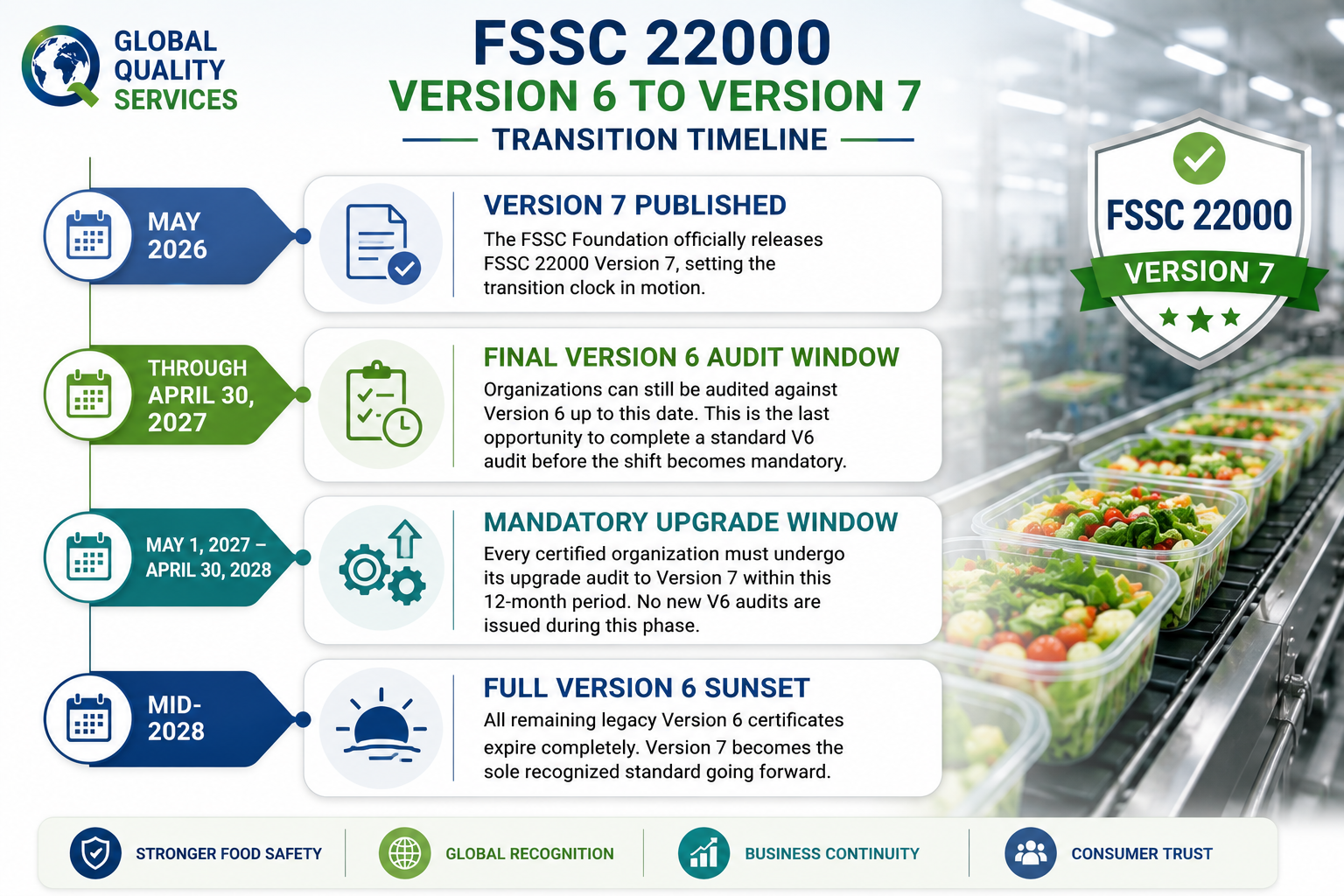
The current version is FSSC 22000 Version 7, released in May 2026. Version 7 introduces mandatory allergen management plans, food loss and waste reduction policies with measurable targets, updated food fraud and food defense requirements, and alignment with the new ISO 22002-100:2025 umbrella standard. Organizations currently certified to Version 6 must transition within an 18-month window at their next scheduled audit.
Malaysia’s Ministry of Health Food Safety division and MAQIS (Malaysian Quarantine and Inspection Services) both recognize internationally accredited food safety management system certifications as evidence of systematic food safety control, and GFSI-benchmarked certifications including FSSC 22000 are increasingly referenced in export health certificate and buyer qualification documentation.
Why FSSC 22000 Certification Matters Specifically in Klang
Three features of Klang’s industrial environment make FSSC 22000 certification a direct commercial priority rather than a general best practice.
Port Klang as Malaysia’s food export gateway. Port Klang connects manufacturers and traders to more than 200 ports across 120 countries. Whether you are shipping rubber gloves to Europe, importing steel coils from China, or moving palm oil products to the Middle East, there is a good chance your goods pass through Port Klang. For Klang food manufacturers, the same port infrastructure that moves industrial goods also moves processed food, packaged products, and food ingredients into markets where FSSC 22000 certification is a buyer qualification gate. Holding a current certificate means that gate is open on first approach.
The halal food export opportunity through Pulau Indah. Pulau Indah Industrial Park has been transformed into a strategic site for heavy industries, logistics hubs, halal manufacturing, and international trade, spearheaded by Central Spectrum as part of Selangor’s vision to create a port-integrated industrial hub. Halal food manufacturers at Pulau Indah and across the Klang corridor export into the Gulf Cooperation Council, Indonesia, and other markets where buyers increasingly require both JAKIM halal certification and GFSI-benchmarked food safety certification. FSSC 22000 satisfies the food safety layer that halal certification alone does not cover.
Port Klang Free Zone manufacturers. The Port Klang Free Zone offers duty-free status and tax incentives for manufacturers operating within its boundaries. For PKFZ food manufacturers whose competitive advantage depends on export volume and market access, an FSSC 22000 certificate is the buyer-qualification mechanism that converts duty-free manufacturing cost advantages into actual export contracts.
Which Businesses in Klang Does FSSC 22000 Cover?
FSSC 22000 Version 7 defines distinct scope categories covering the full range of food manufacturing and food-adjacent activities in the Klang corridor. The categories most relevant to Klang businesses are:
- Category CI – CIV: Ambient and Chilled Food Manufacturing. Covers thermal processing, dried goods, preserved foods, baked products, edible oils, palm-based food products, beverages, ready meals, and shelf-stable packaged foods. Applicable to the broad base of food processors and packagers in Klang’s industrial estates.
- Category C0: Animal Primary Conversion. Slaughter and primary conversion of animal-derived products, including halal slaughterhouse operations, introduced as a standalone category in Version 7.
- Category G: Storage and Distribution. Cold-chain operators, third-party logistics providers, and ambient warehouses handling food products within and adjacent to the Port Klang terminal areas. Directly applicable to the food ingredient importers and distributors that cluster around Northport and Westport.
- Category F: Food Ingredients and Additives. Covers producers of food additives, flavors, enzymes, and processing aids. Applicable to the ingredient manufacturing and distribution operations that supply into the broader Klang Valley food production chain.
- Category I: Food Packaging Manufacturing. Producers of food-contact packaging materials including films, foils, containers, and disposable packaging items.
- Category D: Animal Feed. Feed manufacturers supplying into the livestock and aquaculture sectors operating in Selangor and adjacent states.
Benefits of FSSC 22000 Certification for Klang Food Businesses
Direct Export Market Access Through Port Klang. A current FSSC 22000 certificate satisfies buyer qualification requirements for retail and food service supply chains across Japan, the EU, the US, and the GCC simultaneously. For a Klang food manufacturer shipping through Westport or Northport into multiple export markets, one GFSI-benchmarked certificate replaces repeated market-by-market buyer audits.
Halal and FSSC 22000: A Combined Export Qualification. Gulf, Indonesian, and Malaysian-heritage export buyers in premium retail increasingly require both halal certification and an internationally recognized food safety management system from their suppliers. FSSC 22000 provides the food safety layer that JAKIM halal certification does not cover, and holding both positions a Klang halal food manufacturer as a premium, fully qualified export supplier rather than one with only half the required documentation.
Systematic Hazard Control From Port to Production. FSSC 22000 combines ISO 22000’s HACCP methodology with sector-specific Prerequisite Programs to identify and control food safety hazards at every point in the production and distribution process, including the temperature-sensitive cold chain operations that connect Klang food manufacturers to Port Klang’s container terminals.
Stronger Compliance Standing With Malaysian Food Regulators. Malaysia’s Food Act 1983 and MAQIS export documentation requirements both expect systematic food safety management from food exporters. FSSC 22000 builds the documented, auditable system that demonstrates that management to regulators and export market health authorities simultaneously.
Reduced Recall Risk. Mandatory allergen controls, food fraud vulnerability assessments, and contamination prevention programs under Version 7 significantly reduce the likelihood of product recalls, which carry compounded commercial consequences for a Klang manufacturer whose products are already in transit through Port Klang to international markets.
SME Corp and Government Grant Eligibility. Malaysian SMEs may be eligible for grant support toward food safety management system certification costs through SME Corp Malaysia and the Ministry of Investment, Trade and Industry (MITI) industry development programs.
Our FSSC 22000 Certification Process for Klang Facilities
Step 1: Free Gap Assessment. A Global Quality Services food safety consultant conducts an on-site or remote review of your existing food safety practices against FSSC 22000 Version 7 requirements, benchmarking your HACCP plan, Prerequisite Program documentation, and management system against all clause-level requirements and producing a prioritized gap report.
Step 2: Scope and Category Confirmation. We confirm the correct FSSC 22000 scope category for your Klang facility, define the certification boundary, and prepare a realistic project timeline aligned with your next scheduled audit window or Version 7 transition deadline.
Step 3: Food Safety Management System Implementation. Our consultants work directly with your food safety team to develop or upgrade all FSMS documentation, including your hazard analysis and HACCP plan, allergen management plan, food fraud vulnerability assessment, food defense plan, food safety culture program, and all Prerequisite Programs required under ISO 22002 for your scope category.
Step 4: Staff Training and Awareness. We deliver targeted training sessions for production, quality assurance, and management teams covering food safety culture expectations under Version 7, allergen control procedures, halal integrity controls where applicable, and individual roles within the FSMS.
Step 5: Internal Audit and Management Review. Global Quality Services conducts a full internal audit against all FSSC 22000 Version 7 requirements and facilitates the mandatory management review. All non-conformities are identified and closed before the external certification audit, ensuring your facility enters the audit in the strongest possible position.
Step 6: Certification Audit Support and Ongoing Surveillance. We coordinate with your chosen accredited Certification Body for Stage 1 documentation review and Stage 2 on-site audit, support your team through audit interactions, and manage post-audit corrective action plans. Post-certification, we provide ongoing support for annual surveillance audits to keep your certificate current throughout the 18-month Version 7 transition window.
Malaysian Government Resources for Klang Food Businesses
Ministry of Health Malaysia — Food Safety — The Malaysian regulatory authority for food safety standards and food legislation, including the Food Act 1983 and Food Regulations 1985 that govern food manufacturing and distribution compliance in Malaysia.
MAQIS — Malaysian Quarantine and Inspection Services — The agency responsible for food import and export inspection, quarantine certification, and export health certificates. MAQIS documentation requirements for food exports increasingly reference internationally recognized food safety management systems.
JAKIM Halal Malaysia — The Department of Islamic Development Malaysia, responsible for Malaysia’s halal certification scheme. For Klang halal food manufacturers, JAKIM halal certification and FSSC 22000 together constitute the complete buyer qualification for premium halal export markets.
SME Corp Malaysia — The central coordinating agency for SME development in Malaysia. Malaysian SMEs should check current SME Corp and MITI-linked grant programs for eligible food safety management system certification support.
Migrating From FSSC 22000 Version 6 to Version 7
FSSC 22000 Version 7 was released in May 2026. If your facility holds a current Version 6 certificate, you have an 18-month transition window to migrate at your next scheduled surveillance or recertification audit.
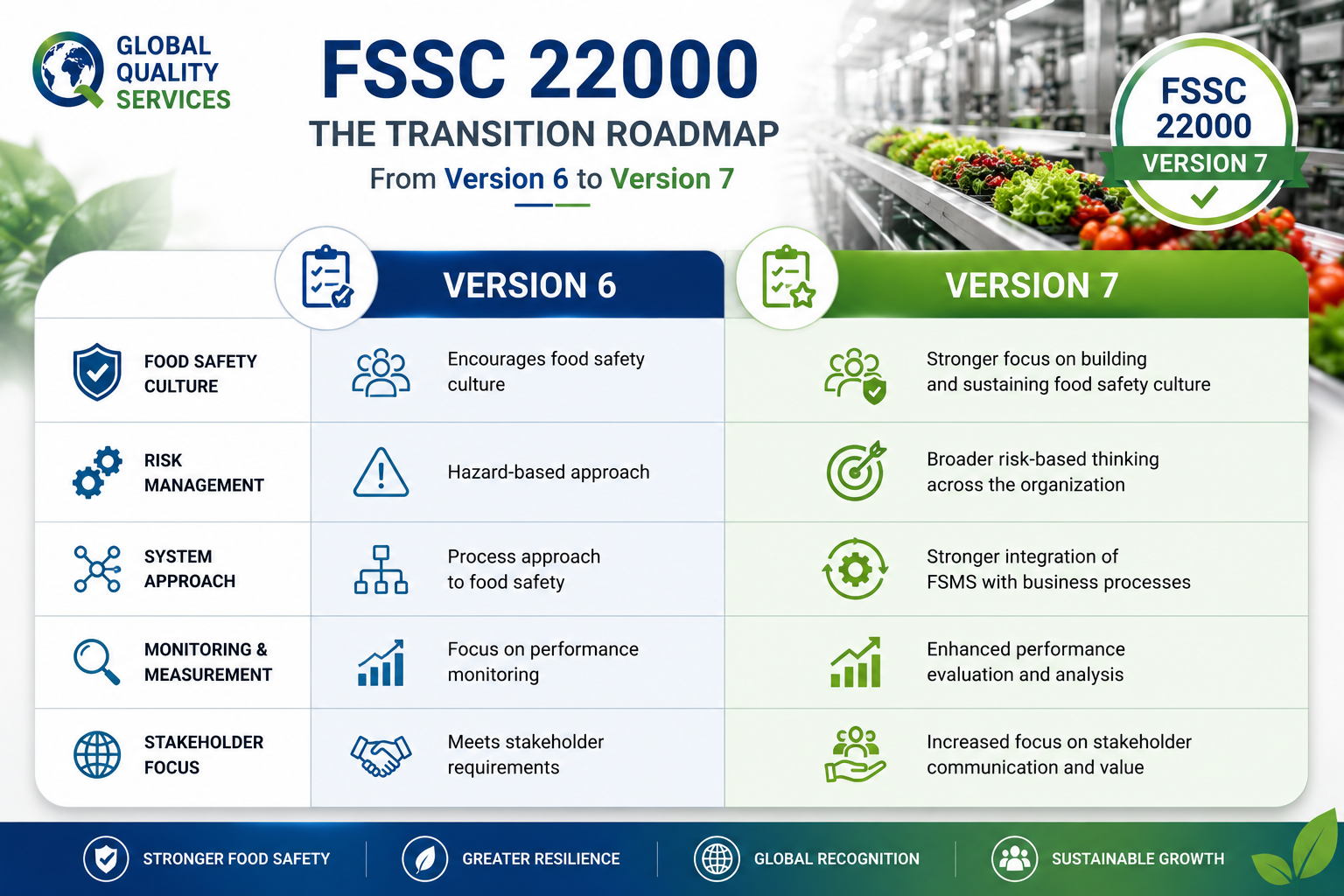
The transition is not a full rebuild. Most of your existing documentation remains valid. What changes falls into five specific areas.
- Allergen management, now mandatory and documented. Version 7 requires a formal allergen management plan that covers every allergen handled on-site, validated control measures, an annual review, and documented allergen awareness training. A general allergen policy referenced in your HACCP plan is no longer sufficient.
- Food loss and waste, now a measurable commitment. A food loss and waste reduction policy with defined, measurable targets is a new Version 7 requirement aligned with the UN SDG 12.3 commitment to halve food loss and waste by 2030. Your existing sustainability commitments may partially cover this, but they need to be formalized within the FSMS with measurable objectives.
- Food fraud and food defense, updated scope. Both plans require updating to reflect the Version 7 guidance, including reassessing your fraud vulnerability analysis and reviewing access controls and threat scenarios under the updated food defense requirements.
- Food safety and quality culture, now audited. Version 7 requires measurable objectives for food safety and quality culture set at the top management level. This was implicit in Version 6. It is explicit and auditable in Version 7.
- ISO 22002-100:2025 alignment. Version 7 references the new ISO 22002-100:2025 umbrella standard. Your prerequisite programs need to be reviewed for alignment, particularly if your scope category has been renumbered or renamed under the updated category structure.
Global Quality Services scopes every Version 6 to Version 7 transition against your specific facility, products, and audit schedule so the migration is completed within your existing audit cycle rather than requiring a separate standalone visit.
FSSC 22000: Version 6 to Version 7 Transition Timeline
Why Choose Global Quality Services for FSSC 22000 Certification in Klang
Global Quality Services has supported food safety and management system certification projects across Malaysia, Singapore, and the Asia-Pacific region for over two decades. Our food safety consultants travel directly to your Klang facility rather than managing the engagement remotely, and every food safety management system we build reflects your actual products, processes, and export market obligations.
We understand the specific commercial environment of Klang: food manufacturers exporting through Port Klang into multiple international markets simultaneously, halal producers needing FSSC 22000 to complement their JAKIM certification for Gulf and Southeast Asian buyers, and cold-chain and distribution operators whose food safety documentation must satisfy both Malaysian regulatory requirements and the third-party audit expectations of their multinational principals.
For Klang manufacturers also pursuing ISO 9001:2026 quality management or ISO 14001:2026 environmental management, we scope FSSC 22000 to sit alongside your existing management system framework rather than operate as a separate track, enabling combined audits and shared documentation where the Harmonized Structure allows.
Certification is not the finish line. We stay engaged through your annual surveillance audits, your Version 7 transition if applicable, and any production, product, or export market scope changes that require updates to your certified food safety management system. For a Klang food manufacturer whose Port Klang export contracts depend on a current, active FSSC 22000 certificate, that continuity is not a courtesy — it is a commercial necessity.
In addition to FSSC 22000 Certification, we also provide consultancy/guidance for PCQI (Preventive Controls Qualified Individual) in Training and Certification to help food manufacturers comply with the U.S. FDA FSMA requirements.
Frequently Asked Questions
Is FSSC 22000 recognized as a valid food safety management system for Malaysian food exporters?
Yes. FSSC 22000 is a GFSI-benchmarked certification scheme recognized by retail and food service buyers across Japan, the EU, the US, GCC, and ASEAN markets as a valid and preferred food safety management system. It is also recognized by MAQIS and Malaysian food safety authorities as evidence of systematic food safety management for export documentation purposes.
Do Klang halal food manufacturers need both JAKIM halal certification and FSSC 22000?
They are separate and complementary certifications that cover different requirements. JAKIM halal certification confirms that products are produced in compliance with Islamic law requirements. FSSC 22000 covers food safety management, hazard control, allergen management, and traceability. Premium Gulf and international halal market buyers increasingly expect both, and Global Quality Services scopes FSSC 22000 implementations to be compatible with existing JAKIM halal requirements.
What is the difference between FSSC 22000 Version 6 and the new Version 7?
FSSC 22000 Version 7, released May 2026, introduces mandatory allergen management plans, food loss and waste reduction policies with measurable targets, updated food fraud and food defense requirements, and alignment with ISO 22002-100:2025. Organizations currently certified to Version 6 must transition within an 18-month window at their next scheduled surveillance or recertification audit.
How long does FSSC 22000 certification take for a Klang food manufacturing facility?
Most Klang food manufacturing facilities complete the end-to-end certification process in four to nine months, depending on the maturity of existing food safety documentation and whether a functioning HACCP system is already in place. Facilities with an established HACCP plan and basic management system documentation typically complete the process in four to six months.
Can Malaysian SMEs get government funding support for FSSC 22000 certification costs?
Malaysian SMEs should check current grant programs through SME Corp Malaysia and MITI-linked industry development initiatives, as eligibility and available support change periodically. Global Quality Services advises clients on applicable grant programs as part of every engagement for eligible Malaysian SME food manufacturers.