One-North brings together technology firms, research centers, and biomedical companies that depend on reliable systems and specialist resources. A disruption can delay projects, interrupt services, or affect important client commitments. Singapore’s Cyber Security Agency reported in November 2026 that monthly cyber incidents had tripled compared with the January-to-August average.
ISO 22301 helps organizations prepare for interruptions and plan how to restore essential operations. A reputed consultant such as Global Quality Services can help your team understand the requirements and build a business continuity system that works in practice.
What is ISO 22301 Certification
ISO 22301:2019 is the international standard for a Business Continuity Management System (BCMS). It sets requirements for preparing for disruptions, responding to incidents, and restoring business activities within an acceptable time.
The standard asks organizations to look closely at their operations. Which services must continue? What happens if a key system becomes unavailable? How long can a department operate without a particular employee, facility, or supplier?
Your organization must answer these questions and turn the answers into practical continuity arrangements. For a company in One-North, this could mean planning for a laboratory equipment failure, loss of access to research data, a cyber incident, a cloud service outage, or an interruption involving an essential supplier.
Why Should One-North Businesses Consider ISO 22301 Certification?
One-North brings together organizations involved in research, technology, biomedical sciences, and knowledge-based industries. Their operations may look different, but many depend on specialist people, digital infrastructure, equipment, and reliable external services.
A disruption can affect more than the department where it starts. Consider a few situations your business may face.
1. Protect research and project continuity
Research teams work with project schedules, specialist equipment, digital records, and external collaborators. An interruption can delay experiments, affect project milestones, or create problems with client commitments. Continuity planning helps teams decide how to respond and resume priority work.
2. Reduce the impact of technology failures
Technology companies depend on software platforms, networks, cloud services, and data access. A system outage can interrupt customer support, product development, and service delivery. ISO 22301 helps organizations plan recovery actions before such incidents occur.
3. Prepare for laboratory and equipment disruptions
Biomedical and research organizations may rely on specialized instruments, controlled environments, and equipment maintenance providers. A continuity plan helps identify which resources need priority attention and what alternatives may be available.
4. Manage supplier-related interruptions
A business may depend on a small number of suppliers for essential materials, software, maintenance, or specialist services. If a supplier cannot deliver, the organization needs to know how it will respond.
5. Give customers and business partners greater confidence
Clients may ask how your company handles emergencies, protects essential services, and resumes operations after an incident. ISO 22301 certification gives you independent evidence that your organization has established and maintained a formal business continuity system.
6. Give management a clearer recovery plan
Without assigned responsibilities, employees may lose valuable time deciding what to do during an incident. A BCMS sets out who takes charge, how teams communicate, and which activities receive priority.
Which Organizations in One-North Can Apply for ISO 22301?
ISO 22301 applies to organizations of different sizes and industries. It does not limit certification to banks, large corporations, or companies with dedicated emergency management departments.
Businesses in One-North that may consider certification include:
- Biotechnology and biomedical companies: Organizations that depend on laboratory facilities, specialist equipment, research data, and controlled operations.
- Technology and software companies: Businesses that operate digital platforms, develop software, or manage technology services for clients.
- Research and development organizations: Teams that need to protect project schedules, specialist resources, intellectual property, and research records.
- IT service providers: Companies responsible for hosting, maintaining, supporting, or managing client systems.
- Healthcare and life sciences businesses: Organizations whose services depend on reliable facilities, equipment, information, and trained personnel.
- Professional and corporate service firms: Companies that handle client information, business transactions, and time-sensitive services.
- Regional offices and multinational companies: Organizations that coordinate business activities across several locations and markets.
The certification scope should reflect the actual operations of your organization. A software company may focus on service availability and data recovery, while a research organization may need to address laboratory access, equipment, and critical suppliers.
What are the Main Requirements of ISO 22301
ISO 22301 requires more than a written emergency plan. Your organization must establish a BCMS, put it into practice, check its performance, and make improvements when necessary.
Here are the main areas your team needs to address.
1. Understand Your Organization
Identify the internal and external issues that could affect business continuity. Consider your services, facilities, technology, employees, suppliers, customers, and other interested parties. Define which parts of the business the BCMS will cover.
2. Establish Leadership and Accountability
Top management must support the BCMS and take responsibility for its effectiveness. The organization needs a business continuity policy, clear responsibilities, suitable resources, and support from relevant departments.
3. Conduct a Business Impact Analysis
A Business Impact Analysis (BIA) helps identify activities that are essential to your operations. It examines what could happen if those activities stop and helps establish recovery priorities.
For example, a research company may need to restore access to critical project records before resuming routine administrative work.
4. Assess Business Continuity Risks
Identify events that could interrupt your operations. These may include cyberattacks, equipment failures, power outages, building access problems, staff shortages, supplier interruptions, and technology failures.
Your assessment should reflect the risks your organization actually faces.
5. Set Recovery Objectives
Determine how quickly the organization needs to restore important activities. Establish suitable Recovery Time Objectives (RTOs) and Recovery Point Objectives (RPOs), where applicable.
These targets help your team plan recovery arrangements around business needs rather than assumptions.
6. Develop Business Continuity Plans
Prepare documented plans that explain how employees should respond to disruptions. Include responsibilities, escalation arrangements, communication methods, recovery resources, and steps for restoring critical activities.
7. Train Employees and Test the Plans
Employees need to understand their roles before an incident occurs. Conduct suitable exercises to check whether the plans work and whether teams can follow them under realistic conditions.
8. Monitor and Improve the BCMS
Use internal audits, management reviews, exercises, and corrective actions to check the system. Update your arrangements when business activities, technology, suppliers, or risks change.
How to Get ISO 22301 Certification in One-North
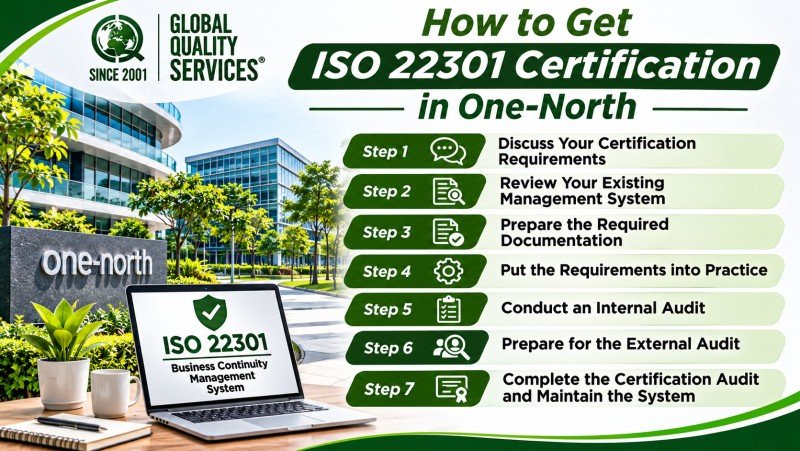
The certification process starts with understanding your current business continuity arrangements. Your organization then develops and implements a BCMS that meets the standard’s requirements.
The following stages explain how the work generally progresses.
Step 1: Discuss Your Certification Requirements
Discuss your business activities, locations, certification scope, and existing continuity plans with a consultant. This helps establish the work involved and identify the departments that need to participate.
Step 2: Review Your Existing Management System
Examine your current risk assessments, emergency procedures, recovery plans, supplier arrangements, and related records. Compare these arrangements with ISO 22301 requirements and identify areas that need improvement.
Step 3: Prepare the Required Documentation
Develop the necessary business continuity policy, procedures, business impact analysis, risk assessments, recovery plans, and supporting records. Keep the documentation relevant to your actual operations.
Step 4: Put the Requirements into Practice
Assign responsibilities and communicate the continuity arrangements to relevant employees. Make sure departments understand their roles and have access to the resources needed during a disruption.
Step 5: Conduct an Internal Audit
Review the BCMS against ISO 22301 requirements and your organization’s procedures. Record any gaps or nonconformities and address them before the external certification assessment.
Step 6: Prepare for the External Audit
Review your documentation, training records, audit findings, and exercise results. Make sure employees responsible for business continuity can explain their roles and demonstrate how the arrangements work.
Step 7: Complete the Certification Audit and Maintain the System
An independent certification body conducts the external audit. It evaluates your documentation and checks how the BCMS operates in practice. Once your organization meets the applicable requirements and closes any required nonconformities, the certification body can make its certification decision. Your team must continue maintaining the system and completing the required surveillance audits.
How Global Quality Services Experts Help You with ISO 22301 Certification in One-North
Choosing a consultant deserves careful consideration. Your organization needs a team that understands ISO management systems and can relate the requirements to your business activities. A consultant should also explain what your team needs to do, answer technical questions, and help avoid unnecessary documentation.
Global Quality Services offers ISO certification consultancy, training, documentation, and certification preparation support. Its service portfolio includes business continuity, information security, quality management, environmental management, and other management system requirements.
As a reputed consultant, Global Quality Services brings these key strengths to your project:
- Established management system consultancy background, with operations serving clients across international markets
- Experience supporting organizations with multiple ISO certification requirements
- Consultancy and training support across different business sectors
- Knowledge of business continuity and information security management requirements
- Documentation and audit preparation assistance
- Support for organizations pursuing individual or integrated management systems
- Client feedback highlighting professional guidance, responsiveness, and assistance during certification projects
Global Quality Services also offers related services through its IT and Cyber Security Consultancy Services page. This gives businesses with connected continuity and information security requirements a useful starting point for discussing their needs.
Choose Global Quality Services for ISO 22301 Consulting in One-North
A disruption can affect research schedules, technology services, customer commitments, and essential business operations. Do not wait for an incident to find gaps in your recovery arrangements. Contact Global Quality Services to discuss ISO 22301 certification in One-North. Share your business activities and current continuity plans with our team. We can help you understand the requirements and prepare for an independent certification audit.
Frequently Asked Questions
1. Is ISO 22301 certification suitable for biotechnology and research companies?
Yes. These organizations can use ISO 22301 to plan for disruptions involving laboratory facilities, research data, specialist equipment, employees, and essential suppliers.
2. Can a technology startup in One-North apply for ISO 22301 certification?
Yes. The standard applies to organizations of different sizes. A startup can define a BCMS scope that covers its critical services, technology, people, and business activities.
3. Does ISO 22301 require companies to maintain a backup facility?
No. The standard does not prescribe one specific recovery arrangement. Your organization must select suitable strategies based on its operations, risks, resources, and recovery requirements.
4. Can we integrate ISO 22301 with ISO 27001?
Yes. Organizations can integrate the two management systems where appropriate. ISO 22301 addresses business continuity, while ISO 27001 focuses on information security management.
5. Who issues the ISO 22301 certificate in Singapore?
An independent certification body audits the Business Continuity Management System and makes the certification decision. Global Quality Services provides consultancy and preparation support, not the independent certification decision.