Suzhou is one of China’s major manufacturing and industrial centers, with a strong presence in electronics, machinery, automotive components, electrical equipment, precision engineering, and advanced manufacturing. Its industrial scale makes factory-level quality verification an important consideration for international buyers sourcing products from the region.
According to the Suzhou Municipal Government’s 2025 statistical report, the city’s GDP reached approximately RMB 2.77 trillion, while the total industrial output of above-designated-size enterprises reached RMB 4.90 trillion. High-tech industries accounted for 56.2% of this industrial output. Manufacturing activity continued to expand in 2026, with above-designated-size industrial output increasing by 7.1% during January–August. Computer, communication, and other electronic equipment manufacturing recorded 9.9% growth during the same period.
These figures reflect the scale and technical diversity of Suzhou’s manufacturing ecosystem. For overseas buyers, however, selecting a supplier involves more than comparing product prices and production capacity. The factory’s quality management practices, production controls, equipment condition, material handling, inspection records, and ability to maintain consistent specifications also matter.
Global Quality Services provides Factory Inspection Services in Suzhou, China, for buyers, importers, manufacturers, and businesses evaluating suppliers or monitoring manufacturing operations. Inspections can be structured around the facility, production processes, quality control arrangements, product requirements, and the scope agreed with the client.
What Are Factory Inspection Services?
Factory inspection is an independent examination of a manufacturing facility and its relevant operations to assess whether the factory’s resources, processes, and quality controls meet specified requirements.
Unlike a product-only inspection, a factory inspection examines how products are manufactured, how raw materials are received, how production activities are controlled, and how finished goods are verified before release.
Depending on the inspection objective, the assessment may cover the factory premises, production equipment, incoming material controls, manufacturing procedures, in-process testing, quality management records, product traceability, nonconforming product handling, and finished goods storage.
The inspection is planned according to the buyer’s requirements. It may be used during supplier selection, before placing a large order, during ongoing production, or as part of a supplier monitoring program.
Why Do Buyers Need Factory Inspection in Suzhou?
A supplier’s quotation, product samples, and production capacity do not always provide a complete picture of its manufacturing operations. Factory inspection gives buyers an opportunity to examine the actual processes and controls behind the products they intend to purchase.
Verify Manufacturing Capability
A factory may claim to manufacture a particular product, but buyers need to understand whether its machinery, workforce, production processes, and technical resources are suitable for the order. An inspection can examine available production equipment, workstations, process arrangements, and manufacturing activities relevant to the product.
Examine Quality Management Practices
A documented quality policy does not automatically mean that procedures are consistently followed on the production floor. Factory inspection can examine how incoming materials are checked, how production parameters are monitored, how defects are recorded, and how corrective actions are handled.
Identify Supplier and Production Risks
Issues such as inadequate equipment maintenance, inconsistent work instructions, poor material segregation, missing inspection records, and uncontrolled subcontracting can affect product conformity. Identifying these concerns early gives buyers a clearer basis for supplier evaluation and purchasing decisions.
Check Production Consistency
A supplier may produce an acceptable sample but struggle to maintain the same specifications during larger production runs. Reviewing process controls, inspection checkpoints, and production records helps buyers understand how consistency is maintained.
Improve Supplier Monitoring
For businesses with recurring orders, factory inspections can form part of a supplier monitoring program. Periodic reviews provide information about changes in production arrangements, quality procedures, equipment, and manufacturing practices.
Benefits of Factory Inspection Services
A structured factory inspection provides buyers with information about the supplier’s manufacturing environment and quality controls. It offers better visibility into the production resources and processes behind a supplier’s claims.
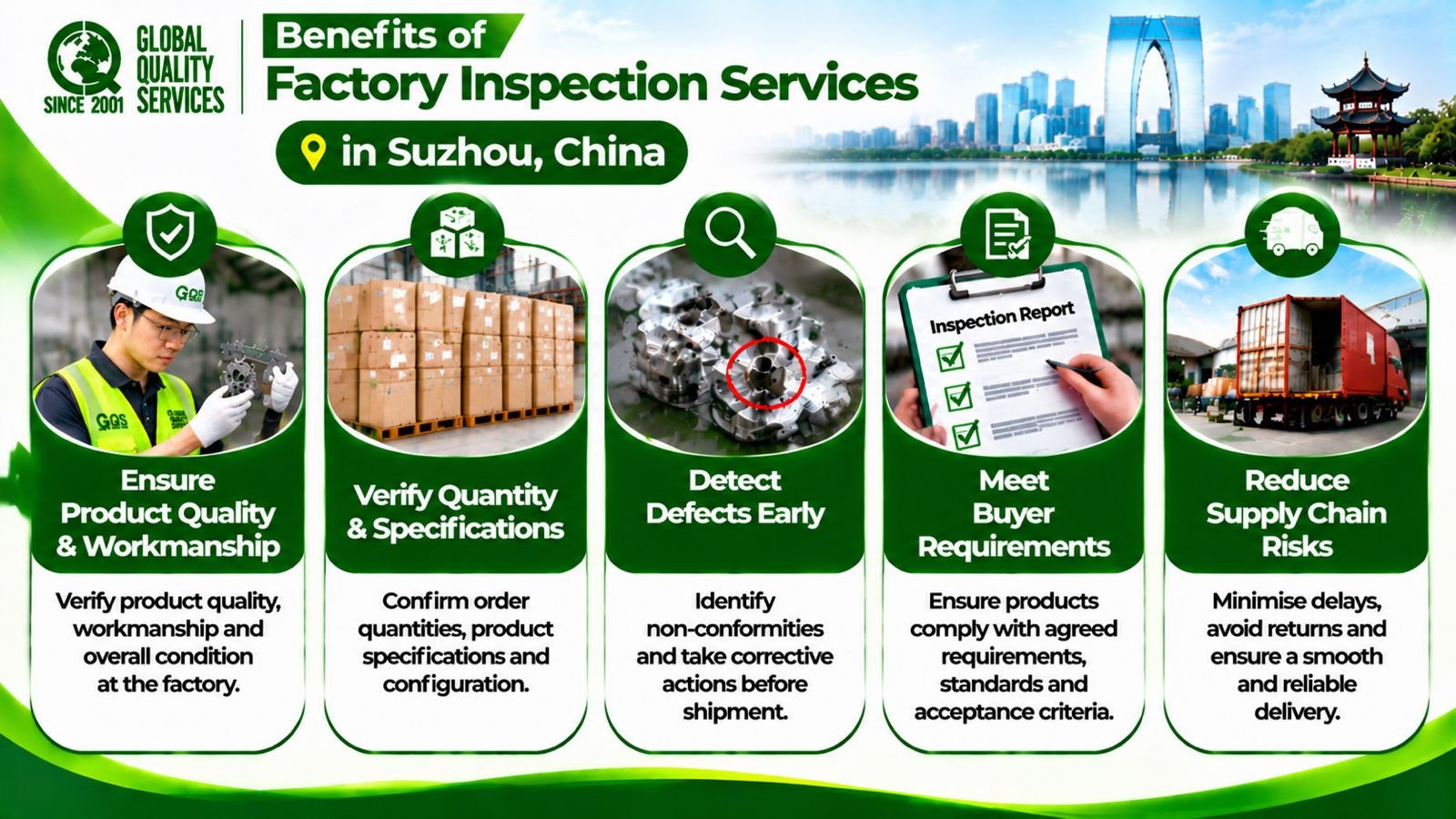
By examining material controls, process monitoring, testing arrangements, and documentation, buyers can identify potential gaps before they affect larger orders. Inspection findings also provide a documented reference when reviewing supplier performance, requesting corrective actions, or deciding whether further verification is necessary.
For businesses working with suppliers over several production cycles, periodic factory inspections can provide a useful comparison of manufacturing practices and quality controls over time.
What Does Our Factory Inspection Cover?
The inspection scope is tailored to the factory type, product category, order requirements, and buyer’s evaluation criteria.
1. Factory Infrastructure and Production Environment
The inspection begins with an overview of the manufacturing premises and relevant production areas. It examines the general condition and organization of the facility, production floor layout, workflow, equipment availability, and maintenance arrangements.
Inspectors may also review material storage, handling procedures, separation of raw materials and finished goods, housekeeping, and environmental conditions relevant to product quality. These observations help establish whether the production environment is appropriate for the manufacturing activities being reviewed.
2. Raw Material and Incoming Quality Control
Material quality directly affects the characteristics of the finished product. An inspection may review how the factory receives, identifies, verifies, stores, and releases raw materials and purchased components.
For example, an electronics manufacturer may need controls for component identification, approved part numbers, and batch traceability. A metal component supplier may need material grade verification, incoming test records, and appropriate storage arrangements.
The inspection can examine purchase specifications, incoming inspection procedures, material test certificates where required, batch identification, material segregation, and procedures for handling rejected or unapproved materials.
3. Manufacturing Process Controls
This is a key part of a factory inspection. It examines whether manufacturing activities follow documented methods and specified production requirements.
Checks may cover approved process flow diagrams, work instructions, standard operating procedures, production parameters, machine settings, process monitoring, operator responsibilities, and records of production deviations.
For example, an injection molding factory may require control of temperature, pressure, cycle time, and mold condition. A metal fabrication facility may need documented welding procedures, dimensional controls, and process records. The inspection scope should reflect the actual processes and technical requirements involved.
4. In-Process Quality Inspection
Quality checks during manufacturing can identify deviations before they affect an entire production batch. The inspection may review whether the factory has defined checkpoints, inspection methods, sampling arrangements, and acceptance criteria for work-in-progress.
Inspectors can examine dimensional and visual checks, assembly verification, process-specific testing, inspection frequency, rejection records, rework documentation, and sample approval arrangements. They may also observe selected production activities to understand how quality is monitored during manufacturing.
5. Testing and Measurement Equipment
Measurement and testing equipment must be suitable for the checks being performed. Where measurement accuracy is important, the inspection may review equipment identification, calibration status, maintenance arrangements, and relevant records.
Common equipment may include vernier calipers, micrometers, height gauges, coordinate measuring machines, electrical testing instruments, hardness testers, and temperature or pressure measurement devices.
A calibration label alone is not sufficient evidence of measurement reliability. Relevant calibration records, equipment identification, calibration intervals, and traceability to appropriate measurement standards may also be reviewed.
6. Quality Management System and Documentation
Factory inspection can include a review of the documented quality management arrangements relevant to the manufacturing scope. This may involve examining quality manuals, procedures, production instructions, incoming material inspection records, in-process and final inspection reports, calibration records, training records, nonconformity reports, and corrective action documentation.
Where the supplier claims ISO 9001 certification, the certificate details, issuing certification body, validity, and stated scope can be reviewed as part of the agreed assignment. A factory inspection does not itself provide ISO certification or replace a formal certification audit.
7. Finished Product Inspection and Storage
The inspection may examine how finished goods are verified and controlled before dispatch. This includes final inspection procedures, product identification, packaging condition, storage arrangements, segregation of rejected goods, and release authorization.
Where requested, selected finished products can be examined against approved drawings, specifications, reference samples, or purchase requirements.
8. Product Traceability and Nonconformity Management
Traceability allows a factory to connect finished products with relevant production information, material batches, components, and inspection records. The inspection may examine whether the supplier can identify the origin and production history of selected products.
It may also review how defects are recorded, segregated, investigated, and addressed. Corrective action records can provide useful evidence of whether the factory identifies underlying causes rather than repeatedly addressing only visible defects.
Factory Inspection Services for Different Industries in Suzhou
Suzhou’s industrial output includes several manufacturing sectors with different technical and quality control requirements. The inspection checklist should reflect the actual production risks of each industry.
| Industry | Important Factory Inspection Areas |
|---|---|
| Electronics and electrical equipment | Component traceability, ESD controls where applicable, soldering processes, electrical testing, and inspection records |
| Automotive components | Approved part specifications, material traceability, production process controls, dimensional checks, and nonconformity management |
| Industrial machinery | Equipment condition, assembly processes, mechanical components, operational checks, and maintenance records |
| Precision engineering | Drawing revisions, dimensional tolerances, measurement equipment, machining controls, and surface finish |
| Medical devices and equipment | Applicable production controls, material identification, process records, cleanliness requirements, and product-specific documentation |
| Metal fabrication | Material grades, cutting and forming processes, welding controls, dimensional inspection, and surface treatment |
| Plastics and injection molding | Resin identification, mold condition, process parameters, sample approval, and dimensional consistency |
Specialized requirements, including cleanroom qualification, product safety certification, laboratory testing, and regulated manufacturing audits, should be separately defined where required.
Different Stages at Which Factory Inspection Can Be Conducted
Factory inspection is not limited to a single point in the supplier relationship. Buyers can arrange inspections at different stages depending on the purpose.
Initial Factory Evaluation
This inspection is conducted before approving a new supplier or placing a significant order. It examines the factory’s manufacturing resources, production arrangements, relevant quality procedures, and ability to meet the proposed requirements.
During-Production Inspection
This inspection takes place while manufacturing is underway. It can review production progress, process controls, work-in-progress quality, and whether the approved specifications are being followed.
Final Factory Inspection
This inspection focuses on completed products and the factory’s final quality controls before goods are released or dispatched. It may include finished product checks, packaging, identification, and supporting documentation.
Periodic Supplier Inspection
For long-term supplier relationships, periodic inspections can review changes in equipment, production processes, quality procedures, material sourcing, and corrective action arrangements.
The timing and frequency depend on the buyer’s supplier risk assessment, order volume, product complexity, and previous inspection findings.
Factory Inspection vs. Factory Audit vs. Product Inspection
These terms are sometimes used interchangeably, but they do not necessarily describe the same activity.
| Activity | Main Focus | Typical Objective |
|---|---|---|
| Factory Inspection | Facility, production activities, equipment, and selected quality controls | Examine manufacturing conditions and operational practices |
| Factory Audit | Systematic evaluation against defined audit criteria | Assess conformity with a management system, customer requirements, or supplier audit checklist |
| Product Inspection | Physical examination and testing of selected products | Verify product characteristics against specifications |
| Pre-Shipment Inspection | Finished goods and shipment requirements | Review goods before dispatch |
| Pre-Delivery Inspection | Product condition and readiness before handover | Verify supplied items before acceptance |
A factory inspection may include elements of a supplier audit or product inspection, but the scope should be agreed in advance. A limited factory inspection should not be presented as a complete ISO 9001 certification audit or regulatory compliance assessment.
Our Factory Inspection Process in Suzhou
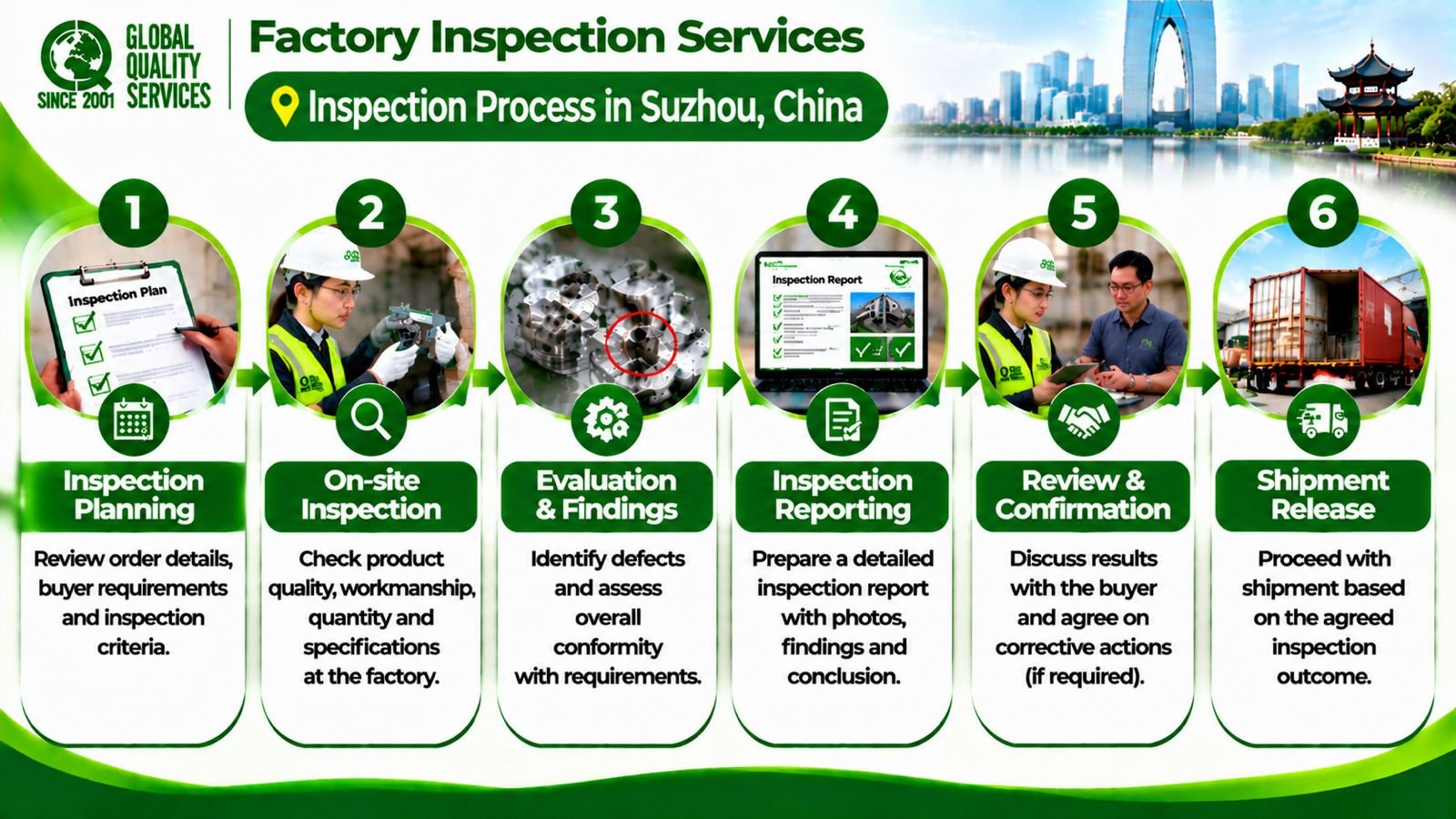
Global Quality Services follows an inspection process based on the buyer’s objectives and the agreed scope.
Step 1: Define the Inspection Objective
The buyer shares the supplier details, product category, purchase requirements, and reason for the inspection. The scope may focus on factory capability, production controls, quality documentation, or a combination of these areas.
Step 2: Review Documents and Inspection Criteria
Relevant documents are reviewed before the visit. These may include product specifications, process flow diagrams, quality procedures, approved drawings, inspection checklists, and applicable customer requirements.
Step 3: Plan the Factory Visit
The inspection date, factory location, access arrangements, relevant departments, and areas to be examined are coordinated with the supplier.
Step 4: Conduct the On-Site Inspection
The inspection covers the agreed facility and manufacturing activities. It may include observing production operations, examining equipment, reviewing records, and discussing findings with relevant factory personnel.
Step 5: Record Findings and Nonconformities
Observations are documented against the agreed criteria. Where evidence indicates a discrepancy, the report records the affected area, available supporting information, and relevant details.
Step 6: Prepare the Inspection Report
The report summarizes the inspection scope, activities performed, observations, supporting photographs where appropriate, and identified gaps. Any areas not inspected or checks that could not be completed are also identified.
Step 7: Review Corrective Actions or Follow-Up Requirements
The buyer can review the findings with the supplier and determine whether corrective action, additional evidence, or a follow-up inspection is necessary.
Why Choose Global Quality Services for Factory Inspection in Suzhou?
Global Quality Services provides third-party inspection services for buyers and businesses seeking independent information about manufacturing facilities and production operations.
Each factory inspection is structured around the facility, product category, technical requirements, and inspection objectives. The scope can include production capability, raw material controls, process monitoring, equipment condition, quality documentation, traceability, and finished product arrangements.
The inspection findings are recorded in a report that distinguishes between the areas examined, observations made, and any identified discrepancies. This gives buyers a documented basis for supplier evaluation and quality-related decisions.
The inspection scope is agreed before the visit. Certification audits, specialized laboratory testing, statutory assessments, and technical approvals are not implied unless separately specified and undertaken by appropriately qualified or authorized parties.
Areas Covered in and Around Suzhou
Factory Inspection Services can be arranged at manufacturing facilities across Suzhou and its surrounding industrial locations, subject to scheduling and site access.
Coverage may include:
- Suzhou Industrial Park (SIP)
- Suzhou New District (SND)
- Wujiang Economic Development Zone
- Wuzhong District
- Xiangcheng District
- Kunshan
- Taicang
- Changshu
- Zhangjiagang
Arrange Factory Inspection Services in Suzhou with Global Quality Services
Evaluating a factory requires more than reviewing its production capacity or product samples. Understanding the manufacturing process, quality controls, equipment, material traceability, and inspection records can provide a more complete picture of supplier performance.
Contact Global Quality Services to discuss Factory Inspection Services in Suzhou, China. Share the factory address, product category, inspection objective, relevant specifications, and preferred inspection date to establish the appropriate scope.
Frequently Asked Questions
1. What is included in a factory inspection in Suzhou?
A factory inspection may include a review of manufacturing facilities, production equipment, raw material controls, process monitoring, in-process quality checks, testing arrangements, documentation, traceability, and finished product handling. The scope depends on the buyer’s requirements and the type of factory.
2. When should a buyer arrange a factory inspection?
A factory inspection can be arranged before approving a new supplier, before placing a large order, during production, or as part of periodic supplier monitoring. The appropriate timing depends on product complexity, supplier risk, order value, and previous quality performance.
3. Does factory inspection verify ISO 9001 certification?
A factory inspection can include a review of an ISO 9001 certificate and relevant quality management records. However, it does not replace an independent ISO 9001 certification audit. Certification must be conducted by an appropriate certification body.
4. Can factory inspection be conducted during production?
Yes. During-production inspections can examine selected manufacturing stages, process controls, work-in-progress quality, production records, and corrective actions. This allows buyers to review actual manufacturing activities rather than relying only on a completed product sample.
5. What information is required to arrange a factory inspection in Suzhou?
Buyers should provide the factory name and address, product category, inspection objective, purchase or technical specifications, relevant quality requirements, and preferred inspection date. Existing supplier audit checklists or inspection criteria can also be shared to define the scope.