ISO 20121 helps event businesses manage these responsibilities. If you plan to pursue certification, an experienced consultant like Global Quality Services can guide your team through the requirements and audit preparation.
What Does ISO 20121 Certification Mean for a Business in Sentosa?
ISO 20121 is not simply an environmental certificate. It addresses the way an organization plans, manages, and reviews its events.
The standard applies to the entire event cycle. This includes decisions made before an event, activities on the day, and responsibilities that continue after the audience leaves.
Consider a hotel hosting an international business conference. Its sustainability responsibilities may include:
- Selecting caterers who follow responsible food purchasing practices.
- Reducing single-use materials in conference arrangements.
- Managing food waste and coordinating suitable disposal.
- Choosing event suppliers based on their environmental and social practices.
- Making facilities accessible to attendees with different needs.
- Managing staff welfare, contractor safety, and working conditions.
- Reviewing energy, water, and material consumption after the event.
These are everyday business decisions, not separate sustainability projects. ISO 20121 helps organizations bring them under one management system.
The current standard is ISO 20121:2024, published by the International Organization for Standardization in April 2024. It places particular attention on social responsibility, inclusivity, and the wider impact of events.
Which Businesses in Sentosa Should Consider ISO 20121?
Not every organization in Sentosa organizes public events. Some manage private functions, corporate gatherings, hospitality experiences, or services behind the scenes. ISO 20121 can apply to all these business activities when they fall within the organization’s event-related operations.
You should consider certification if your business belongs to any of these categories:
- Hotels and Resorts: If your property hosts weddings, conferences, business meetings, and corporate functions, ISO 20121 can help you manage the sustainability impact of these activities.
- Event Management Companies: If you coordinate exhibitions, product launches, conferences, or private celebrations, the standard gives you a way to manage sustainability expectations across different projects.
- Venues and Attraction Operators: If your venue welcomes large visitor groups, manages entertainment activities, or hosts special events, certification can help you address operational and stakeholder responsibilities.
- Catering Companies: Food purchasing, packaging, food waste, and supplier selection all affect event sustainability. ISO 20121 helps catering businesses address these areas.
- Event Production Companies: Stage construction, lighting, sound equipment, temporary installations, and material disposal can create considerable resource demands. A management system helps production companies manage these activities.
- Event Logistics and Transportation Providers: Transportation planning, vehicle use, fuel consumption, and supplier coordination can form part of an event’s sustainability impact.
- Exhibition and Conference Contractors: Contractors involved in booth construction, equipment installation, event materials, and dismantling can also work within an ISO 20121 management system.
Your organization does not need to operate a large event venue to qualify. The certification scope depends on the activities and services your business performs.
What Does Your Business Need to Meet ISO 20121 Requirements?
A common mistake is treating ISO 20121 as a document preparation exercise. Having a sustainability policy does not automatically mean your business meets the standard.
Your organization must show how it identifies important impacts, assigns responsibilities, controls activities, and checks whether its decisions produce the intended results.
For an event business in Sentosa, the following areas deserve attention.
1. Event Sustainability Policy
Your management must establish a policy that reflects the organization’s actual sustainability commitments. It should address the environmental, social, and economic responsibilities associated with your event activities.
2. Environmental and Social Impact Assessment
Identify the issues that matter to your operations. These may include waste, energy, water, transportation, accessibility, employee welfare, community concerns, and responsible purchasing.
3. Supplier and Contractor Management
Your suppliers influence the way your events operate. Establish suitable selection criteria and communicate your expectations to caterers, production teams, transport providers, and other contractors.
4. Resource and Waste Management
Look at how your business purchases, uses, and disposes of materials. Track relevant resource consumption and identify practical ways to reduce unnecessary waste.
5. Employee Responsibilities and Training
Employees should understand their roles in event sustainability. Train the relevant teams and make sure contractors know which requirements apply to their work.
6. Performance Monitoring
Set objectives that your organization can measure. Review relevant information, including resource consumption, waste records, supplier performance, and stakeholder feedback.
7. Internal Audits and Management Reviews
Check whether employees follow the established procedures. Management should review audit findings, performance results, and outstanding issues before the external certification assessment.
How to Get ISO 20121 Certification in Sentosa
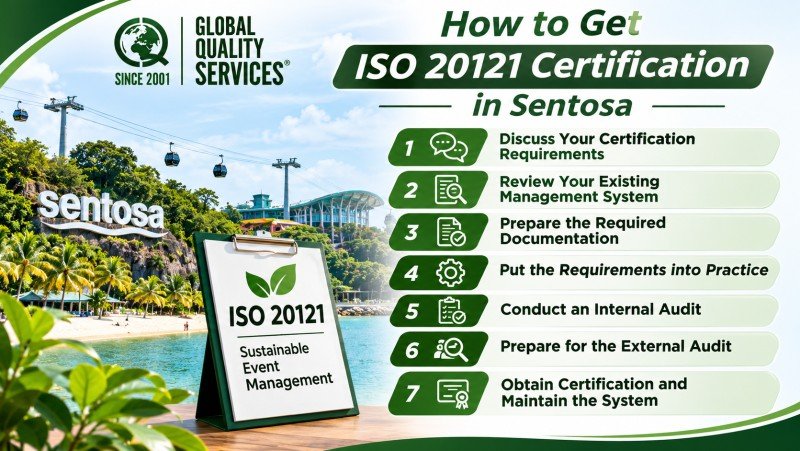
The certification journey should reflect your current business operations. A hotel with an established environmental management system will have different requirements from a newly established event management company. Global Quality Services starts by understanding this difference.
Here is how the engagement generally progresses:
1. Discuss Your Certification Requirements
We first understand your services, event activities, existing sustainability arrangements, and business objectives. This discussion helps establish a suitable certification scope.
2. Review Your Existing Management System
Our consultants examine your current policies, operational controls, supplier arrangements, and records. We identify the requirements you already meet and the areas that need attention.
3. Prepare the Required Documentation
We help develop or revise the necessary management system documents. These may include sustainability policies, impact assessments, procedures, objectives, and monitoring records.
4. Put the Requirements into Practice
Your team begins applying the agreed controls to actual business activities. We guide relevant employees and help address practical implementation concerns.
5. Conduct an Internal Audit
An internal audit checks whether your management system meets the standard’s requirements. Your organization must address any identified nonconformities before the certification assessment.
6. Prepare for the External Audit
An independent certification body conducts the formal assessment. Our team helps you prepare the required records, understand audit expectations, and respond to identified issues.
7. Obtain Certification and Maintain the System
Following a successful certification decision, the certification body issues your certificate. Your organization must continue following the management system and undergo periodic surveillance audits.
How Global Quality Services Experts Help You with ISO 20121 Certification in Sentosa
Choosing an ISO consultant is an important business decision. The quality of guidance you receive affects how well your team understands the requirements and how useful the management system becomes after certification.
Global Quality Services has worked with organizations across different industries and certification standards for more than two decades. Our Singapore consulting practice supports businesses with ISO certification, management system implementation, training, and assessment preparation.
What makes Global Quality Services a reputed consultant?
- More than 21 years of management consulting experience, according to our published company profile.
- ISO 27001-certified consulting organization.
- TUV SUD Singapore Certified Management Consultant credentials.
- Experience supporting clients across multiple industries and international markets.
- Established consulting, training, and certification support services.
- Practical understanding of integrated management systems.
- Client references and published certification engagement records.
- Guidance from initial assessment through audit preparation.
- Continued support for businesses maintaining and improving their management systems.
Our work with clients also reflects our experience with combined certification requirements. For example, our engagement with Resources Revival on ISO 9001, ISO 14001, ISO 45001, and R2 certification demonstrates our experience with multi-standard certification projects.
Why Work with an ISO 20121 Consultant Instead of Handling Certification Alone?
Your internal team may already understand event operations, supplier relationships, and sustainability concerns. However, translating those activities into an ISO-compliant management system requires a clear understanding of the standard.
An experienced consultant can help your organization avoid common problems, such as:
- Preparing documents that do not match actual business activities.
- Missing important environmental or social impacts.
- Setting sustainability objectives without measurable results.
- Overlooking supplier and contractor responsibilities.
- Assigning unclear responsibilities to employees.
- Entering the certification audit without adequate preparation.
- This support can save management time and help employees focus on their regular responsibilities.
For a business operating in Sentosa, where event schedules and guest commitments often leave little room for administrative delays, practical consulting support can make the certification journey easier to manage.
Speak with Global Quality Services About ISO 20121 Certification
Planning to achieve ISO 20121 Certification for your business in Sentosa? Let Global Quality Services help you get started. Our experienced consultants will understand your business requirements, guide your team through the necessary steps, and help you prepare for the certification audit. Get in touch with Global Quality Services today at +65 9344 1973 or info@gqssingapore.com to discuss your requirements and request a consultation.
Frequently Asked Questions
1. Can a hotel in Sentosa obtain ISO 20121 certification for its event operations alone?
Yes. A hotel can define its certification scope around event-related services, such as conferences, weddings, and corporate functions, rather than including every hotel operation.
2. Does ISO 20121 certification require businesses to eliminate all event waste?
No. The standard does not demand zero waste. It requires organizations to identify significant impacts, establish suitable controls, monitor performance, and work towards improvement.
3. Can we include external event suppliers in our ISO 20121 management system?
Yes. Your organization can establish sustainability requirements for external suppliers and contractors. You must also monitor relevant services that influence your event sustainability performance.
4. Is ISO 20121 certification useful when responding to corporate event tenders?
Yes. Certification gives procurement teams documented evidence of your event sustainability management system. It can strengthen your credentials when sustainability forms part of supplier evaluation.
5. What happens if our organization already follows ISO 14001?
Your existing environmental management system can support ISO 20121 implementation. However, you must also address event-specific social and economic impacts that ISO 14001 does not fully cover.
6. Does Global Quality Services issue the ISO 20121 certificate?
No. Global Quality Services provides consulting, documentation, implementation, and audit preparation support. An independent certification body conducts the formal assessment and makes the certification decision.