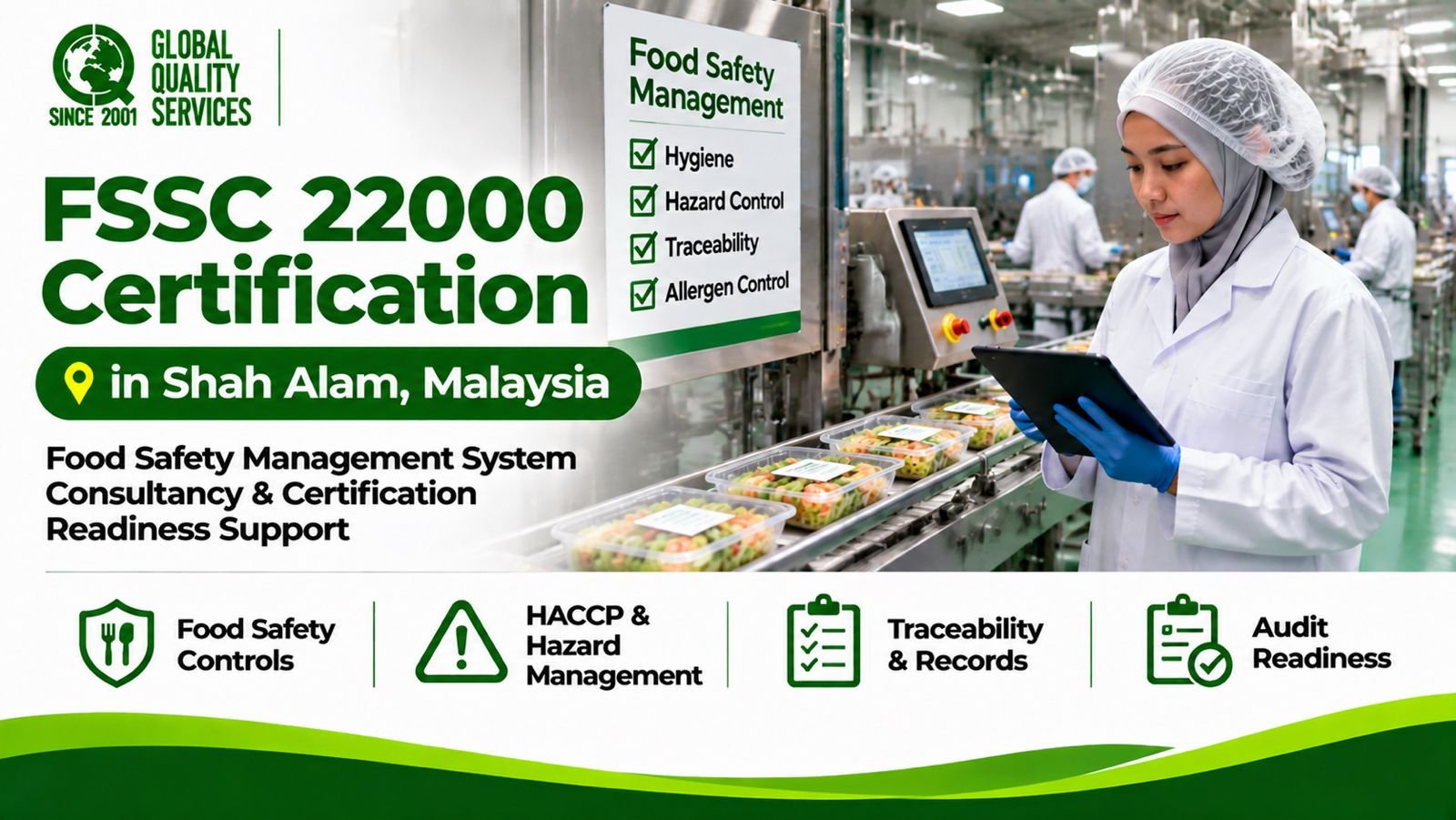
Malaysia’s food manufacturing sector continues to expand, increasing the importance of structured food safety management across production, processing, packaging, and distribution operations. According to the Department of Statistics Malaysia, food processing products grew by 9.4% in 2025. Selangor, meanwhile, generated RM460.1 billion in gross domestic product, with manufacturing contributing RM131 billion, or 28.5% of the state’s economy. These figures underline the importance of manufacturing and food-related supply chains across the state.
Shah Alam is an important industrial and commercial center in Selangor, with businesses involved in food and beverage manufacturing, ingredient processing, packaging, warehousing, and distribution. As manufacturers supply supermarkets, food service companies, institutional buyers, and international markets, maintaining consistent food safety controls becomes essential.
FSSC 22000 Certification provides a recognized framework for establishing, implementing, and maintaining a Food Safety Management System (FSMS). It combines ISO 22000 requirements, sector-specific prerequisite programs (PRPs), and additional scheme requirements to address food safety risks throughout the applicable supply chain.
Global Quality Services provides FSSC 22000 certification-related services in Shah Alam, Malaysia, covering system gap assessment, implementation planning, documentation, and certification readiness. The objective is to establish food safety controls that reflect the organization’s actual processes, products, hazards, and operational requirements.
What Is FSSC 22000 Certification?
FSSC 22000 is a Food Safety Management System certification scheme developed by Foundation FSSC. It is designed for organizations operating in different parts of the food supply chain, including food manufacturing, animal feed, catering, packaging, storage, transportation, and related activities covered by the scheme.
Unlike a standalone food hygiene checklist, FSSC 22000 establishes a structured management system for identifying food safety hazards, assessing risks, controlling processes, monitoring performance, and improving food safety practices.
The scheme has three main components:
ISO 22000: Establishes the requirements for a Food Safety Management System, including hazard analysis, operational controls, management responsibilities, monitoring, verification, and continual improvement.
Prerequisite Programs (PRPs): Establish the basic environmental and operational conditions required for safe food production and handling. These requirements vary according to the organization’s activities and applicable sector.
FSSC 22000 Additional Requirements: Introduce further controls defined by the scheme, covering areas such as food defense, food fraud prevention, allergen management, environmental monitoring, and other applicable food safety and organizational requirements.
Organizations must implement all applicable elements before undergoing certification audits by an FSSC-licensed certification body.
Why Is FSSC 22000 Certification Important for Shah Alam Businesses?
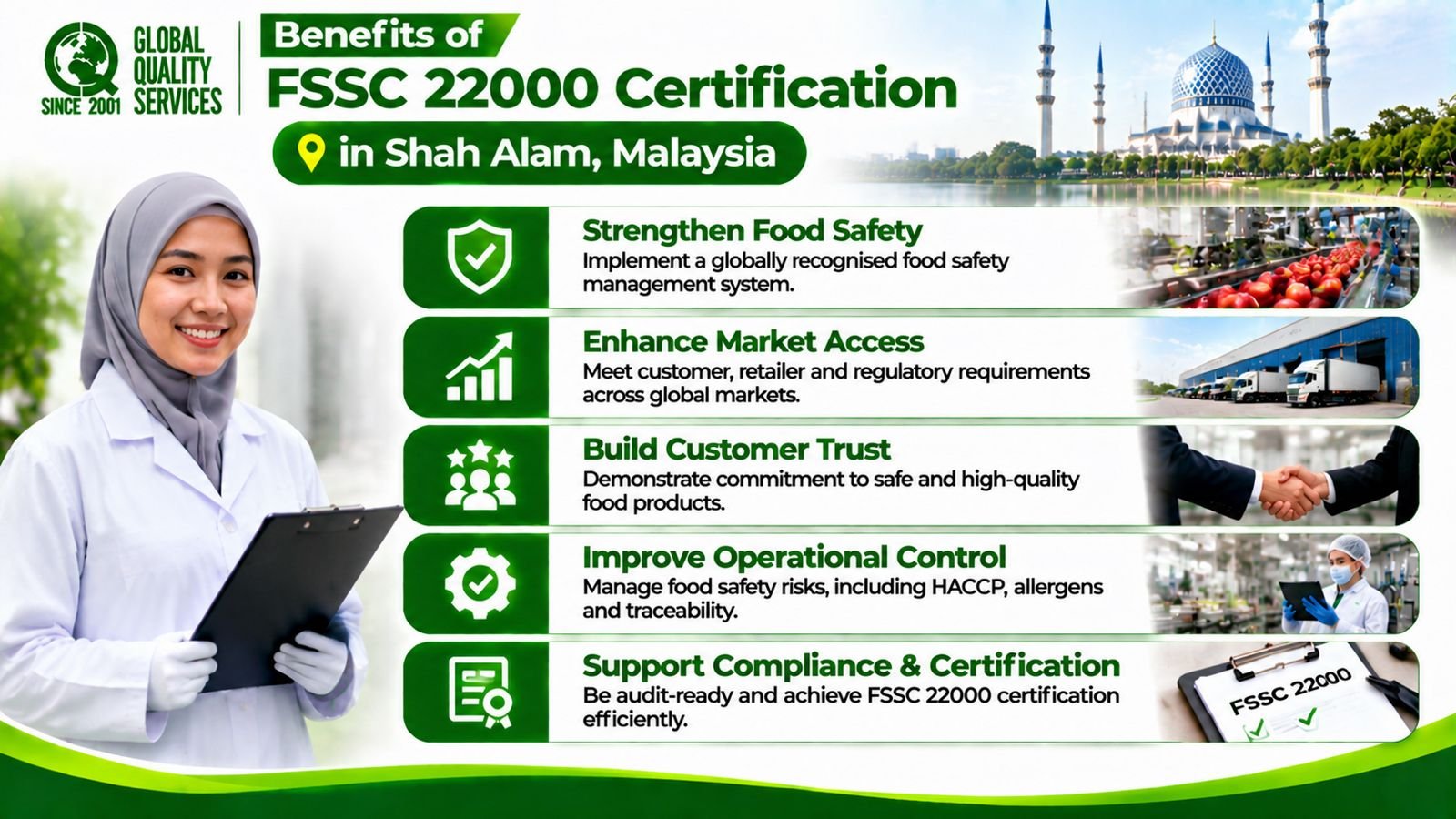
Food businesses in Shah Alam operate in supply chains where product safety, regulatory compliance, customer specifications, and traceability influence purchasing decisions. FSSC 22000 provides a systematic approach to managing these responsibilities.
Stronger Food Safety Risk Management
Food manufacturers handle different biological, chemical, physical, and allergen-related hazards. FSSC 22000 requires organizations to identify relevant hazards and establish controls based on the nature of their products and processes.
For example, a frozen food manufacturer may need controls for cooking, cooling, freezing, storage temperatures, and contamination risks. A bakery may need documented allergen controls, ingredient verification, and production scheduling to prevent cross-contact.
Improved Customer and Supplier Confidence
Retail chains, food service companies, international buyers, and large manufacturers often evaluate suppliers based on their food safety management arrangements. FSSC 22000 certification provides independently verified evidence that an organization’s FSMS has been assessed against the applicable scheme requirements.
Better Control Across Production Operations
The scheme connects purchasing, raw material acceptance, manufacturing, packaging, storage, and distribution within a structured food safety system. This helps organizations maintain consistent procedures and records across different operational stages.
Stronger Traceability and Recall Preparedness
Food businesses need to identify affected ingredients, batches, and finished products when a safety issue occurs. FSSC 22000 supports the establishment of traceability, withdrawal, and recall arrangements so that potentially unsafe products can be managed systematically.
Access to International Supply Chains
FSSC 22000 is recognized by the Global Food Safety Initiative (GFSI). Certification can therefore be relevant to manufacturers supplying customers that specify GFSI-recognized certification programs as part of their supplier approval requirements. It does not automatically guarantee acceptance by every retailer or export market.
Which Businesses in Shah Alam Can Apply for FSSC 22000?
FSSC 22000 covers several food-chain activities. The applicable category and prerequisite program depend on the organization’s actual operations and certification scope.
Food and Beverage Manufacturers
Manufacturers of processed foods, ready-to-eat products, frozen foods, dairy products, beverages, bakery items, confectionery, sauces, and packaged meals can fall within the relevant food manufacturing categories.
Their food safety systems need to address process-specific hazards, sanitation, ingredient handling, temperature control, allergen management, and product release.
Food Ingredient and Additive Manufacturers
Businesses producing food ingredients, flavorings, additives, processing aids, and related materials need controls over raw material approval, formulation, processing, contamination prevention, and finished product specifications.
Food Packaging Manufacturers
Manufacturers producing packaging materials intended for food contact may fall within the relevant packaging material category. Their controls may include material specifications, contamination prevention, production hygiene, storage, traceability, and product conformity.
Warehousing and Distribution Businesses
Organizations involved in food storage and transportation can also be eligible under applicable FSSC categories. Temperature monitoring, vehicle hygiene, pest control, handling practices, stock rotation, and traceability are important considerations.
Other Eligible Food-Chain Organizations
Depending on their activities, catering businesses, animal feed manufacturers, and other organizations within the scheme’s scope may also pursue FSSC 22000 certification.
The certification scope should accurately describe the activities, products, processes, and locations covered by the Food Safety Management System.
Key FSSC 22000 Requirements for Food Businesses
An effective FSSC 22000 system must reflect the organization’s operational risks rather than rely only on generic procedures. The following areas are particularly important for food businesses.
Food Safety Hazard Analysis and HACCP
Organizations must identify potential biological, chemical, physical, and allergen hazards associated with their products and processes. The HACCP-based approach is used to evaluate risks and establish appropriate control measures.
The food safety team should consider raw material hazards, processing conditions, cross-contamination, packaging, storage, and distribution. Operational prerequisite programs, prerequisite programs, and critical control points must be established where appropriate.
Prerequisite Programs and Hygiene Controls
PRPs establish the basic conditions required for safe food production. These may include cleaning and sanitation, pest management, personnel hygiene, facility maintenance, waste handling, water quality, equipment design, and prevention of cross-contamination.
The applicable PRP standard depends on the organization’s food-chain category.
Allergen Management
Food manufacturers must identify allergens present in raw materials and finished products. Controls should address ingredient verification, storage, production scheduling, cleaning, labeling, and prevention of unintended allergen cross-contact.
For manufacturers handling multiple product formulations, documented allergen risk assessments and verification activities are particularly important.
Food Fraud Prevention and Food Defense
Food fraud vulnerability assessment examines the possibility of intentional substitution, dilution, misrepresentation, or economically motivated adulteration of ingredients and products.
Food defense focuses on protecting products, processes, and facilities against intentional malicious contamination or other deliberate threats. Organizations must establish controls that reflect their identified vulnerabilities and risks.
Environmental Monitoring
Where relevant to the organization’s operations and hazards, environmental monitoring helps verify the effectiveness of hygiene and contamination controls. Sampling locations, organisms of concern, frequency, testing methods, and response procedures should be determined according to risk.
Traceability, Withdrawal, and Recall
Organizations need arrangements to trace raw materials, ingredients, packaging, work-in-progress, and finished products through relevant stages of the supply chain.
A documented recall procedure should identify responsibilities, communication arrangements, product identification methods, and the steps for managing affected products. Traceability and recall arrangements should be tested at planned intervals.
Supplier and Outsourced Process Control
Food safety risks can originate outside the organization’s own production facility. Suppliers of ingredients, packaging, processing services, and other outsourced activities should therefore be evaluated according to their effect on food safety.
Approval criteria, supplier monitoring, specifications, incoming checks, and performance reviews should be documented and maintained.
FSSC 22000 Version 7: Important Changes for 2026–2028
Foundation FSSC officially released FSSC 22000 Version 7 on 1 May 2026. The new version introduces changes to prerequisite programs, scheme requirements, food-chain category structure, and alignment with the GFSI Benchmarking Requirements 2024.
Updated ISO 22002-x:2025 Prerequisite Programs
One of the most important changes is the incorporation of the updated ISO 22002-x:2025 series.
For food manufacturing organizations, Version 7 requires the common requirements of ISO 22002-100:2025 together with the applicable sector-specific standard, such as ISO 22002-1:2025.
Packaging manufacturers, catering businesses, and storage or transportation organizations must identify the corresponding PRP requirements for their activities. For example, food packaging manufacturing uses ISO 22002-100:2025 alongside ISO 22002-4:2025.
Organizations certified to Version 6 should not assume that their existing PRP procedures automatically satisfy the updated requirements. A documented review of the applicable standards and operational controls is necessary.
Alignment with GFSI Benchmarking Requirements 2024
Version 7 incorporates alignment with the GFSI Benchmarking Requirements 2024. This update reflects developments in food safety assurance and the expectations placed on recognized certification programs.
Greater Focus on Sustainability
The updated scheme strengthens its contribution to relevant United Nations Sustainable Development Goals. Organizations should review the applicable requirements concerning food loss and waste reduction and sustainable packaging as part of their Version 7 transition planning.
Version 6 to Version 7 Transition Timeline
The transition period is particularly important for Shah Alam businesses currently holding FSSC 22000 Version 6 certificates.
- 1 May 2026: FSSC 22000 Version 7 officially released.
- Until 30 April 2027: Version 6 audits are permitted.
- 1 May 2027 to 30 April 2028: Version 7 upgrade audits are scheduled to take place.
- After the transition: Organizations must maintain certification against Version 7 under the applicable scheme requirements.
The Foundation FSSC has also specified that remaining Version 6 certificates that have not been upgraded will be withdrawn from the Assurance Platform after 30 June 2028. Organizations should coordinate their audit arrangements with their certification body well ahead of the transition deadlines.
FSSC 22000 Certification Process in Shah Alam
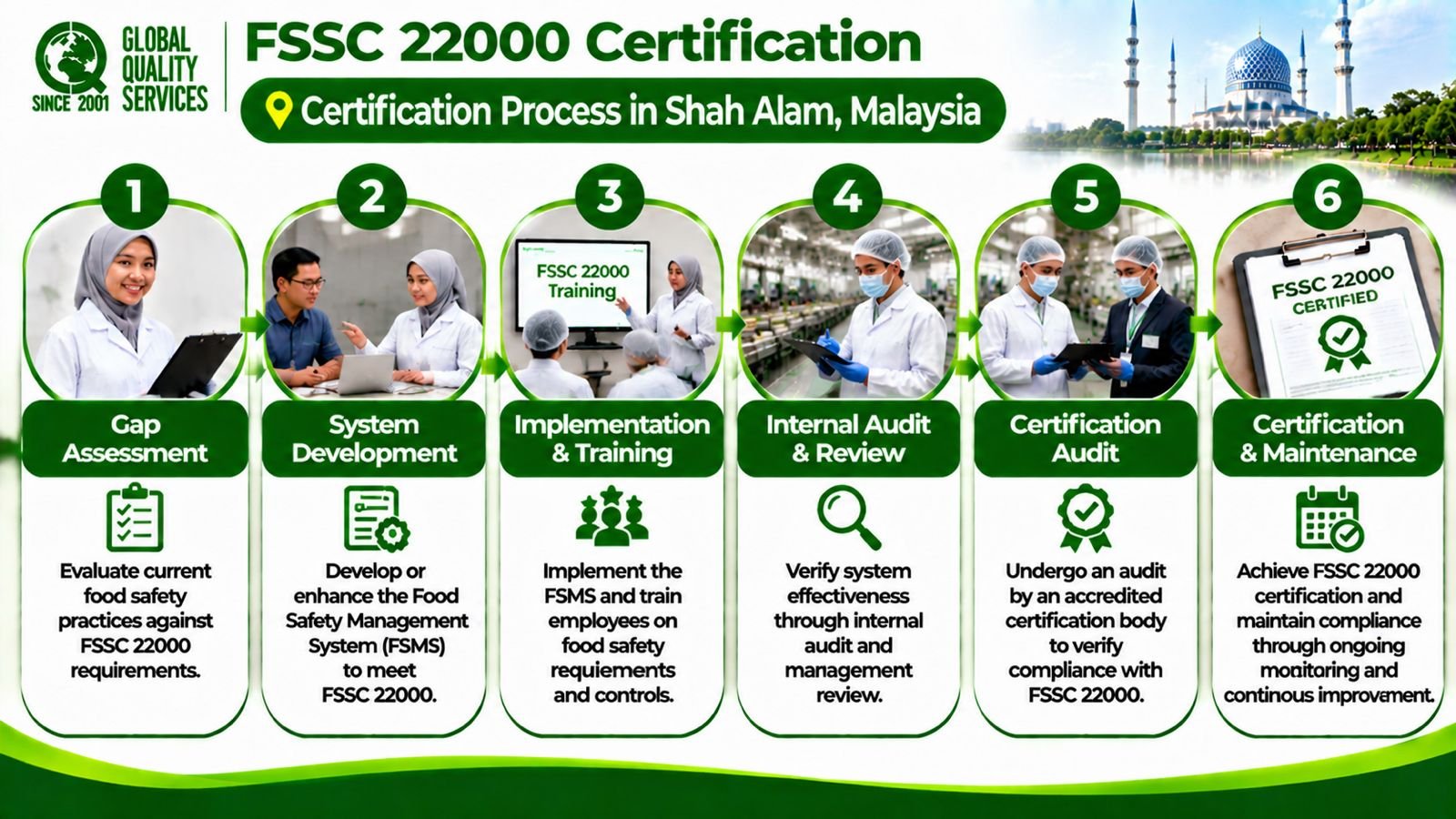
Achieving certification involves developing and implementing the required Food Safety Management System before an independent certification audit.
Step 1: Determine the Certification Scope
The first step is to identify the organization’s food-chain category, products, manufacturing activities, processes, and locations. This determines which prerequisite program standards and scheme requirements apply.
Step 2: Conduct a Gap Assessment
Existing food safety procedures, HACCP studies, PRPs, supplier controls, traceability arrangements, and supporting records are reviewed against the applicable FSSC 22000 requirements. Gaps are documented so that the organization can establish an implementation plan.
Step 3: Develop and Implement the FSMS
The organization establishes or updates its food safety policy, objectives, hazard analysis, operational controls, procedures, monitoring arrangements, and supporting documentation.
Implementation must be reflected in actual production and handling activities rather than remaining limited to written procedures.
Step 4: Establish Operational and Verification Controls
The organization verifies that food safety controls are functioning as intended. This may include monitoring critical control points, reviewing sanitation records, checking supplier performance, validating relevant control measures, conducting environmental monitoring where applicable, and maintaining traceability.
Step 5: Conduct Internal Audit and Management Review
An internal audit evaluates whether the FSMS conforms to the applicable requirements and is effectively implemented. Management review considers audit findings, food safety objectives, performance indicators, nonconformities, corrective actions, and opportunities for improvement.
Step 6: Complete the Certification Audit
An FSSC-licensed certification body conducts the independent certification audit. The process generally includes Stage 1 and Stage 2 audits for initial certification, subject to the applicable scheme requirements.
The certification body evaluates the documented system and its implementation. Any nonconformities must be addressed through the prescribed corrective action process.
Step 7: Certification Decision and Maintenance
Certification is granted only after the certification body completes its review and makes a positive certification decision. Certified organizations must maintain their systems through surveillance audits and subsequent recertification in accordance with scheme requirements.
Malaysia’s Food Safety Regulations and FSSC 22000
Food businesses operating in Shah Alam must comply with applicable Malaysian food laws, regardless of whether they hold FSSC 22000 certification.
The Ministry of Health Malaysia administers the Food Safety and Quality Programme under the Food Act 1983. Relevant legal requirements include the Food Regulations 1985, which establish food standards and labeling requirements, and the Food Hygiene Regulations 2009, which address hygiene practices for food premises, owners, and food handlers.
Malaysia also has food safety recognition and certification programs, including MeSTI, GMP, and HACCP-related programs. These have their own eligibility and regulatory requirements.
FSSC 22000 is a separate international certification scheme. It does not replace Malaysian statutory obligations, food premises requirements, product registration or approval where applicable, or other legal responsibilities. Businesses should assess both their regulatory obligations and customer certification requirements.
Why Choose Global Quality Services for FSSC 22000 Certification?
Global Quality Services provides certification-related services for organizations preparing to establish or improve their Food Safety Management Systems.
The engagement can cover an initial gap assessment, review of existing HACCP arrangements, applicable PRP requirements, documentation planning, implementation review, internal audit readiness, and preparation for the independent certification process.
For Shah Alam food businesses preparing for Version 7, particular attention can be given to the updated ISO 22002-x:2025 requirements, relevant additional scheme requirements, and the transition from Version 6.
Global Quality Services does not issue FSSC 22000 certificates. Certification audits and certification decisions are conducted by FSSC-licensed certification bodies. The organization remains responsible for implementing and maintaining its food safety management system.
Frequently Asked Questions
1. Is FSSC 22000 Version 7 mandatory for companies currently certified to Version 6?
Yes. Organizations holding Version 6 certification must complete the transition to Version 7 within the scheme’s prescribed transition arrangements. Version 6 audits are permitted only until 30 April 2027, and Version 7 upgrade audits are scheduled from 1 May 2027 to 30 April 2028. Businesses should coordinate their transition plans with their certification body.
2. Which ISO 22002 standard applies to food manufacturers under FSSC 22000 Version 7?
Food manufacturing organizations generally need to apply ISO 22002-100:2025 together with the relevant sector-specific standard, such as ISO 22002-1:2025. The exact requirements depend on the organization’s food-chain category and activities.
3. Can a company with ISO 22000 certification apply for FSSC 22000?
Yes. An organization already certified to ISO 22000 can pursue FSSC 22000 by meeting the applicable prerequisite program standards and additional FSSC scheme requirements. It must also undergo the required certification audit through an FSSC-licensed certification body.
4. Is FSSC 22000 certification compulsory for food manufacturers in Malaysia?
FSSC 22000 is not a blanket legal requirement for all food manufacturers in Malaysia. However, buyers, retailers, international customers, or supply chain partners may require it as a condition of supplier approval. Food businesses must still comply with applicable Malaysian food safety laws and regulations.
5. How long does it take to obtain FSSC 22000 certification?
The timeline depends on the organization’s size, number of employees, product range, food safety risks, existing management systems, and implementation status. Businesses with established ISO 22000 and HACCP arrangements may have fewer gaps to address, while organizations developing a complete FSMS from the beginning may require more preparation time. The certification body determines the audit arrangements and certification decision.