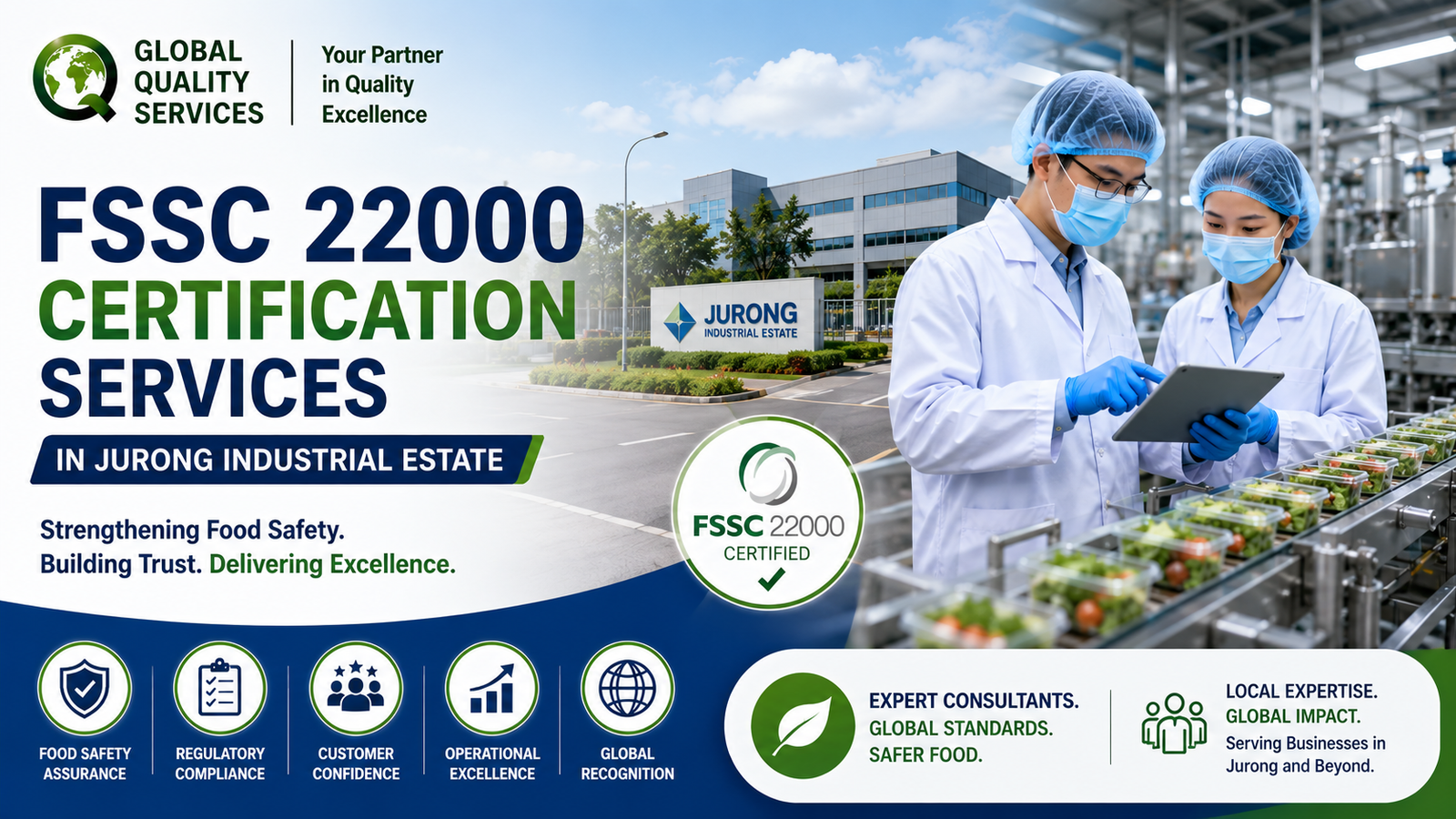
Jurong Industrial Estate is one of Singapore’s most active food manufacturing corridors — home to large-scale food processors, packaging facilities, cold-chain operators, and ingredient suppliers serving both domestic retailers and international export markets. For businesses operating here, demonstrating credible, third-party-verified food safety competence is not just good practice; it is increasingly a commercial prerequisite demanded by retailers, export partners, and regulatory bodies alike.
GQS Singapore provides end-to-end FSSC 22000 Certification Services for food businesses in Jurong and across Singapore — from the initial gap assessment through system implementation, internal audit, and final third-party certification. Our consultants bring hands-on experience with the food manufacturing environments unique to this industrial precinct: ambient processing lines, chilled distribution, multi-product packaging halls, and contract catering operations. The Singapore Food Agency (SFA) explicitly recognises FSSC 22000 as an approved Food Safety Management System (FSMS) standard under its regulatory framework — making GQS-supported FSSC 22000 certification directly relevant to your Singapore licensing obligations.
What Is FSSC 22000?
FSSC 22000 (Food Safety System Certification 22000) is a globally recognized, GFSI-benchmarked certification scheme built on three interlocking pillars: ISO 22000:2018, the ISO 22002 series of sector-specific Prerequisite Programs (PRPs), and additional FSSC Scheme Requirements that ensure scheme integrity and governance.
With over 42,000 certified organizations in 140+ countries, FSSC 22000 is the world’s most widely adopted food safety certification scheme. The current version — Version 7 (released May 2026) — introduces mandatory allergen management plans, food loss and waste reduction policies with measurable targets, updated food fraud and food defense plans, and alignment with the new ISO 22002-100:2025 umbrella standard.
The Singapore Food Agency lists FSSC 22000 as one of its approved FSMS certifications — meaning FSSC 22000 certification can directly support your SFA licensing compliance and improve your grade under the Safety Assurance for Food Establishments (SAFE) Framework.
Which Businesses in Jurong Industrial Estate Does FSSC 22000 Cover?
FSSC 22000 Version 7 defines distinct scope categories covering the full range of food sector activities. The categories most relevant to Jurong Industrial Estate businesses are:
- Category CI – CIV — Ambient & Chilled Food Manufacturing: Thermal processing, dried goods, preserved foods, baked products, edible oils, beverages, and chilled or ambient ready meals.
- Category C0 — Animal Primary Conversion: Slaughter and primary conversion of animal-derived food products, now a standalone scope category under Version 7.
- Category D — Feed Manufacturing: Animal feed manufacturers supplying livestock or aquaculture industries.
- Category E — Catering & Food Service: Renamed in Version 7 to include restaurant chains, institutional caterers, food trucks, and cafeteria operations.
- Category I — Packaging Manufacturing: Producers of food-contact packaging materials including disposable items, foils, films, and containers — with explicit scope boundaries added in Version 7.
- Category G — Storage & Distribution: Cold-chain operators, third-party logistics providers, and ambient storage facilities handling food products.
Benefits of FSSC 22000 Certification for Jurong Food Businesses
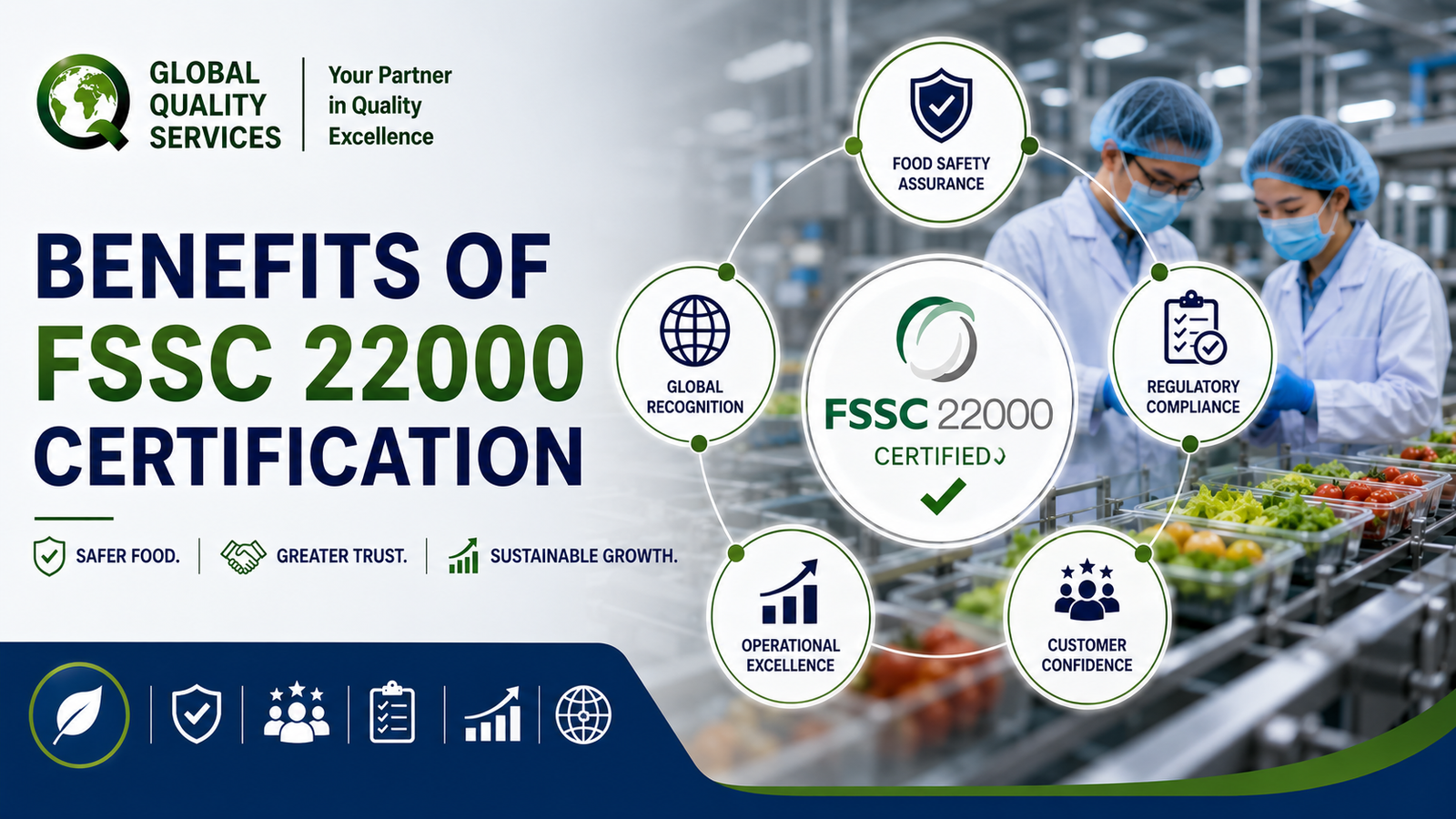
Let us have a look at the FSSC 22000 Certification for Jurong Food Businesses
SFA Compliance Support — Directly satisfies the SFA-approved FSMS requirement and supports higher SAFE Framework grading for catering and food establishments.
Global Market Access — GFSI-benchmarked status satisfies buyer requirements from Carrefour, Walmart, Tesco, AEON, and major FMCG brands — enabling access to premium international markets without repeated buyer audits.
Systematic Hazard Control — Combines ISO 22000’s HACCP methodology with sector-specific PRPs to identify and eliminate food safety hazards before they reach consumers.
Supply Chain Confidence — Third-party certification gives retailers, distributors, and contract customers documented assurance of your food safety capabilities, significantly reducing audit fatigue.
Reduced Recall Risk — Mandatory allergen controls, food fraud vulnerability assessments, and contamination prevention programmes under Version 7 significantly reduce the likelihood and severity of product recalls.
EDG Grant Eligible — Singapore SMEs may recover up to 50% of consultancy and certification costs through Enterprise Singapore’s Enterprise Development Grant (EDG) under the Standards Adoption project category.
Our FSSC 22000 Certification Process for Jurong Facilities
Step 1 — Free Gap Assessment
A GQS food safety consultant conducts an on-site or remote review of your existing practices against FSSC 22000 Version 7 requirements, benchmarking your HACCP plan, PRP documentation, and management system against all clause-level requirements and producing a prioritised gap report.
Step 2 — Scope Determination & Project Planning
We confirm the correct FSSC 22000 scope category for your Jurong facility, define the certification boundary, and prepare a realistic project timeline aligned with your next scheduled audit window or Version 7 transition deadline.
Step 3 — Food Safety Management System Implementation
Our consultants work directly with your food safety team to develop or upgrade all FSMS documentation — hazard analysis and HACCP charts, allergen management plans, food fraud vulnerability assessments, food safety culture programmes, and all PRPs required under ISO 22002 for your sector. All documentation is prepared for GoBusiness portal submission where SFA mandates it.
Step 4 — Staff Training & Awareness
We deliver targeted awareness sessions for production, QA, and management teams, covering food safety culture expectations under FSSC V7, allergen control procedures, and individual roles within the FSMS — aligned with SFA’s joint food safety responsibility guidelines.
Step 5 — Internal Audit & Management Review
GQS conducts a full internal audit against all FSSC 22000 V7 requirements and facilitates the mandatory management review. All non-conformities are closed out before the external audit, ensuring you enter certification in the strongest possible position.
Step 6 — Certification Audit Support & Ongoing Surveillance
We coordinate with your chosen accredited Certification Body for Stage 1 (documentation) and Stage 2 (on-site) audits, accompany your team during audit interactions, and manage post-audit corrective action plans. Post-certification, we support annual surveillance audits to keep your certificate current throughout the 18-month Version 7 transition window.
Migration For FSSC 22000 from Version 6 to Version 7
Version 7 of FSSC 22000 was released in May 2026. The 18-month transition clock started the same day. For Singapore food businesses currently certified to Version 6, that means your migration deadline falls in November 2027 at the latest, and your next scheduled audit, whether surveillance or recertification, is almost certainly the only practical window to complete it without incurring an additional audit fee.
Here is what the timeline looks like in practice.
- Now to Month 3. Conduct a gap assessment against the five areas Version 7 changes: allergen management plan, food loss and waste policy, updated food fraud and food defense plans, food safety culture objectives, and ISO 22002-100:2025 alignment. Most Version 6 facilities have partial coverage of these areas already. The gap assessment confirms exactly what needs updating and what does not.
- Month 3 to Month 9. Update documentation, embed changes into daily operations, and run your next internal audit cycle against Version 7 requirements, not Version 6. Certifying bodies will not accept a Version 6 internal audit as evidence of Version 7 readiness. This stage also includes a top management briefing on the new measurable food safety culture objectives, which is an audited requirement in Version 7.
- Month 9 to Month 18. Your Stage 1 or Stage 2 audit, whether a scheduled surveillance visit or a recertification, is conducted against Version 7. If your documentation and internal audit are already aligned, this is a normal audit cycle with an updated scope rather than an additional visit.
Miss this window and your options narrow. A lapsed Version 6 certificate that cannot be transitioned in time means re-entering the certification process from Stage 1, an outcome that affects your buyer qualifications, your SFA SAFE framework grade, and any EDG grant claims tied to your active certificate.
Global Quality Services plans and executes your Version 7 transition around your existing audit schedule so the migration is completed on time, within budget, and without an unplanned lapse in your certification status.
Why Choose Global Quality Services for FSSC 22000 Certification in Jurong Industrial Estate
Global Quality Services has supported food safety and management system certification projects across Singapore and the Asia-Pacific region for over two decades. Our food safety consultants have direct, on-the-ground experience with the manufacturing environments that define Jurong Industrial Estate: ambient and chilled processing lines, multi-product packaging halls, cold-chain distribution operations, and contract food production facilities, and every food safety management system we build reflects the actual processes, hazards, and regulatory obligations of your specific Jurong facility.
We do not apply off-the-shelf templates. Your HACCP plan, allergen management plan, food fraud vulnerability assessment, and PRP documentation are developed around your products, your processes, and your site, and prepared in the format required for SFA licensing and GoBusiness portal submission from day one.
For Singapore SMEs, we also manage the Enterprise Development Grant application process on your behalf, ensuring your qualifying consultancy and certification costs are captured correctly for up to 50% grant support under the Standards Adoption category.
Certification is not the finish line. We stay engaged through your annual surveillance audits, your Version 7 transition if applicable, and any production or product scope changes that need to be reflected in your certified food safety management system. That continuity matters in a dynamic manufacturing environment like Jurong, where a new product line, a new supplier, or a new piece of equipment can each affect your FSSC 22000 scope in ways that need to be proactively managed rather than discovered during an audit.
Contact Global Quality Services to begin your FSSC 22000 certification in Jurong Industrial Estate. In addition to FSSC 22000 Certification, we also provide consultancy / guidance for PCQI (Preventive Controls Qualified Individual) in Training and Certification to help food manufacturers comply with the U.S. FDA FSMA requirements.
Frequently Asked Questions
Q: Is FSSC 22000 recognised by the Singapore Food Agency (SFA) as a valid food safety management system?
Yes. The Singapore Food Agency officially recognises FSSC 22000 as an approved Food Safety Management System (FSMS) standard — equivalent in standing to ISO 22000:2018, SS 444:2018, and BRC Global Food Standards.
Q: What is the difference between FSSC 22000 Version 6 and the new Version 7, and does my Jurong facility need to transition?
FSSC 22000 Version 7 (released May 2026) introduces mandatory allergen management plans, food loss and waste targets, updated food fraud and defence requirements, and new ISO 22002:2025 reference standards. If you are currently certified to Version 6, you must transition at your next regular audit within the 18-month transition window.
Q: How long does it take to get FSSC 22000 certified for a food manufacturing facility in Jurong Industrial Estate?
For most Jurong food manufacturing facilities, the end-to-end certification process takes between 4 and 9 months, depending on the maturity of your existing food safety documentation and whether a functioning HACCP system is already in place. Facilities with an existing, well-documented HACCP plan and basic management system infrastructure can typically complete the process in 4 to 6 months.
Q: Can Singapore SMEs get government funding to offset the cost of FSSC 22000 certification?
Yes. Singapore SMEs may claim up to 50% of qualifying consultancy and certification costs for first-time FSSC 22000 certification through Enterprise Singapore’s Enterprise Development Grant (EDG), under the Standards Adoption project category.