JTC Food Hub @ Senoko at 15 Senoko Drive is not a general industrial estate with food companies mixed among other tenants. It is Singapore’s purpose-built food manufacturing hub for small and medium enterprises, a seven-storey ramped-up development designed specifically for the food industry by JTC Corporation in collaboration with the Singapore Food Manufacturers’ Association and Singapore Manufacturing Federation.
Every company at JTC Food Hub @ Senoko is a food manufacturer. They share a pay-per-use integrated cold room and warehouse facility, a logistics provider, and, since April 2022, FoodPlant, Singapore’s first shared facility for small batch food production designed to help 200 food manufacturers develop 400 new products by 2026.
Why FSSC 22000 Certification Matters Specifically at JTC Food Hub @ Senoko
The shared environment at Senoko changes the food safety calculation compared to a standalone factory in a general industrial estate.
Shared cold room and allergen cross-contamination risk
The integrated cold room and warehouse facility at JTC Food Hub @ Senoko is shared across multiple food manufacturers. FSSC 22000 Version 6 introduces new allergen management protocols including needing a list of all allergens handled on site, documented validation and verification of control measures, training in allergen awareness, and the implementation of an allergen management plan reviewed annually or following significant changes.For a Senoko food manufacturer sharing cold storage with neighbors handling different allergen profiles, this requirement is not administrative. It is a direct operational control that protects product integrity, consumer safety, and your brand.
New product development through FoodPlant.
FoodPlant at JTC Food Hub @ Senoko was launched to help 200 Singapore food manufacturers develop 400 new products by 2026. Every product line developed through FoodPlant and commercialized for retail or export supply requires a validated food safety management system behind it. FSSC 22000 provides the GFSI-benchmarked framework that retail buyers in Singapore, Japan, the European Union, the United States, and Australia require before they will list a new product from a new supplier.
SFA’s SAFE framework and the fast-track to Grade A.
The Singapore Food Agency’s SAFE framework, effective January 2026, offers food manufacturers a fast-track to Grade A for those with a certified food safety management system. For a Senoko SME manufacturer whose Grade A status is visible to potential retail buyers and enterprise clients, FSSC 22000 certification directly supports that commercial outcome.
Export market access for Singapore food manufacturers.
Singapore’s food export sector is growing, and Senoko manufacturers developing products through FoodPlant for markets in Japan, Australia, and Europe face buyer qualification requirements that list GFSI-benchmarked certification as a baseline. FSSC 22000 certification is the most widely accepted GFSI scheme for these markets.
FSSC 22000 Version 6 and the Shared Facility Challenge
FSSC 22000 Version 6 has been mandatory for all organizations seeking certification since 1 April 2024. Its requirements carry particular weight for Senoko-based manufacturers operating in a shared facility environment.
- Allergen management. Version 6 requires a documented allergen management plan that covers every allergen handled on-site, including cross-contamination risks from shared equipment, loading bays, and cold storage. For Senoko manufacturers sharing infrastructure with multiple food businesses, this plan must account for what is entering the shared facility from neighboring tenants, not just your own production line.
- Food defense. FSSC 22000 requires a documented food defense plan covering intentional adulteration risks. In a multi-tenant facility like JTC Food Hub @ Senoko where access is shared across numerous businesses, the food defense assessment must reflect the access control environment of the shared building, not just your individual unit.
- Prerequisite programs for food manufacturing. ISO 22002-1, which forms part of FSSC 22000, covers cleaning and disinfection, pest control, personnel hygiene, and waste management. In a shared facility, your waste room, loading dock, and facility perimeter are partially shared. Your prerequisite programs must document how your controls operate within that shared environment.
- Environmental monitoring. Version 6 requires an environmental monitoring program for pathogen control. Designing an effective environmental monitoring program in a shared building requires understanding your zone boundaries relative to the shared spaces, a scope that a standalone factory assessment does not need to address.
What FSSC 22000 Version 6 Covers
FSSC 22000 is built on three elements.
- ISO 22000:2018. The core food safety management system standard covering food safety policy, hazard analysis and critical control points, prerequisite programs, food safety objectives, and management review.
- ISO 22002-1. Sector-specific prerequisite programs for food manufacturing, covering facility design, cleaning and disinfection, pest control, personnel hygiene, purchased material management, and waste disposal.
- FSSC 22000 Additional Requirements. The scheme-specific requirements covering food defense, food fraud mitigation, allergen management, environmental monitoring, quality control, food loss and waste management, and new equipment installation and commissioning.
Our FSSC 22000 Certification Process for Senoko Food Manufacturers
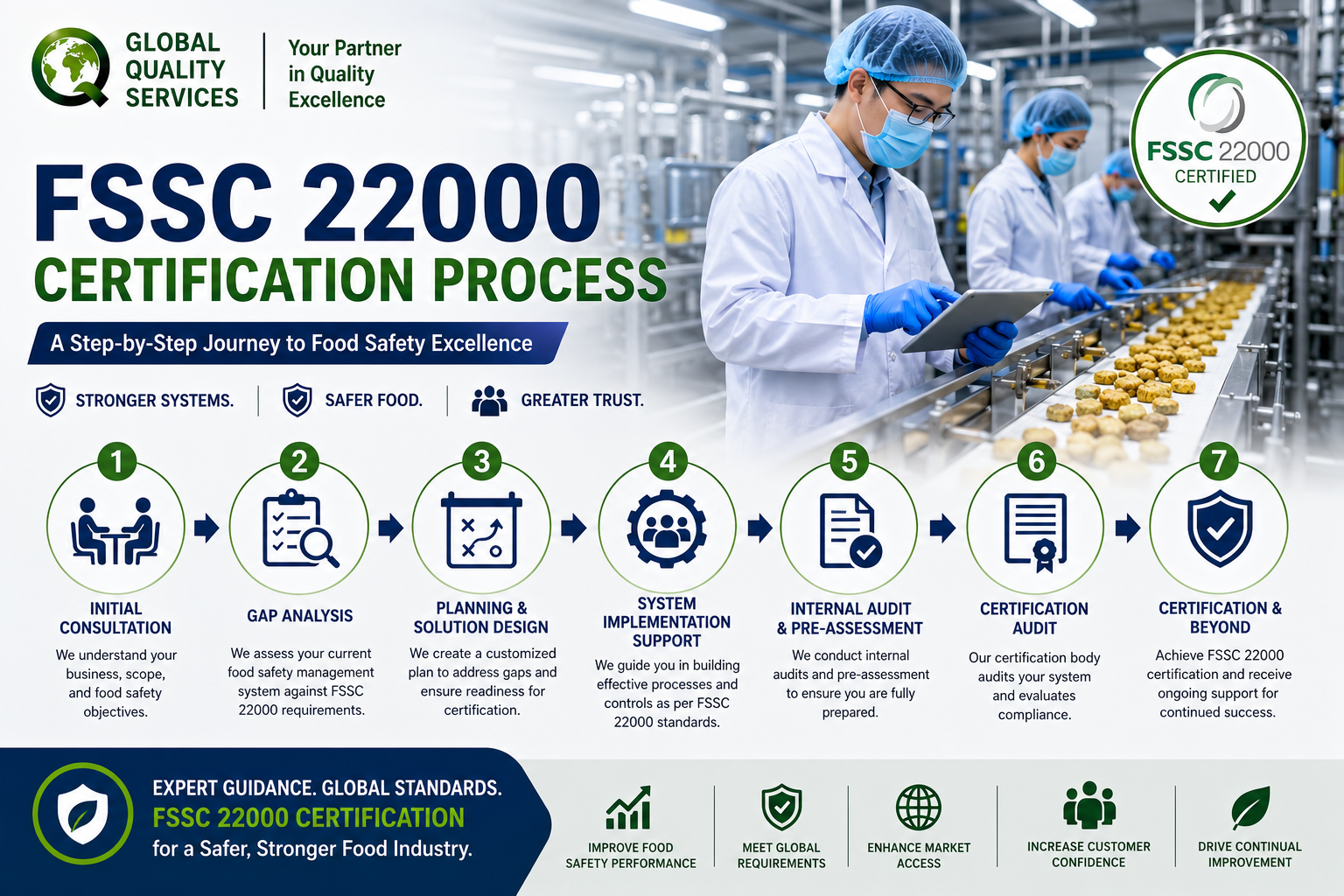
All stages of our process are scoped around the specific environment of JTC Food Hub @ Senoko, including its shared infrastructure, shared cold room, and multi-tenant building context.
Step 1: Scope and category confirmation. We confirm your food chain category, the products and processes within scope, and the applicable ISO 22002 prerequisite program standard for your Senoko operation.
Step 2: Gap assessment. Your current food safety practices, documentation, and controls are reviewed against ISO 22000:2018, ISO 22002-1, and the FSSC 22000 Version 6 Additional Requirements, with specific attention to allergen management, food defense, environmental monitoring, and prerequisite programs as they apply in a shared facility.
Step 3: Food safety management system build. We develop your food safety policy, HACCP plan, prerequisite programs, allergen management plan, food fraud vulnerability assessment, food defense plan, and food safety and quality culture documentation, all scoped to the actual shared-facility environment at Senoko.
Step 4: Implementation and training. Updated systems are embedded in your production operations, and your food safety team is trained on the Version 6 requirements, with particular emphasis on allergen management, shared infrastructure controls, and environmental monitoring.
Step 5: Internal audit and management review. An internal audit is conducted against the full FSSC 22000 Version 6 requirements before the external certification audit begins, with findings addressed and closed.
Step 6: Certification audit support. We coordinate your Stage 1 and Stage 2 certification audits with your chosen accredited certification body and provide technical support through to certificate issuance.
Benefits of FSSC 22000 Certification for Senoko Food Manufacturers
Let us know more about the benefits of FSSC 22000 Certification for Senoko Food Manufacturers:
Alignment With SFA’s Food Safety and Security Act 2025
Singapore’s Food Safety and Security Act 2025 introduces stronger traceability, record-keeping, and documentation obligations for food businesses. FSSC 22000’s documentation and traceability requirements build the systems that satisfy these obligations as part of the same engagement rather than as a separate compliance project.
New Products Ready for Retail and Export From Day One
Every product developed through FoodPlant and scaled up for commercial production needs a certified food safety management system behind it before major retail buyers will list it. FSSC 22000 gives Senoko manufacturers that certification for their new product lines, not after they have already been rejected by a buyer requiring it.
Fast-Track to SFA SAFE Grade A
Under SFA’s SAFE framework, food establishments with a certified food safety management system qualify for the accelerated Grade A pathway. For a Senoko manufacturer whose grade is visible to trade buyers and enterprise clients, this is a direct commercial benefit of the certification.
Documented Allergen Controls That Reflect the Shared Facility
FSSC 22000 Version 6’s allergen management requirements produce an allergen management plan that is scoped to your actual operating environment, including the shared cold room, shared loading dock, and shared building access. That documentation protects you from allergen cross-contamination claims arising from a shared environment rather than your own production line.
GFSI Recognition Across Multiple Export Markets
One FSSC 22000 certificate opens access to buyers in Japan, the European Union, the United States, and Australia simultaneously. For a Senoko SME developing new products through FoodPlant for export, that market breadth from a single certificate is more efficient than meeting each market’s individual food safety scheme separately.
Migration or FSSC 22000 from Version 6 to Version 7
FSSC 22000 Version 7 launched in May 2026, and if your business holds a Version 6 certificate, you will need to move across to the new version within 18 months at your next audit. Here is what that means in plain terms.
- You are not starting over. Version 7 is an update, not a replacement. The core structure of your food safety management system stays the same. What you need to do is fill four specific gaps that Version 7 adds.
- Write a formal allergen management plan. Version 7 makes this a standalone requirement with its own documented plan, validation records, and annual review. If allergen control currently lives inside your HACCP chart or a general food safety procedure, it needs to be separated out and formalized.
- Add a food loss and waste policy with targets. This is a new Version 7 addition. Your business needs a written policy that commits to reducing food loss and waste, with specific, measurable targets attached, not just a general statement of intent.
- Review your food fraud and food defense plans. Both need to be checked and updated in line with the Version 7 guidance. For most smaller food businesses, this is a half-day review rather than a full rewrite.
- Document your food safety culture objectives. This existed in Version 6 as an expectation. Version 7 makes it a formal, auditable requirement with measurable targets set by top management.
The 18-month window sounds generous, but it fills quickly once you account for your audit schedule and the time needed to update documentation and train your team. Global Quality Services manages the full transition process for you, ensuring your Version 7 certificate is in place before your Version 6 certificate lapses.
Why Choose Global Quality Services
Global Quality Services has supported food safety and management system certification projects across Singapore for over two decades. Our FSSC 22000 consultants work directly with your food safety team and understand the specific operating environment of JTC Food Hub @ Senoko, including its shared cold room, shared logistics infrastructure, and multi-tenant building context.
In addition to FSSC 22000 Certification, we also provide guidance for PCQI (Preventive Controls Qualified Individual) Training and Certification to help food manufacturers comply with the U.S. FDA FSMA requirements.
PCQI training equips designated personnel with the knowledge to develop and manage Food Safety Plans, implement preventive controls, and support regulatory compliance for businesses exporting food products to the United States.
We do not apply standalone factory templates to shared-facility environments. Every allergen management plan, food defense assessment, and environmental monitoring program we build for a Senoko manufacturer reflects the actual shared-facility risks of operating at JTC Food Hub @ Senoko rather than assuming a controlled single-tenant environment. Contact Global Quality Services to begin your FSSC 22000 certification at JTC Food Hub @ Senoko.
Frequently Asked Questions
What makes FSSC 22000 certification different for a company at JTC Food Hub @ Senoko compared to a standalone factory?
The shared cold room, shared loading facilities, and multi-tenant building environment at Senoko create allergen cross-contamination, food defense, and environmental monitoring challenges that do not exist in a standalone factory. FSSC 22000 Version 6’s allergen management plan, food defense plan, and environmental monitoring requirements must all be scoped to reflect those shared-facility conditions rather than assuming a single-tenant environment.
Does FSSC 22000 help with SFA’s SAFE framework requirements?
Yes. SFA’s SAFE framework, effective January 2026, allows food establishments with a certified food safety management system to fast-track to Grade A. FSSC 22000 is a GFSI-benchmarked certified food safety management system that satisfies that requirement.
Can a Senoko food manufacturer certify new products developed through FoodPlant under FSSC 22000?
Yes. FSSC 22000 certification covers the food safety management system for your operations, including new products developed and scaled up for commercial production. Buyers who require GFSI certification will accept FSSC 22000 for new product lines produced under your certified system.
What version of FSSC 22000 is currently required?
Version 6 has been mandatory for all organizations seeking FSSC 22000 certification since 1 April 2024. All certification audits are now conducted against Version 6 requirements.
How long does FSSC 22000 certification take for a Senoko SME food manufacturer?
Most food manufacturers at JTC Food Hub @ Senoko complete certification in three to six months, depending on the number of product categories in scope and the current state of existing food safety documentation. Companies with existing HACCP plans or ISO 22000 documentation typically move faster.