
Your company may already have security policies, regular data backups, password rules, and employee training. But are these measures enough to meet ISO 27001:2022 requirements? You may not know the answer until you review your existing information security practices.
This is where an ISO 27001 gap analysis helps. It shows you what your company is doing right, where improvements are needed, and which requirements still need attention before certification.
For example, your IT team may create backups every day, but when was the last time anyone checked whether those backups could be restored? Your company may also have an access control policy, but do you review employee access when someone changes roles or leaves?
These are the kinds of questions a gap analysis helps answer. In this guide, we explain how to conduct an ISO 27001:2022 gap analysis, what to check, and how to use the findings to prepare for certification.
What is an ISO 27001:2022 Gap Analysis
An ISO 27001:2022 gap analysis is a review of your current information security practices against the requirements of ISO/IEC 27001:2022.
The aim is simple: find out what is already in place and what still needs work.
Suppose your company has a policy for reporting security incidents. However, employees are unsure whom to contact when an incident occurs, and the company does not keep proper incident records. The policy exists, but the process may not work as it should. A gap analysis helps you spot this problem and decide how to fix it.
The assessment looks at two main areas:
- Clauses 4 to 10: These cover the main requirements for setting up and managing an Information Security Management System (ISMS).
- Annex A controls: These cover different areas of information security, including employee responsibilities, physical security, supplier management, and technical safeguards.
ISO/IEC 27001:2022 contains 93 Annex A reference controls. Your company does not automatically have to implement all 93. Instead, it must assess its risks, decide which controls are necessary, and record those decisions in its Statement of Applicability (SoA).
A gap analysis helps you understand where your company stands before you invest time and money in certification preparation.
Why Should You Conduct an ISO 27001 Gap Analysis
Starting certification preparation without reviewing your existing systems can lead to unnecessary work. You might spend time creating documents you already have while overlooking weaknesses in the way your team handles information.
A gap analysis helps you:
- Find missing requirements: Identify policies, records, or security measures that need attention.
- Spot weaknesses early: Find problems such as outdated access rights, incomplete backups, or unclear incident reporting procedures.
- Plan your work: Understand which changes are needed and who should handle them.
- Use your budget wisely: Focus on important improvements instead of spending resources on unnecessary changes.
- Prepare for the certification audit: Address known gaps and gather evidence that your processes are working.
It is worth remembering that a gap analysis does not guarantee certification. It gives you a clearer picture of the work ahead.
How to Conduct an ISO 27001:2022 Gap Analysis
You do not need to make the process unnecessarily complicated. Start by understanding your current practices, compare them with the standard, and record what needs to change.
Step 1: Decide What Your ISMS Will Cover
First, decide which parts of your business will be included in the Information Security Management System.
For example, a software company may include its development team, customer database, cloud systems, and employee accounts. A financial services company may need to consider customer records, financial systems, office operations, and third-party service providers.
Ask yourself:
- Which teams handle important or confidential information?
- Which systems store or process this information?
- Which offices or business activities are included?
- Which outside service providers support these activities?
Write down the scope clearly. This gives your team a defined area to assess and helps prevent important business activities from being overlooked.
Step 2: Check What You Already Have
Before creating new documents, review the policies and procedures your company already uses. You may have more in place than you realise. The important thing is to check whether these documents are up to date and whether employees actually follow them.
Start with:
- Information security policy
- ISMS scope document
- Risk assessment records
- Risk treatment plan
- Asset register
- User access records
- Incident reports
- Supplier security records
- Employee training records
- Backup and recovery records
- Internal audit reports
- Management review records
Talk to the employees responsible for these activities, too. A procedure may look good on paper, but the people using it can tell you whether it works in practice.
Step 3: Compare Your Practices With ISO 27001:2022
Now compare what your company does with the requirements of the 2022 standard. Start with Clauses 4 to 10. These cover the organisation’s context, leadership, planning, support, operations, performance reviews, and improvements.
For example, does management support information security? Has the company assessed its security risks? Are responsibilities clear? Does management review how the ISMS is performing? Next, review the Annex A controls that apply to your company’s risks and security needs.
Record each finding as you go. Some requirements may already be addressed, while others may need more work. If something does not apply, document the reason where required.
Step 4: Write Down the Gaps Clearly
Once you identify a problem, describe it in a way that tells your team exactly what needs to be fixed.
Avoid writing something vague, such as “access control needs improvement.” Explain the actual issue instead.
For example:
Current situation: Employees have access to shared folders, but access rights are not reviewed when they change departments.
Problem: Employees may continue to access information they no longer need.
Required action: Set up a process to review access rights and remove unnecessary permissions.
This approach makes the findings easier to understand and act on.
For every gap, record the relevant requirement or control, the evidence you checked, the issue you found, the action needed, and the person responsible for fixing it.
Step 5: Decide Which Gaps Need Attention First
Some gaps need to be addressed sooner than others.
For example, an employee who has left the company but still has access to business systems may pose a more immediate concern than an incomplete training record.
Review each finding based on the risk it creates, the information affected, and the work needed to fix it.
Start with serious security weaknesses and requirements that need attention. Then plan the remaining work around your available time, budget, and staff.
Step 6: Make a Simple Action Plan
Once you know what needs to change, prepare a list of actions.
For each gap, decide what needs to be done, who will do it, and when it should be completed.
Your action plan could include tasks such as updating an access control procedure, creating an asset register, improving incident reporting, or testing data recovery arrangements.
Keep the plan practical. Assigning a task without a clear owner or deadline makes it easier for the work to be delayed.
Step 7: Check Whether the Changes Work
After making the changes, check whether they solve the problems you identified.
If your company introduced a new access review process, look for completed review records. If you improved your backup arrangements, check whether recovery tests show that the data can be restored.
Do not close a gap just because someone has written a new policy. The company should be able to show that the process is being followed and that the necessary evidence is available.
Once the main gaps have been addressed, you can continue preparing the ISMS for internal audits, management review, and the certification audit.
Which ISO 27001:2022 Requirements Should You Check
Your gap analysis should cover the main requirements of the standard and the Annex A controls relevant to your business.
Clauses 4 to 10
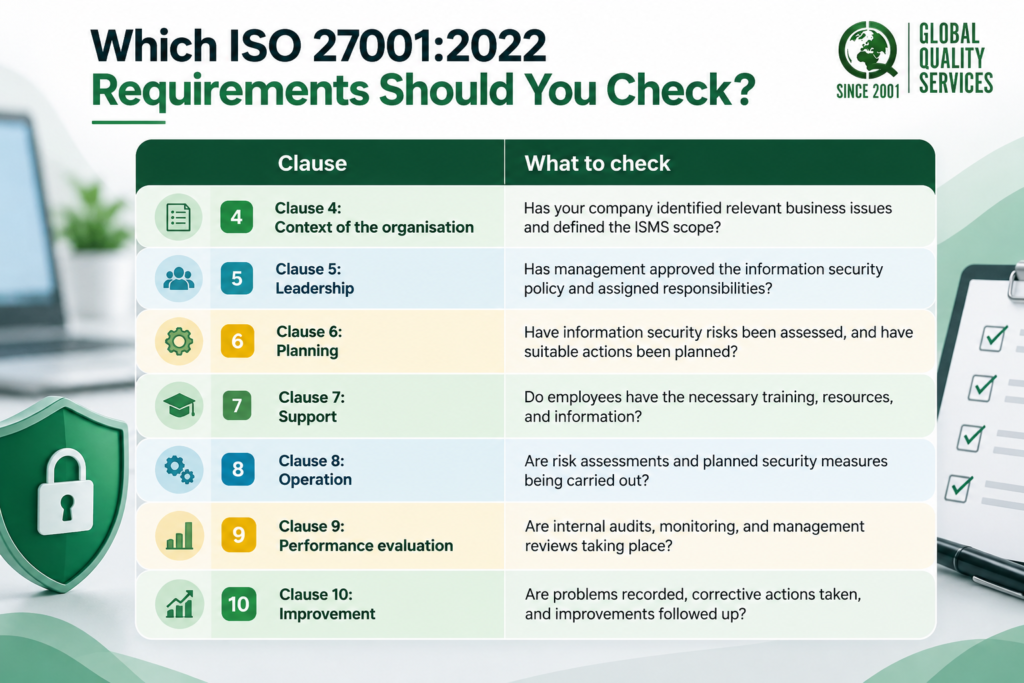
These requirements help you check whether information security is managed properly across the business, rather than being left entirely to the IT team.
Annex A Controls
Annex A contains 93 reference controls grouped into four areas.
- Organisational controls: Policies, security responsibilities, supplier relationships, and information security processes.
- People controls: Employee awareness, responsibilities, and security practices.
- Physical controls: Protection of offices, equipment, and physical records.
- Technological controls: Passwords, access permissions, backups, system monitoring, and vulnerability management.
Consider a simple example. Your company may have strong password rules but no clear process for removing access when an employee leaves. Another company may manage access properly but fail to test its backups.
Both organisations may need improvements, but their findings will be different because their risks and existing practices are different.
That is why Annex A should be assessed in the context of your organisation. The controls you select must be supported by your risk assessment and documented in your Statement of Applicability.
ISO 27001:2022 Gap Analysis Checklist
Use this checklist for an initial review of your information security practices. A complete gap analysis will need to examine the relevant requirements and applicable controls in more detail.
- ISMS scope: Clearly defined business activities and systems.
- Security policies: Updated policies and procedures.
- Risk assessment: Identified information security risks.
- Access control: Restricted access to authorised users.
- Asset management: A list of important information assets.
- Employee awareness: Security training for employees.
- Incident management: A process for reporting security incidents.
- Supplier security: Checks on relevant suppliers.
- Data backup: Regular backups and recovery testing.
- Security controls: Applicable Annex A controls implemented.
- Internal audits: Regular checks of the ISMS.
- Corrective actions: A process for fixing identified gaps.
What Should an ISO 27001:2022 Gap Analysis Report Include
After completing the assessment, prepare a report that explains what you checked, what you found, and what needs to happen next. Your report should include:
- Scope: The departments, systems, and business activities reviewed.
- Assessment results: The requirements and applicable controls you checked.
- Identified gaps: A clear description of each issue.
- Supporting evidence: The documents, records, or observations behind each finding.
- Priority: Which gaps need attention first and why.
- Corrective actions: What needs to change.
- Responsibilities and deadlines: Who will complete each task and by when.
- Follow-up: How you will check that the changes have worked.
For example, the report might identify that access rights are not reviewed after employee role changes. The action plan could require the IT team to introduce a review process, involve department managers, and retain records of completed reviews.
A good report should help the team get on with the work. It should not simply list problems without explaining how to address them.
Common Mistakes to Avoid During an ISO 27001:2022 Gap Analysis
A gap analysis can miss important issues when the team focuses on documents instead of actual practices.
Watch out for these common mistakes:
- Using an outdated checklist: Make sure your assessment follows ISO/IEC 27001:2022.
- Assuming a policy is enough: Check whether employees follow the procedure and whether records support it.
- Trying to implement every Annex A control automatically: Assess which controls are necessary for your risks and document your decisions.
- Writing unclear findings: Explain what is missing instead of using broad statements.
- Ignoring high-risk issues: Give priority to weaknesses that could seriously affect business information.
- Leaving tasks without owners: Assign responsibility and realistic deadlines.
- Closing gaps too early: Check the evidence before marking an action complete.
A little care during the assessment can save time later and help your team focus on the changes that matter.
What Happens After an ISO 27001:2022 Gap Analysis
Completing the gap analysis is the starting point, not the end of the certification process. Once you have reviewed the findings, the next steps usually include:
- Address the gaps identified in the report.
- Update the required policies, procedures, and records.
- Complete the risk assessment and risk treatment activities.
- Implement the applicable security controls.
- Document control decisions in the Statement of Applicability.
- Train employees on the processes they need to follow.
- Conduct an internal audit.
- Hold a management review and deal with outstanding issues.
- Prepare for the certification audit.
How Global Quality Services Helps With ISO 27001:2022 Gap Analysis
Global Quality Services (GQS) helps organisations review their existing information security practices and prepare for ISO 27001:2022 certification.
- Gap analysis: Review current practices and identify areas that need attention.
- Documentation support: Help prepare or update the policies, procedures, and records required for the ISMS.
- Risk assessment guidance: Help identify information security risks and plan suitable treatment measures.
- Implementation support: Guide your team through the changes needed to put applicable controls into practice.
- Internal audit preparation: Help review the ISMS and identify remaining issues before the certification audit.
- Certification preparation: Support your team as it prepares the required documents and evidence for the independent audit.
GQS brings 26 years of experience to certification consultancy, helping businesses plan their work according to their existing systems and requirements.
Get Help With ISO 27001:2022 Certification Preparation
Find out where your information security practices need improvement and plan your next steps with Global Quality Services. Contact GQS to discuss your ISO 27001:2022 gap analysis and consultancy requirements.
Frequently Asked Questions
1. What is the purpose of an ISO 27001:2022 gap analysis?
It helps you compare your current information security practices with the 2022 standard. You can identify missing requirements, find weaknesses in existing processes, and decide what needs to change before certification.
2. How long does an ISO 27001:2022 gap analysis take?
It depends on the size of your company, the number of systems and locations involved, and how well your existing documents and processes are maintained. A smaller, well-organised business may need less time than a company with several sites and complex systems.
3. Is a gap analysis mandatory for ISO 27001:2022 certification?
The standard does not require a separate activity specifically called a gap analysis. However, it is a useful way to understand your current position and plan the work needed to establish a conforming ISMS.
4. How many controls are included in ISO 27001:2022?
The standard includes 93 Annex A reference controls across organisational, people, physical, and technological areas. Organisations assess which controls are necessary based on their risks and document the relevant decisions in the Statement of Applicability.
5. Can we conduct an ISO 27001:2022 gap analysis ourselves?
Yes. Your team can conduct the assessment if it understands the standard and can review the necessary documents, systems, and processes. External consultancy can help if you need guidance or do not have enough in-house experience.