
Facility management entails far more than just keeping buildings clean and maintaining equipment. It encompasses maintenance scheduling, space optimization, contractor management, occupational safety, energy consumption, and the overall quality of services offered to tenants. In the absence of such processes within a coherent system, organizations may encounter a series of problems ranging from frequent maintenance, increasing operational costs, ambiguous accountabilities, and poor service quality.
Certification according to ISO 41001 enables organizations to organize their operations around a coherent Facility Management System (FMS). It offers a standard methodology for aligning the provision of facility services to organizational objectives, managing operational risks, and monitoring performance. Moreover, organizations specializing in facility management, property ownership, and managing extensive properties benefit significantly from demonstrating their approach to facility management to customers and stakeholders.
This article highlights ten advantages of gaining ISO 41001 certification, illustrates their practical application within facility management practices, and considers factors worth pondering prior to embarking on certification.
What is ISO 41001 Certification
ISO 41001 is the international standard for Facility Management Systems. Published in 2018, the standard sets out the criteria that organizations must follow to achieve efficient and effective facility management practices, comply with relevant requirements, and operate sustainably.
This standard applies to any organization of any size and sector, whether the organization has internal facility management processes or provides services externally. This includes managing the organization’s facility management processes using a management system.
An organization seeking ISO 41001 certification undergoes an audit of its Facility Management System by the certification body. This audit verifies whether the organization meets all criteria specified within the standard.
Within Singapore, national adoption occurs via SS ISO 41001:2024, which implements ISO 41001:2018. Additionally, the Singapore Accreditation Council launched an accreditation scheme for facility management certification on 23 November 2023. Organizations must ensure that their chosen certification body has been accredited before proceeding with certification.
10 Key Benefits of ISO 41001 Certification for Facility Management
Achieving ISO 41001 certification will help organizations enhance their maintenance planning process, supplier management process, operational risk control process, and service measurement process. Below are explanations of how adopting this framework can benefit facility management outcomes.
1. Improves Facility Management Efficiency
Facility management teams often run several processes at once. These include maintenance requests, scheduling, inspections, security protocols, and contractor appointments. Without adequate processes, facility managers risk duplication of work and spending resources solving issues that shouldn’t arise.
ISO 41001 encourages organizations to set up clear roles and responsibilities, process definitions, and performance monitoring. Facility management teams know whose job it is to do something, how they should carry out tasks, and when there are signs of trouble.
For instance, think of an operator working in a commercial facility. With ISO 41001 compliance, they will establish a streamlined process for handling maintenance requests, assigning work to technicians, following up on completion, and tackling outstanding issues.
2. Helps Control Facility Operating Costs
Budgets allocated toward facility management are susceptible to pressures due to expenses associated with maintenance activities, unexpected repairs, utilities, subcontractor fees, and the replacement of aging assets. Under-preparedness almost always tends to magnify any doubts surrounding such spending.
ISO 41001 promotes the assessment of organizational practices regarding resource allocation, service coordination, vendor management, and operational efficiency evaluations. These evaluations may point towards recurring expenditures, inefficient contracts, and neglected preventative maintenance practices.
For example, a facility management department that keeps finding itself paying for urgent AC repairs will be motivated to review their records and develop a better preventative maintenance schedule.
Certification does not guarantee savings of specific amounts within your budget either. Results will differ according to pre-existing conditions, implementation efficacy, and routine assessments performed by organizations adopting this standard.
3. Strengthens Maintenance Planning and Asset Management
Equipment failure at inconvenient times causes interruptions and costly repairs. There are lift maintenance, HVAC servicing, electrical maintenance, pump servicing, and fire safety maintenance that need proper planning.
ISO 41001 helps facilities managers develop a planned process around their services. You could delegate maintenance duties, schedule maintenance activities, store documentation of the job done, and ensure compliance.
Take a hospital or office block with many important mechanical systems, for example. A maintenance plan will help the facility services staff keep tabs on scheduled maintenance activities, notice any overdue jobs, and arrange contractors before there’s a problem in operations.
ISO 41001 doesn’t replace existing equipment manuals or legislation around inspection. It only acts as a structure for overseeing the whole maintenance process.
4. Improves Workplace Safety and Occupant Well-Being
Poorly maintained facilities can expose employees, visitors, contractors, and other occupants to avoidable risks. Examples include damaged flooring, faulty lighting, blocked emergency exits, inadequate ventilation, and poorly controlled maintenance work.
ISO 41001 encourages organisations to identify facility-related risks, assign responsibilities, and review whether their controls work as intended. These practices help facility teams address problems systematically rather than relying only on complaints or emergency responses.
A building operator, for example, can establish a process for recording safety concerns, assigning corrective actions, and verifying that the issue has been resolved.
The standard supports a more organised approach to facility-related safety and well-being. It does not, by itself, establish compliance with every applicable workplace safety or fire safety law.
5. Creates Clearer Control Over Contractors and Suppliers
Organisations often subcontract cleaners, guards, gardeners, exterminators, machinery repairers, and other facility service roles. It becomes hard work coordinating multiple service providers, especially if each contractor operates using its own methods or measures success in unique ways.
ISO 41001 recommends setting clear terms of reference for services, assigning accountability, evaluating vendor performance, and solving issues systematically using processes. For instance, a facilities management firm may develop criteria for cleanliness, examine findings from audits, document grievances, and implement solutions. In doing so, it has a systematic approach to determining the degree to which vendors deliver contracted services according to specifications.
Supplier oversight could prove useful in identifying trends in poor service delivery, helping management make sound judgment calls regarding contracts and improvements.
6. Supports Regulatory and Contractual Compliance
Facility management processes might include responsibilities pertaining to fire safety, maintenance, occupational health and safety, environmental management, and equipment inspection, among other considerations. Precise responsibilities will vary according to location, usage, and offerings of individual facilities.
ISO 41001 offers guidance regarding how organizations should determine requirements, delegate accountability, document information, and evaluate progress toward objectives.
In the case of an organization operating multiple sites, this framework allows management to ensure that there is consistency across inspections, maintenance, and compliance activities at each location.
7. Helps Organisations Manage Operational Risks
Facility management risks impact business continuity, service delivery, cost efficiency, and occupant safety. Risks include equipment failures, contractor delays, insufficient maintenance, resource scarcity, and emergencies – among others.
ISO 41001 prompts organizations to consider risks and opportunities associated with their FM processes. These are evaluated for their impacts, and appropriate actions are planned.
Consider how a data center facility management team might recognize the risk of cooling system failure. Appropriate controls will be put in place, including escalation plans and contingencies.
Risk assessment prevents unnecessary exposure when conducted proactively prior to disruption. It leads to sound operational planning decisions.
8. Improves Resource Use and Supports Sustainability
Buildings require energy, water, materials, and other resources. Poorly managed building operations will drive up expenditures unnecessarily without delivering value.
A Facility Management System using the ISO 41001 standard allows organizations to evaluate the effectiveness of facility service delivery towards organizational goals and sustainable development considerations. Organizations can track performance metrics, assess existing service agreements, and find ways to optimize resource utilization better.
For instance, a commercial building manager can assess ongoing maintenance needs, lighting patterns, cooling demands, and any associated water challenges.
It’s important to note that ISO 41001 doesn’t prescribe fixed percentages for energy or water savings. Each organization needs to set appropriate benchmarks according to its unique facility requirements and sustainability priorities.
9. Strengthens Client Confidence and Tender Readiness
Facility management clients want assurance that service providers can deliver property management services consistently, comply with contractual obligations, and implement proper controls during operations.
ISO 41001 certification offers third-party verification of a facility management system’s compliance with an internationally recognized standard. Certification may serve as proof during negotiations with potential clients and improve a company’s reputation when discussing its organizational structure.
However, obtaining certification will not automatically secure the award of a tender or customer contract if it requires compliance with ISO 41001. Organizations must still satisfy any other technical, financial, or qualification criteria set out by the client.
10. Establishes a Basis for Continual Improvement
Facility performance can change as buildings age, occupancy patterns shift, service contracts change, and business needs develop. A system that worked well several years ago may no longer deliver the required results.
ISO 41001 encourages organisations to monitor performance, review problems, investigate their causes, and implement corrective actions. Internal audits and management reviews help decision-makers assess whether the Facility Management System remains suitable and effective.
For example, if maintenance response times repeatedly miss agreed targets, management can examine staffing levels, spare-parts availability, contractor performance, and work allocation before deciding on corrective action.
This creates a repeatable method for improving facility services rather than treating each problem as an isolated incident.
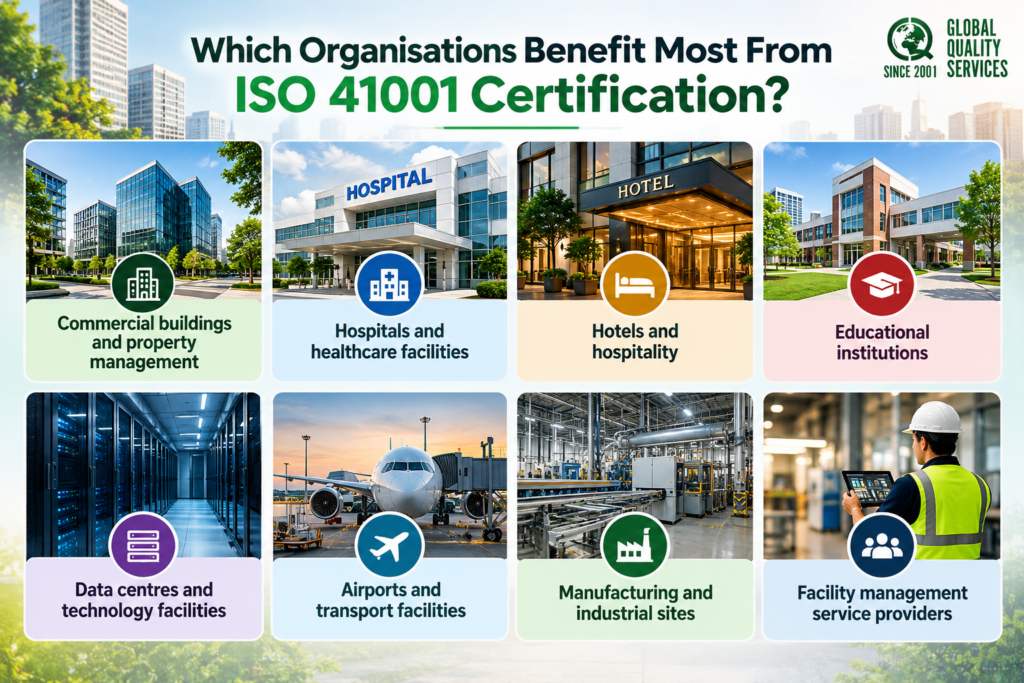
Which Organisations Benefit Most From ISO 41001 Certification
ISO 41001 is suitable for public and private organisations across different sectors. Its value is particularly relevant where facility services involve several teams, multiple sites, external contractors, or critical building infrastructure:
Get ISO 41001 Certification Support From Global Quality Services
The successful adoption of an FMS needs insight into how your business works, what its current controls look like, and what is needed for certification. That’s where Global Quality Services steps in, helping firms get ready for ISO certification with their management system implementations.
Our support can include:
- Conducting a gap analysis of current FM processes based on the ISO 41001 standard.
- Developing or refining process documentation and assigning roles and responsibilities.
- Performing risk assessments, monitoring performance, and preparing for internal audits.
- Taking action to correct issues and preparing for management reviews prior to certification audits.
- Implementation consulting and certification readiness assistance.
Contact Global Quality Services today for expert guidance on ISO 41001 certification and facility management system implementation.
Frequently Asked Questions
1. What are the key purposes of the ISO 41001 standard?
The key purposes of ISO 41001 certification include demonstrating the effectiveness of your FM system in accordance with the standard. This means being able to deliver services systematically while satisfying the relevant requirements, managing risks, and achieving improved performance through continuous improvement processes.
2. Is ISO 41001 certification compulsory in Singapore?
The ISO 41001 standard is not a mandated requirement across all industries in Singapore. That said, you may come across cases where the client or tender document demands this particular certification. Make sure to review any applicable procurement requirements or industry obligations before pursuing ISO 41001 certification.
3. In what ways does ISO 41001 lead to cost savings in facilities management?
By highlighting inefficient practices, improving maintenance scheduling, tracking subcontractor performance, and better managing resource allocation, ISO 41001 may be able to eliminate unnecessary expenditures. However, how much money will be saved will vary based on each company’s unique circumstances.
4. How does ISO 41001 compare to ISO 9001?
Whereas ISO 41001 deals specifically with facility service management, ISO 9001 addresses the broader topic of quality management within an organization’s product offerings and service delivery processes.
5. What services does an ISO 41001 consultant provide?
An ISO 41001 consultant evaluates current procedures, identifies deficiencies, documents and implements new standards, trains staff members, and assists with conducting internal audits. Our consultancy at Global Quality Services helps you get ready for certification.