
Penang’s electronics manufacturing sector continues to attract significant investment. According to the Malaysian Investment Development Authority (MIDA), the state’s Electrical and Electronics (E&E) cluster secured RM11.3 billion in approved investments across 83 projects in 2025, with foreign investors accounting for 78% of the investment. This activity reflects the importance of Penang’s manufacturing ecosystem in international technology supply chains.
For manufacturers and exporters operating in Bayan Lepas Free Industrial Zone, maintaining shipment quality is an important part of meeting buyer specifications and delivery commitments. Electronic assemblies, semiconductor-related components, precision parts, and finished equipment may pass through several production and packing stages before dispatch. A discrepancy in product configuration, quantity, labeling or protective packaging can create problems after goods leave the factory.
Global Quality Services provides third-party pre-shipment inspection in Bayan Lepas Free Industrial Zone, Malaysia, to help buyers and suppliers assess finished goods before shipment. The inspection can cover product specifications, workmanship, quantities, packaging, labels, and supporting documents against agreed requirements.
Why Pre-Shipment Inspection Matters for Manufacturers in Bayan Lepas
Pre-shipment inspection gives buyers an opportunity to review a completed order before it is dispatched. In an electronics manufacturing environment, the inspection needs to consider more than the external appearance of a finished product.
A shipment may contain several models, revisions, component configurations, or production batches. Even when the products look similar, incorrect part numbers, missing accessories, or inconsistent labeling can affect receiving, inventory control, and downstream assembly.
For businesses in Bayan Lepas, inspection can be planned around the characteristics of the order, including:
- Model and revision control: Confirming that the products match the approved model numbers, specifications, and revision details.
- Production-lot consistency: Checking whether sampled units show consistent workmanship and product characteristics.
- Component and accessory verification: Comparing included parts, cables, connectors, manuals and other accessories with the purchase order.
- Identification and traceability: Reviewing serial numbers, batch codes, date codes and product labels where applicable.
- Packaging suitability: Checking protective materials, carton condition, internal arrangement and shipping marks.
- Shipment documentation: Comparing available packing lists, product details and inspection records with the agreed order information.
These checks help identify discrepancies while the goods are still accessible at the supplier’s premises.
What Does Pre-Shipment Inspection Cover?
The inspection scope is developed around the product type, purchase order and buyer’s acceptance requirements. For Bayan Lepas manufacturers, this may include electronic products, electrical assemblies, industrial components, precision-engineered parts and finished equipment.
Product Identification and Specification Verification
Inspectors compare product details with the approved specifications, drawings, purchase order or reference samples provided by the client. Checks may include model numbers, product descriptions, ratings, dimensions, configurations and visible identification markings.
Where products have multiple revisions or variants, the inspection can verify whether the sampled units correspond to the correct order requirements.
Workmanship and Physical Condition
A visual examination helps identify defects that may affect product appearance, assembly or usability. Depending on the product, this can include:
- Scratches, dents, cracks or damaged surfaces.
- Loose fittings, incomplete assembly or visible misalignment.
- Connector, port and housing damage.
- Missing fasteners, covers or protective components.
- Inconsistent finishing or visible contamination.
The inspection findings are recorded against the agreed acceptance criteria.
Functional and Basic Operational Checks
Where the product and inspection arrangement permit, selected units can undergo basic functional checks. These may include power-on verification, display operation, button response, indicator status, connectivity or other specified functions.
The buyer should define the test method and acceptance criteria before inspection. Specialized semiconductor testing, laboratory analysis, electrical safety certification and detailed performance validation are separate activities unless specifically arranged within an appropriate technical scope.
Quantity, Batch and Serial Number Verification
Incorrect quantities or mixed product variants can create receiving and inventory issues. Inspectors can compare the available goods with the purchase order and packing list, count cartons and units, and check selected serial numbers or batch identifiers.
For orders containing several models, the inspection can also verify whether the product quantities are allocated to the correct carton or shipment group.
Packaging, ESD Protection and Shipping Marks
Packaging deserves particular attention when shipments contain electronic components or sensitive assemblies. The inspection can review the use and condition of specified protective materials, including antistatic bags, cushioning, separators and moisture-barrier packaging where required by the buyer.
Other checks may include carton strength and condition, sealing, internal arrangement, palletization, shipping marks, handling labels and destination details. A visual inspection does not independently validate ESD protection performance or moisture-barrier effectiveness; these require suitable technical testing where necessary.
Export Documents and Accessories
The inspection can compare the available packing list, product labels, carton markings, quantities and accessory records with the purchase order or other agreed references. Any missing manuals, cables, adapters, certificates supplied by the manufacturer or other specified items can be recorded.
This review helps identify documentation or packing discrepancies before the shipment is released.
AQL Sampling and ISO 2859-1:2026 for Shipment Inspection
Acceptance Quality Limit (AQL) sampling provides a structured method for selecting units from a production lot for inspection. Rather than examining every product, the inspector checks a defined sample and compares the findings with agreed acceptance and rejection criteria.
The current ISO 2859-1:2026 is the third edition of the standard for sampling schemes indexed by AQL for lot-by-lot inspection. Published in January 2026, it introduces skip-lot sampling procedures and updated guidance on applying sampling strategies.
For a Bayan Lepas shipment, the buyer and supplier should agree on the following before inspection:
- Inspection level and sample size.
- AQL values for critical, major and minor defects, where applicable.
- Defect classification and acceptance criteria.
- Product specifications and approved reference samples.
- Functional checks and packaging requirements.
- Conditions for accepting, rejecting or reworking the lot.
AQL sampling is not a guarantee that the entire shipment is defect-free. It is a sample-based acceptance method, and the inspection report reflects the units and checks covered during the inspection.
Benefits of Third-Party Pre-Shipment Inspection in Bayan Lepas
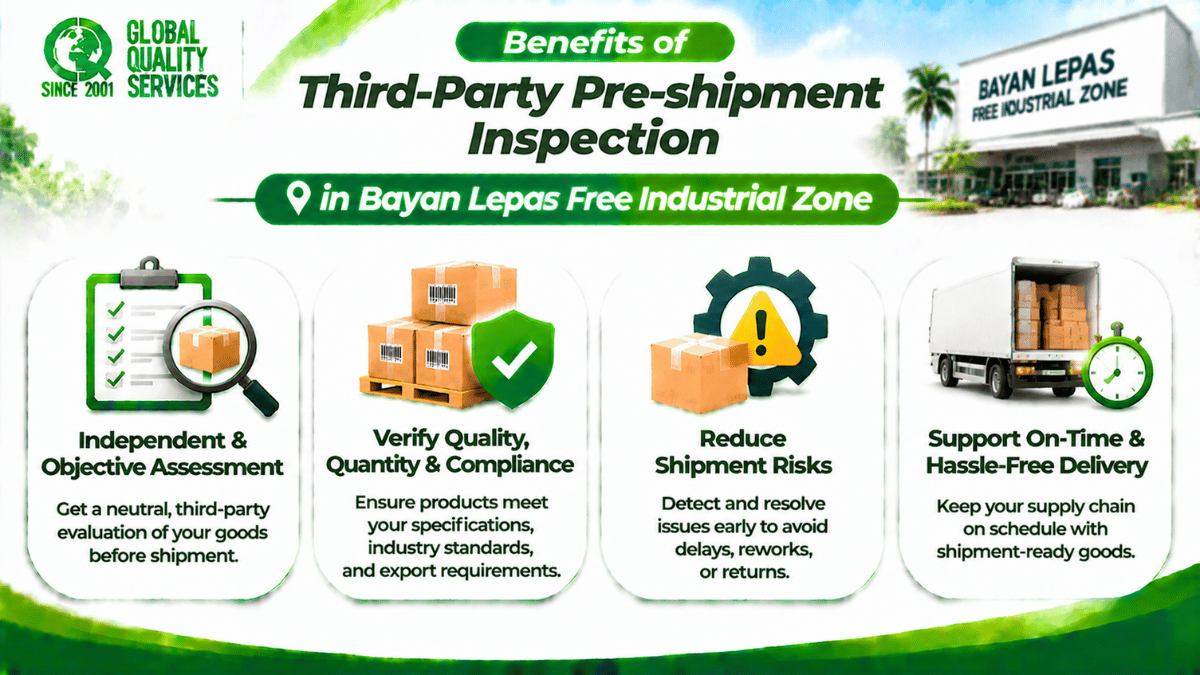
An independent inspection provides buyers with a documented view of the shipment before it leaves the supplier’s facility. It also gives suppliers an opportunity to address identified discrepancies before dispatch.
Identify Order Discrepancies Before Dispatch
Inspection can reveal incorrect models, missing accessories, quantity differences, visible defects and packaging problems while corrective action is still possible.
Improve Shipment Traceability
Checking batch codes, serial numbers, product labels and carton markings helps buyers maintain clearer records of the goods being dispatched.
Review Packaging for Transit Requirements
A review of protective materials, carton condition, internal arrangement and shipping marks helps identify visible packaging weaknesses that could affect handling and transportation.
Support Buyer-Supplier Communication
A third-party inspection report records observations against agreed requirements. Buyers and suppliers can use the findings to discuss corrective action, rework or further verification before shipment.
Make Shipment Decisions With Better Information
Documented inspection findings give purchasing and quality teams additional information when deciding whether the inspected lot meets the agreed acceptance criteria.
Our Pre-Shipment Inspection Process in Bayan Lepas
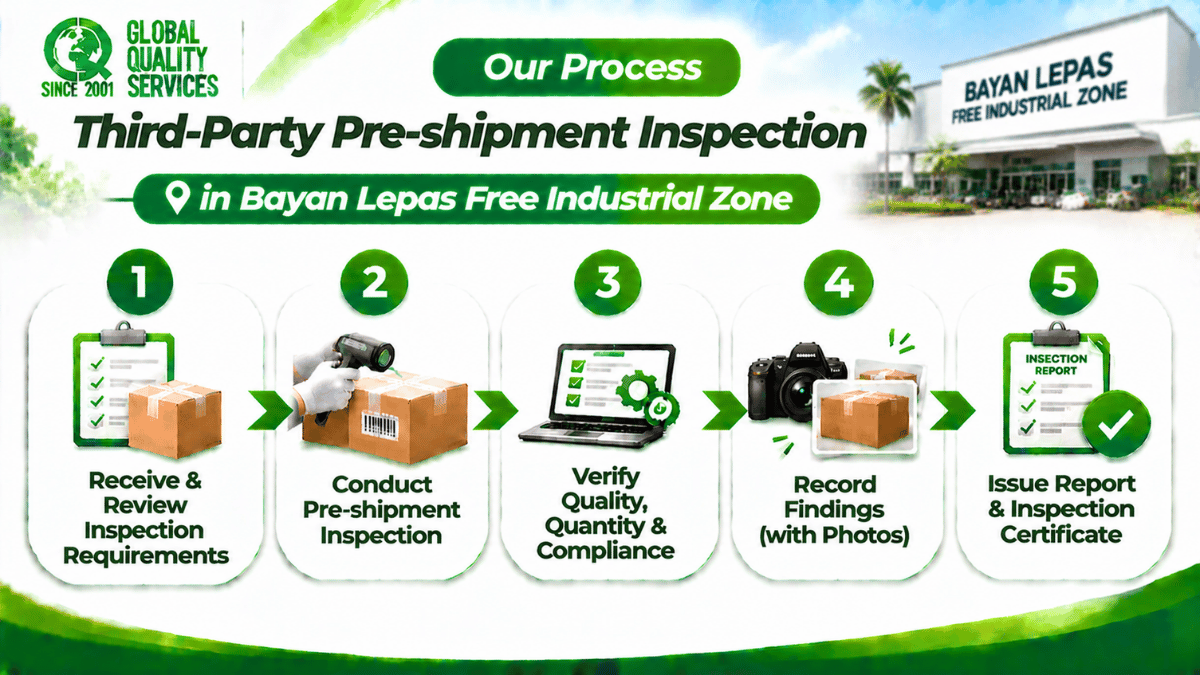
Global Quality Services follows a planned inspection approach based on the product, order size and buyer’s requirements.
1. Review of Order and Inspection Requirements
The process begins with reviewing the purchase order, product specifications, drawings, approved samples, packing requirements and inspection checklist. The buyer’s defect classification and AQL requirements are also confirmed where sampling is required.
2. Inspection Planning and Scheduling
The inspection is scheduled when the goods are sufficiently complete and available for examination. The inspection plan identifies the product batches, sampling requirements, checks to be performed and documents needed at the supplier’s facility.
3. Physical Inspection and Sampling
Inspectors examine the available products and select samples according to the agreed inspection plan. Product identity, quantity, workmanship, visible condition, accessories and specified functional characteristics are checked.
4. Packaging and Documentation Review
The inspection includes the agreed packaging and labeling checks. Carton markings, protective materials, packing quantities and available shipment documents are compared with the buyer’s requirements.
5. Inspection Report and Findings
The findings are compiled into an inspection report, including observations, identified defects and relevant inspection records. The report gives the buyer a basis for reviewing the shipment and discussing any corrective action with the supplier.
Why Choose Global Quality Services?
Global Quality Services provides independent third-party inspection services for buyers, manufacturers and suppliers involved in international trade. The inspection scope is planned around the products being shipped and the requirements agreed between the parties.
For businesses in Bayan Lepas, the service can be arranged for electronics, electrical products, precision components, industrial equipment and other manufactured goods. Inspection findings are documented so that clients can review product condition, shipment quantities, packaging and identified non-conformities before dispatch.
The inspection is independent of the supplier’s internal quality checks. It does not replace product certification, laboratory testing, statutory approvals or specialized technical validation.
Frequently Asked Questions
1. When should pre-shipment inspection be arranged in Bayan Lepas?
Inspection is generally scheduled when production is substantially complete and the goods are available for examination. The buyer may specify that a certain proportion of the order must be completed or packed before inspection. The exact timing should be agreed with the supplier and inspection provider.
2. Can pre-shipment inspection cover electronic components and assemblies?
Yes. The scope can include product identification, visible workmanship, configuration, quantity, labeling, accessories and specified basic functional checks for electronic products and assemblies. Specialized semiconductor testing or laboratory analysis requires separate technical arrangements.
3. Does pre-shipment inspection include ESD packaging verification?
The inspection can review the presence, condition and use of specified ESD packaging materials, such as antistatic bags and protective packaging. It does not automatically establish that the materials meet ESD performance requirements. Technical testing is needed for that purpose.
4. Is AQL sampling suitable for mixed-model shipments?
AQL sampling can be planned for mixed-model orders, but the inspection plan should clearly identify each product type, lot and quantity. Separate sampling arrangements may be necessary where products have different specifications or acceptance criteria.
5. Does a pre-shipment inspection report guarantee that the entire shipment is defect-free?
No. The report records the results of the inspection performed within the agreed scope. Where sampling is used, only selected units are examined. The report provides information about the inspected goods but cannot guarantee that every item is free from defects.