Malaysia’s food manufacturing industry continues to expand, creating more opportunities for businesses that can meet international food safety expectations. Food manufacturers, beverage producers, packaging companies, and ingredient suppliers must maintain strict controls to protect consumers and build buyer confidence. According to the Department of Statistics Malaysia, food processing recorded 9.1% growth in 2025, compared with 4.7% in 2024. This growth highlights the importance of maintaining strong food safety practices across the industry.
FSSC 22000 certification helps Malaysian businesses manage food safety risks, meet customer expectations, and access international supply chains. However, certification requires more than maintaining basic hygiene practices. Your business needs a food safety management system that meets the scheme requirements.
Global Quality Services provides FSSC 22000 certification consultancy in Malaysia to help your organization prepare for certification with the right guidance. Explore our services and see how we can support your certification goals.
What is FSSC 22000 Certification
FSSC 22000 (Food Safety System Certification 22000) is an internationally recognized food safety certification scheme. It helps businesses manage food safety risks and maintain consistent controls across their operations. The scheme combines three main elements:
- ISO 22000 requirements for food safety management systems.
- Relevant ISO 22002 series requirements for industry-specific prerequisite programs.
- Additional FSSC 22000 requirements that address specific food safety risks and operational controls.
The Foundation FSSC manages the scheme, and the Global Food Safety Initiative (GFSI) recognizes it. This recognition makes FSSC 22000 relevant to businesses that supply international retailers, food brands, and major supply chains.
Why Do Malaysian Food Businesses Need FSSC 22000 Certification?
Food safety directly affects customer confidence, product quality, and business reputation. Poor handling, contamination, and weak supplier controls can lead to product recalls and financial losses. FSSC 22000 certification helps businesses address these risks and improve their food safety practices. Key benefits include:
- Better food safety controls: Identify and manage biological, chemical, and physical hazards.
- Greater market opportunities: Meet the food safety expectations of international buyers and retailers.
- Stronger customer confidence: Demonstrate your commitment to recognized food safety standards.
- Lower operational risks: Improve controls for contamination, allergens, and food fraud.
- Better supplier management: Set clear food safety expectations for suppliers.
- Improved regulatory compliance: Support compliance with relevant Malaysian food safety laws and customer requirements.
- Consistent operations: Establish clear procedures for food handling, production, storage, and distribution.
Which Industries in Malaysia Benefit from FSSC 22000 Certification?
FSSC 22000 covers several food chain activities. Businesses must check their eligibility and applicable certification category before applying. The following industries can benefit from FSSC 22000 consultancy:
- Food manufacturing
- Beverage manufacturing
- Dairy processing
- Meat and poultry processing
- Seafood processing
- Food packaging
- Ingredient manufacturing
- Food storage and distribution
- Catering and food services
Key Requirements for FSSC 22000 Certification in Malaysia
Your business must meet the applicable FSSC 22000 requirements before it can obtain certification. These requirements cover food safety management, production controls, employee practices, and risk management. The main requirements include:
1. Food Safety Management System
Establish food safety policies, procedures, objectives, and responsibilities across your organization.
2. Hazard Analysis and Critical Control Points (HACCP)
Identify potential food safety hazards, assess their risks, and establish suitable control measures throughout production and handling.
3. Prerequisite Programs (PRPs)
Maintain proper hygiene and working conditions through cleaning, pest control, equipment maintenance, waste management, and employee hygiene practices.
4. Food Defense and Food Fraud Prevention
Identify risks related to intentional product contamination and food fraud. Establish suitable controls to protect your products and supply chain.
5. Allergen Management
Identify allergens and prevent cross-contact, incorrect labeling, and unintended allergen exposure.
6. Traceability and Product Recall
Maintain records that help your team track raw materials, ingredients, packaging, and finished products. Establish clear procedures for product withdrawal and recall.
7. Food Safety Culture and Employee Awareness
Train employees to understand their food safety responsibilities and follow the required practices during daily operations.
8. Environmental Monitoring and Quality Control
Monitor relevant production areas and apply suitable testing methods to identify contamination risks.
How to Get FSSC 22000 Certification in Malaysia
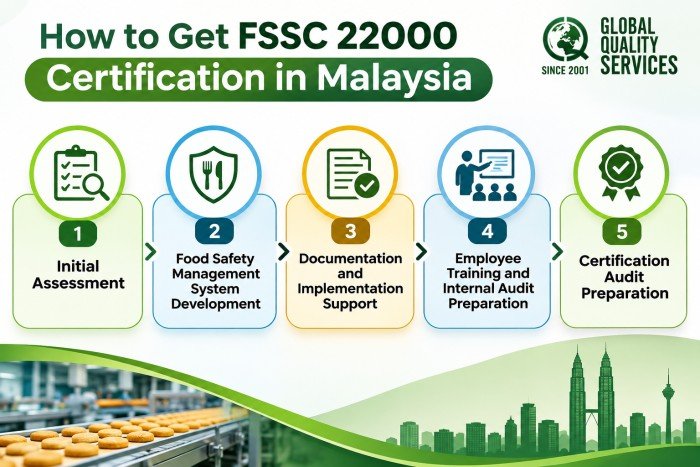
Global Quality Services helps Malaysian businesses prepare their food safety management systems for certification. Our consultants follow five key steps to guide your organization through the preparation process:
1. Initial Assessment
We review your existing food safety practices, operational controls, and documentation. Our consultants identify gaps against the applicable FSSC 22000 requirements and highlight areas that need improvement.
2. Food Safety Management System Development
We help your team prepare food safety policies, procedures, HACCP plans, and operational controls that match your business activities.
3. Documentation and Implementation Support
Our consultants guide your team in maintaining records, managing suppliers, improving traceability, and applying food safety controls across relevant departments.
4. Employee Training and Internal Audit Preparation
We help employees understand their responsibilities and prepare your team for internal audits. We also guide your staff in identifying nonconformities and maintaining the required records.
5. Certification Audit Preparation
We review your system’s readiness, help your team address gaps, and prepare your organization for the external certification audit. An independent certification body conducts the audit and makes the certification decision.
How Global Quality Services Experts Help You with FSSC 22000 Certification Services in Malaysia
Global Quality Services is a reputed consultant with 26 years of management consultancy experience. We support businesses across different industries with certification consultancy, management system improvements, and compliance requirements. Our key strengths include:
- 26 years of professional consultancy experience.
- More than 1,450 clients supported across industries.
- Experience across 17 global locations.
- More than 1,200 training programs delivered.
- Experienced consultants and qualified lead auditors.
- Expertise in international ISO and food safety management standards.
- Industry-specific consultancy solutions.
- Practical documentation and implementation guidance.
- Employee awareness and internal auditor training support.
- Clear communication and client-focused consultancy.
- Regional presence in Malaysia, Singapore, Indonesia, and the Philippines.
We understand that food manufacturers, packaging companies, and ingredient suppliers face different food safety challenges. Our consultants consider your business activities and existing systems before recommending solutions. We focus on practical improvements that help your team manage food safety requirements without adding unnecessary paperwork.
FSSC 22000 Certification Consultancy for Malaysian Businesses
Whether you operate a food processing plant in Selangor, a packaging facility in Penang, or a manufacturing unit in Johor, Global Quality Services can help you understand the applicable certification requirements.
We also provide consultancy for ISO 22000 certification, which helps businesses establish and maintain an effective food safety management system.
Our consultants can discuss your existing food safety practices, identify your certification needs, and recommend suitable consultancy support for your organization.
Get Expert FSSC 22000 Certification Support in Malaysia
Prepare your business to meet international food safety expectations with the right consultancy support. Contact Global Quality Services to discuss your certification requirements, understand the applicable scheme standards, and receive a proposal based on your business needs.
Connect with Global Quality Services today through our website and take the next step toward FSSC 22000 certification in Malaysia.
Frequently Asked Questions
1. Can a Malaysian company apply for FSSC 22000 certification if it exports food products?
Yes. Eligible Malaysian food manufacturers and other food chain businesses can apply for FSSC 22000 certification. The certification can help demonstrate food safety practices to international buyers. However, export markets may have additional legal and customer requirements.
2. Does FSSC 22000 certification cover food packaging manufacturers?
Yes. FSSC 22000 includes eligible food packaging manufacturing activities. Businesses must meet the relevant food chain category requirements and applicable prerequisite programs.
3. Can a company with multiple manufacturing facilities use one FSSC 22000 certificate?
A company may qualify for multi-site certification if it meets the scheme’s eligibility conditions. The certification body reviews the locations, central functions, activities, and proposed certification scope before making a decision.
4. Does FSSC 22000 certification help Malaysian businesses work with international retailers?
Yes. Many international food buyers recognize FSSC 22000 as evidence of a structured food safety management system. However, individual retailers may also request additional audits, product specifications, or supplier approvals.
5. What happens if an auditor identifies a major nonconformity?
Your company must investigate the issue, identify its root cause, and implement corrective action. The certification body reviews your corrective action evidence and decides whether your organization meets the certification requirements.