Technology companies handling customer data must demonstrate that their systems and internal controls are designed to manage security risks and protect sensitive information. For SaaS providers, cloud service companies, technology startups, and other service organizations, a SOC 2 report can provide customers and business partners with independent information about relevant controls.
Global Quality Services (GQS) offers SOC 2 assessment and readiness support for organizations in MRANTI Park, Kuala Lumpur. Our services review existing controls, identify gaps against applicable SOC 2 Trust Services Criteria, and prepare organizations for an independent examination by a qualified service auditor.
Located in Bukit Jalil, MRANTI Park supports technology development, research, and innovation across multiple industries. For businesses operating in this environment, a structured approach to security, data protection, and control documentation can help address customer assurance requirements as operations grow.
What Is a SOC 2 Assessment?
A SOC 2 assessment evaluates controls within a service organization’s systems that are relevant to the Trust Services Criteria established by the American Institute of Certified Public Accountants (AICPA). These criteria address security, availability, processing integrity, confidentiality, and privacy.
SOC 2 is commonly requested by customers that rely on external providers to host data, process transactions, operate cloud platforms, or deliver technology-enabled services. A SOC 2 report describes the service organization’s system and the relevant controls examined by an independent service auditor.
A SOC 2 readiness assessment is different from the formal SOC 2 examination. Readiness work helps an organization understand applicable requirements and identify areas that may need attention before the independent examination begins. The formal SOC 2 report is issued by the qualified independent service auditor, not by GQS.
Why Do Businesses in MRANTI Park Need SOC 2 Assessment Services?
Technology-focused organizations often work with enterprise customers, strategic partners, investors, and overseas clients that want evidence of how information is protected. SOC 2 readiness can help businesses understand their control responsibilities and prepare for these assurance requests.
Address Customer Security Requirements
Enterprise customers may request a SOC 2 report during vendor onboarding, procurement, or security reviews. Assessing readiness helps organizations identify what needs to be established before pursuing a formal examination.
Strengthen Information Security Controls
A structured review can identify weaknesses in access management, system monitoring, incident response, change management, and other security-related processes.
Support Technology Business Growth
As companies expand their services or enter new markets, documented controls can help them respond more consistently to customer due diligence and third-party risk assessments.
Improve Control Documentation
SOC 2 readiness involves more than having security tools in place. Organizations also need suitable policies, assigned responsibilities, documented procedures, and evidence showing how relevant controls operate.
Address Data Protection Responsibilities
Organizations processing personal data should consider applicable Malaysian legal requirements alongside SOC 2 readiness. Malaysia’s Personal Data Protection Act 2010, as amended, is relevant to personal data processed in commercial transactions within its scope. SOC 2 readiness does not automatically establish compliance with the Act.
Which Organizations Can Benefit from SOC 2 Assessment?
SOC 2 assessment and readiness services can benefit service organizations that store, process, transmit, or manage information on behalf of customers.
Businesses in MRANTI Park and the wider Kuala Lumpur technology ecosystem that may benefit include:
- SaaS providers: Companies that deliver subscription-based software and manage customer information.
- Cloud and hosting providers: Organizations operating infrastructure, applications, or data-hosting services.
- Technology startups: Growing businesses preparing for enterprise customers or formal vendor security reviews.
- IT service providers: Companies managing systems, applications, networks, or technology operations for clients.
- Data analytics companies: Businesses processing customer information to generate reports, insights, or business intelligence.
- Fintech and digital service providers: Organizations whose customers require evidence of security and operational controls.
- Managed service providers: Companies responsible for maintaining or supporting customer technology environments.
- Digital health and research technology companies: Organizations that handle sensitive information through technology platforms and are subject to specific regulatory and contractual obligations.
SOC 2 applicability depends on the services provided, the systems in scope, and the assurance requirements of the organization’s customers.
Which Trust Services Criteria Apply to SOC 2?
SOC 2 examinations use the AICPA Trust Services Criteria. Security is the common category, while the other categories are included according to the organization’s services, commitments, and reporting objectives.
1. Security
Security addresses protection against unauthorized access, use, or disclosure that could compromise systems and information. Relevant controls may cover user access, authentication, security monitoring, incident management, and vulnerability management.
2. Availability
Availability concerns whether systems and services meet defined availability commitments. Relevant controls may include system monitoring, backup arrangements, disaster recovery, capacity planning, and business continuity procedures.
3. Processing Integrity
Processing integrity addresses whether system processing is complete, valid, accurate, timely, and authorized according to applicable commitments. It may be relevant to organizations processing transactions, calculations, or other customer data.
4. Confidentiality
Confidentiality concerns information designated as confidential and the controls used to protect it. Examples include access restrictions, information classification, secure data handling, and controlled information disposal.
5. Privacy
Privacy addresses the collection, use, retention, disclosure, and disposal of personal information in accordance with applicable commitments and the relevant criteria.
The categories included in an examination should reflect the organization’s services and customer requirements rather than automatically including all five.
Our SOC 2 Assessment and Readiness Process
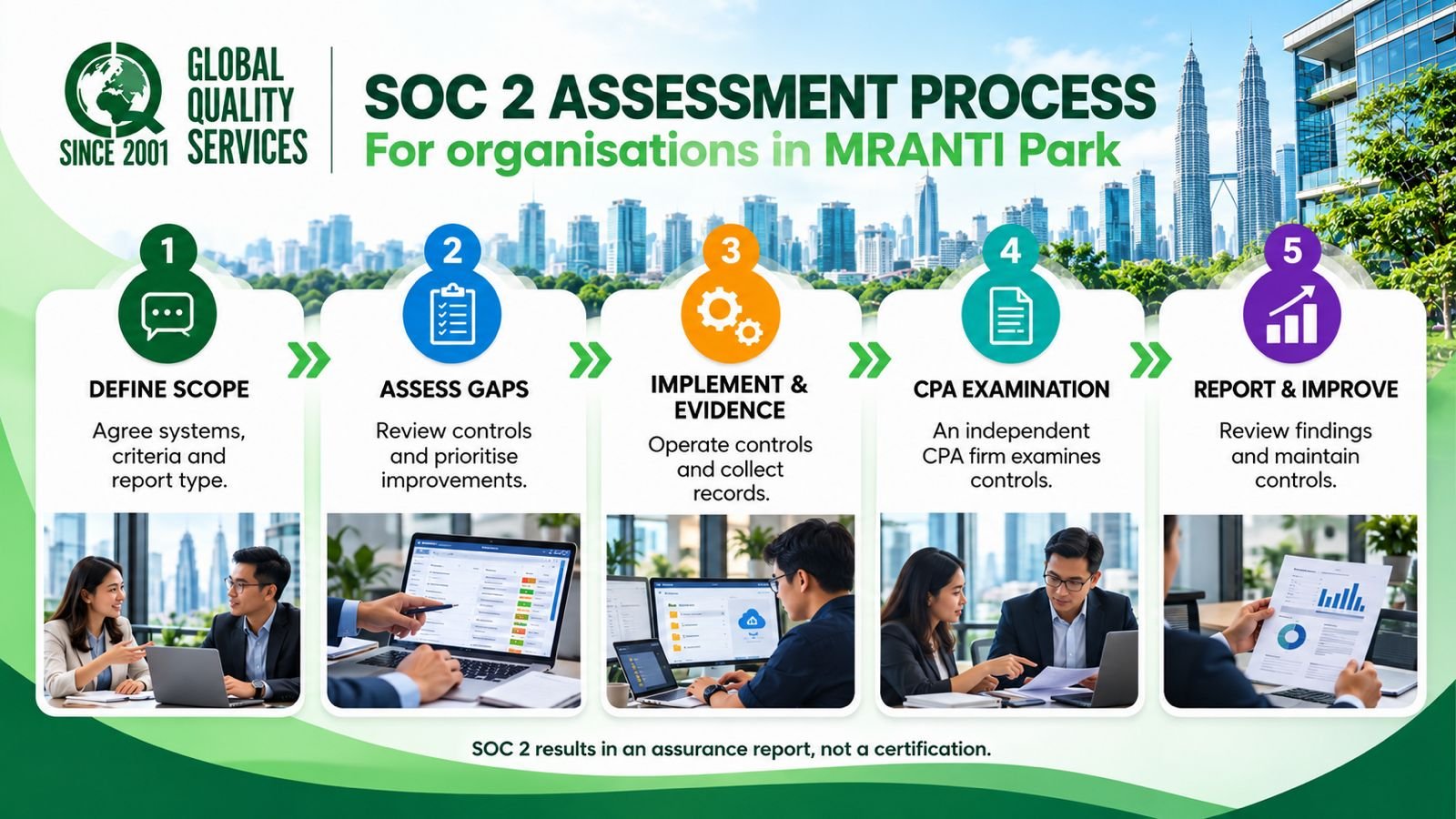
GQS structures SOC 2 readiness work around the organization’s services, systems, customer commitments, and applicable Trust Services Criteria.
Step 1: Define the Scope
The first step is to identify the services, systems, infrastructure, locations, and relevant third-party dependencies that should be considered within the intended SOC 2 scope.
Step 2: Review Existing Controls
Existing policies, technical safeguards, operating procedures, and control records are reviewed against the applicable criteria. The review helps establish the organization’s current level of readiness.
Step 3: Identify Control Gaps
Gaps between existing practices and the applicable requirements are documented. These may relate to access management, risk assessment, incident response, vendor management, change control, or evidence retention.
Step 4: Review Policies and Documentation
Relevant documentation is examined to identify missing, incomplete, or inconsistent information. This may include information security policies, access control procedures, incident response plans, risk registers, and business continuity documentation.
Step 5: Develop a Readiness Action Plan
Findings are organized into practical actions according to their significance, dependencies, and the organization’s target timeline. Responsibility for each action can be assigned to the relevant internal team.
Step 6: Prepare for the Independent Examination
The organization reviews its control documentation and evidence collection processes before engaging the independent service auditor. For a Type II examination, this preparation should account for the need to demonstrate control operation throughout the agreed examination period.
The independent service auditor determines the examination procedures and issues the formal report. Readiness support does not guarantee an unmodified opinion or successful examination outcome.
Documents and Evidence Commonly Reviewed for SOC 2
The evidence required depends on the systems, controls, and Trust Services Criteria included in scope. Common examples include:
Information security policies and procedures
- System descriptions and architecture diagrams
- Asset inventories and data flow documentation
- Risk assessments and risk treatment records
- User access approvals and access review records
- Employee onboarding, role changes, and offboarding records
- Security awareness records
- Vulnerability management and patching evidence
- Incident response procedures and incident records
- Change management and software release records
- Backup, recovery, and business continuity documentation
- Supplier assessments and third-party agreements
- Monitoring logs and security review records
- Control testing records and corrective action tracking
Not every document applies to every organization. Evidence should be relevant to the actual system and controls being examined.
Benefits of SOC 2 Readiness Support
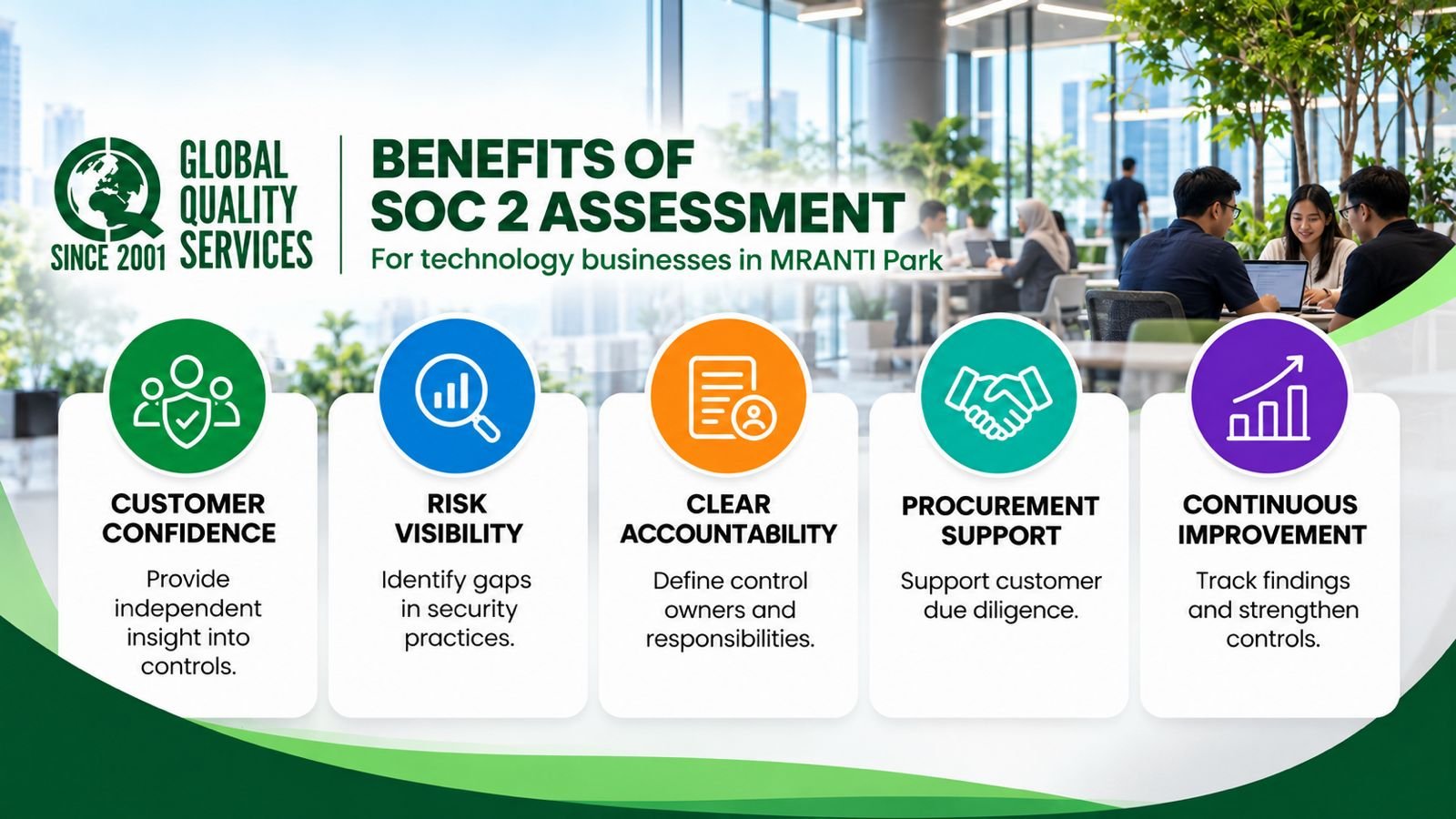
Identify Gaps Before the Formal Examination
A readiness review helps organizations understand where existing controls or documentation may fall short of the applicable criteria, allowing them to plan corrective action before the formal examination.
Improve Control Ownership and Accountability
Defining responsibilities and maintaining records can help internal teams understand who operates each control, who reviews it, and what evidence should be retained.
Prepare for Customer Due Diligence
A more organized control environment can help businesses respond to security questionnaires and prepare for customer requests for independent assurance.
Support More Consistent Security Practices
Reviewing access controls, incident response, change management, and vendor oversight can help organizations strengthen how these processes are managed.
Plan the SOC 2 Examination More Effectively
Defining the scope, report type, and evidence requirements in advance helps organizations coordinate internal teams and set clear expectations with the independent service auditor.
Why Choose Global Quality Services for SOC 2 Assessment in MRANTI Park?
GQS provides structured SOC 2 readiness support tailored to an organization’s services, existing controls, and assurance objectives. Our approach focuses on scope review, gap identification, documentation assessment, and practical preparation planning against the applicable Trust Services Criteria. We help organisations organise readiness activities and identify the evidence they may need for an independent examination. This enables businesses to approach the process with a clearer understanding of their control gaps, responsibilities, and next steps. The independent service auditor remains responsible for conducting the formal SOC 2 examination and issuing the report.
A SOC 2 examination requires a clear scope, suitable controls, reliable documentation, and evidence aligned with the organization’s services and customer commitments. Early readiness work can help businesses identify gaps and organize their preparation before engaging an independent service auditor.
Contact Global Quality Services (GQS) to discuss SOC 2 assessment and readiness support for your organization in MRANTI Park, Kuala Lumpur. Share your service model, target report type, customer requirements, and current control maturity to help define the next steps.
Contact GQS to discuss your SOC 2 readiness requirements.
Frequently Asked Questions
1. Is SOC 2 a certification?
No. SOC 2 is an independent examination and reporting framework, not a certification scheme. A qualified independent service auditor examines the relevant controls and issues the SOC 2 report.
2. Does my company in MRANTI Park need SOC 2 Type I or Type II?
The right report depends on customer expectations, the assurance you need, and the maturity of your controls. Type I assesses control design at a specified date, while Type II also examines operating effectiveness over a defined period. Confirm the required report type with your customers and service auditor.
3. How long does SOC 2 readiness take?
The timeline depends on the organization’s size, system complexity, existing controls, documentation, and identified gaps. Type II preparation must also account for the agreed period over which controls will be evaluated. A readiness review can help establish a more realistic plan.
4. Does SOC 2 replace Malaysia’s Personal Data Protection Act requirements?
No. SOC 2 and Malaysia’s Personal Data Protection Act 2010 address different requirements. A SOC 2 report may describe relevant controls, but it does not automatically demonstrate compliance with Malaysian data protection law. Organizations should assess their legal obligations separately.
5. Can a startup prepare for SOC 2 before signing an enterprise customer?
Yes. A startup can review its controls and prepare documentation before a customer formally requests a report. Early preparation helps the business understand its control responsibilities and plan the scope and timing of an independent examination.