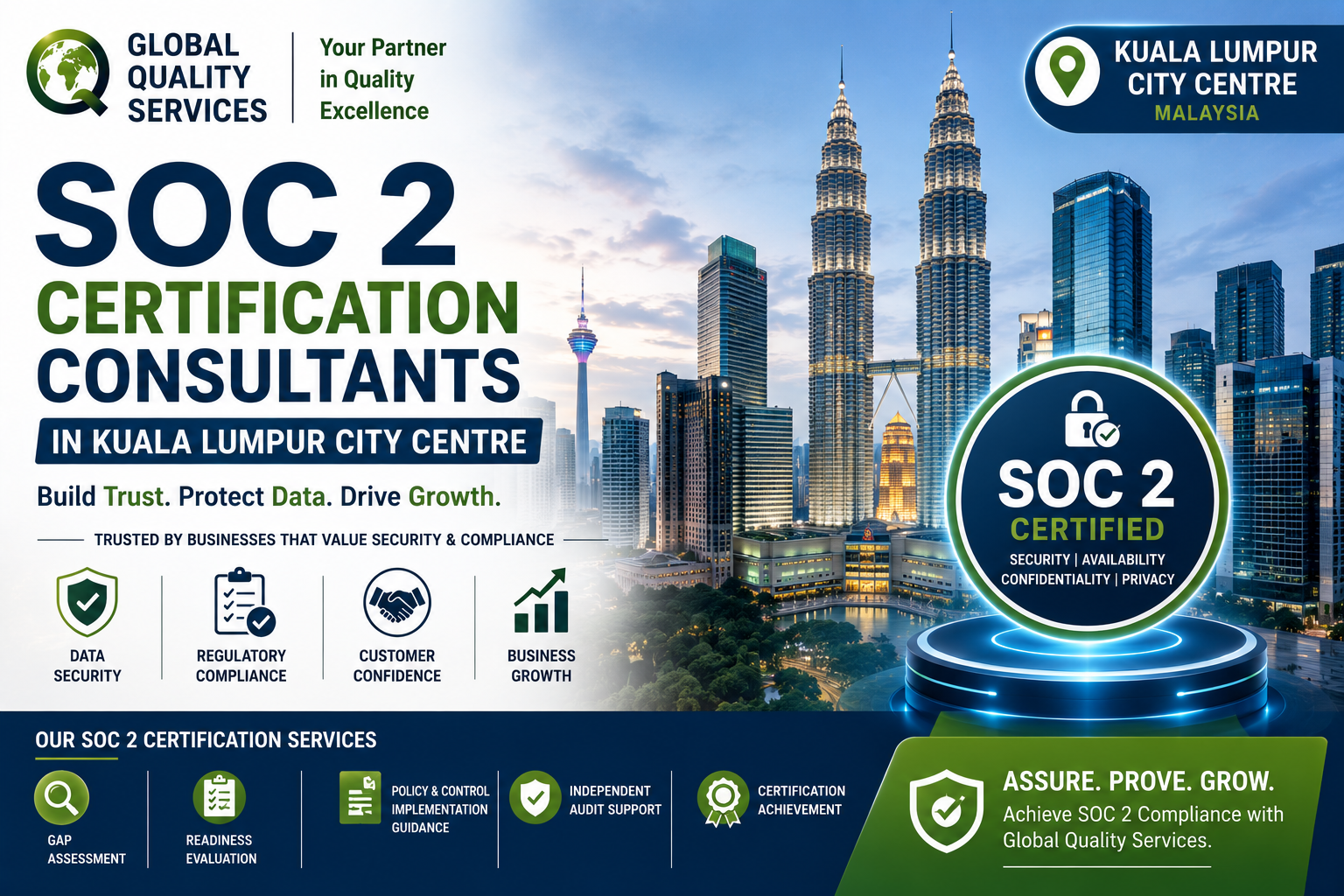
A Kuala Lumpur City Centre address carries a specific commercial signal. A KLCC address immediately signals credibility, ambition, and serious market commitment. Multinational corporations, leading financial institutions, and professional services firms cluster here because the address opens doors.
But that signal has a gap. When a KLCC-based technology company, regional headquarters, or fintech firm closes an enterprise deal with a buyer in the US, the UK, or Australia, the buyer’s procurement team conducts a vendor security qualification process. The single most common item on that checklist is a SOC 2 report. Without one, a company that has spent significant capital establishing a premium address in Malaysia’s most prestigious business district is removed from enterprise vendor lists before the commercial conversation concludes.
SOC 2 is the attestation standard developed by the American Institute of Certified Public Accountants that US enterprise buyers use to verify that a service provider’s security, availability, and data handling controls have been independently tested and proven over time. It is not issued by a certification body as ISO 27001 is. It is an attestation report issued by an independent, AICPA-licensed CPA firm after a structured audit process. The consultancy work that gets you audit-ready is where Global Quality Services operates.
We provide end-to-end SOC 2 readiness consultancy for technology companies, fintech firms, regional headquarters, and professional services organizations based in Kuala Lumpur City Centre, Tun Razak Exchange, and the surrounding Golden Triangle district.
What Is SOC 2 and What It Is Not
SOC 2 is not a certification issued by a government body or international standards organization. It is an attestation report developed by the AICPA and issued by an independent, AICPA-licensed CPA firm following a structured audit of your control environment.
This distinction matters commercially. Global Quality Services prepares your organization, builds your control framework, and gets your team audit-ready. An independent CPA firm then conducts the formal attestation. Our job is to ensure that when the auditor arrives, nothing surfaces as a surprise.
SOC 2 Type 1 vs SOC 2 Type 2
For KLCC companies entering enterprise vendor qualification processes, the first decision is which type of report your buyers require.
SOC 2 Type 1 assesses whether your security controls are suitably designed at a specific point in time. It is faster to obtain, typically three to six months from readiness start, and is used by companies that need to demonstrate progress toward full SOC 2 compliance while the Type 2 observation period runs.
SOC 2 Type 2 assesses whether your controls are suitably designed and operating effectively over a defined observation period, typically six to twelve months. This is the report that US enterprise procurement teams, institutional clients, and regulated-sector buyers require. A Type 2 report with a twelve-month observation window carries significantly more weight in a KLCC enterprise sales cycle than a Type 1.
Most KLCC companies pursuing SOC 2 for the first time begin with a Type 1 to close an immediate buyer-qualification requirement and then move to Type 2 within the same engagement timeline.
The Five Trust Service Criteria
SOC 2 is organized around five Trust Service Criteria. Security is mandatory for every engagement. The remaining four are selected based on your service profile and buyer requirements.
- Security. Mandatory. Covers protection of systems and data against unauthorized access, disclosure, and damage through 64 Common Criteria covering logical access, change management, risk assessment, monitoring, and incident response.
- Availability. Covers whether systems are available for operation as committed. Relevant for SaaS platforms, regional data operations, and any KLCC-based service with uptime SLA obligations to enterprise clients.
- Processing Integrity. Covers whether processing is complete, valid, accurate, timely, and authorized. Relevant for payment processors, financial calculation engines, and data transformation services in the TRX and KLCC financial ecosystem.
- Confidentiality. Covers whether information designated as confidential is protected as committed. Highly relevant for legal tech, advisory firms, and professional services companies handling commercially sensitive client data in the Golden Triangle.
- Privacy. Covers the collection, use, retention, and disclosure of personal information. Directly aligned with Malaysia’s PDPA obligations and the data handling expectations of European clients subject to GDPR.
Why KLCC Companies Need SOC 2
KLCC’s status as Malaysia’s premier financial and corporate headquarters district creates a distinct SOC 2 demand profile that differs from that of a general BPO corridor or technology park.
- Enterprise sales cycles to US and UK buyers. The multinational corporations, global financial services firms, and professional services operations that cluster in KLCC sell into enterprise procurement processes in North America, the United Kingdom, and Australia that treat SOC 2 Type 2 as a standard qualification gate. A KLCC-based technology or advisory firm competing for these contracts without a current SOC 2 report faces a structural disadvantage at the vendor qualification stage that the address alone cannot overcome.
- The Tun Razak Exchange ecosystem. The Tun Razak Exchange is Kuala Lumpur’s international financial district, offering advanced physical infrastructure for the development of the regional financial and fintech ecosystem.As TRX matures into Malaysia’s financial hub with international banks, asset managers, and fintech companies as tenants, the security attestation expectations of global financial buyers follow those companies into the district. SOC 2 is increasingly the baseline credential expected of technology and service providers supplying into TRX’s financial tenant base.
- BNM RMiT alignment for financial services suppliers. KLCC is home to the headquarters and regional offices of several BNM-regulated financial institutions. Technology companies supplying into these institutions face BNM’s Risk Management in Technology framework as an indirect requirement through their institutional clients’ vendor management programs. SOC 2’s Common Criteria overlap significantly with RMiT’s security control expectations, and implementing SOC 2 positions a KLCC technology supplier for RMiT-aligned third-party assessments more effectively than an unstructured security program.
- PDPA compliance evidence for personal data handling. KLCC-based professional services firms, legal tech companies, and financial advisory operations handle significant volumes of personal data under Malaysia’s Personal Data Protection Act. SOC 2’s Privacy Trust Service Criterion provides a structured, independently audited framework for demonstrating PDPA security principle compliance that a self-assessment cannot match.
- NACSA’s Cybersecurity Act 2024. The Cybersecurity Act 2024 introduces licensing requirements for cybersecurity service providers and strengthens obligations across digital infrastructure. For KLCC technology companies operating in a regulated environment, a SOC 2 report provides independent security attestation that complements NACSA’s emerging certification landscape.
Who Needs SOC 2 in Kuala Lumpur City Centre
- Regional headquarters of technology companies using a KLCC address to signal credibility to global enterprise clients in North America, the United Kingdom, and Australia who require SOC 2 for vendor qualification
- Fintech companies in the KLCC and TRX ecosystem processing payments, financial data, or investment information for institutional clients subject to security attestation requirements Legal technology and professional services firms handling confidential client data across cross-border mandates where international law firm clients or institutional counterparties require documented security controls
- SaaS companies delivering platforms to enterprise clients in financial services, healthcare, or technology sectors where SOC 2 is a standard contract or procurement prerequisite
- Regional shared services and outsourcing operations whose multinational principals have global vendor qualification policies that include SOC 2 as a standing security attestation requirement
- MSC Malaysia status companies in the KLCC ecosystem serving US and European technology clients who include SOC 2 in their vendor due diligence frameworks
Our SOC 2 Readiness Consultancy Process for KLCC Companies
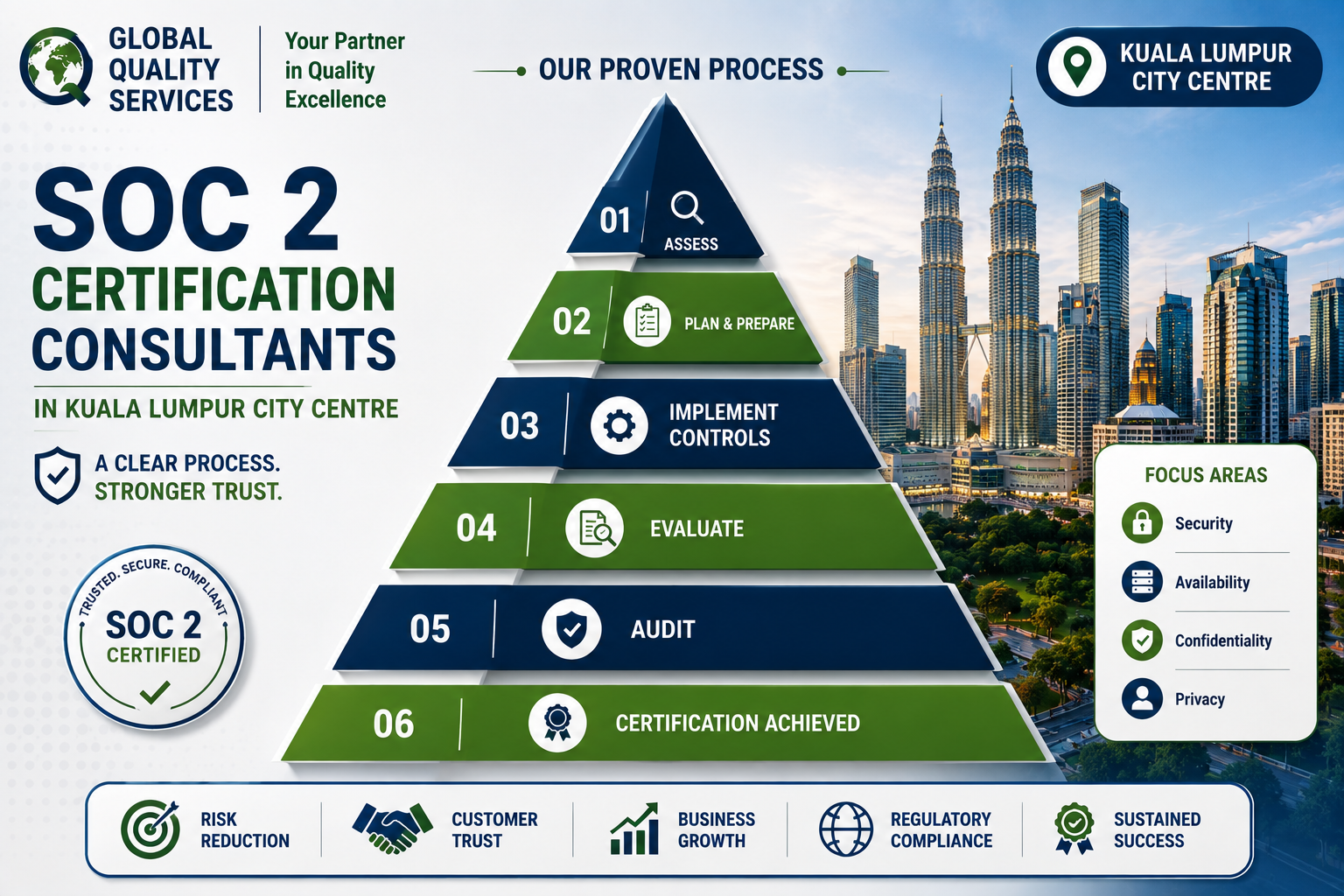
Step 1: Scoping and Trust Service Criteria selection. We confirm which Trust Service Criteria are relevant to your KLCC services and what your target clients specifically require. For most KLCC technology and financial services companies, Security is the mandatory baseline, with Availability and Confidentiality the most commonly added criteria for enterprise client qualification.
Step 2: Readiness assessment. Your current control environment is reviewed against the SOC 2 Common Criteria and the additional criteria for your selected Trust Service categories. A written readiness report identifies gaps by control domain and prioritizes remediation by audit risk.
Step 3: Control design and policy development. We build or update your information security policies, access management procedures, change management controls, vendor management program, incident response procedures, and monitoring and logging framework to satisfy SOC 2 control requirements, scoped to the operating environment of a KLCC-based technology or professional services organisation.
Step 4: Evidence collection framework. SOC 2 Type 2 requires continuous evidence that controls operated effectively over the observation period. We build your evidence collection processes so audit artifacts are gathered automatically rather than assembled under pressure before the audit window closes.
Step 5: Gap remediation support. Technical and process gaps are closed through direct support to your engineering, IT, and operations teams, including vendor risk management, penetration testing coordination, and security awareness training.
Step 6: Type 1 and Type 2 audit support. We coordinate your engagement with an AICPA-licensed CPA firm for the formal attestation, support your team through auditor queries, and manage any management response requirements in the final report.
Benefits of SOC 2 for Kuala Lumpur City Centre Companies
Closing the KLCC Credential Gap
A KLCC address positions your company at the top of Malaysia’s commercial hierarchy. A current SOC 2 Type 2 report ensures that position is matched by the security credential enterprise buyers require, closing the gap between address-based credibility and documented, independently verified security assurance.
Winning and Retaining US and UK Enterprise Contracts
SOC 2 Type 2 removes the most common security qualification obstacle KLCC technology companies face in US and UK enterprise sales cycles. It replaces lengthy security questionnaires and third-party risk assessment requests with a single, independently attested document that procurement teams accept on first submission.
BNM RMiT and PDPA Alignment in One Framework
SOC 2’s Common Criteria cover logical access, change management, risk assessment, monitoring, and incident response, control categories that map directly to both BNM RMiT’s technology risk requirements and PDPA’s security principle. Implementing SOC 2 builds a compliance infrastructure that satisfies multiple Malaysian regulatory expectations rather than treating each as a separate project.
Competitive Differentiation in the TRX and KLCC Ecosystem
As TRX matures into Malaysia’s international financial district, the competition for financial and enterprise technology contracts in the KLCC ecosystem intensifies. A SOC 2 Type 2 report in a competitive shortlist signals that security controls have been independently tested over time, not just documented, a meaningfully stronger position than a competitor relying on ISO 27001 alone or no third-party security attestation.
Faster Enterprise Sales Cycles
Enterprise clients requiring SOC 2 include it as a standard vendor due diligence checklist item. A current SOC 2 Type 2 report closes that item on first submission, shortening sales cycles by weeks or months compared to engaging in additional questionnaires, interviews, and customer-conducted audits for each new enterprise account.
Why Choose Global Quality Services
Global Quality Services has supported compliance and certification projects across Malaysia, Singapore, and the Asia-Pacific region for over two decades. Our SOC 2 readiness engagements are built for the specific commercial environment of Kuala Lumpur City Centre: technology companies using a KLCC address to compete for global enterprise contracts, fintech firms operating in the TRX financial ecosystem, and professional services organisations handling sensitive cross-border client data in the Golden Triangle.
We understand how SOC 2 sits alongside ISO 27001, PDPA, and BNM RMiT in the Malaysian regulatory and client qualification landscape, and we scope every engagement to build a control framework that satisfies multiple requirements rather than optimizing for SOC 2 alone.
For KLCC companies also pursuing ISO 27001 information security certification, the overlap between the two frameworks is significant, and we structure engagements to maximize that overlap rather than duplicate work across two parallel tracks.
Frequently Asked Questions
Is SOC 2 mandatory for companies in Kuala Lumpur City Centre?
No. SOC 2 is a voluntary attestation standard developed by the AICPA. It is not mandated by Malaysian law, BNM, or NACSA. However, it is increasingly required by US, UK, and Australian enterprise buyers from KLCC-based technology and professional services vendors as a standard security qualification condition of supply.
How is SOC 2 different from ISO 27001 for a KLCC company?
ISO 27001 is an international management system certification that assesses whether an organisation has implemented and maintains an information security management system. SOC 2 is a US attestation standard that tests whether specific security controls existed and operated effectively over a defined observation period for a service organisation. Most KLCC companies competing for US enterprise contracts find that buyers specifically request SOC 2 rather than ISO 27001, though holding both provides the broadest market coverage.
What does a KLCC company need to prepare for a SOC 2 Type 2 audit?
A SOC 2 Type 2 audit requires a defined control environment covering logical access, change management, risk assessment, incident response, and monitoring, along with continuous evidence that those controls operated effectively over a minimum six-month observation period. Global Quality Services builds the control framework and evidence collection processes as part of the readiness engagement before the formal audit begins.
How long does SOC 2 Type 2 take for a KLCC-based company?
From readiness start to final Type 2 report issuance, most KLCC technology and professional services companies complete the process in twelve to eighteen months, including the observation period. Companies with mature existing security controls and an established ISO 27001 management system typically move faster due to existing documentation and process discipline.
Does SOC 2 help with PDPA compliance?
Yes. SOC 2’s Security and Privacy Trust Service Criteria cover the access controls, monitoring, incident response, and data handling practices that PDPA’s security principle requires. A current SOC 2 Type 2 report provides independently verified evidence of those controls rather than a self-assessment, which is more defensible in the event of a PDPA inquiry or data breach investigation.