Singapore is a major aerospace hub supporting aircraft manufacturing, maintenance, repair and overhaul (MRO), aftermarket services, aerospace parts distribution, precision engineering and related supply-chain activities. The country’s aerospace ecosystem includes more than 130 companies across manufacturing, MRO, R&D, and aftermarket services, alongside a strong network of local SME suppliers.
For organizations that distribute aircraft parts, components, materials, and assemblies, AS 9120 Certification in Singapore provides a specialized quality management framework for the aviation, space, and defense supply chain.
GQS Singapore supports organizations with AS 9120 readiness, gap assessment, QMS documentation, implementation guidance, and certification audit preparation.
What Is AS 9120 Certification?
AS 9120 is an Aerospace Quality Management System standard for organizations that distribute aviation, space, and defense products.
It is based on ISO 9001 quality management requirements. It also adds requirements relevant to aerospace distribution, including controls for product conformity, traceability, counterfeit-part risks, supplier management, purchasing, product preservation, and other supply-chain concerns.
IAQG explains that 9120 is intended for organizations that support product manufacturers and the aerospace and defense aftermarket. It can also be used in other sectors where a quality management system with requirements beyond ISO 9001 is appropriate.
Latest AS 9120 Development: AS9120B Remains the Current Standard
AS9120B remains the current AS9120 standard. SAE International lists AS9120B as the revised November 2016 edition, covering quality management system requirements for aviation, space, and defense distributors. The standard incorporates ISO 9001:2015 requirements, along with additional aerospace, space, and defense requirements.
IAQG continues to list 9120 within its Aerospace Quality Management System standards and provides resources for the 2016 edition, including key changes, auditor guidance and correlation information.
Organizations should therefore be careful when referencing an alleged new “AS 9120:2026” certification. AS9120B remains the applicable edition, as identified by SAE and IAQG.
Who Needs AS 9120 Certification in Singapore?
AS 9120 is primarily intended for organizations that procure aerospace, space, or defense products and distribute or resell them without changing the product’s characteristics or conformity.
This can include:
Aerospace Parts Distributors
Distributors supplying aircraft components, parts, materials and assemblies to aerospace manufacturers, MRO organizations and other customers can use AS 9120 to demonstrate a controlled distribution process.
Aviation Supply Companies
Companies that source and supply aviation products need robust controls over purchasing, suppliers, product identification, traceability, and delivery.
Space and Defense Distributors
Organizations distributing products for space programs and defense applications can use AS 9120 to establish controls appropriate to these supply chains.
Aerospace Aftermarket Suppliers
Singapore’s aerospace ecosystem includes significant aftermarket and MRO activity. Distributors supporting replacement parts and maintenance requirements can benefit from a quality system aligned with aerospace customer expectations.
Stockists and Trading Organizations
Stockists that hold aerospace materials or components and supply them to customers can use AS 9120 to establish controlled processes for storage, identification, preservation and distribution.
AS 9120 and Singapore’s Aerospace Industry
Singapore has developed a substantial aerospace ecosystem covering manufacturing, MRO, aftermarket services, R&D and aerospace parts distribution. EDB identifies Singapore as a major aerospace hub in the Asia-Pacific region and highlights its connectivity, infrastructure and supply-chain capabilities.
The country’s aerospace sector also includes a strong local enterprise network that supports global aerospace companies. In August 2026, EDB highlighted partnerships between global aerospace companies and Singapore enterprises to strengthen manufacturing, innovation and supply-chain resilience.
This environment creates opportunities for distributors that can demonstrate reliable sourcing, product integrity, traceability, and consistent quality management.
Why Is AS 9120 Important for Aerospace Distributors in Singapore?
Aerospace distributors operate in a supply chain where the wrong product, incorrect documentation, inadequate traceability,y or uncontrolled sourcing can create significant downstream risks.
AS 9120 provides a framework for controlling these activities.
Strengthens Product Traceability
The standard helps organizations establish controls to identify products and maintain relevant records throughout purchasing, storage, and distribution.
Improves Supplier Control
Aerospace distributors often depend on multiple manufacturers, authorized suppliers, and external sources. AS 9120 strengthens processes for supplier evaluation, purchasing and monitoring.
Reduces Counterfeit-Part Risks
Counterfeit and suspect parts can present serious safety and operational risks. AS 9120 includes controls relevant to preventing the acceptance and distribution of suspect or counterfeit products.
Supports Customer Requirements
Aerospace customers frequently have stringent quality and traceability expectations. AS 9120 can help distributors demonstrate that their processes are structured around these requirements.
Improves Operational Consistency
A documented QMS establishes consistent processes for purchasing, receiving, storage, preservation, order fulfillment, delivery, and handling of nonconforming products.
Strengthens Supply-Chain Confidence
Certification to an internationally recognized aerospace QMS standard can give customers and supply-chain partners greater confidence in the distributor’s quality processes.
What Are the Key AS 9120 Requirements?
AS 9120B incorporates ISO 9001:2015 requirements and adds aerospace-specific controls.
The requirements cover areas including:
- Organizational context and QMS scope
- Leadership and quality responsibilities
- Risk-based planning
- Competence and awareness
- Documented information
- Supplier and purchasing controls
- Product identification and traceability
- Product preservation and storage
- Monitoring and measurement
- Control of nonconforming outputs
- Corrective action
- Internal audits
- Management review
- Continual improvement
The exact applicability of individual requirements should be determined by the organization’s activities, products, processes, and certification scope.
AS 9120 and Counterfeit Parts Prevention
Counterfeit-part prevention is particularly important in aerospace distribution because distributors can sit between manufacturers, suppliers and end customers.
An effective system should provide controls for supplier selection, product verification, documentation, traceability and handling of suspect products.
SAE and IAQG resources also identify counterfeit-part control as an important area within aerospace supply-chain management.
For Singapore distributors, these controls can help strengthen confidence in the authenticity and conformity of aerospace products moving through the supply chain.
AS 9120 and Product Traceability
Traceability is a key consideration when distributing aviation and aerospace products.
Depending on the product and customer requirements, organizations may need to maintain information such as manufacturer details, part numbers, batch or lot information, certificates, shelf-life information, and other relevant documentation.
The objective is to maintain sufficient information to establish product identity and demonstrate conformity throughout the distribution process.
AS 9120 and Supplier Management
Aerospace distributors may source products from multiple manufacturers, authorised suppliers and other supply-chain partners.
AS 9120 requires organizations to establish appropriate controls for externally provided products and services. Supplier evaluation, purchasing information, verification, and monitoring should align with the risks associated with the products being supplied.
A controlled supplier-management process can also help organizations respond more effectively to customer-specific requirements.
Who Should Choose AS 9120 Instead of AS 9100?
The distinction between AS 9100 and AS 9120 is important.
AS 9120 is intended for distributors, particularly organizations that procure products and resell them to aviation, space, and defense customers without altering the product’s form, fit, or function.
IAQG guidance explains that AS9120 is intended for pass-through distributors where the product’s characteristics are not being altered. Organizations whose primary activities involve aviation maintenance may fall under AS 9110.
The appropriate standard should therefore be determined from the organization’s actual activities and certification scope.
What Is the AS 9120 Certification Process in Singapore?
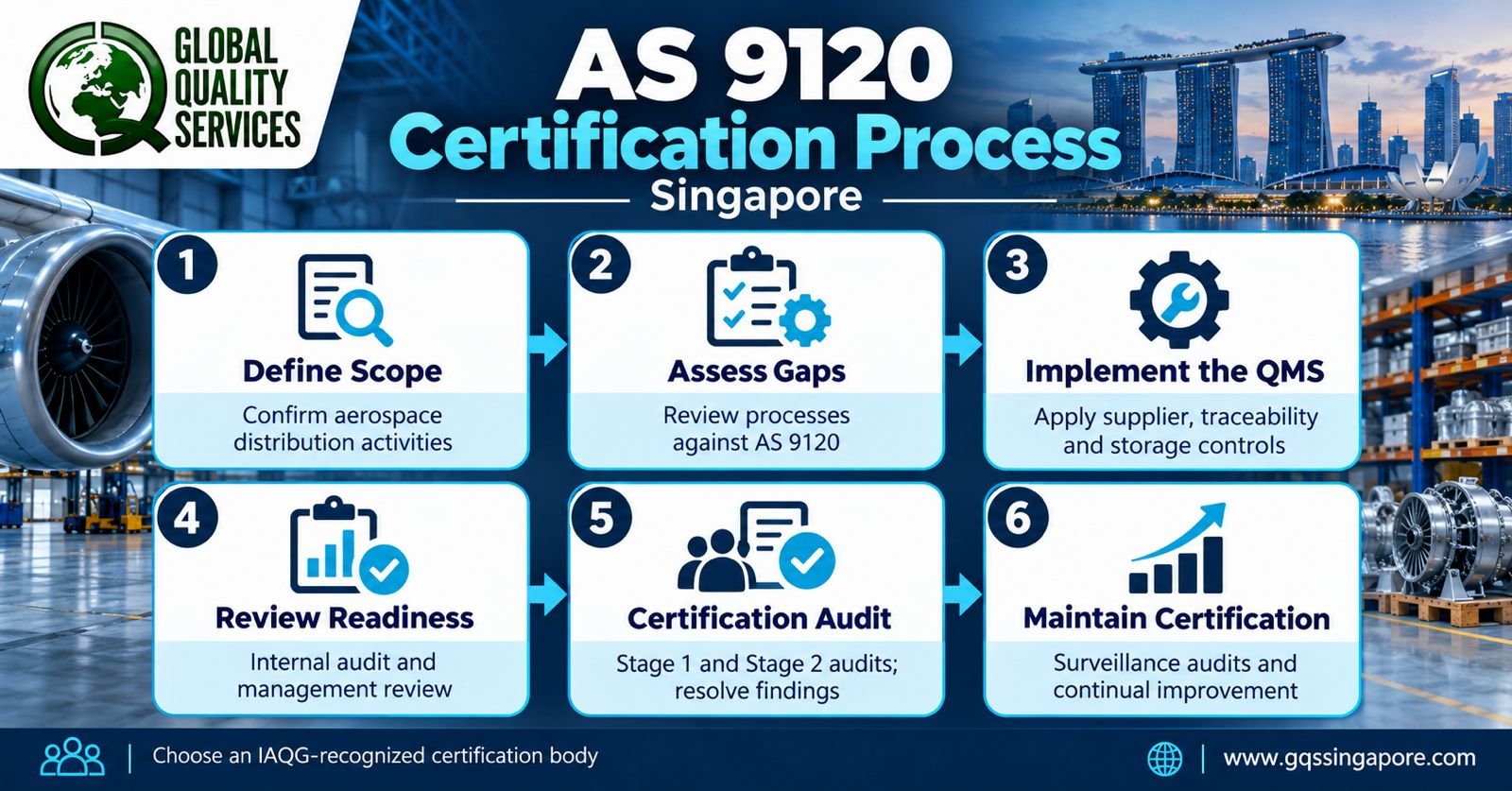
1. Determine Applicability and Scope
The organization first establishes whether AS 9120 is appropriate and defines the products, services, locations, and processes that will be covered.
2. Conduct a Gap Assessment
The organization reviews existing quality-management processes against AS9120B requirements to identify gaps in documentation, implementation, and operational controls.
3. Develop the QMS
Required processes, procedures, policies and documented information are established or updated to meet applicable requirements.
4. Implement the System
The organization puts the QMS into operation. This includes supplier controls, traceability, product handling, purchasing, nonconformity management and other applicable processes.
5. Conduct Internal Audit
An internal audit evaluates whether the QMS has been effectively implemented and identifies areas requiring corrective action before the certification audit.
6. Management Review
Top management reviews the QMS’s performance and effectiveness and determines whether further improvements or resources are required.
7. Certification Audit
An accredited certification body conducts the applicable certification audit against AS9120B requirements.
8. Corrective Action and Certification
If nonconformities are identified, the organisation addresses them within the applicable certification process. Once the requirements are satisfactorily met, certification can be issued by the certification body.
How Long Does AS 9120 Certification Take in Singapore?
The timeline varies based on the organization’s size and complexity, number of locations, QMS maturity, and the extent of aerospace-specific controls that must be implemented.
An organisation with an established ISO 9001-based system may already have several foundational processes in place. However, aerospace-specific requirements, traceability, supplier controls, product integrity, and customer requirements may require additional work.
A gap assessment provides a better basis for estimating the implementation and certification timeline.
What Factors Affect AS 9120 Certification Cost?
The cost of AS 9120 certification depends on factors such as theorganization’ss size, number of employees, number of locations, operational complexity, certification scope, and existing management-system maturity.
The certification body’s audit duration and applicable certification arrangements also influence the overall cost.
Additional consultancy or remediation work may be required where significant gaps exist between the existing QMS and AS9120B requirements.
AS 9120 Certification and OASIS
AS 9120 certification forms part of the IAQG Aerospace Quality Management System certification scheme.
IAQG maintains OASIS, the Online Aerospace Supplier Information System, which provides information on suppliers certified or registered under IAQG rules, along with certification bodies and aerospace auditors involved in the scheme.
For aerospace customers evaluating suppliers, OASIS provides an important source for checking aerospace supplier certification and registration information.
AS 9120 Certification and the IAQG Certification Scheme
The IAQG manages the Aerospace Quality Management System certification scheme covering the 9100-series standards, including AS 9100, AS 9110 and AS 9120.
The certification scheme operates through requirements established in the AS9104 series, including AS9104/1 for the AQMS certification program.
This internationally coordinated approach helps aerospace organizations and their customers recognize certifications issued within the applicable certification scheme.
AS 9120 Certification for Singapore Aerospace Supply Chains
Singapore’s aerospace sector includes global OEMs, MRO organizations, component manufacturers, aftermarket providers and local enterprises. EDB also highlights Singapore’s role as a regional base for aerospace parts distribution and management.
For distributors serving these organizations, a structured aerospace QMS can help create greater consistency across sourcing, receiving, storage, traceability, and delivery activities.
This becomes increasingly important as aerospace supply chains place greater emphasis on resilience, reliable sourcing and supplier capability.
Benefits of AS 9120 Certification in Singapore
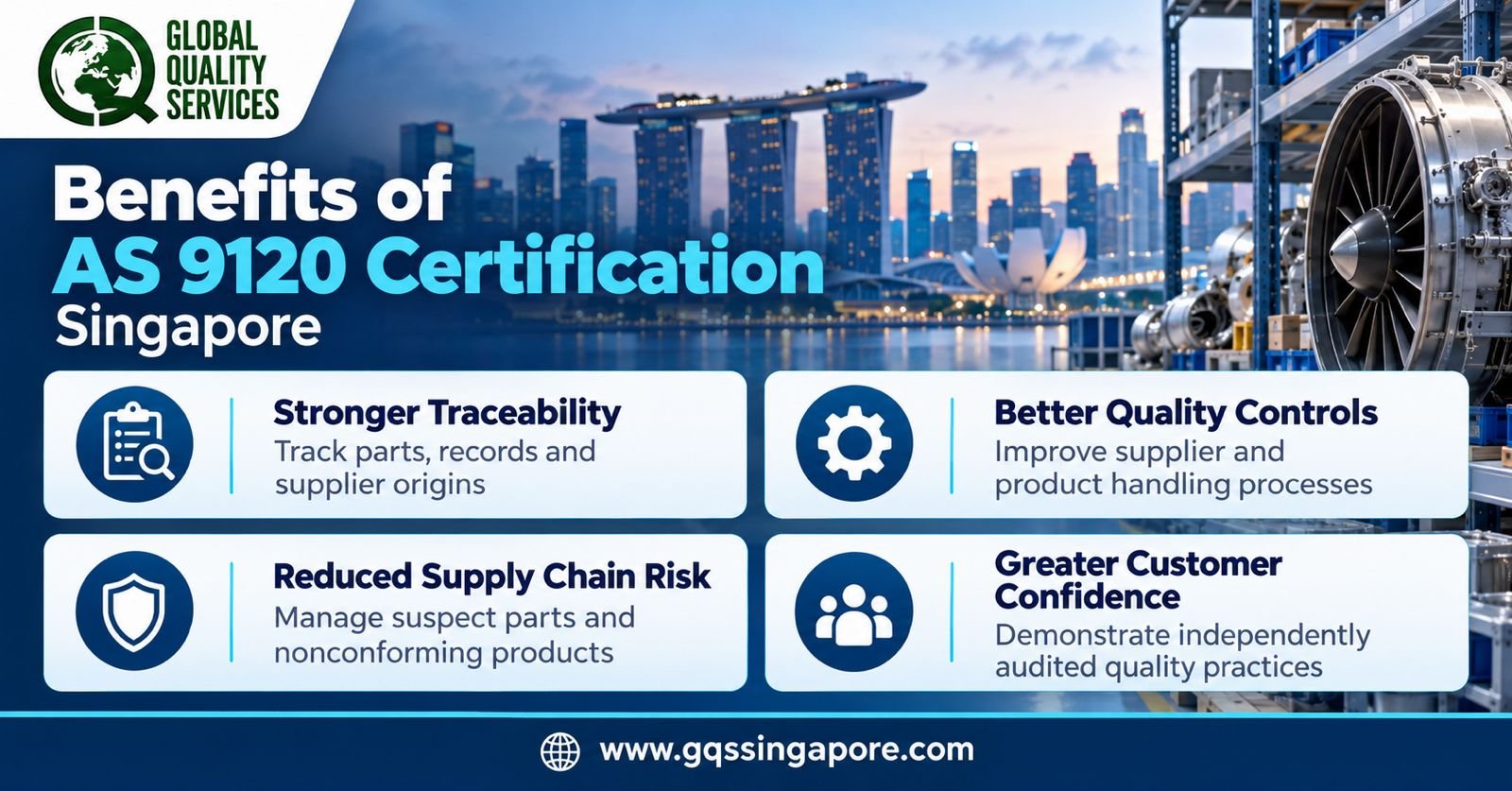
Stronger Aerospace Supply-Chain Controls
AS 9120 helps distributors establish controlled processes for purchasing, receiving, storage, traceability and delivery.
Better Product Integrity
The standard supports controls designed to ensure that products supplied to customers meet specified requirements and remain appropriately identified throughout the distribution process.
Improved Supplier Management
A structured supplier-management process helps organizations evaluate and monitor external providers according to their requirements and associated risks.
Greater Customer Confidence
Certification can provide aerospace customers with independent evidence that the organization operates a quality management system aligned with aerospace distribution requirements.
Reduced Risk of Counterfeit or Suspect Parts
Controls around sourcing, verification, traceability, and product documentation can help reduce the risk of suspect products entering the supply chain.
Improved Audit Readiness
A documented and implemented QMS helps organisations prepare for customer audits, certification audits and other supply-chain assessments.
Support for International Aerospace Business
An internationally recognized aerospace QMS can help Singapore-based distributors demonstrate their capability when working with customers and partners across global aviation, space, and defense markets.
How Global Quality Services Can Help
GQS Singapore helps aerospace distributors prepare for AS 9120 certification through a practical, organization-specific approach. Our support can include gap assessment, QMS documentation, implementation guidance, internal audit support, management-review preparation and certification audit readiness.
We begin by understanding the organization’s distribution activities, product types, suppliers, customers, and existing quality controls so that the QMS is aligned with the actual business rather than built around generic documentation.
Frequently Asked Questions
Can AS 9120 cover multiple distribution locations in Singapore?
Yes. An organization can establish a certification scope covering multiple locations where the relevant distribution activities are managed under the same quality management system. The scope needs to clearly identify the applicable locations, activities, and types of distribution services.
Does AS 9120 apply to kitting and splitting activities?
It can. IAQG specifically recognizes kitting and splitting in the distributor environment, provided these activities do not alter the product’s characteristics. The organization should define these activities within its QMS scope and establish appropriate controls for identification, handling, and traceability.
What records should an AS 9120 distributor maintain?
The organization must maintain and retain documented information to demonstrate that its processes are operating as planned. Depending on the business, this can include supplier information, purchasing records, product identification and traceability records, inspection or verification evidence, nonconformity records and other quality-related documentation.
Can AS 9120 apply if the distributor does not keep physical stock?
Yes. Physical stockholding is not the only factor that determines whether a distributor needs AS 9120 controls. An organization still needs to consider relevant processes such as traceability, supplier management, and product information even where products are not held in its own inventory.
How does AS 9120 address changes to product configuration?
Configuration management matters because distributors must maintain product identity and conformity as products move through the supply chain. IAQG guidance notes that configuration management can remain relevant even when a distributor does not manufacture the product.
What happens when an aerospace customer has additional quality requirements?
AS 9120 requirements are complementary to customer and applicable statutory or regulatory requirements. When customers impose additional contractual requirements, the distributor must identify and manage them within its relevant processes, rather than assuming AS 9120 alone covers every customer-specific obligation.