Singapore enjoys a solid track record of maintaining food safety standards, quality assurance measures, and reliable food supply chains. However, for food producers, processors, packagers, and distributors, satisfying client demands frequently entails far more than merely adhering to the law. BRCGS Certification offers a widely accepted structure for controlling food safety, product quality, legal compliance, authenticity, and operation control.
The latest revision of BRCGS Food Safety, known as Issue 9, is currently implemented in over 130 nations worldwide and utilized in over 22,000 facilities globally. Singapore’s food sector is subject to strict regulation. Based on data collected by the Singapore Food Agency in 2025, the percentage of non-conformance among food processing and manufacturing enterprises decreased from 15.0% in 2024 to 8.4% in 2025.
Singapore Food Agency Businesses hoping to improve their food safety practices and fulfill stringent client needs may consider pursuing BRCGS Certification. Read on to learn about its prerequisites, advantages, procedure, and how GQS Singapore can assist you along the way.
What is BRCGS Certification
BRCGS Certification refers to a worldwide certification program used to evaluate the food safety, product quality, legal compliance, authenticity, and controls employed during the manufacture and processing of foods.
The BRCGS Global Standard for Food Safety is on its ninth issue. It was established specifically for use by companies engaged in the manufacture, processing, and packaging of food products.
The standard covers areas such as:
- Senior management commitment
- Food safety culture
- HACCP-based food safety planning
- Product safety and quality management
- Site standards
- Product control
- Process control
- Personnel requirements
- Traceability
- Food fraud prevention
- Food defense
- Internal audits
- Corrective and preventive action
- Supplier and raw material controls
Why is BRCGS Certification Important for Singapore Businesses
The food industry in Singapore addresses demand from both domestic and international customers. For food producers and distributors operating within this ecosystem, there is an additional challenge of meeting compliance requirements alongside retailer demands, brand owner demands, importer demands, distributor demands, and foreign consumers.
In January 2026, the Singapore Food Agency rolled out its SAFE program – Safety Assurance for Food Establishments. With SAFE, the Singaporean government will focus heavily on past food safety records and implementation of food safety management systems at food processors and preparers.
BRCGS Certification may provide additional support to your business’ overall approach towards managing food safety in a structured manner. It will enable your business to achieve:
- Strengthen food safety and quality controls
- Demonstrate commitment to customer protection
- Meet retailer and buyer approval requirements
- Improve traceability across the supply chain
- Reduce the likelihood of food safety failures
- Identify weaknesses before they become costly problems
- Improve consistency across production activities
- Support access to international supply chains
- Build greater confidence among customers and business partners
Who Needs BRCGS Certification in Singapore
BRCGS Food Safety is particularly relevant to organizations involved in the manufacture, processing, handling, and packing of food or food ingredients. It can be suitable for:
- Food manufacturing companies
- Food processing facilities
- Food ingredient manufacturers
- Ready-to-eat food producers
- Meat and seafood processors
- Dairy and bakery manufacturers
- Beverage manufacturers
- Frozen food manufacturers
- Snack and confectionery manufacturers
- Prepared food manufacturers
- Private-label food suppliers
- Food packaging and packing operations within the applicable BRCGS scope
- Businesses supplying major retailers and foodservice companies
Key Requirements of BRCGS Food Safety Issue 9
BRCGS Food Safety Issue 9 takes a holistic approach to food safety and product quality requirements. The standard covers the relationships between management systems, facilities, manufacturing processes, personnel, and risk management strategies.
1. Management Commitment
Management must demonstrate its commitment to food safety and quality by allocating resources and tracking performance.
2. Food Safety Program and HACCP
Organizations need to develop an effective food safety program using the principles of HACCP. The steps involved are hazard identification, risk assessment, hazard control, monitoring, and reassessment.
3. Food Safety and Quality Management System
An FQMS will contain documentation such as policy manuals, procedure manuals, records, specifications, customer complaints, corrective actions, and management reviews.
4. Site Standards
The facility must be maintained in a way that supports hygienic production. This includes premises, equipment, cleaning, maintenance, pest management, waste management, and hygiene controls.
5. Product Control
Controls should address product specifications, allergens, product testing, labeling, product authenticity, and other relevant product safety and quality considerations.
6. Process Control
Production processes must be defined, monitored, and controlled to ensure that products consistently meet safety and quality requirements.
7. Personnel
Employees must receive appropriate training and follow hygiene and food safety requirements relevant to their responsibilities.
8. Traceability and Food Fraud Controls
The business must be able to trace relevant materials and finished products through the supply chain. Vulnerability assessments and appropriate controls are also required for food fraud risks.
9. Internal Audits and Corrective Action
Internal audits help verify whether documented systems are actually working in practice. BRCGS identifies internal auditing as an important part of maintaining effective food safety and quality controls.
BRCGS Certification Process in Singapore
Although every organization has different requirements, the certification journey generally involves the following stages:
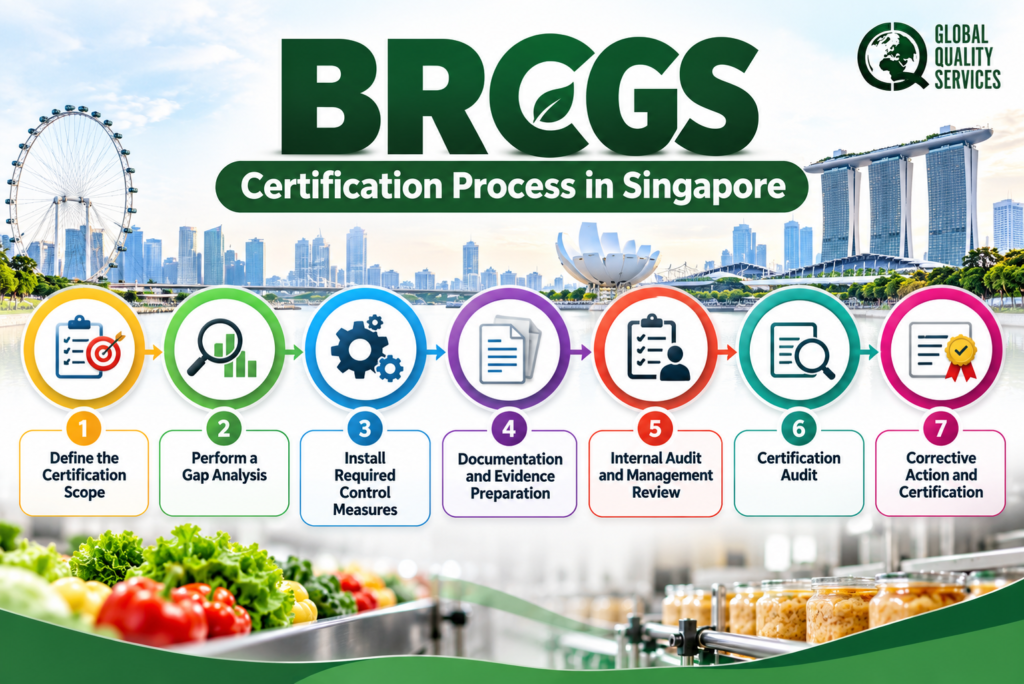
Step 1: Define the Certification Scope
The next thing to do is determine which products, operations, facilities, and activities fall under the BRCGS certification scope.
Step 2: Perform a Gap Analysis
Current food safety and quality procedures are assessed against relevant BRCGS Issue 9 standards. This will help uncover areas where improvements must be made before starting the certification audit process.
Step 3: Install Required Control Measures
The business then takes corrective action on these areas, enhances controls, documents changes, and trains staff members on new expectations.
Step 4: Documentation and Evidence Preparation
Documents, procedures, records, monitoring findings, training, audits, corrective actions, and any necessary evidence are assessed for accuracy and alignment.
Step 5: Internal Audit and Management Review
Internal audits take place to evaluate whether the process is effective. Management considers the outcomes and ensures any remaining problems get sorted out.
Step 6: Certification Audit
An officially BRCGS-registered certification body performs the audit. According to BRCGS guidelines, organizations should appoint a Certified Body within their registry for the certification audit.
Step 7: Corrective Action and Certification
If non-conformities are identified, the organization must address them within the applicable requirements and provide the necessary evidence. Once certification requirements are satisfied, the certification body issues the certificate.
Important 2026 Update for BRCGS Issue 9
Businesses auditing their compliance with Food Safety Issue 9 from BRCGS should not base themselves only on outdated checklists or earlier interpretations of the standard. Updated position statements concerning Food Safety Issue 9 were announced as coming into effect for audits performed starting August 10, 2026, by BRCGS.
The updated version brings the BRCGS Food Safety Issue 9 standard into alignment with the GFSI Benchmarking Requirements 2024 framework. It follows logically that organizations based in Singapore planning certification should ensure that their practices meet these new criteria. Businesses auditing their compliance with Food Safety Issue 9 from BRCGS should not base themselves only on outdated checklists or earlier interpretations of the standard. Updated position statements concerning Food Safety Issue 9 were announced as coming into effect for audits performed starting August 10, 2026, by BRCGS.
The updated version brings the BRCGS Food Safety Issue 9 standard into alignment with the GFSI Benchmarking Requirements 2024 framework. It follows logically that organizations based in Singapore planning certification should ensure that their practices meet these new criteria.
Benefits of BRCGS Certification for Singapore Businesses
Here are the key benefits of BRCGS certification for Singapore Businesses:
- Improved Food Safety Management System: The BRCGS Standard gives companies a framework to manage their food safety risk during manufacturing.
- Boosted Consumer Trust: By becoming certified, organizations provide third-party validation to consumers and other stakeholders that there is adherence to global best practices when managing food safety risks.
- Enhanced Supplier Management Processes: Using a process-based approach towards evaluating suppliers, specifying requirements, and monitoring performance allows organizations to better manage food safety risks within their supply chain.
- Increased Market Access: International retailers, restaurants, and brands rely on food safety certifications as a key component of assessing suppliers.
- Traceability Benefits: Good traceability solutions allow firms to respond promptly to issues related to their products, components, or materials. This could mean an investigation or product recall.
- Operational Risk Reduction: Ongoing audits, monitoring, verification, and corrective measures enable firms to recognize potential risks in advance of any actual food safety or quality concerns developing.
BRCGS Certification and Singapore’s Food Safety Requirements
BRCGS Certification will not fulfill any of the laws and licenses set out in Singapore. Food companies should still adhere to all Singapore Food Agency laws and licensing requirements for food safety and beyond.
According to SFA, food processing facilities need to abide by all licensing and food safety requirements. BRCGS does not replace such compliance.
Rather than replace existing requirements, however, BRCGS can provide an additional framework for food safety, product quality, traceability, supplier control, and operational risk management processes. Organizations looking for an enhanced food safety management system may also consider ISO 22000 Certification in Singapore.
What Can Affect the Cost of BRCGS Certification in Singapore
There is no single BRCGS Certification cost applicable to every organization. The overall investment depends on factors such as:
- Size of the facility
- Number of employees
- Number of production lines
- Product categories
- Manufacturing processes
- Certification scope
- Existing food safety systems
- Level of documentation already available
- Number of sites
- Training requirements
- Extent of corrective work required
- Certification body audit requirements
BRCGS Certification Support Across Singapore
Food businesses across Singapore can access BRCGS Certification support from Global Quality Services, whether their operations are based in Jurong, Tuas, Woodlands, Senoko, Changi, or Jurong Innovation District.
Our local consulting support helps food manufacturers, processors, packers, and suppliers understand BRCGS requirements and prepare their systems with greater confidence. With practical guidance and industry-focused expertise, we support organizations in meeting certification expectations while keeping their food safety and quality systems suitable for day-to-day operations.
Why Choose Global Quality Services for BRCGS Certification in Singapore
Global Quality Services has established itself as a reputed consultant supporting organizations with certification, training, assessment, and implementation requirements.
- 26 years of professional consulting experience
- 1,450+ customers supported
- Presence across 17 locations
- 1,200+ training programs delivered
- Practical understanding of management system standards
- Singapore-based consulting support
- Experienced certification and assessment support team
- Industry-focused guidance rather than generic templates
Get BRCGS Certification Support From a Reputed Singapore Consultant
Global Quality Services provides food safety consultancy services that enable organizations to develop a robust food safety management system, close certification loopholes, and become fully prepared for a third-party BRCGS audit. To schedule an appointment, reach out to us via phone at +65 9344 1973 or via email at info@gqssingapore.com.
Frequently Asked Questions
1. Is BRCGS Certification mandatory in Singapore?
BRCGS Certification is not a universal legal requirement for every food business in Singapore. However, customers, retailers, brand owners, and international buyers may require recognized third-party food safety certification as part of their supplier approval requirements.
2. Which BRCGS standard is currently applicable to food businesses?
For food safety, BRCGS Global Standard for Food Safety Issue 9 is the current edition. BRCGS is also reviewing the standard as part of the development of Issue 10.
3. Is BRCGS recognized internationally?
Yes. BRCGS Food Safety is used internationally and is accepted by major global brands and retailers. BRCGS states that Food Safety Issue 9 has been adopted by more than 22,000 sites in over 130 countries.
4. How long does BRCGS Certification take?
Certification timelines differ widely based on current infrastructure, facility size, scope of certification, gaps found in an assessment, and organizational readiness for the audit process. Companies with developed food safety systems need fewer preparation resources compared to businesses that lack such infrastructure altogether.
5. Can a new food manufacturing company apply for BRCGS Certification?
Absolutely, assuming that the company complies with relevant BRCGS standards and implements these appropriately based on evidence from its own processes and documentation. A site assessment should precede any audit activity.