Businesses in Tuas involved in manufacturing, warehousing, and international trade must take cargo security seriously. Singapore’s port handled a record 44.66 million TEUs in 2025, an 8.6% increase from 2024, according to The Straits Times. For companies handling U.S.-bound shipments, C-TPAT participation offers an opportunity to demonstrate stronger supply chain security.
Global Quality Services helps businesses review security gaps, understand CBP requirements, and prepare the necessary documentation. Hiring an experienced consultant can make the preparation process clearer and help your company address compliance requirements effectively.
What is C-TPAT Certification?
C-TPAT stands for Customs-Trade Partnership Against Terrorism. It is a voluntary supply chain security program managed by U.S. Customs and Border Protection (CBP).
The program brings CBP and eligible businesses together to protect international supply chains against terrorism, cargo tampering, unauthorized access, and other security threats.
Companies participating in C-TPAT agree to follow the Minimum Security Criteria (MSC) applicable to their business category. These requirements cover different aspects of supply chain operations, including business partners, cargo handling, facility security, employee practices, and information systems.
C-TPAT encourages businesses to examine their existing security arrangements and address weaknesses before they affect international shipments.
Eligible business categories include:
- U.S. importers
- Foreign manufacturers
- Customs brokers
- Freight forwarders
- Third-party logistics providers
- Sea, air, and land carriers
- Consolidators
- Certain other eligible supply chain entities
C-TPAT participation is voluntary. However, companies must meet the eligibility conditions for their respective categories. CBP reviews applications and security profiles before accepting applicants into the program. It may also conduct validations to assess whether participants follow the applicable security requirements.
Why is C-TPAT Important for Businesses in Tuas?
Tuas is an important industrial and logistics area in western Singapore. It has manufacturing facilities, industrial warehouses, transport operations, and businesses connected to international trade.
Companies operating here often coordinate with overseas suppliers, shipping companies, freight forwarders, and distribution partners. Each connection creates a responsibility to protect cargo and maintain reliable security procedures.
For businesses shipping products to the United States, weak security controls can create unnecessary complications. Cargo tampering, unauthorized facility access, inaccurate shipment records, and unreliable business partners can affect deliveries.
C-TPAT encourages eligible companies to take a closer look at these risks and improve their supply chain security practices.
Here are five reasons why businesses in Tuas should consider the program.
1. Protect Goods During International Transportation
Cargo passes through different facilities and transportation channels before reaching its destination. Businesses must control how employees load, inspect, seal, and release shipments. C-TPAT encourages companies to establish suitable cargo inspection procedures and protect containers against unauthorized interference.
2. Build Trust With Overseas Business Partners
International customers want reliable suppliers who take cargo security seriously. C-TPAT participation can demonstrate your company’s commitment to recognized supply chain security practices. It also encourages businesses to communicate security expectations clearly with suppliers, carriers, and logistics partners.
3. Strengthen U.S.-Bound Trade Operations
Manufacturers and other eligible businesses involved in U.S.-bound supply chains may benefit from C-TPAT participation. The program creates opportunities to work with CBP and demonstrate stronger cargo security practices. However, companies must first meet the eligibility requirements for their business category.
4. Identify Weaknesses Across Your Supply Chain
Security problems do not always originate inside your own facility. They can also arise through transportation providers, outsourced warehouses, suppliers, or other business partners. C-TPAT preparation encourages businesses to assess these connections and address weaknesses before they affect shipments.
5. Meet International Customer Security Expectations
Overseas customers may review your security arrangements before entering into business agreements. They may ask about employee screening, cargo inspections, facility access, and shipment records. A structured security program helps your team explain these practices and demonstrate how your company manages supply chain risks.
Key C-TPAT Security Requirements
C-TPAT follows Minimum Security Criteria that vary according to the applicant’s business category. A foreign manufacturer in Tuas, for example, may follow different requirements from a U.S. importer or freight forwarder. Companies should review the latest criteria published by CBP before starting their preparation.
The major security areas include:
1. Business Partner Requirements
Companies should evaluate suppliers, manufacturers, freight forwarders, and transportation providers before working with them. Maintain written records of partner assessments and check whether eligible partners hold C-TPAT participation or follow equivalent security practices.
2. Procedural Security
Businesses need documented procedures for receiving, handling, storing, and dispatching cargo. These procedures should cover shipment verification, manifest accuracy, cargo discrepancies, reporting suspicious activities, and maintaining reliable shipping records.
3. Physical Security
Facilities should have suitable physical safeguards against unauthorized entry. Depending on the facility’s risk profile, these measures may include perimeter fencing, controlled gates, security lighting, surveillance cameras, alarms, and secure storage areas.
4. Personnel Security
Companies should follow appropriate employee screening practices. They should verify employment information, review references, and conduct background checks where permitted by local regulations. They must also remove facility and system access when employees leave.
5. Education and Security Training
Employees should understand their responsibilities in protecting cargo and facilities. Training should cover security threats, suspicious activities, cargo inspection procedures, access restrictions, and incident reporting.
6. Access Controls
Businesses should control who enters their facilities and restricted operational areas. Employee identification, visitor registration, temporary access passes, and controlled key distribution can help prevent unauthorized entry.
7. Container and Conveyance Security
Companies involved in loading and transporting goods should inspect containers, trailers, and vehicles before use. They should also apply appropriate high-security seals, maintain seal records, and report damaged or suspicious containers.
8. Information Technology Security
Businesses should protect shipment records, commercial information, and operational systems against unauthorized access. Individual user accounts, password controls, access restrictions, system monitoring, and employee awareness can support information security.
These requirements should reflect the company’s actual operations. Foreign manufacturers must also review security practices across outsourced facilities and relevant business partners. Source: CBP Foreign Manufacturer Security Criteria.
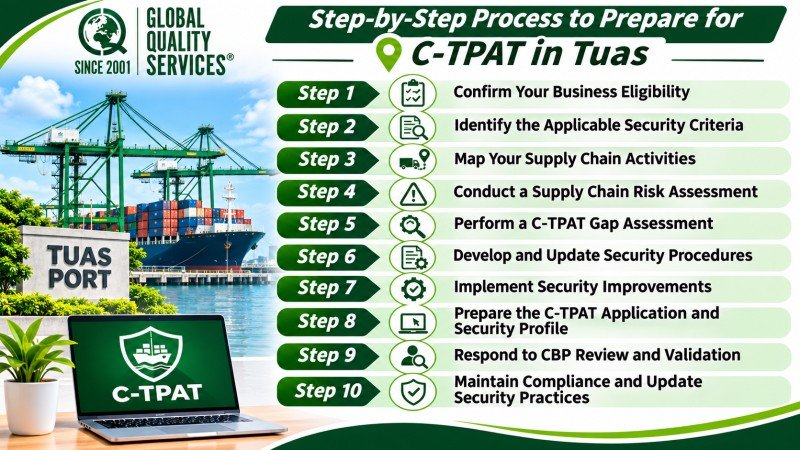
Step-by-Step Process to Prepare for C-TPAT in Tuas
C-TPAT preparation requires more than collecting security policies and completing application forms. Your company must first understand its eligibility and review the security measures it currently follows.
A structured preparation process helps management identify missing controls and organize the necessary evidence.
Step 1: Confirm Your Business Eligibility
Identify your company’s role in the international supply chain. Determine whether you operate as a foreign manufacturer, carrier, logistics provider, or another eligible business category. Review CBP’s eligibility conditions before investing time in application preparation.
Step 2: Identify the Applicable Security Criteria
Obtain the latest C-TPAT Minimum Security Criteria for your business category. Review the requirements covering business partners, cargo handling, employee screening, facility protection, transportation, and information security.
Step 3: Map Your Supply Chain Activities
Identify the suppliers, manufacturing facilities, warehouses, freight forwarders, and transportation companies involved in your operations. Map how goods move between these parties and identify the locations where security risks may arise.
Step 4: Conduct a Supply Chain Risk Assessment
Examine potential threats across your supply chain. Consider cargo theft, unauthorized access, shipment tampering, employee-related risks, and information security weaknesses. Document the findings and prioritize areas that need attention.
Step 5: Perform a C-TPAT Gap Assessment
Compare your existing security practices against the applicable CBP criteria. Review current policies, inspection records, employee procedures, and business partner arrangements. Identify missing controls and prepare a list of corrective actions.
Step 6: Develop and Update Security Procedures
Prepare documented procedures for cargo inspections, visitor management, employee screening, shipment verification, container sealing, and incident reporting. Assign responsibilities to relevant employees and management representatives.
Step 7: Implement Security Improvements
Put the necessary controls into practice across your facilities and supply chain. Depending on your findings, improvements may include better access restrictions, CCTV monitoring, employee training, container inspections, and stronger supplier checks.
Step 8: Prepare the C-TPAT Application and Security Profile
Collect company information and supporting security records. Complete the application through the official CBP C-TPAT Portal and prepare a security profile explaining how your organization meets the applicable requirements.
Step 9: Respond to CBP Review and Validation
CBP reviews the submitted information and may request additional details. Following acceptance, the company must cooperate with the applicable validation process. CBP may review records, interview employees, and examine relevant facilities to assess security practices.
Step 10: Maintain Compliance and Update Security Practices
C-TPAT participation requires ongoing attention. Review your supply chain risks regularly, maintain inspection records, train employees, and update security procedures whenever business operations or identified risks change.
Benefits of C-TPAT Participation
C-TPAT participation can offer several advantages to eligible companies involved in international trade. These benefits depend on the participant’s category, program status, and applicable CBP arrangements.
1. Reduced Likelihood of Cargo Examinations
CBP considers compliant C-TPAT participants lower-risk trading partners. Eligible participants may receive fewer examinations of their shipments at U.S. ports of entry. However, participation does not guarantee examination-free cargo movement.
2. Potentially Faster Cargo Clearance
C-TPAT offers trade facilitation benefits that can support smoother movement through certain U.S. customs processes. Eligible participants may also qualify for specific priority processing arrangements, depending on their business category.
3. Better Understanding of Supply Chain Risks
Preparing for C-TPAT encourages companies to examine their entire supply chain. This process helps management identify security weaknesses, review existing controls, and make informed decisions about operational improvements.
4. Stronger Relationships With Business Partners
A clear approach to cargo security helps companies communicate expectations with suppliers, freight forwarders, carriers, and warehouse operators. Documented security practices can also support discussions during international supplier assessments.
5. Access to CBP Guidance and Resources
Accepted participants can work with an assigned CBP Supply Chain Security Specialist. This relationship gives companies access to program guidance and resources through the C-TPAT Portal.
6. Potential Mutual Recognition Benefits
CBP has established mutual recognition arrangements with selected foreign customs administrations. These arrangements can support cooperation between recognized supply chain security programs and may offer additional trade facilitation advantages to eligible participants.
7. Improved Supply Chain Preparedness
Security assessments encourage businesses to prepare for cargo-related incidents, suspicious activities, and operational disruptions. Clear responsibilities and documented response procedures can help employees react appropriately when security concerns arise.
Why Choose Global Quality Services for C-TPAT Consulting in Tuas?
Preparing for C-TPAT can become complicated when your business manages several suppliers, warehouses, and transportation partners. Global Quality Services helps companies understand the applicable requirements and organize their preparation.
Our consulting support covers:
- Eligibility Review: We help you understand the relevant C-TPAT business category and eligibility conditions.
- Security Gap Assessment: We review existing security practices and identify areas that need improvement.
- Documentation Support: We help organize security policies, inspection records, employee procedures, and supporting documents.
- Security Implementation Guidance: We guide your team in addressing gaps across relevant operational areas.
- Application Preparation: We support your team in preparing the required company information and security profile.
- Validation Preparation: We help employees understand the requirements and prepare relevant records for CBP validation.
We focus on your actual business activities rather than recommending generic security measures. This approach helps your team understand what needs attention before applying for C-TPAT participation.
Speak With Global Quality Services About C-TPAT Consulting in Tuas
Looking to prepare your business for C-TPAT participation? Start by discussing your supply chain activities and security requirements with Global Quality Services.
Our consultants can help you review eligibility, identify security gaps, and understand the documentation required for your business category. Whether you operate a manufacturing facility, warehouse, or logistics business in Tuas, we can guide your preparation. Contact Global Quality Services today to discuss your C-TPAT consulting requirements.
Frequently Asked Questions
1. Can a Singapore-based manufacturer apply for C-TPAT without having a U.S. office?
Yes. Eligible foreign manufacturers can participate without establishing a U.S. office. However, they must meet CBP’s specific eligibility conditions and supply chain security requirements.
2. How often should a company review its C-TPAT security arrangements?
Companies should review their supply chain security at least annually. They should also reassess controls after security incidents, operational changes, or increased threat levels.
3. Does C-TPAT require companies to inspect every shipping container?
Companies must follow suitable container inspection procedures. CBP recommends a seven-point inspection covering the front wall, sides, floor, ceiling, doors, and undercarriage.
4. Can an outsourced warehouse affect a manufacturer’s C-TPAT compliance?
Yes. Outsourced warehouses form part of the supply chain. Manufacturers must assess relevant partners, communicate security expectations, and verify that appropriate controls remain in place.
5. Does C-TPAT participation automatically guarantee faster customs clearance?
No. Participation can offer reduced examination rates and certain trade facilitation benefits. However, CBP retains the authority to examine shipments based on security risks and operational requirements.