
Responsible business practices have become an important consideration for manufacturers supplying international electronics and technology companies. Buyers increasingly examine not only product quality and delivery performance but also how suppliers manage their workforce, maintain safe workplaces, control environmental impacts, and conduct business ethically.
For manufacturers operating in Bayan Lepas Free Industrial Zone (FIZ), Malaysia, alignment with the Responsible Business Alliance (RBA) Code of Conduct can provide a structured approach to meeting these expectations.
Commonly referred to as RBA Certification, the process involves adopting the RBA requirements, establishing suitable management controls, and demonstrating conformity through the applicable assessment process. The framework addresses labor standards, occupational health and safety, environmental practices, business ethics, and management systems.
For electronics manufacturers and their supply-chain partners in Bayan Lepas, RBA alignment can strengthen responsible sourcing practices and provide customers with greater confidence in workplace and operational standards.
Why RBA Compliance Matters in Bayan Lepas Free Industrial Zone
Bayan Lepas Free Industrial Zone is an established electronics and manufacturing hub in Penang. Its industrial ecosystem includes semiconductor-related operations, electronics assembly, electrical components, precision manufacturing, and supporting suppliers.
Businesses in these sectors often operate within international supply chains where customers expect suppliers to demonstrate responsible employment practices and effective environmental and workplace controls.
These expectations can extend across multiple levels of the supply chain. A manufacturer may be asked to adopt the RBA Code directly, provide evidence of compliance, complete a customer assessment, or undergo an RBA Validated Assessment Program audit.
RBA alignment is particularly relevant to:
- Electronics and semiconductor manufacturers: Facilities involved in component production, assembly, testing, and related manufacturing operations.
- Electrical equipment suppliers: Businesses manufacturing electrical products and components for international customers.
- Contract manufacturers: Organizations producing goods on behalf of global brands and original equipment manufacturers.
- Precision engineering companies: Suppliers supporting electronics manufacturing through specialized components and processes.
- Industrial material suppliers: Businesses providing materials and manufacturing inputs used in electronics supply chains.
- Labor-intensive manufacturing facilities: Organizations that need structured controls for recruitment, working hours, wages, worker welfare, and occupational safety.
RBA requirements can also extend to suppliers and subcontractors through customer expectations and supply-chain agreements. Their application should therefore be considered beyond the immediate manufacturing site.
Understanding the Responsible Business Alliance Framework
The Responsible Business Alliance is an industry coalition that promotes responsible business conduct across global supply chains. Its Code of Conduct establishes expectations for safe working conditions, fair treatment of workers, environmental responsibility, and ethical business practices.
Although the framework originated in the electronics industry, it is now used across several other sectors. The RBA Code of Conduct is organized into five main sections. Each addresses a different aspect of responsible business operations.
A. Labor: Protecting Workers’ Rights
The labor requirements focus on ensuring that employees are treated fairly and that employment practices respect fundamental worker rights.
Important areas include:
- Freely chosen employment and prevention of forced labor
- Protection of young workers
- Working hours and overtime arrangements
- Wages, benefits, and legally required compensation
- Non-discrimination and prevention of harassment
- Humane treatment and worker dignity
- Freedom of association and collective bargaining
For Bayan Lepas manufacturers, this means maintaining transparent recruitment practices, accurate employment records, fair compensation arrangements, and suitable grievance mechanisms.
B. Health and Safety: Maintaining Safe Workplaces
Manufacturing environments may involve machinery, chemicals, electrical equipment, repetitive activities, and other occupational hazards. RBA requirements establish expectations for identifying and managing these risks.
The main areas include:
- Occupational safety and hazard prevention
- Emergency preparedness
- Occupational injuries and illnesses
- Industrial hygiene
- Physically demanding work
- Machine safeguarding
- Sanitation, food, and housing
- Health and safety communication
Facilities should establish workplace safety procedures, provide appropriate protective equipment, maintain emergency arrangements, and communicate relevant risks to employees.
C. Environment: Controlling Industrial Impacts
Environmental responsibility is another important part of RBA alignment, particularly for manufacturing operations involving energy, water, chemicals, emissions, and industrial waste.
The environmental section addresses:
- Environmental permits and reporting
- Pollution prevention and resource conservation
- Hazardous substances management
- Solid waste management
- Air emissions
- Materials restrictions
- Water management
- Energy consumption and greenhouse gas emissions
Manufacturers should maintain suitable environmental controls, monitor relevant impacts, and keep records demonstrating compliance with applicable requirements.
D. Ethics: Conducting Business Responsibly
The ethics requirements address how organizations conduct their commercial activities and interact with employees, customers, suppliers, and other stakeholders.
Relevant areas include:
- Business integrity and anti-corruption
- No improper advantage
- Disclosure of information
- Intellectual property protection
- Fair business practices and advertising
- Protection of whistleblowers
- Responsible sourcing of minerals
- Privacy and protection of personal information
These expectations encourage transparent business conduct and establish controls against unethical practices throughout the supply chain.
E. Management Systems: Making Compliance Sustainable
The management systems section provides the organizational structure needed to implement and maintain the other four areas.
It covers elements such as:
- Management commitment and accountability
- Risk assessment and management
- Legal and customer requirement identification
- Improvement objectives and performance monitoring
- Employee training and communication
- Audits and assessments
- Corrective action processes
- Documentation and record retention
- Supplier responsibility and engagement
A facility must demonstrate more than written policies. Its management systems should show how responsible business requirements translate into daily activities and are reviewed over time.
What Should a Bayan Lepas Facility Prepare for RBA Alignment?
Preparing for an RBA assessment requires coordination across human resources, production, environmental management, occupational safety, procurement, and senior management.
The following areas deserve particular attention.
| Preparation area | Records and operational evidence |
|---|---|
| Employment practices | Employment contracts, recruitment records, wage details, working-hour records, and grievance procedures |
| Worker welfare | Policies on fair treatment, non-discrimination, harassment prevention, and employee communication |
| Workplace safety | Risk assessments, safety procedures, incident records, emergency plans, and training documentation |
| Environmental management | Permits, waste records, emissions information, chemical controls, and environmental monitoring |
| Business ethics | Anti-corruption policies, conflict-of-interest controls, whistleblower procedures, and privacy safeguards |
| Management systems | Responsibilities, internal audit records, objectives, corrective actions, and management reviews |
| Supplier management | Supplier requirements, evaluations, contractual commitments, and relevant monitoring records |
The applicable evidence depends on the facility’s operations, workforce, legal obligations, customer expectations, and assessment scope.
RBA Adoption and the VAP Assessment Process
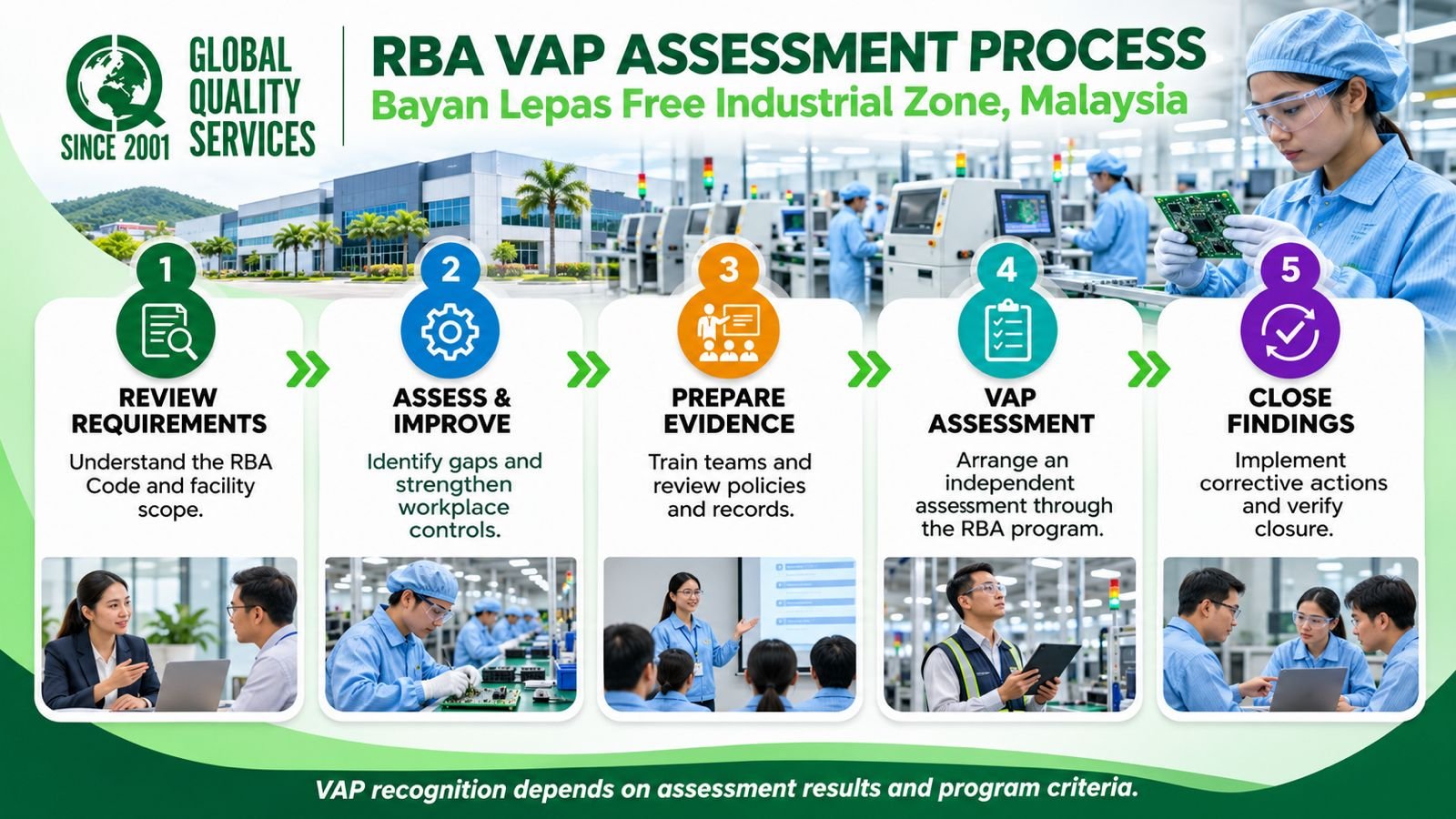
Organizations often use the term RBA Certification when referring to the process of demonstrating conformity with RBA requirements. However, the RBA framework should be distinguished from conventional third-party certification schemes.
The RBA Code can be adopted by businesses, while the RBA Validated Assessment Program (VAP) provides a standardized approach to assessing facilities against applicable requirements.
A typical preparation and assessment journey involves the following stages:
1. Confirm the Applicable Requirements
Determine which version of the RBA Code and which assessment requirements apply. Also review customer-specific expectations and the facility’s scope.
2. Evaluate Existing Practices
Examine current employment arrangements, workplace safety measures, environmental controls, ethical policies, and management systems against the applicable requirements.
3. Identify Areas Requiring Improvement
Document gaps involving working hours, recruitment practices, worker facilities, safety controls, environmental records, or management responsibilities.
4. Establish and Implement Controls
Develop or revise policies, procedures, monitoring arrangements, training programs, and recordkeeping practices. Ensure the requirements are implemented in actual workplace operations.
5. Conduct Internal Reviews
Evaluate the effectiveness of the established controls through internal assessments, record reviews, and workplace observations. Correct identified nonconformities and retain evidence of action taken.
6. Undergo the Applicable Assessment
Where a VAP audit is required, the facility proceeds through the RBA assessment arrangements using an authorized assessment provider under the applicable program requirements.
7. Address Findings and Maintain Performance
Review assessment findings, establish corrective actions, and maintain ongoing controls. Responsible business practices require regular monitoring rather than a one-time compliance exercise.
How RBA Alignment Benefits Electronics Manufacturers
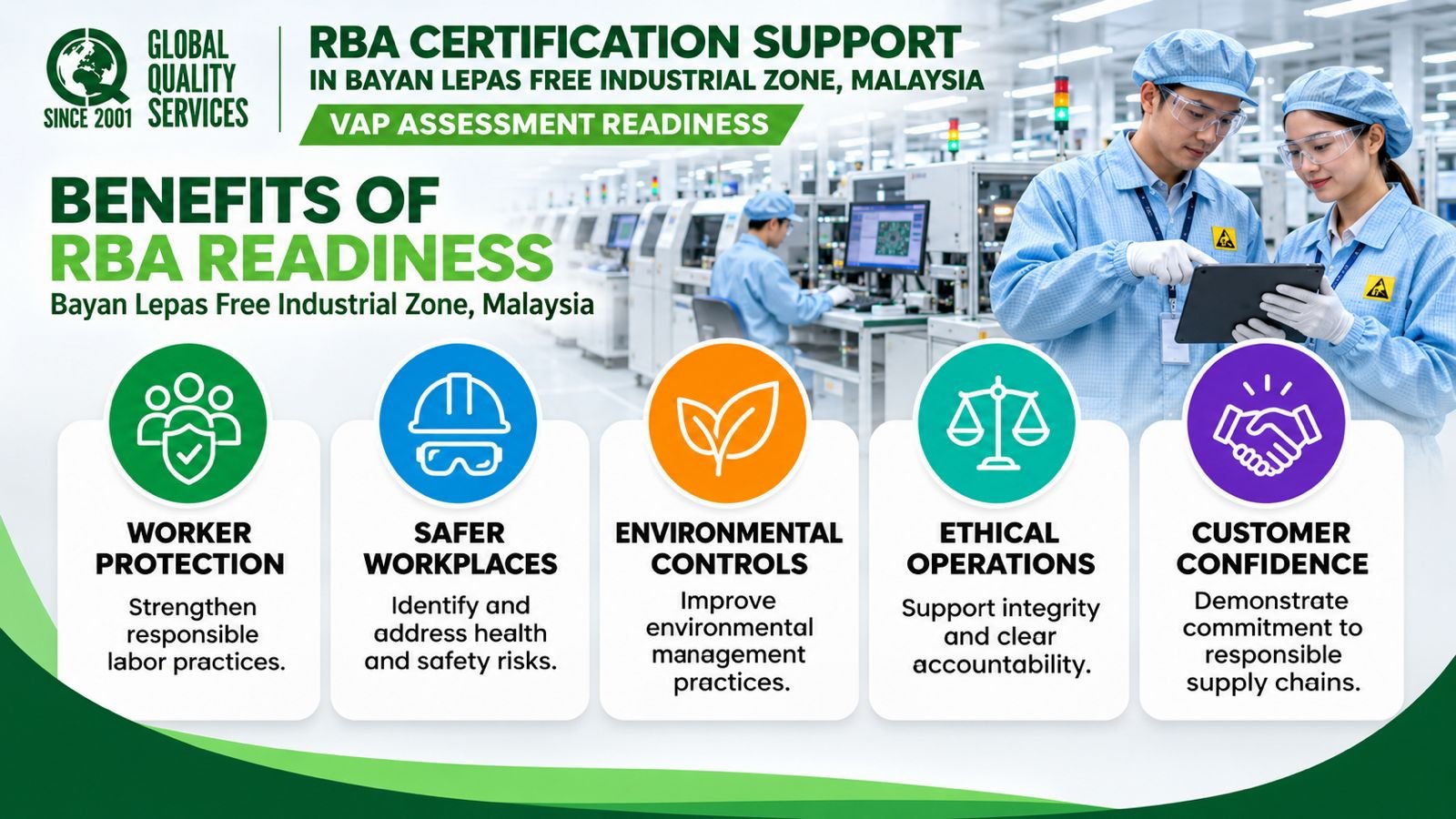
For businesses in Bayan Lepas Free Industrial Zone, responsible business practices can influence supplier relationships, operational stability, and long-term customer confidence.
Some important advantages include:
- Improved supply-chain acceptance: Demonstrating alignment with recognized responsible business expectations can strengthen a supplier’s position when working with customers that apply RBA requirements.
- Better workforce management: Structured employment practices can improve transparency around recruitment, compensation, working hours, and worker welfare.
- Safer manufacturing operations: Consistent hazard identification and safety controls can help reduce workplace risks.
- Stronger environmental oversight: Documented environmental procedures can improve the management of waste, emissions, chemicals, energy, and water.
- More transparent business practices: Ethical policies and reporting mechanisms establish clearer expectations for employees and business partners.
- Improved management accountability: Defined responsibilities, performance monitoring, and corrective actions make it easier to maintain operational controls.
- Greater customer confidence: Documented evidence of responsible business practices can support customer evaluations and supplier reviews.
RBA alignment does not automatically establish compliance with every Malaysian law or customer-specific requirement. Organizations must continue to meet applicable legal obligations and address any additional requirements imposed by their customers.
RBA Compliance and Certification-Related Services in Bayan Lepas Global Quality Services
Global Quality Services (GQS) works with organizations across different industrial sectors on quality and certification-related requirements.
For manufacturers in Bayan Lepas Free Industrial Zone, understanding the applicable RBA Code provisions, assessment expectations, and management system requirements is an important part of planning an effective compliance approach.
GQS can discuss the requirements relevant to a facility’s operations and the assessment route it may need to follow. Arrange any VAP audit or formal RBA assessment through the applicable RBA program and authorized assessment arrangements.
With 26 years of experience in the quality and certification sector, GQS works with businesses seeking to strengthen their management practices and address industry-specific requirements.
Contact Global Quality Services to discuss RBA requirements for your manufacturing facility in Bayan Lepas Free Industrial Zone, Penang, Malaysia.
Frequently Asked Questions
1. Is RBA Certification compulsory for manufacturers in Bayan Lepas?
RBA adoption is generally voluntary. However, electronics brands and other international customers may require their suppliers to follow the RBA Code, provide compliance evidence, or undergo a specified assessment. Contractual and customer requirements can therefore make RBA alignment commercially important.
2. Is RBA Certification the same as an ISO certification?
No. RBA is based on a Code of Conduct covering labor, health and safety, environmental responsibility, ethics, and management systems. It is not a conventional ISO-style certification scheme. The RBA VAP is an assessment program that evaluates facility-level conformance against applicable requirements.
3. Which companies in Bayan Lepas should consider RBA requirements?
Electronics manufacturers, semiconductor-related suppliers, contract manufacturers, electrical component producers, and other businesses serving supply chains that apply RBA expectations should evaluate the framework. Customer requirements and the nature of their operations determine the level of applicability.
4. What is the difference between RBA Code adoption and a VAP audit?
Code adoption means that a business commits to implementing the RBA requirements within its operations and relevant supply chain. A VAP audit is a structured assessment of a facility against the applicable RBA requirements. Adopting the Code does not automatically mean that a facility has completed a VAP audit.
5. How often should a company review its RBA compliance?
RBA-related controls should be monitored continuously. Companies should conduct periodic internal reviews, assess changes in legal and customer requirements, review workplace and environmental performance, and address identified gaps. The timing of external assessments depends on the applicable RBA program and customer requirements.